Claude Sonnet 5 Pricing: Tokenizer Cost vs Sonnet 4.6
Claude Sonnet 5 pricing is $2/$10 per million tokens, but its tokenizer adds ~30% more tokens than Sonnet 4.6. Real cost math and migration traps.
Claude Sonnet 5 pricing is $2 per million input tokens and $10 per million output tokens on the Claude API, with the Batch API at half that and cache reads at $0.20 per million. That rate card is a third cheaper than Sonnet 4.6's $3/$15, but Sonnet 5's new tokenizer produces approximately 30% more tokens for the same text, so the real saving on an equivalent request is closer to 13%, and smaller still once default thinking kicks in.
Here is the full price table, the cost math against Sonnet 4.6, and the migration traps that return a 400 error.
Key Takeaways:
- Sonnet 5 costs $2 input / $10 output per million tokens; Batch API is $1 / $5; cache reads are $0.20
- Anthropic made $2/$10 the permanent standard price; the $3/$15 rate some older pages quote does not apply
- The new tokenizer counts ~30% more tokens for the same text, so equivalent requests cost about 13% less than on Sonnet 4.6, not 33% less
- Adaptive thinking is on by default on Sonnet 5 and thinking bills as output, which can erase the saving on output-heavy work
- Three API changes will 400 your requests on migration: manual extended thinking, non-default sampling params, and an unrevisited max_tokens
Claude Sonnet 5 Pricing Today
All figures are per million tokens (MTok), taken from Anthropic's pricing page and the Sonnet 5 model page on October 28, 2026.
| Claude Sonnet 5 | Price per MTok |
|---|---|
| Input | $2 |
| Output | $10 |
| 5-minute cache write | $2.50 |
| 1-hour cache write | $4 |
| Cache read (hit) | $0.20 |
| Batch API input | $1 |
| Batch API output | $5 |
Two modifiers can move these numbers. Pinning inference to the US with inference_geo: "us" applies a 1.1x multiplier to every token category, and long prompts cost nothing extra: the full 1M-token context window bills at the standard rate, so a 900K-token request pays the same per token as a 9K-token one.
Anthropic launched Sonnet 5 on June 30, 2026 at $2/$10, and in August it confirmed that price is permanent. The $3/$15 figure you'll still find in some write-ups is Sonnet 4.6's rate, not Sonnet 5's.
Here is where Sonnet 5 sits against the rest of the Claude API lineup:
| Model | Input / output per MTok | Cache read | Batch input / output |
|---|---|---|---|
| Claude Sonnet 5.5 (current Sonnet) | $2 / $10 | $0.10 | $1 / $5 |
| Claude Sonnet 5 | $2 / $10 | $0.20 | $1 / $5 |
| Claude Sonnet 4.6 | $3 / $15 | $0.30 | $1.50 / $7.50 |
| Claude Opus 5.5 | $4 / $20 | $0.20 | $2 / $10 |
| Claude Opus 5 and Opus 4.8 | $5 / $25 | $0.50 | $2.50 / $12.50 |
| Claude Haiku 5.5 (prompts up to 100K tokens) | $0.10 / $0.50 | $0.01 | $0.05 / $0.25 |
Anthropic's launch post says Sonnet 5's performance is "close to that of Opus 4.8, but at lower prices," and at half Opus 4.8's rate card that is the whole pitch. Its launch announcement on X called it "our most agentic Sonnet yet," one that runs autonomously "at a level that just a few months ago required larger and more expensive models." Note that Anthropic now lists Sonnet 5 as a legacy model: Sonnet 5.5, released September 28, 2026, has the same input and output price with cheaper cache reads. More on that choice below.
Put Claude's output where your work already happens
Zentor runs Claude on a task and places the finished result in Notion, Airtable, Slack, or your inbox instead of a chat reply.
See the Claude integration →
Sonnet 5 vs Sonnet 4.6 Cost: One Workload, Same Text
The clearest way to see the Sonnet 5 vs Sonnet 4.6 cost difference is a worked example. Take a modest production workload that, measured on Sonnet 4.6's tokenizer, runs 2,000,000 input tokens and 400,000 output tokens per day. Over 30 days that is $360 on Sonnet 4.6. Now send exactly the same text to Sonnet 5.
| Model | Rate (in / out) | Tokens billed per day (same text) | Monthly cost |
|---|---|---|---|
| Sonnet 4.6 | $3 / $15 | 2.0M in / 0.4M out | $360 |
| Sonnet 5 | $2 / $10 | 2.6M in / 0.52M out | $312 |
| Sonnet 5, Batch API | $1 / $5 | 2.6M in / 0.52M out | $156 |
The +30% tokenizer inflation turns 2.0M/0.4M into 2.6M/0.52M in every Sonnet 5 row. Because the per-token rate dropped by a third, the bill still falls, from $360 to $312, about 13%. The headline "33% cheaper" only holds if you ignore the token count.
There is a break-even worth knowing. Sonnet 5's rates are two-thirds of Sonnet 4.6's, so Sonnet 5 stays cheaper for the same text as long as your content inflates by less than 50%. Anthropic says the increase "depends on the content and workload shape," and that is why the only number that matters is the one you measure on your own prompts.
Why Token Counts Rise: The New Tokenizer
Anthropic's pricing docs say it plainly: Claude 4.7 and later models use a newer tokenizer that "produces approximately 30% more tokens for the same text," while Sonnet 4.6 and earlier use the old one. Sonnet 5 and Sonnet 5.5 both sit on the new side of that line. Request and response shapes don't change, so the tokenizer itself needs no code changes.
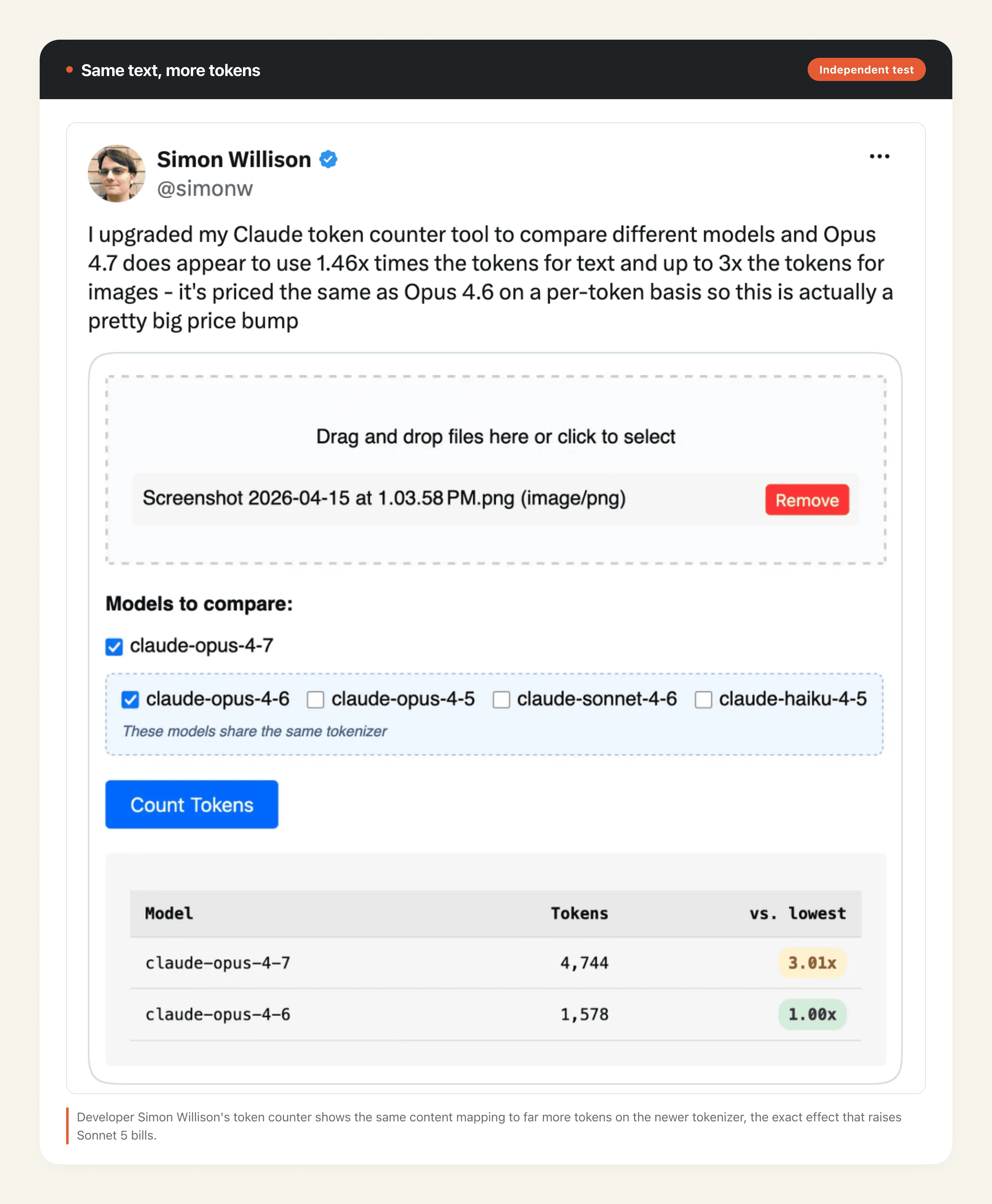
The effect lands on anything you measure or budget in tokens. Usage fields report higher counts for the same text. Your 1M context window holds less actual text: Anthropic puts it at roughly 555K words on the new tokenizer, against about 750K words on earlier models. And max_tokens limits tuned for 4.6 may truncate equivalent output. The fix for measurement is simple and non-negotiable: don't reuse token counts from earlier models. Recount your real prompts with Anthropic's token counting endpoint against Sonnet 5 before you finalize any budget.
The Cost Most Teams Miss: Thinking Is On by Default
This is the part that turns a 13% saving into a surprise. On Sonnet 4.6, a request with no thinking field runs with thinking off. On Sonnet 5, the same request runs with adaptive thinking on, according to the thinking docs, and the default effort level is high.
Thinking tokens are billed as output tokens, even when the thinking text isn't returned to you, and they count toward max_tokens. Output is the expensive side of the rate card ($10 per MTok), so a request that used to produce 500 output tokens can now produce that plus however much the model chose to think. Drop-in migrations that change nothing but the model ID are exactly the ones that hit this.
Marcus, a composite indie developer running a support-triage bot, did exactly that: he swapped claude-sonnet-4-6 for claude-sonnet-5, saw the $2/$10 rate card, and expected his bill to fall by a third. It barely moved. The tokenizer had already taken part of the saving, and every triage call now carried thinking tokens it didn't need. Sending thinking: {"type": "disabled"} on the classification endpoint brought the bill back in line with the roughly 13% cut the table above predicts.
You have two levers. Send thinking: {"type": "disabled"} for calls that don't need reasoning, such as extraction and classification, or keep thinking on and steer it with the effort parameter at medium or low. Measure a day of traffic with each setting before you decide, because the right answer differs per endpoint.
Prompt Caching and the Batch API on Sonnet 5
Both discounts stack, and both apply at full strength across the 1M context window.
Prompt caching bills repeated context at $0.20 per MTok on Sonnet 5 instead of $2. Rerun the workload from the table above, assuming 80% of each day's input is a cached system prompt and knowledge base (and ignoring the small cost of cache writes): Sonnet 5 comes to about $200 a month, against about $230 on Sonnet 4.6 with the same caching. The Batch API halves both input and output for asynchronous jobs, which is how the $156 row above happens.
Where neither helps is net-new output. Generated text is never cached, so an output-heavy agent, the kind that writes long responses on every call, feels the tokenizer and default thinking almost fully. A retrieval bot that re-sends the same system prompt can blunt most of the token inflation through caching. An autonomous writing or refactor agent that emits thousands of fresh output tokens per run can't. Before you assume caching saves you, model your own split of cached versus uncached and input versus output; that ratio decides your real exposure.
Migration Checklist: The Three 400-Error Traps
Sonnet 5 is close to a drop-in replacement for Sonnet 4.6, but three behavior changes will return a 400 error or quietly break output if you migrate blind:
- Swap the model ID.
claude-sonnet-4-6becomesclaude-sonnet-5. That part is trivial. - Trap 1, manual extended thinking.
thinking: {type: "enabled", budget_tokens: N}returns a 400 error on Sonnet 5. It was deprecated on 4.6. Move to adaptive thinking and use the effort parameter instead of a token budget. - Trap 2, sampling parameters. Setting
temperature,top_p, ortop_kreturns a 400 error. Remove them entirely and steer behavior through your system prompt. - Trap 3, max_tokens sizing. Thinking is on by default and counts against
max_tokens, and the tokenizer inflates output, so a limit tuned for 4.6 can truncate equivalent responses. Revisit anymax_tokensset close to your expected output length.
One inherited constraint still trips people: assistant message prefilling was already unsupported on 4.6 and stays that way. Use structured outputs or system-prompt instructions instead.
Anika, a composite platform engineer, ran her migration in a staging branch first and caught two of these in an afternoon: a leftover temperature: 0.2 on her extraction endpoint and a budget_tokens call buried in a rarely used reasoning path. Both would have returned 400s in production. A staging pass is cheap insurance; grep for both before you ship.
Sonnet 5 or Sonnet 5.5: Same Price, Different Breaking Changes
If you are migrating from Sonnet 4.6 today, you have a choice Sonnet 5's launch coverage never mentioned. Sonnet 5.5 costs the same $2/$10, uses the same tokenizer, and halves the cache-read price to $0.10. Anthropic marks Sonnet 5 as legacy, with retirement no sooner than June 30, 2027.
Price alone favors Sonnet 5.5, especially for cache-heavy workloads: in the caching example above it comes to about $193 a month against Sonnet 5's $200. The catch is code. Per the Sonnet 5.5 migration guide, Sonnet 5.5 rejects forced tool use (tool_choice of type any or tool) with a 400 error, returns text between tool calls inside thinking blocks, ties thinking blocks to the model and conversation, and declines in more safety categories than Sonnet 5. The three traps above apply to Sonnet 5.5 as well.
So: if your code forces tool calls or streams the model's between-tool notes to users, Sonnet 5 is the shorter hop from 4.6. If not, go straight to Sonnet 5.5 and migrate once.
FAQ
How much does Claude Sonnet 5 cost?
$2 per million input tokens and $10 per million output tokens on the Claude API. The Batch API is $1 / $5, cache reads are $0.20, and 5-minute cache writes are $2.50 per million tokens.
Is Sonnet 5 more expensive than Sonnet 4.6?
Per token, no: $2/$10 against $3/$15. Per equivalent request it is still cheaper, but by about 13% rather than 33%, because the new tokenizer produces about 30% more tokens for the same text. Default thinking can narrow that further on output-heavy work.
Is Sonnet 5 cheaper than Opus?
Yes. Opus 5 and Opus 4.8 cost $5/$25 and Opus 5.5 costs $4/$20, while Sonnet 5 is $2/$10 with performance Anthropic describes as close to Opus 4.8.
Why is my Claude bill higher after upgrading to Sonnet 5?
Check two things: per-request token counts (the tokenizer adds roughly 30%) and thinking tokens (on by default on Sonnet 5, billed as output). Request volume alone won't show either.
Why am I getting a 400 error on temperature with Sonnet 5?
Sonnet 5 returns a 400 if temperature, top_p, or top_k is set. Remove those parameters and guide behavior through the system prompt.
Do I need to change my code to migrate?
Swap the model ID, remove sampling params, move off budget_tokens to adaptive thinking, and revisit max_tokens. For a plain-English overview of the model itself, see what's new in Claude Sonnet 5. Aside from those, code that ran on Sonnet 4.6 runs on Sonnet 5.
Recount Before You Commit the Model Swap
Sonnet 5 is cheaper than Sonnet 4.6 on the rate card and, for most workloads, on the invoice too. Just don't budget off the rate card. Recount your real prompts against the new tokenizer, decide per endpoint whether default thinking earns its output tokens, clear the three 400-error traps in staging, and check whether Sonnet 5.5 is the better place to land.
Not everyone on the team should be doing that work. Ravi, a composite consultant who isn't a developer, didn't want to manage API billing or recount tokens mid-project; handing his research-and-draft tasks to an agent got him finished documents back instead of chat replies. If the people who need Claude's output aren't the ones writing API code, Zentor's built-in models need no API key, and Smart Routing picks the best, fastest or cheapest model for each task. See how Zentor works with Claude; new accounts get a 3-day trial with 1,000 credits, which is enough to check it fits if your team wants the finished work without the plumbing.
Editor's note: Pricing and model details here were checked against Anthropic's documentation on October 28, 2026. Model lineups change often, so check the linked sources before making production decisions.

Zentor Editorial Zentor editorial team
The Zentor editorial team writes about workflow automation, AI agents, and the tools we build. Default byline for industry overviews, listicles, and collaborative pieces.
Stop doing this manually.
Zentor handles research, monitoring, reports, and browser tasks for you. No setup. No self-hosting.
References Claude Docs: What's New in Sonnet 5 · Anthropic: Introducing Claude Sonnet 5 · Claude Docs: Token Counting · Finout: Claude Sonnet 5 Hidden Costs · The New Stack: Claude Sonnet 5 Launch · Claude: Introducing Sonnet 5, Our Most Agentic Sonnet (X post)