Claude Fable 5.2 vs Opus 5.5: Tested

Claude Fable 5.2 vs Opus 5.5: official benchmarks, real same-prompt community tests, pricing, effort defaults, and which model to pick for which work.
Choosing between Claude Fable 5.2 vs Opus 5.5 comes down to how hard your task actually is. Fable 5.2 is the stronger model on every benchmark Anthropic published and costs twice as much; Opus 5.5 is Anthropic's recommended daily driver and covers most work at half the price. For a subscriber staring at the model picker, the right default is Opus 5.5, with Fable 5.2 reserved for the jobs that justify the premium.
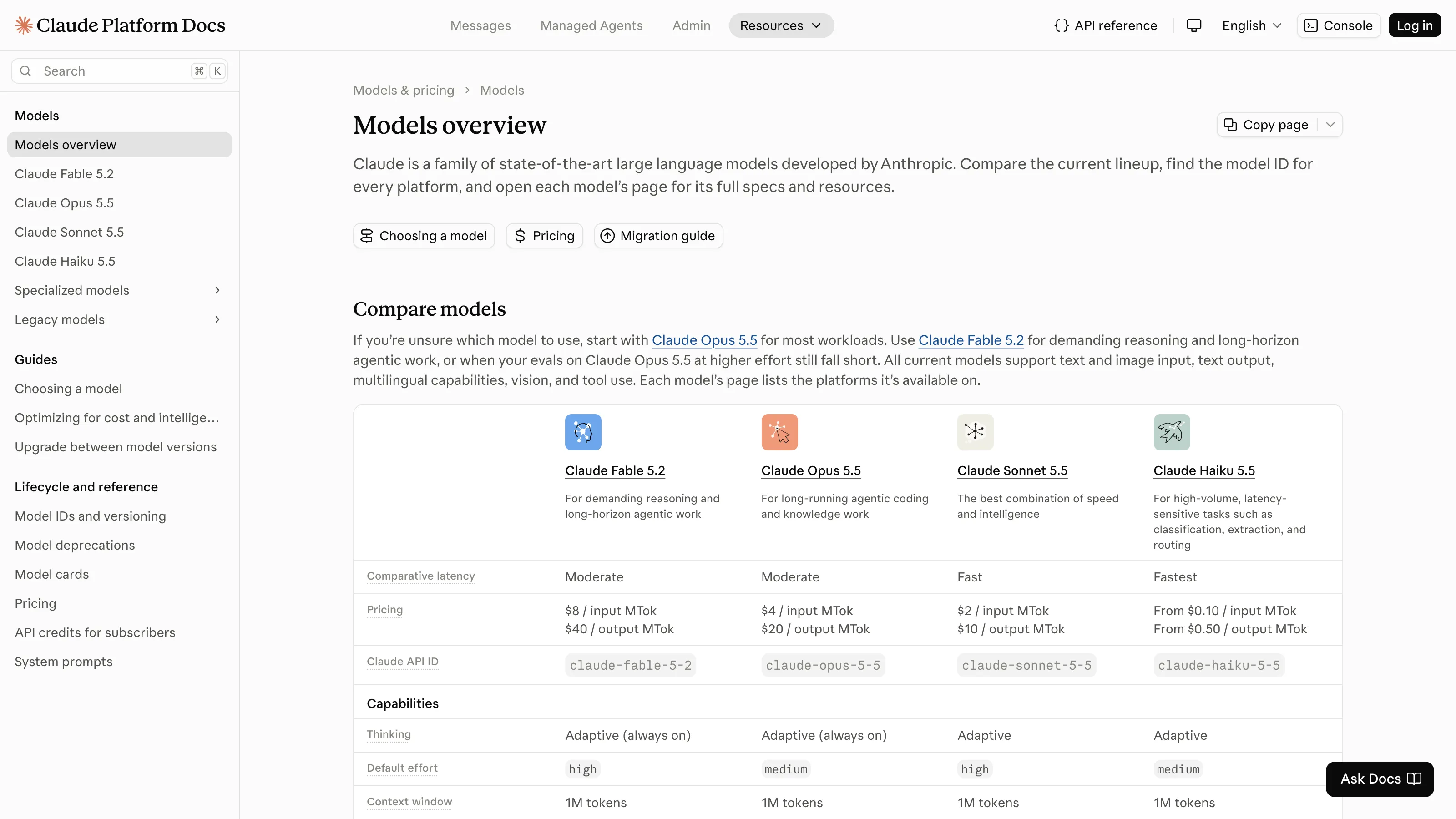
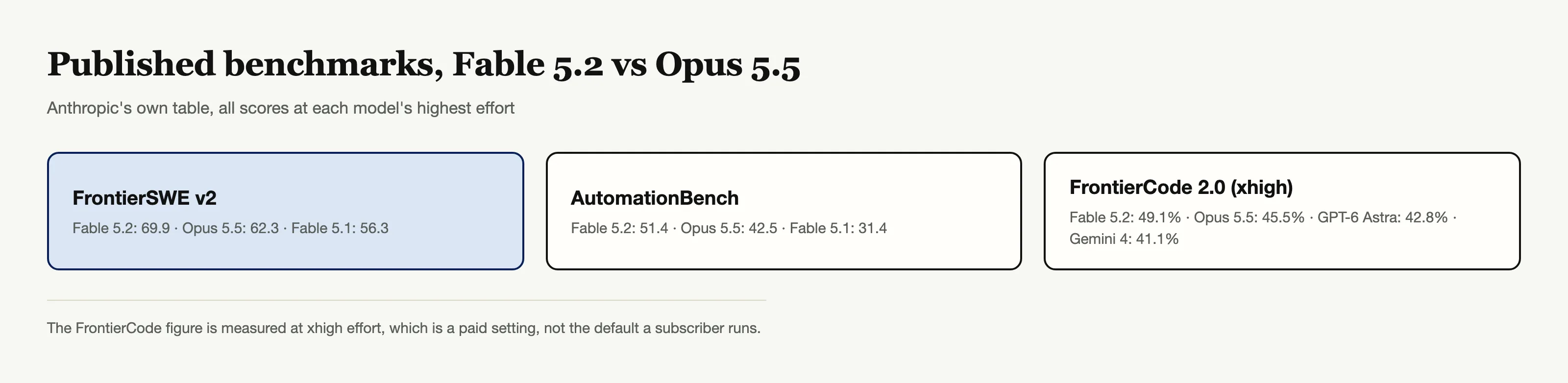
The official numbers put Fable 5.2 ahead on everything: 69.9 on FrontierSWE v2 against Opus 5.5's 62.3, 51.4 on AutomationBench against 42.5, and 49.1% on FrontierCode 2.0 against 45.5% (the launch page). API pricing is $8/$40 per million tokens for Fable 5.2 against $4/$20 for Opus 5.5.
Key Takeaways:
- Fable 5.2 leads every published benchmark; biggest gaps on FrontierSWE v2 (+7.6) and AutomationBench (+8.9)
- It costs exactly 2x per token and defaults to higher effort, so real tasks often cost more than 2x
- Community same-prompt tests show better detail and sometimes faster finishes, at 2-4x the spend
- Opus 5.5 is the correct daily driver; Fable 5.2 earns its price on long, open-ended builds
- On Zentor, Ultra is the Fable tier and Auto routes per turn
The benchmark gap in Anthropic's own table
| Benchmark | Fable 5.2 | Opus 5.5 | Fable 5.1 |
|---|---|---|---|
| FrontierSWE v2 | 69.9 | 62.3 | 56.3 |
| AutomationBench | 51.4 | 42.5 | 31.4 |
| FrontierCode 2.0 (xhigh) | 49.1% | 45.5% | 32.4% |
Two readings matter more than the raw lead. The 5.1-to-5.2 jump dwarfs the Opus-to-Fable gap on AutomationBench, where the new model nearly doubles its predecessor. And Fable's FrontierCode score is quoted at xhigh effort, meaning the ceiling figure assumes you are paying for deeper thinking. Against GPT-6 Astra (42.8%) and Gemini 4 Carbon (41.1%) on the same board, both Claude models sit at the top regardless.
Price: double the sticker, more on effort
Per million tokens, Fable 5.2 is $8 input and $40 output; Opus 5.5 is $4 and $20 (model overview). Cache reads are $0.20 on both. Fable adds a fast mode at $16/$80 for up to 2.5x faster output, which Opus lacks.
The multiplier that hides in the comparison is effort. Fable defaults to high; Opus 5.5 defaults to medium (effort docs). Out of the box, Fable spends more thinking tokens per request, so real-world cost per task regularly lands above the 2x list ratio, which is exactly what same-prompt tests found.
What same-prompt community tests show
Verified head-to-head posts give the messier, more useful picture. @Bhavani_00007 ran a rocket-launch scene on both: Fable 5.2 finished in 32 minutes for $23.45, Opus 5.5 in 24 minutes for $10.35. Their read was that Fable's detail and realism were clearly stronger but they had expected efficiency closer to Fable 5.1 (post).
@petergyang built a playable browser kart racer with Fable 5.2, six racers, drifting, ramps, items, single and multiplayer, the kind of loosely-specified build where Fable's orchestration shows (post). And @0xRhinoX's effort sweep on one iceberg prompt is the cost-control lesson that applies to both models: $24.31 at High to $642.42 at the top setting, a 26x spread from the dial alone (post).
The pattern: Fable wins on quality in every verified test, occasionally finishing long renders faster, and it consistently costs 2-4x more. Whether that premium is worth it tracks how loosely specified the task is.
Run Fable 5.2 and Opus 5.5 side by side
Zentor serves both in one workspace. Pick Ultra for Fable 5.2, or let Auto route each turn to the tier that fits.
Try Zentor →
Where each model actually fits
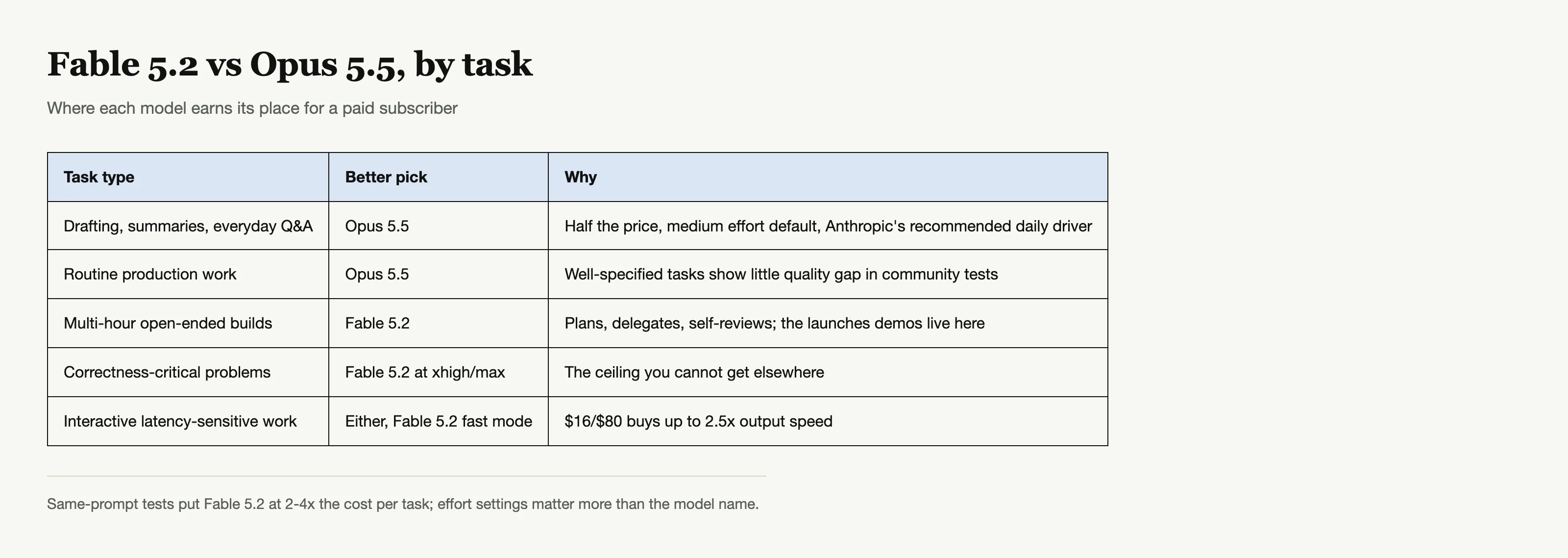
Opus 5.5 is the right default for drafting, summarizing, routine research, everyday Q&A, and anything where "very good at half the price" beats "best." Anthropic literally positions it as the recommended starting point for most work.
Fable 5.2 earns its tier on loosely-defined agentic tasks: multi-stage builds that need planning and self-checking, runs measured in hours rather than minutes, orchestrating subagents, and frontier-level problems where a wrong answer costs more than the compute. It can act as an advisor or orchestrator over other models, a role Opus 5.5 is not positioned for.
The effort caveat that hides in the comparison
Every headline number above comes with an effort footnote. Fable's FrontierCode figure is quoted at xhigh, a paid setting, and the same prompt at the defaults both models actually run shows a smaller gap. Community tests confirm the shape: the lead is real but so is the cost, and the gap between them is set by how loosely you define the task, not by which model you pick.
A decision rule that survives the bill
Price the task, not the model. Default to Opus 5.5 for the daily workload; reach for Fable 5.2 when the goal is open-ended enough that planning, delegation, and self-review matter more than token cost. And treat effort as the bigger dial: a Fable run at max effort can cost an order of magnitude more than the same prompt at high, which outweighs the model choice itself.
Picking between them on Zentor
On Zentor's Fable 5.2 page, the split maps onto tiers: Ultra runs the Fable line while cheaper tiers handle everyday work, and Auto routing sends reasoning-heavy turns to the strongest available model automatically. Because workspace memory carries across models, you can draft on a lower tier and hand the same thread to Fable 5.2 for the hard part without losing context. For the wider access picture see how to access Claude Fable 5.2.
Speed: faster output, longer runs
Anthropic rates both models at moderate comparative latency, and Fable 5.2 generates output up to 30% faster than Fable 5.1. Wall-clock comparisons from the community go both ways: one cathedral-style render test had Fable finishing roughly 75 minutes sooner than Opus 5.5 at nearly double the cost, while the rocket scene went the other way on time. Elapsed time depends more on effort and how much thinking the model chooses than on the model name.
Fable's fast mode deserves its own line: for double the token price ($16/$80), output speeds up to 2.5x. For interactive sessions where latency is the cost that hurts, it is a real option Opus 5.5 does not offer, though for most subscribers the tier choice matters more than the speed switch.
Subscription access: who can actually run each
Both models require a paid Claude plan, but the billing shape differs. Opus 5.5 is bundled into the normal Pro and Max allowances. Fable 5.2 is bundled on Max, Ultra, and premium seats, while on Pro and standard seats it meters through pay-as-you-go usage credits after launch week (plan details). So a Pro user comparing the two is really comparing "included" against "metered," which is why Pro users hit walls during launch week.
On Zentor the comparison is simpler: both live inside plan credits, Ultra is the Fable tier, and you do not manage a second billing account to try the expensive one.
The thinking-token line item people miss
Both models run always-on adaptive thinking, and thinking tokens bill at output rates. On a prompt that triggers a long reasoning pass, the thinking share can exceed visible output by 5x or more, so a "$40 per million output" model produces bills that look nothing like a 1:1 input-output ratio. The iceberg effort sweep is the clearest public example: the difference between $24 and $642 on one prompt was pure thinking time.
Prompt-level instructions like "just answer directly" do not suppress thinking at medium effort and above on Fable 5.2, per Anthropic's migration notes, so the only reliable lever on thinking spend is the effort parameter itself. That makes Opus 5.5's medium default a quiet cost feature, not a weakness.
Effort and the settings that matter
Adaptive thinking is always on for both; effort is calibrated per model, so Opus 5.5 at max is not Fable at high. Fable 5.2 defaults to high and Anthropic positions xhigh and max for the jobs that justify them. For a subscriber, the practical version of this is: the two models differ more on their defaults than on their ceilings, and most of the "Fable is expensive" reports are really "high effort is expensive" reports.
The honest caveat from week one
A few early users reported worse instruction-following on Fable 5.2 than they expected, saying prompts needed more explicit framing than Opus 5.5 required. That is a small sample on a week-old model, but it is worth testing your own prompts before routing everything to the top tier. The verified evidence says Fable wins on quality; it does not say it wins on every prompt shape.
So which one should you actually pick
The cleanest answer to fable 5.2 vs opus 5.5: Opus 5.5 for the 80% of work that is well-specified or routine, Fable 5.2 for the tasks where a better plan matters more than a cheaper token. The verified community tests all point the same way: quality ceiling up, cost floor up, and the gap between them set by how loosely you define the task.
What changes after launch week ends
The access math above shifts on November 16. During the window, Pro and standard Team seats get Fable included up to 50% of weekly limits, which makes this the cheapest period to run your own side-by-side test instead of trusting anyone's benchmarks. After it closes, Pro meters Fable on credits and the decision becomes purely about value: whether the visible quality gain on your tasks covers a 2x price and a higher default effort.
What the tests do not tell you
Every same-prompt test on X is one datapoint under one effort setting. The iceberg sweep and the rocket scene are honest receipts, but your workload is neither a render nor a launch scene, so the right move is running your own task on both models inside the launch window, where the comparison costs almost nothing. Anthropic's own benchmark table is the other half of the picture: it says Fable leads on capability, and the community tests say it leads on cost too. Both can be true at once.
A note on benchmark context
The published numbers show each model at its highest available effort, which means the frontier figures assume deep-thinking runs. A buyer reading them should apply a discount: the same table that gives Fable 5.2 its FrontierCode lead was computed at xhigh, not at the defaults a subscriber actually pays for. The honest comparison for a plan holder is Opus at medium versus Fable at high, and that delta is what the same-prompt community tests are actually measuring.
A note on the Fable 5.1 comparison
If your mental model comes from Fable 5.1, recalibrate: 5.2 is 20% cheaper per token, generates output up to 30% faster, and added a max effort ceiling and fast mode its predecessor never had. The Opus-vs-Fable spread on AutomationBench (51.4 vs 42.5) is also much wider than the 5.1-era gap, which is why "just use Opus" is weaker advice this generation for the genuinely hard tasks.
FAQ
Is Claude Fable 5.2 better than Opus 5.5?
On benchmarks and in verified community tests, yes on quality. Whether it is better value depends on the task: it costs 2x per token and defaults to higher effort.
How much more expensive is Fable 5.2 vs Opus 5.5?
Exactly 2x on list price ($8/$40 vs $4/$20 per million tokens). Real tasks often cost 2-4x because Fable thinks longer.
Which should I use for everyday work?
Opus 5.5. Anthropic positions it as the daily driver; reach for Fable 5.2 on the hardest open-ended tasks.
Does Fable 5.2 have anything Opus 5.5 lacks?
A fast mode (up to 2.5x output at $16/$80), a max effort ceiling, and orchestrator/advisor positioning.
Can I switch between them mid-task?
In the apps and on Zentor, yes. On the API, Fable 5.2 reads Opus 5.5's thinking blocks but not the reverse.

Zentor Editorial Zentor editorial team
The Zentor editorial team writes about workflow automation, AI agents, and the tools we build. Default byline for industry overviews, listicles, and collaborative pieces.
Choosing between tools? Let Zentor run the work.
An always-on AI assistant that does the work. No switching required, no setup.
References Claude Fable product page and benchmarks · Claude Fable 5.2 model overview · Claude effort parameter docs · Same-prompt rocket test by @Bhavani_00007 · Kart racer demo by @petergyang · Effort-level cost test by @0xRhinoX · API data retention requirements · Fable models on your plan