Claude Managed Agents: 64 at Once, 1,000 Total

Claude managed agents can start 1,000 agents per run, but only 64 at once. See the bug-test evidence, beta setup and token-cost trade-off before buying in.
Claude managed agents can now turn a large job into a server-run dynamic workflow: one agent plans the work, other agents handle separate pieces, and the workflow combines their results. The headline is 1,000 agents per run, not 1,000 agents working simultaneously: Anthropic's run limits list 64 working at once as of October 2026. The question for a buyer isn't how large a swarm can get; it's whether splitting the work finds enough extra errors to pay for the extra tokens.
Key Takeaways:
- A dynamic workflow runs in phases on Anthropic's servers; the lead agent can report progress while the run continues.
- One run can start up to 1,000 agents across its lifetime, with up to 64 working at once under the documented current limit.
- In Anthropic's planted-bug test, the workflow found 66 of 70; single-agent runs found 14 to 27. This is one vendor test, not a cost comparison.
- Start with a bounded, divisible task and compare coverage, total spend, elapsed time and human review against a single agent.
What are Claude managed agents and dynamic workflows?
Managed Agents is Anthropic's hosted system for running agent sessions. Its multiagent documentation distinguishes ordinary subagent delegation, where the lead agent can message a worker again, from a dynamic workflow, where Claude writes a program that runs agents in phases and passes results between them. The server executes that program in the background. Individual agents have separate session threads, while run and phase events let the main session track progress. This is multi-agent orchestration, not an option in a standard Claude chat.
Zentor is a separate workspace-memory hub that connects memory to AI through Zentor MCP; we make no claim that it runs Anthropic's Managed Agents feature. For research across your own tools, reusable context can matter more than parallel workers.
Keep your working context across tools
Zentor keeps workspace memory portable through MCP. Explore its integrations if your daily work needs continuity, rather than a developer-run agent swarm.
Get early access →
How does fan-out/fan-in work in practice?
Suppose you need to review hundreds of documents for conflicting claims. One agent defines the question and partitions the documents; independent workers inspect separate batches; a later phase reconciles repeated claims and reports which documents nobody checked. That's fan-out followed by fan-in. It helps only if each piece can be examined without waiting for the answer to every other piece.
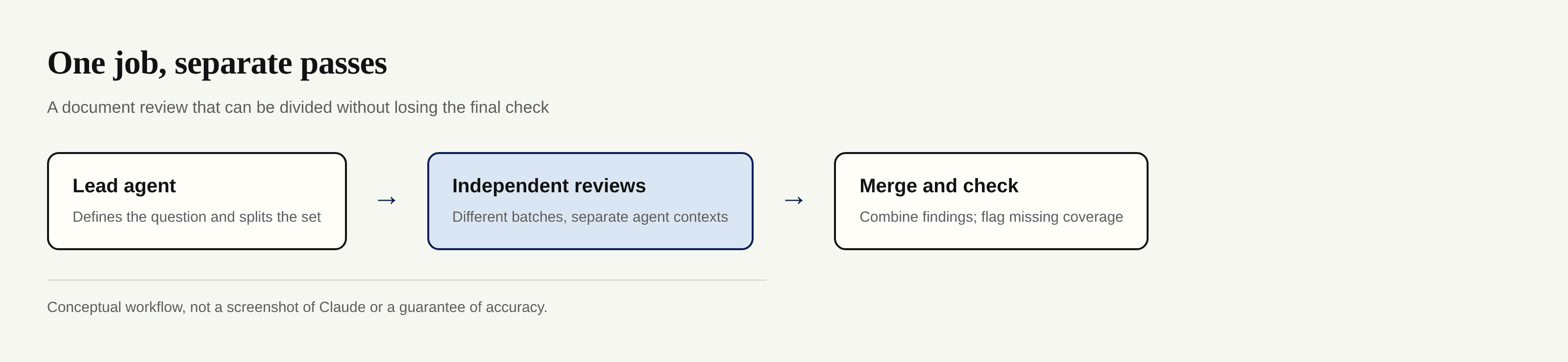
Anthropic says workflow runs expose phase and run events, and each worker's thread can be inspected. The lead agent can keep talking to you while the server works. If two workers summarize the same source differently, the merged answer still needs to point back to it. Zentor's self-adaptive workspace addresses a different friction: keeping your work usable across tasks, rather than scheduling Anthropic subagents.
What do 64 concurrent and 1,000 lifetime agents mean?
These are two limits on one workflow run, not interchangeable descriptions of capacity. Anthropic's limits table says a run can have 64 threads working at once; once one finishes, another may start. A workflow can start 1,000 agents over its full lifetime. Anthropic warns the concurrent figure isn't guaranteed and may change. The 1,000 figure is a ceiling on starts, not a recommendation or a promise of 1,000 parallel AI agents.
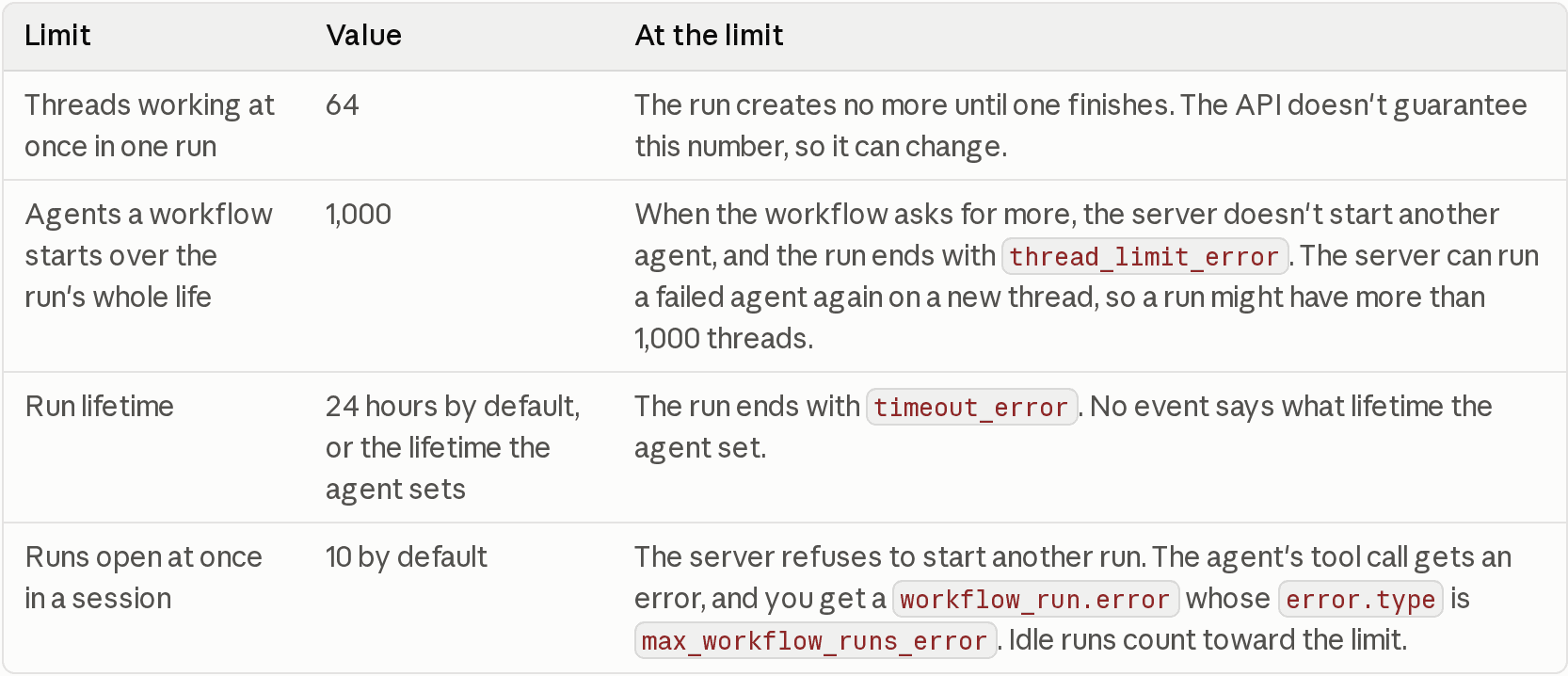
For procurement, a large batch can cycle through many paid agent calls. Don't infer throughput or cost from the ceiling alone.
Does the 70-bug benchmark justify the swarm?
In a test reported by The Decoder, Anthropic planted 70 bugs in a 116,000-line codebase. A single agent found between 14 and 27 in separate runs; its dynamic workflow found 66 each time. The coverage gap is large. Yet the report doesn't provide matched token use, elapsed time or a cost-per-bug figure, so it cannot establish that the workflow was cheaper.
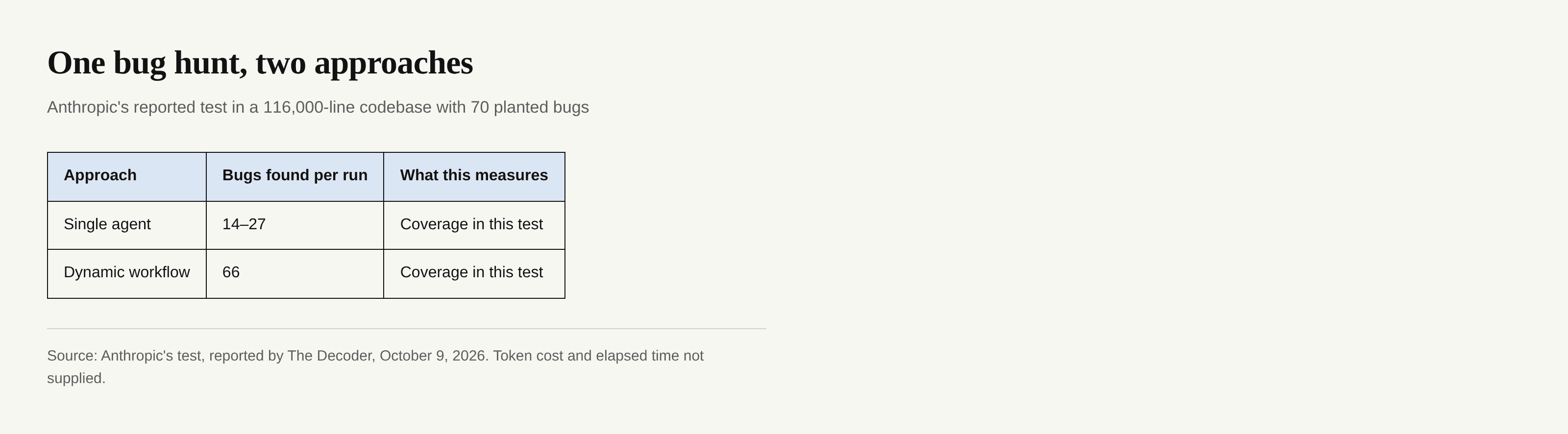
A planted-bug search divides naturally into files and areas. A short writing task or a decision that depends on one evolving conversation may not. Use the result as evidence that extra coverage is possible on a wide search, not as a forecast for your own documents. For another view of how orchestration differs from individual agent tasks, see our AI orchestration guide.
How is the beta capability enabled?
As of October 2026, Anthropic's Managed Agents examples use the managed-agents-2026-04-01 beta header for API requests and a multiagent configuration with type multiagent_20261001; workflows are enabled by default for that type unless turned off. Those are identifying details of a developer-facing beta, not instructions to turn it on inside a personal Claude account. Check current documentation and access terms before planning a deployment.
The token-cost debate: when are more agents worth it?
Eric Provencher, an OpenAI Codex developer, argued that agent swarms can spend tokens on redundant checks and coordination, according to The Decoder's report of his posts. That's a warning about poor task design, not a measured rebuttal of Anthropic's bug test. Anthropic's own guidance says every agent consumes tokens and urges users to keep runs for tasks that need them. Its session budgets apply across the threads, though the platform checks the cap between model requests, so the final tally can exceed it slightly.
Compare a single-agent baseline with a small workflow on the same bounded job. Record items correctly found, unsupported claims, staff review time, elapsed time and total cost. If the extra coverage doesn't change a decision or prevent an expensive miss, buy the simpler run. Zentor's Smart Routing picks a model suited to each task and is a separate cost-control idea; it doesn't imply Zentor operates Claude's dynamic workflows.
FAQ: Claude dynamic workflows and agent limits
Can Claude run 1,000 agents at the same time?
No. Anthropic's October 2026 documentation lists up to 64 working at once in one workflow run and 1,000 agent starts over that run's life. The concurrent limit may change.
Do Claude managed agents cost more than a single agent?
Each agent uses tokens, so a larger run can cost more. The published 70-bug result doesn't include a matched token or dollar comparison. Measure both methods on your own task before drawing a return-on-spend conclusion.
Which jobs fit a fan-out/fan-in workflow?
Document batches, cross-checking independent sources and wide audits fit when workers can return traceable findings for a later merge. A small sequential task rarely needs a swarm.
How is a dynamic workflow different from one agent using tools?
One agent carries the task through its own conversation and tool calls. A dynamic workflow launches separate agent threads in phases and combines their results; that buys wider coverage at the expense of coordination and token use.
Zentor Research Public data on the AI ecosystem
Zentor Research publishes quarterly data studies on the AI tools ecosystem, drawing on public registries (npm, GitHub, Hugging Face, arXiv, Google Trends). All charts and datasets ship under CC-BY 4.0.
Turn insights into action.
Zentor automates the recurring work your analysis points to. No engineering required.