8 Ways to Cut Your AI Agent Bill

Reduce AI agent costs without breaking the agent: prompt caching, model tiers, retry caps, and 5 more levers, with real 2026 provider prices.
To cut your AI agent bill, start with the two levers that pay off fastest: turn on prompt caching so you stop re-billing the same system prompt every call, and drop your default model down a tier for the routine steps that don't need a frontier model. Those two moves alone often halve a production agent's spend, and neither one touches what the agent actually does.
The reason bills climb isn't usually a pricing rug-pull. Anthropic's cache-read tokens bill at 0.1x the base input rate, a 90% discount that sits behind one config field most teams never flip. When Uber rolled Claude Code out to roughly 5,000 engineers, it burned through its entire 2026 AI budget in four months, with average spend of $150 to $250 per engineer per month and power users hitting $500 to $2,000. Consumption pricing punishes waste, and most agent waste is avoidable.
This guide walks eight levers in the order I'd pull them, each with a rough dollar shape, a real provider price where it matters, and an honest note on what it won't fix. The first six you can do yourself in an afternoon. The last two are where a managed platform earns its keep.
Key Takeaways
- Prompt caching is the single biggest lever: cached input tokens bill at roughly 10% of the base rate on Anthropic, OpenAI, and Gemini, so a static system prompt resent hundreds of times a day gets 90% cheaper.
- Model tier is the second lever. A cheap model handles most routine steps; reserve the expensive one for the reasoning that actually needs it.
- Blind retries and idle polling quietly triple bills. One production case saw four agents loop for 11 days and rack up a $47,000 charge before anyone noticed.
- Because APIs bill the full conversation history on every call, an unbounded agent loop grows cost at O(N-squared). Trim context and cap turns.
- A managed agent platform removes the levers you can't easily fix alone: caching defaults, per-run cost visibility, idle sessions that don't bill, and shared skills instead of re-sent instructions.
Start by Turning On Prompt Caching
Every agent resends the same block of text on every call: the system prompt, the tool definitions, the few-shot examples, the persona. If that block is 10,000 tokens and your agent fires 500 times a day, you're paying full input price for 5 million tokens of identical text daily. Prompt caching bills that repeated prefix at a fraction of the rate. Here's what the three big providers charge for cached input against their standard rate, verified against current docs:
| Provider | Base input (per 1M tokens) | Cache read | Cache write | Discount on reads |
|---|---|---|---|---|
| Anthropic, Claude Sonnet 5 | $2.00 | $0.20 (0.1x) | $2.50 (5-min, 1.25x) | 90% |
| Anthropic, Claude Haiku 4.5 | $1.00 | $0.10 (0.1x) | $1.25 (5-min, 1.25x) | 90% |
| OpenAI, cached input | standard rate | 0.1x standard | 1.25x standard | 90% |
| Google, Gemini 2.5+ implicit cache | standard rate | 0.1x standard | none (implicit) | 90% |
On Anthropic, a five-minute cache write costs 1.25x the base rate, a one-hour write costs 2x, and every read after is 0.1x, so caching pays for itself after one read on the five-minute tier (Anthropic pricing docs). OpenAI applies its cached-input rate automatically once a prompt crosses 1,024 tokens, no code change needed (OpenAI prompt caching guide). Gemini 2.5 and newer turn implicit caching on by default (Gemini caching docs).
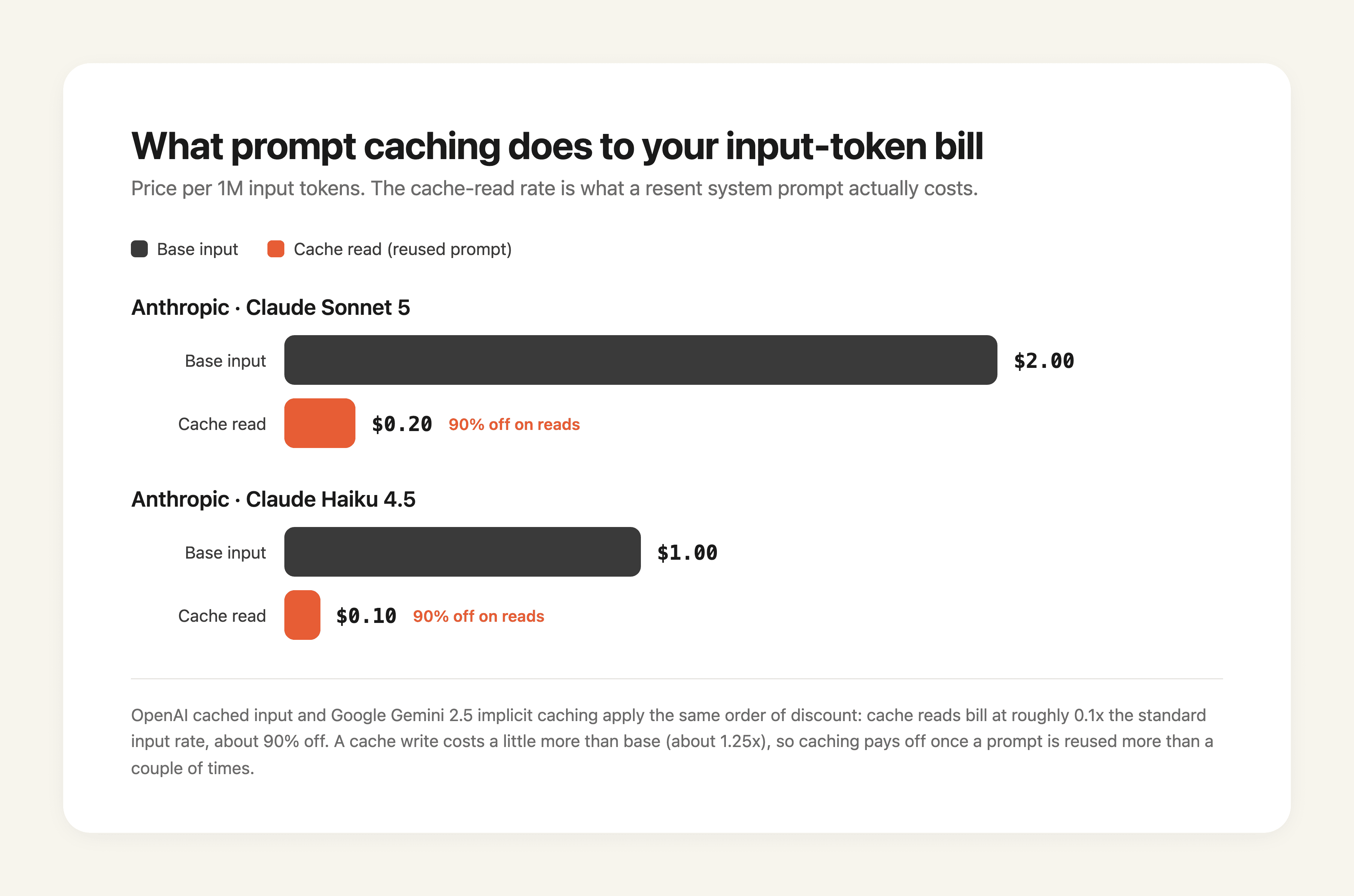
Work the earlier example: a 10,000-token prefix, 500 calls a day, on Sonnet 5. Uncached, that's 5M tokens at $2, so $10 a day in prefix alone. Cached, the first call writes and the other 499 read at $0.20, dropping the same work to roughly $1, about $270 a month saved on one agent from one setting.
What this saves: 40% to 90% of input-token cost on any agent with a stable prefix. What it won't fix: if your prompt changes every call, there's nothing to cache, and dynamic user data still bills at full rate.
Match the Model Tier to the Task
Most agents run one model for everything, and it's usually the strongest one the team trusted during the demo. That's the expensive habit. A frontier model reasoning about a multi-step plan is worth its price; a frontier model reformatting a date or classifying an email as spam is pure waste.
The tier gap is steep. Claude Opus 4.8 lists at $5 per million input tokens; Claude Haiku 4.5 lists at $1, with output at $25 versus $5. Route the routine 70% of your agent's calls to the cheap tier and you cut those calls' cost by four to five times. Anthropic's own worked example runs 10,000 support-ticket conversations through Haiku 4.5 for about $37 total, because the task doesn't need heavier reasoning.
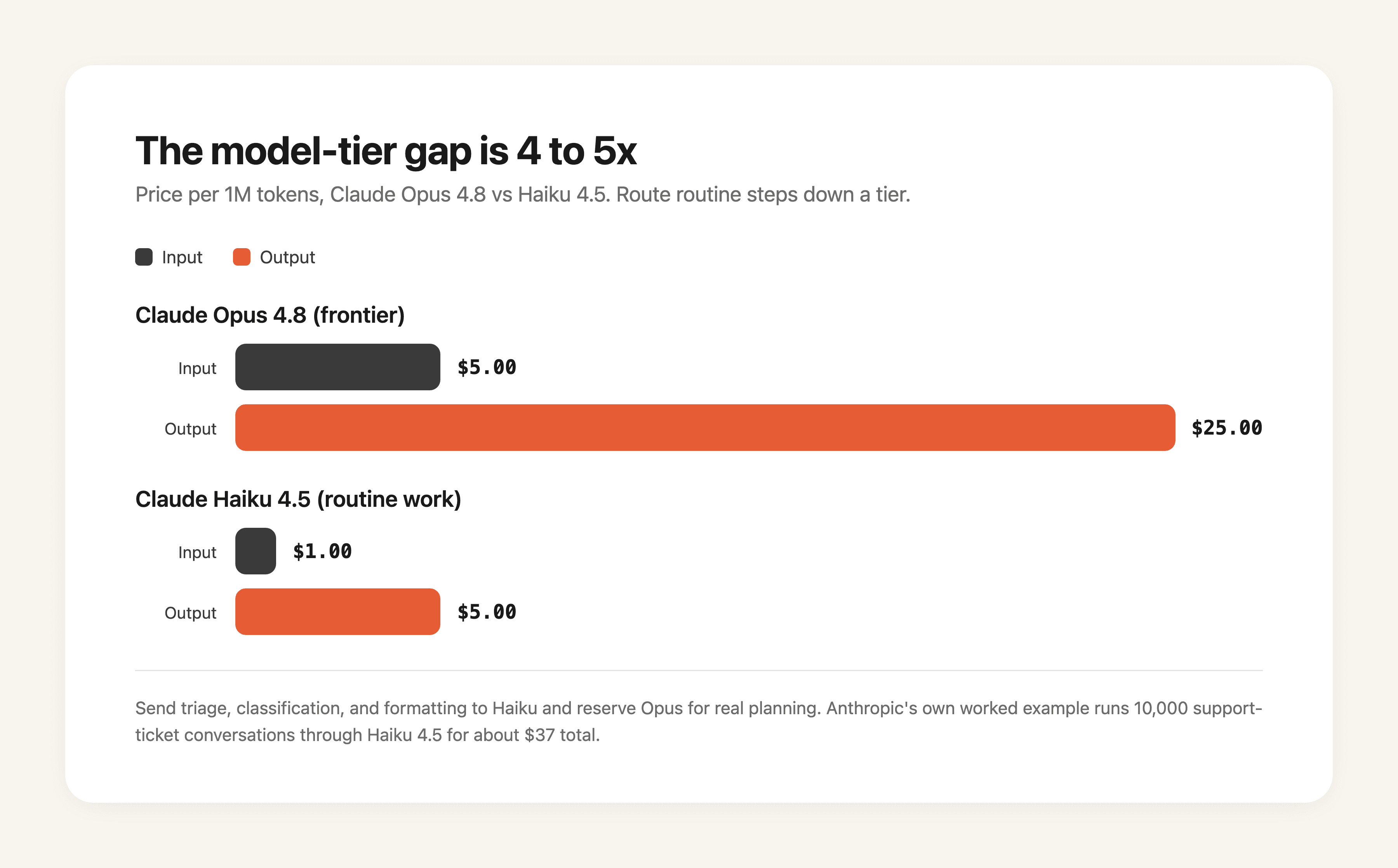
The pattern that works is a router: a cheap model does triage and classification, hands off to the strong model only when the task needs planning, then drops back down to format the output. You're not choosing one model; you're spending the expensive tokens where they change the answer.
What this saves: 30% to 60% on agents where most steps are simple. What it won't fix: if every step is genuinely hard reasoning, downgrading tanks quality and you pay it back in retries.
Cap Retries and Kill Runaway Loops
Blind retries are the scariest line on the bill because they hide until they don't. An agent that loops on a failing tool call, or two agents that keep handing work back to each other, can run unattended for a long time. In one documented incident, four agents entered an infinite loop and ran for 11 days before a $47,000 bill surfaced it.
The math compounds because LLM APIs bill the entire conversation history on every call. A loop that grows one turn at a time grows its cost at O(N-squared), so a 5x retry multiplier doesn't add 5x, it can push a $5 task toward $28. The fix is boring and mandatory: a hard cap on turns per task, a hard cap on tokens per run, and a circuit breaker that halts the agent and pings a human when either trips. Add a per-agent daily spend ceiling on top.
What this saves: insurance, not a steady percentage, but the tail it cuts off is the expensive one. What it won't fix: a well-behaved agent doing a lot of legitimate work still costs what it costs.
Stop Polling, Start Listening
Agents that watch for something (a new email, a Slack message, a file drop) often poll on a timer. Every poll is a live model call, and most polls find nothing. An agent checking an inbox every minute fires around 1,440 times a day whether or not a single message arrived, and each of those idle checks carries your full prefix cost unless it's cached, plus the model call itself.
Swap polling for event triggers wherever the source supports them: webhooks, push subscriptions, message-queue consumers. The agent wakes only when there's real work. If a source can't push events, widen the interval and gate the expensive model call behind a cheap pre-check that decides whether anything changed.
What this saves: on a chatty always-on agent, idle polling can be the majority of calls, and killing it can cut total call volume by more than half. What it won't fix: sources with no webhook and no change signal still need polling, so pick the widest interval your SLA tolerates.
Trim the Context You Resend Every Turn
Context bloat is the slow leak. As a conversation runs, teams keep appending: the full history, every prior tool result, the entire retrieved document, all of it re-sent on every turn and re-billed every time. Half of it stopped being relevant ten turns ago.
Three trims help. Summarize old turns instead of carrying them verbatim, so a 40-turn history collapses to a running summary plus the last few exchanges. Retrieve the specific passage a step needs rather than pasting the whole knowledge base. And prune tool outputs to the fields the next step reads; a 25,000-token API response usually has 200 useful tokens in it, and Anthropic notes a large documentation page alone runs around 25,000 tokens.
What this saves: 20% to 50% on long-running agents where history and retrieval dominate. What it won't fix: over-trim and the agent loses the thread, then retries or asks clarifying questions that cost more than you saved.
Cache Results, Not Just Prompts
Prompt caching handles repeated input. Result caching handles repeated work. If two runs ask the same sub-question ("what's this company's current pricing," "summarize this document," "classify this ticket type") the second run shouldn't pay the model to redo it. Store the answer keyed on the input and serve it back for free until it goes stale.
This matters most for agents with overlapping workloads: a support agent looking up the same account, a research agent re-summarizing the same source across reports, a monitoring agent re-checking pages that rarely change. A cheap key-value store in front of the model, with a sensible time-to-live, turns repeated questions into near-zero-cost lookups. The discipline is invalidation: set a TTL short enough that stale answers don't cause real harm.
What this saves: variable, but on agents with repetitive queries it removes whole model calls, which beats shaving tokens off calls you still make. What it won't fix: work that's genuinely unique every time has nothing to reuse.
Batch the Work That Can Wait
Not every agent task is interactive. Overnight report generation, bulk classification, backfilling a dataset, weekly digests: none of it needs a sub-second response. Batch APIs exist for exactly this and cost less. Anthropic's Batch API runs at a 50% discount on both input and output tokens, and it stacks with prompt caching.
The trade is latency. Batch jobs return within a window rather than immediately, so this is for work that tolerates delay. But a large share of agent workload is quietly asynchronous the moment you stop treating it as a chat. Split it: interactive tasks stay on the standard endpoint, everything scheduled or bulk goes to batch.
What this saves: half the token cost on any workload you can defer, stackable with caching. What it won't fix: anything a human is waiting on in real time has to stay synchronous.
Let a Managed Platform Own the Levers You Can't
Six of these levers you can pull yourself. A couple you can't, at least not without building infrastructure that isn't your product: caching defaults that just work, per-run cost visibility instead of one opaque monthly total, sessions that stop billing the moment they go idle, and shared skills so a hundred agents reference one instruction set instead of each re-sending it.
This is the case for a managed agent platform. Zentor runs OpenClaw agents as a hosted service, so caching and idle-session behavior sit at the platform layer instead of being wired up per agent. Idle time doesn't accrue runtime charges the way a self-run container does, and skills live once and get referenced, rather than every agent carrying its own copy of the same 10,000-token prompt. If you're weighing whether to run this yourself, the tradeoffs are in our piece on self-hosting versus managed agents, and there's a walkthrough of running a Kimi K3 agent with no self-hosting that shows the model-tier lever in practice. Pricing tiers are on the pricing page.
A managed platform doesn't repeal token economics. You still pay for the tokens your agents consume. What it removes is the waste from every team re-solving caching, idle billing, and cost attribution from scratch. On not overbuying the agent itself, the agent-types overbuying guide pairs well with this.
What this saves: the levers you'd otherwise skip because building them isn't worth your time. What it won't fix: a badly designed agent is still expensive on any platform; managed hosting cuts overhead, not bad prompts.
 @thegreatest_svx.com/thegreatest_sv
A guy funded a swarm of robots with the tokens he stopped wasting. His agent burned ~118,000 tokens per 30-minute session - mostly raw terminal output. 200 lines of a passing test suite when it needed two. He dropped a free filter
 @hanakoxbtx.com/hanakoxbt
8 ways to cut your agent bill: (and when each one pays off) 1) prompt caching → the system prompt and the tool schemas never change between calls, so stop paying full price for them. → use the moment you have more than one turn, w
 @TheTechDiggestx.com/TheTechDiggest
[OpenSource - Developer Tools] Hitting API rate limits or running out of tokens mid-coding session kills developer momentum. 🛑 OmniRoute is an open-source tool that bridges your Claude Code agent across 200+ AI providers—granting
FAQ
How much can prompt caching actually save on a real agent?
On the input side, up to 90%, because cached tokens bill at roughly one-tenth the base rate across Anthropic, OpenAI, and Gemini. Only the stable, repeated part caches. If your system prompt and tool definitions are large and your per-call user input is small (common for agents), caching swings the majority of your input cost. If most of your prompt is fresh user data every call, the savings are thinner.
Does dropping to a cheaper model tier hurt quality?
Only if you route hard reasoning to it. The winning pattern is a cheap model for triage, classification, and formatting, with handoff to the strong model reserved for planning and genuinely hard steps. Claude Haiku 4.5 costs a fifth of Opus 4.8 on input and does most routine agent work fine. Test the split on your actual tasks before committing.
What's the biggest hidden cost in an AI agent bill?
Unbounded loops and idle polling, because both scale silently. APIs bill the full conversation history every call, so a retry loop grows cost at O(N-squared), and an always-on poller fires thousands of idle calls a day. Neither shows up as a single scary line item; they show up as a monthly total that keeps creeping. Caps and event triggers fix both.
Is prompt caching automatic or do I have to code it?
Depends on the provider. OpenAI applies its cached-input rate automatically once a prompt passes 1,024 tokens. Gemini 2.5 and newer enable implicit caching by default. Anthropic gives you a cache_control field for automatic or explicit breakpoints, so you flip one setting rather than build a caching layer.
Should I optimize cost myself or move to a managed platform?
Do the six self-serve levers first; they're free and fast. Consider a managed platform when you're running enough agents that per-run cost visibility, idle-session billing, and shared skills matter, and you don't want to build that plumbing. The self-host versus managed comparison breaks down where the line sits.
Where to Point Your First Hour
If you have one hour and a climbing bill, spend it on the two levers at the top: turn on prompt caching for your agent's stable prefix, and route the routine calls to a cheaper model tier. Between them they usually knock 40% to 60% off spend, and neither changes a single thing the agent does for the user. Add a retry cap and a daily spend ceiling before you close the laptop, because that's the insurance that stops a loop from turning into a $47,000 surprise.
After that, the returns come from discipline: trim context, cache results, batch what can wait, swap idle polling for event triggers. When the overhead of doing all that yourself outweighs the savings, a managed platform like Zentor takes the plumbing off your plate, so you pay for tokens your agents actually needed, not the waste around them. Start with caching. Measure. Then decide what's worth building versus buying.

Zentor Editorial Zentor editorial team
The Zentor editorial team writes about workflow automation, AI agents, and the tools we build. Default byline for industry overviews, listicles, and collaborative pieces.
Ready to put this into practice?
Zentor runs browser tasks, research, and schedules automatically. Try it free.
References Anthropic (Claude) Pricing and Prompt Caching Docs · OpenAI Prompt Caching Guide · Google Gemini API Context Caching Docs · Forbes: Uber Burns Its 2026 AI Budget in Four Months on Claude Code · Unblocked: Why AI Agents Burn Tokens (retry loops and the $47,000 incident)