Autonomous AI Agents: Self-Host vs Managed
Self-host or buy managed for autonomous AI agents? Real costs, ops burden, and reliability compared: Manus, n8n, CrewAI, LangGraph, and Zentor.
Gartner predicts that over 40% of agentic AI projects will be canceled by the end of 2027, and the reason is not that the models failed; it's escalating cost, unclear value, and weak operational controls. For autonomous AI agents, that makes the self-host versus managed question mostly an ops question: self-host when you have a developer who genuinely enjoys owning uptime, and buy managed when you'd rather ship the workflow than babysit a server. Most teams reading this are in the second group and won't admit it yet.
Autonomous "always-on" agents like Manus proved the category works. Manus can wake on a schedule, research 50 competitors overnight, and drop a finished report in your inbox before you're up, no prompting required. The capability is real. What's less discussed is that keeping any unattended agent running at that level, on hardware you control, turns into a second job. This piece maps both paths: the tools, the real prices, the failure modes, and who should pick which.
Key Takeaways
- The agent capability is commoditized; the hard part is keeping it running unattended without a human checking on it every morning.
- Self-host makes sense at real scale, with strict data residency needs, or when you have in-house DevOps. For a solo builder or small team it usually costs more once you price your own time.
- A frontier GPU VPS can run about $1,000 a month; a self-hosted n8n stack adds $50 to $500 a month in infrastructure before you count maintenance hours.
- Managed agents (Manus at $20 to $200 a month, Zentor, hosted platforms) trade some control for zero ops, built-in retries, and multi-channel delivery out of the box.
- Reliability, not raw capability, decides whether an unattended agent survives past week three.
The Short Answer: When Self-Host Beats Managed
Self-hosting an autonomous agent is the right call in a narrower set of cases than most tutorials suggest: when token volume is high enough that API markup genuinely hurts, when regulation forces data to stay inside your walls, or when you already run infrastructure and adding one more service is marginal. Outside those three, the math usually tips toward managed.
Managed wins when your bottleneck is time rather than money, when the agent needs to reach you on Slack or WhatsApp without you wiring up webhooks, and when a failed overnight run costing you a morning is unacceptable. A managed platform absorbs the retries, the patching, and the 3 a.m. page; you give up some control over the model stack and the ability to fork the code. For a founder deciding build-versus-buy on unattended automation, that trade is often worth it.
What this resolved: A clean rule of thumb (scale, compliance, existing infra tips toward self-host; everything else toward managed). What it left unsolved: "High enough volume" and "already run infrastructure" are fuzzy until you price your specific workload, which the rest of this article does.
What 'Always-On' Actually Demands From Your Infrastructure
An always-on AI agent is not a chatbot you talk to. It's a process that has to be awake when you're not: waking on a cron schedule, holding memory across days, calling tools that occasionally 500 on you, and recovering when a website changes its layout mid-task. Manus runs asynchronously in the cloud precisely because that's the hard requirement, an agent that keeps going after you close the tab.
To run one yourself and have it actually stay up, several things have to work together at once:
- A machine or container that never sleeps, with a scheduler firing tasks on time
- Persistent memory that survives restarts, so the agent doesn't relearn your context every morning
- Retry and backoff logic for when a tool call, browser step, or API times out
- Secrets management for the dozen API keys an autonomous agent accumulates
- A channel for the agent to reach you (email, Slack, Telegram) when it needs approval
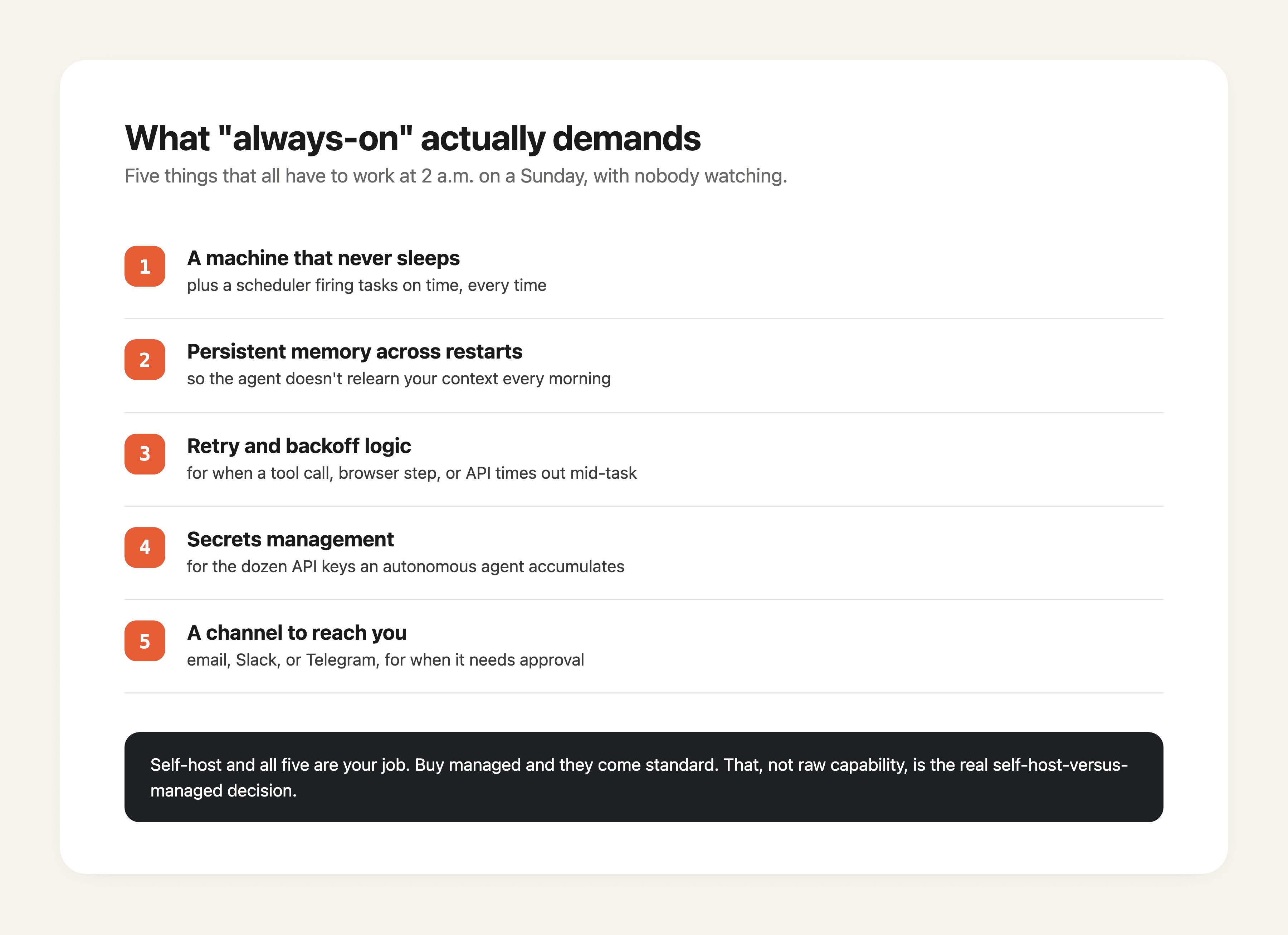
None of these is exotic alone. The cost is that they all have to work at 2 a.m. on a Sunday with nobody watching. An unattended agent that silently dies Friday and gets noticed Monday has burned three days of the exact autonomy you were paying for.
What this resolved: "Always-on" is an ops requirement, not a model requirement. What it left unsolved: Whether you or a vendor carries that ops weight, which is the actual self-host-versus-managed decision.
The Self-Host Stack: What You're Really Signing Up For
Rolling your own autonomous agent typically means one of a few open stacks. You might orchestrate with n8n for the visual workflow layer, build a multi-agent crew in CrewAI, wire explicit control flow in LangGraph, or run a local-first assistant like OpenClaw, which is open source and designed to run on your own machine. All of them are capable. The bill arrives in two currencies: dollars and hours.
The dollars hinge on whether you call a hosted model API or run weights yourself. If you point the agent at an API and only host the orchestration, a small VPS in the $5 to $35 a month range carries the harness. The moment you self-host the model for privacy or volume, the numbers jump: a high-end single-GPU VPS can run around $1,000 a month, and self-hosting only beats a frontier API once you're pushing a few million tokens a day at healthy GPU utilization. Below that line, you're paying rent on an idle graphics card.
The hours are the part people underprice. The n8n community itself is blunt about it: self-hosting demands ongoing attention for updates, backups, and reliability, and one analysis pegs real infrastructure and security spend at $50 to over $500 a month once you add SSL, firewalls, and monitoring. That's before a single hour of your own time patching a CVE, debugging why the scheduler skipped a run, or restoring state after a bad deploy. If you love that work, self-hosting is satisfying. If you tolerate it, it's a slow tax on the output you actually wanted.
Picture a solo operator who stands up a slick n8n research agent over a weekend. It runs beautifully for eleven days. Then an upstream site adds a cookie banner, the browser step hangs, the nightly digest stops arriving, and it takes four days to notice because nothing alerts on "agent produced nothing." That's not a knock on n8n; it's the reality of being your own on-call.
What this resolved: Self-host cost is dollars plus hours, and the hours dominate for small teams. What it left unsolved: How much of that a managed platform actually removes, versus just rebranding it.
The Managed Path: Renting the Autonomy Instead of Building It
Managed autonomous agents hand you the scheduler, the retries, the state persistence, and the delivery channels as someone else's problem.
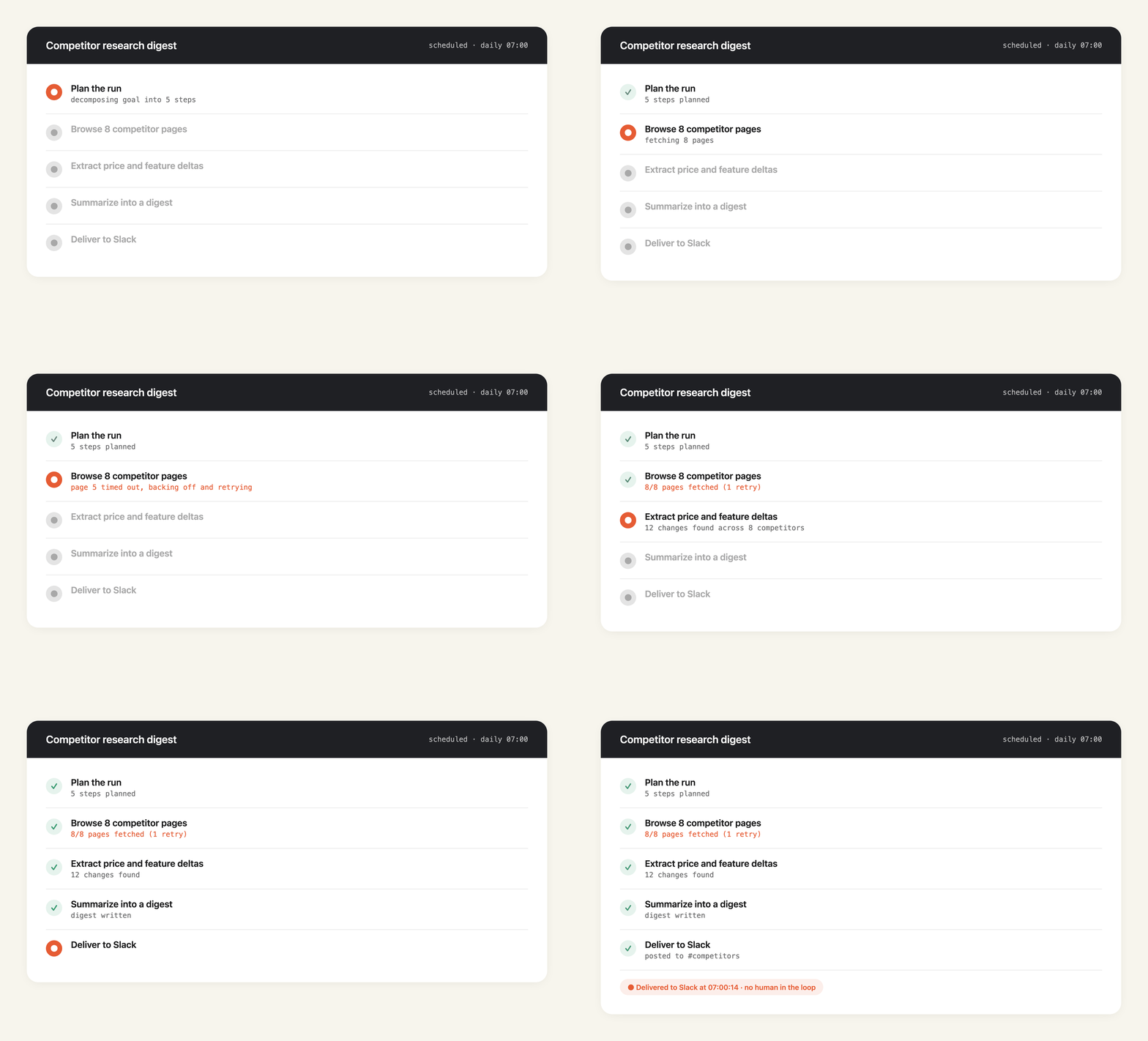
Zentor sits in this managed camp too, as a cloud-hosted take on the OpenClaw framework. The pitch is narrow: same 24/7 autonomy, skills, and persistent memory you'd get from running OpenClaw yourself, but with the infrastructure, scheduling, and multi-channel messaging (email, Slack, WhatsApp, Telegram) managed for you. No GPU to rent, no scheduler to babysit, no CVE to patch on a Sunday. You trade the ability to self-host for getting your evenings back, and whether that's smart depends entirely on how much you value the ops hours.
The genuine risk on the managed side is lock-in and cost drift. Credit-metered pricing can surprise you, and moving off a proprietary platform later is real work. Read the metering model before you commit, and prefer platforms whose pricing you can predict from your workload. For the deeper cost mechanics across both paths, our companion piece on how to cut AI agent costs goes past the sticker price into token and retry economics.
What this resolved: Managed genuinely removes the ops burden, not just relabels it. What it left unsolved: Cost predictability under credit metering, and lock-in, which are the two things to actually diligence before signing.
Self-Host vs Managed: The Comparison Table
Here's the side-by-side I wish existed when I started pricing this out. Prices are from each vendor's public pages, verified July 2026, and reflect entry or representative tiers rather than every SKU.
| Option | Path | Who runs the infra | Real entry cost | Strongest trait | Honest limitation |
|---|---|---|---|---|---|
| n8n (self-hosted) | Self-host | You | Free software; $50 to $500+/mo infra | Full control, visual workflows | You own updates, backups, uptime |
| CrewAI | Self-host | You | Free framework + your compute | Multi-agent orchestration | Requires Python and DevOps |
| LangGraph | Self-host | You | Free framework + your compute | Explicit, debuggable control flow | Steep learning curve |
| OpenClaw | Self-host | You | Free, open source | Runs local, 24+ chat channels | On-machine, you carry uptime |
| Self-hosted model on GPU VPS | Self-host | You | ~$1,000/mo high-end GPU | Data stays in-house, no API markup | Only pays off at high volume |
| Manus | Managed | Vendor | Free tier; $20 to $200/mo | Fully autonomous, zero setup | Credit-metered, can't self-host |
| Zentor | Managed | Vendor | See pricing | Managed OpenClaw, multi-channel | Proprietary hosting, no in-house option |
One read of this table: the self-host rows are cheap in software and expensive in your time; the managed rows are the reverse. There's no universally correct row, only the one that matches your team's actual constraint.
What this resolved: A concrete, priced comparison instead of vibes. What it left unsolved: Reliability, which no price column captures and which matters more than any of these numbers for unattended work.
Reliability Is the Whole Game for Unattended Agents
For an agent a human watches, a flaky failure is an annoyance. For an unattended agent, it's the entire risk surface, because nobody catches the mistake until the damage is done. Klarna is the cautionary tale. Its AI assistant handled two-thirds of customer service chats in its first month, doing the work of 700 agents. Then Klarna walked it back and started re-hiring humans, with CEO Sebastian Siemiatkowski admitting cost had become "a too predominant evaluation factor" and quality had slipped. The lesson isn't that autonomous agents don't work. It's that autonomy without a quality and escalation floor eventually bites.
This is where the choice gets concrete. When you self-host, reliability is a thing you build: alerting on empty output, retries with backoff, health checks, a dead-man's-switch that pings you if the nightly run didn't fire. All doable, all your job. When you buy managed, a chunk of that comes standard, and the vendor's uptime is contractual rather than aspirational. Neither path gives you a reliable unattended agent for free; managed just starts you closer to it.
The practical move on either path is the same: design a benign failure mode. If the worst case of a missed or wrong run is "I skim a slightly stale digest," run it autonomously. If the worst case is a wrong email to a customer or a bad write to billing, keep a human approval gate no matter who hosts it. Capability has outrun reliability across the field, and pretending otherwise is how projects end up in that Gartner 40%.
What this resolved: Reliability is engineered, not inherited, and managed simply starts you further along. What it left unsolved: The specific guardrails your workload needs, which depend on how expensive one bad output is.
How to Decide: Five Questions Before You Commit
Skip the "which platform is best" framing; it's the wrong question. Ask instead which path fits this specific agent, and let these five cut through it.
Do you have someone who owns uptime and wants to? Not "can someone," but "will someone gladly patch and monitor this." If not, self-hosting will rot. Managed exists for exactly this gap.
What's your real token volume? If you're under a few million tokens a day, self-hosting a model on a GPU is renting an idle card. API-plus-managed is almost certainly cheaper once you price your time.
Does regulation force data to stay in-house? If yes, that can override everything else and push you to self-host regardless of the hour cost. If no, don't invent the constraint.
How expensive is one bad unattended run? A stale research digest is cheap; a wrong customer email is not. The costlier the failure, the more you want either managed reliability or a hard human gate, or both.
Where does your team already live? If the agent has to reach you on WhatsApp, Slack, and email, and you'd be hand-wiring those integrations for a week, a managed platform that ships them is a real shortcut.
Run a two-week shootout before any commitment over a couple hundred dollars a month: pick one self-host stack and one managed platform, run the same real workflow on both, and see which one you're still trusting on day fourteen. That's cheaper than a wrong annual contract. If deployment mechanics are the sticking point, our AI agent deployment methods guide and the step-by-step deploy walkthrough go deeper.
What this resolved: A decision procedure keyed to your constraints, not a vendor ranking. What it left unsolved: Nothing you can't answer by running the two-week shootout on your own workflow.
 @shub0414x.com/shub0414
Dead internet. This is scary. China's AI agent, Manus AI, runs 50 Twitter accounts 24/7, completely on its own.
 @slash1solx.com/slash1sol
A TEAM JUST DEPLOYED 15 AUTONOMOUS LOOP AGENTS FROM A SINGLE PROMPT USING APPLIED GRAPH ENGINEERING Most developers still manually hardcode multi agent systems, writing separate logic for every individual task. Graph engineering c
 @FellMentKEx.com/FellMentKE
Still manually building presentations in 2026? Stop. Manus AI is the first general agent that researches your topic, visualizes your data, and builds a complete, editable deck in minutes, not hours. Let’s change how you present fo
 @dkare1009x.com/dkare1009
Google just dropped a 1-hour course on agentic engineering from scratch: 00:00 – How to build your first AI agent 08:24 – Build agent memory (short, persistent, long) 28:34 – Agentic loops, long-running AI agents 40:04 – How to bu
FAQ
Can I run an autonomous AI agent 24/7 without self-hosting?
Yes, and for most people that's the point. Managed platforms like Manus and Zentor keep the agent awake, scheduled, and reachable on chat channels without you owning any infrastructure. If you'd specifically like an always-on agent on a strong open model without renting GPUs, we walk through that in run Kimi K3 agent with no self-hosting.
How much does it cost to self-host an autonomous agent?
With a hosted model API and only the orchestration self-hosted, a $5 to $35 a month VPS often covers it. Self-host the model on a GPU and expect roughly $1,000 a month for a high-end box, plus your maintenance time. n8n-style stacks add $50 to $500 a month in infrastructure and security spend on top of the free software.
Is Manus AI worth it compared to running my own agent?
Manus is worth it when you value zero setup and true unattended execution over control, and its free-to-$200 tiers make it easy to test. It's less attractive if you have high volume, strict data rules, or want to fork the code. The credit metering can also drift up on retry-heavy tasks, so read the model before you scale.
What's the biggest hidden cost of self-hosting an unattended agent?
Your on-call time. The software is often free and the VPS is cheap, but being the person who patches, monitors, and restores the agent, and who notices when it silently stops producing, is the cost that doesn't show up on any pricing page.
Do managed agents lock me in?
Somewhat, yes. Proprietary hosting and credit metering make migration real work, and pricing can be less predictable than a fixed VPS bill. The mitigation is choosing platforms with pricing you can forecast from your workload, and keeping your prompts, skills, and data portable where you can.
Where Each Path Wins, and What I'd Ship This Quarter
Self-host wins for the team with real scale, a hard data-residency rule, or a person who genuinely wants to own the stack; that person will build better reliability than any default and enjoy it. Managed wins for the founder or small team whose scarce resource is time, who wants the agent reachable on Slack and WhatsApp tomorrow, and who'd rather a vendor carry the 3 a.m. page. Both are legitimate. The failure is picking self-host by default because it feels more "serious," then discovering you bought yourself an unpaid on-call rotation.
If I were shipping one autonomous agent this quarter, I'd start managed with a benign-failure workload, a scheduled research or monitoring digest that nobody gets hurt by if it's late. Prove the autonomy earns its keep for two unattended weeks. Then, and only then, decide whether the second agent justifies the self-host tax or should also stay managed. Pick the smallest always-on agent that pays for itself, let it run unwatched, and let its track record decide what comes next. To see the shape of workloads teams actually trust unattended, our use case library and the wider blog are the place to start.

Zentor Editorial Zentor editorial team
The Zentor editorial team writes about workflow automation, AI agents, and the tools we build. Default byline for industry overviews, listicles, and collaborative pieces.
Choosing between tools? Let Zentor run the work.
Always-on AI assistant on its own cloud computer. No switching required, no setup.
References Gartner: Over 40% of Agentic AI Projects Will Be Canceled by End of 2027 · Manus · Cloudzy: Self-Hosting an Open-Weight LLM on GPU VPS, Real Cost Math · Latenode: n8n Self-Hosted Pricing Reality, True Costs Beyond Free · Klarna AI Assistant Handles Two-Thirds of Customer Service Chats in Its First Month · CX Dive: Klarna Reinvests in Human Customer Service Talent · n8n · CrewAI · LangGraph · OpenClaw