GLM-5.3 API: Endpoints, Pricing, Limits
The GLM-5.3 API is open: three protocols, $1.40 in and $4.40 out per million tokens, and one restriction that catches former Coding Plan subscribers.
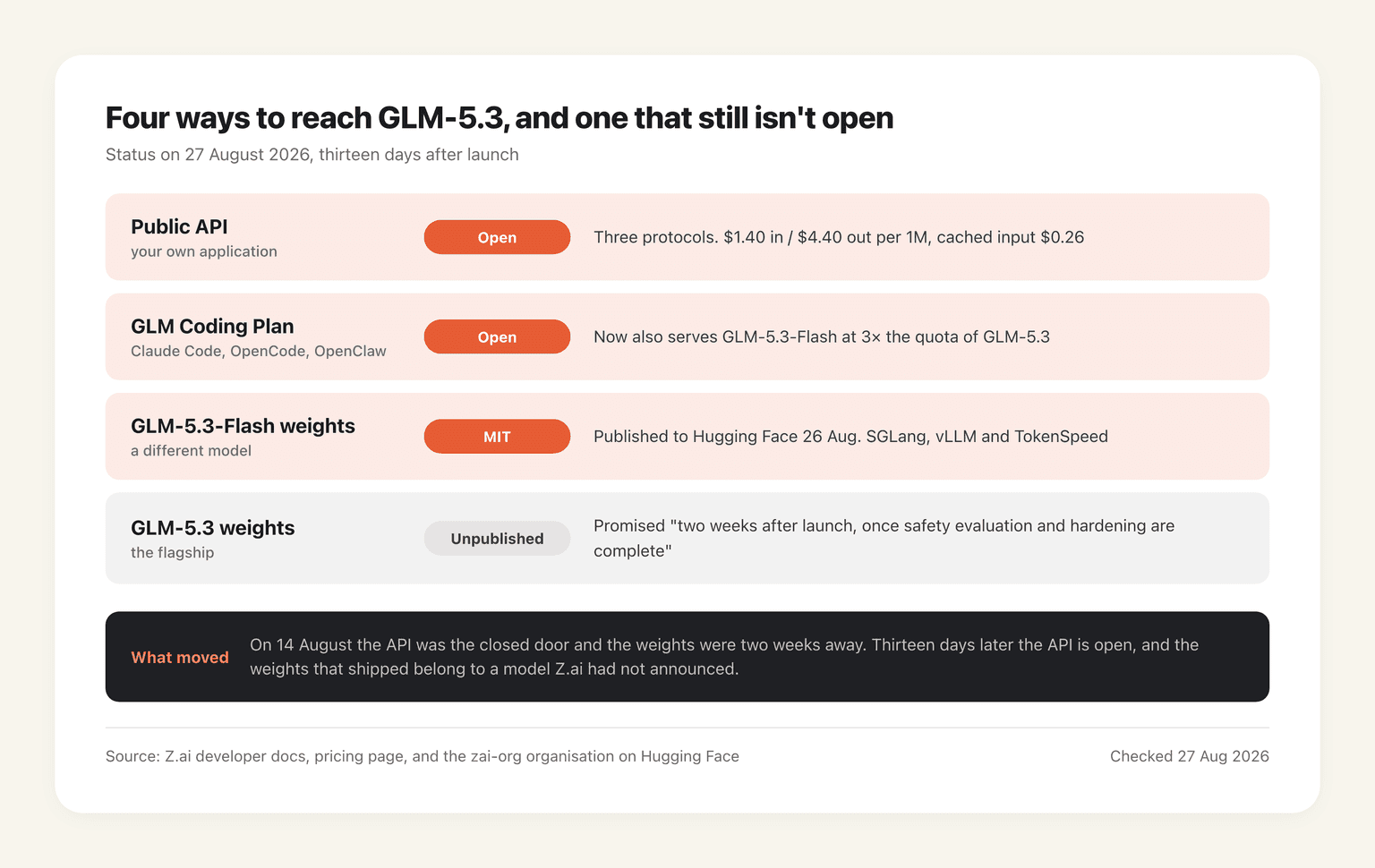
The GLM-5.3 API is open. Z.ai serves it over three protocols, prices it at $1.40 per million input tokens and $4.40 output, and the "coming soon" notice that sat on the model page through launch week is gone.
Key Takeaways:
- Three endpoints: OpenAI Chat Completions, OpenAI Responses, and an Anthropic Messages compatible one
- $1.40 in, $4.40 out per million tokens, with cached input at $0.26 and cache storage free for now
- Anyone who has ever held a GLM Coding Plan, including a lapsed one, is currently restricted to the Chat Completions protocol
- Thinking cannot be switched off, and a request carrying the old
disabledvalue fails outright - The flagship weights are still not published, and the two-week window Z.ai gave itself has now closed
The price is the part worth noting first, because it did not move: GLM-5.3 costs exactly what GLM-5.2 cost, $1.40 and $4.40 per million, per Z.ai's pricing page. A model Z.ai claims is 50% better at coding shipped at flat pricing, which is unusual enough that it is probably the most concrete thing in this article.
Where to call the GLM-5.3 API
Three protocols, and which one you may use depends on your billing history rather than your preference:
| Protocol | Base URL |
|---|---|
| OpenAI Chat Completions | https://api.z.ai/api/coding/paas/v4 |
| OpenAI Responses | https://api.z.ai/api/v1 |
| Anthropic Messages | https://api.z.ai/api/anthropic |
The restriction is documented in one sentence and easy to miss: if you have previously subscribed to a GLM Coding Plan, including an expired subscription, you can currently reach the model API only through the OpenAI Chat Completions protocol. Z.ai says it will improve this in later iterations. Until then, a cancelled subscription from months ago quietly narrows your integration options today.
One inconsistency to plan around. The protocol table gives the Chat Completions base as api.z.ai/api/coding/paas/v4, while the quick-start curl example on the same page posts to api.z.ai/api/paas/v4/chat/completions, without the coding segment. Those are different paths. If your first call 404s or returns a billing error, try the other one before rewriting your client.
What GLM-5.3 costs
Official list pricing, per million tokens:
| Model | Input | Cached input | Output |
|---|---|---|---|
| GLM-5.3 | $1.40 | $0.26 | $4.40 |
| GLM-5.2 | $1.40 | $0.26 | $4.40 |
| GLM-5.3-Flash | $0.15 | $0.03 | $0.50 |
| GLM-4.7 | $0.60 | $0.11 | $2.20 |
Cached input storage is listed as free for a limited time across the range, which is a real saving on long-context agent work and a line item that will eventually appear on your bill.
Work out what the cache is worth before you optimise anything else. Cached input runs at $0.26 against $1.40, so a repeated read costs under a fifth of a fresh one, and an agent loop that re-sends the same repository context on every turn is exactly the shape that benefits. Read a 200,000-token context forty times in one session and you have moved 8M input tokens: $11.20 uncached, $2.08 cached, a saving of about $9 on a single session's input. The saving is larger than most effort-level tuning will get you, and it costs nothing but ordering your messages so the stable part comes first.
Two warnings on the Flash row. It is currently discounted 50%, so you will see $0.075 and $0.25 quoted in most places, including on OpenRouter. That promotion ends at 24:00 on 9 September 2026, Singapore time, after which the numbers in the table above are what you pay. And Flash is a different model rather than a cheaper GLM-5.3, which the next section gets into.
A 1M-token context is a job, not a request.
Z.ai trained GLM-5.3 on tasks it measures in engineer-days, and the agent you drive it from closes when your laptop does. Zentor is a hosted cloud AI computer that stays powered on for the length of the run, working with the tools you already have set up.
Try Zentor →The parameter that fails your first request
GLM-5.3 always reasons. thinking.type: "disabled" worked on GLM-5.2 and is not supported here, so a request carrying it fails rather than degrading gracefully.
{
  "model": "glm-5.3",
  "thinking": { "type": "enabled" },
  "reasoning_effort": "max"
}
Effort takes low, high or max, defaults to max, and Z.ai recommends max for coding. That default is expensive: on Z.ai's own benchmark, max scores 34.5% at roughly 75,000 output tokens per task against high's 31.4% at 50,000, so the shipped setting costs 50% more output for about three points. We worked through which effort level to actually pick separately.
Migrate in this order: switch thinking.type to enabled, set reasoning_effort explicitly, then change the model ID. The other way round produces failed requests.
What still is not open: the flagship weights
On launch day Z.ai wrote that it would "release the weights in two weeks after launch, once safety evaluation and hardening are complete." That was a commitment with a condition attached rather than a date, and the condition is doing the work.
Two weeks on, checked 28 August 2026, the zai-org organisation on Hugging Face has no GLM-5.3 repository. What it does have, uploaded 26 August, is GLM-5.3-Flash and a BF16 variant of it, both MIT licensed. So the window has closed, a different model's weights shipped inside it, and the flagship's did not.
The deadline passed without Z.ai restating the timeline or explaining the gap, which is worth reading as data about how much a conditional weights promise is worth. The security capability is the obvious candidate for what "hardening" means here, since the same launch post reported the model finding 2,436 vulnerabilities across 269 open source projects. If you are planning around local deployment, plan around GLM-5.3-Flash, which you can download today, rather than a flagship release with no published date.
GLM-5.3 versus GLM-5.3-Flash: which API you want
The names suggest a size ladder. They are two different models.
| GLM-5.3 | GLM-5.3-Flash | |
|---|---|---|
| Base model | shared with GLM-5.2 | newly trained |
| Inputs | text only | natively multimodal |
| Context | 1M tokens | 1.31M on OpenRouter |
| Weights | not published | MIT, on Hugging Face |
| List price in/out | $1.40 / $4.40 | $0.15 / $0.50 |
Flash is roughly a ninth of the flagship's list price, handles images, and is the one you can run yourself. Z.ai reports it approaching Claude Opus 4.8 on coding, and on its in-house Code Bench at max effort it reaches 29.0 against Opus 4.8's 29.5, where flagship GLM-5.3 reaches 34.5.
So the flagship is the stronger coder and the Flash is the better default for most workloads, which inverts what the naming implies. Flash also ran anonymously on OpenRouter for six days before launch as a stealth model called Ox Alpha, pulling 3.94 trillion prompt tokens before Z.ai claimed it.
What changed since launch day
This page originally documented the opposite situation, and the movement is the useful record:
| 14 August | 28 August | |
|---|---|---|
| Public API | "coming soon", no date | Open, three protocols |
| GLM Coding Plan | Live | Live, Flash added at 3x the quota |
| Flagship weights | promised in two weeks | Window closed, still unpublished |
| GLM-5.3-Flash | did not exist publicly | Released, MIT weights |
The thing that shipped late was the thing that was promised, and the thing that shipped early was not announced at all. Worth remembering the next time a lab attaches a two-week window to a weights release: read it as intent, not as a date, and build against whatever is downloadable today.
Choosing between the API, the plan, and waiting
If you are writing an application, use the API and set reasoning_effort explicitly rather than inheriting max. If you are coding inside an agent, the GLM Coding Plan is cheaper per unit of work and now serves Flash at three times the quota of GLM-5.3, though it comes with a points system and peak-hour multipliers. If you need weights on your own hardware, that means Flash today and an open question about the flagship.
None of those choices touches the part that actually breaks long jobs. A 1M-token context implies work measured in hours, and the process holding that context ends when the machine holding it goes away. Zentor is a hosted cloud AI computer built for that gap: it keeps running when your laptop does not, alongside the agents you already use. The free trial runs three days on 1,000 credits, and a $20 subscription carries 1,000 credits a month.
FAQ
Is the GLM-5.3 API available?
Yes. As of 27 August 2026 Z.ai's developer documentation lists three live endpoints for glm-5.3, and the "coming soon" notice that appeared during launch week has been removed. It was not available when the model launched on 14 August.
How much does the GLM-5.3 API cost?
$1.40 per million input tokens and $4.40 per million output, with cached input at $0.26 and cached input storage free for a limited period. That is the same price as GLM-5.2.
What is the GLM-5.3 API base URL?
https://api.z.ai/api/coding/paas/v4 for the OpenAI Chat Completions protocol, https://api.z.ai/api/v1 for OpenAI Responses, and https://api.z.ai/api/anthropic for the Anthropic Messages protocol. Note that Z.ai's own quick-start example posts to api.z.ai/api/paas/v4/chat/completions instead, so try both if your first call fails.
Why can I only use one protocol?
Because you have held a GLM Coding Plan at some point. Z.ai restricts current and former subscribers, including those with expired plans, to the OpenAI Chat Completions protocol, and says this will be improved in future iterations.
Are the GLM-5.3 weights available?
Not for the flagship. Z.ai committed to publishing them two weeks after the 14 August launch, conditional on safety evaluation and hardening. That window closed on 28 August with nothing published on Hugging Face. GLM-5.3-Flash weights were published on 26 August under an MIT licence.
Should I use GLM-5.3 or GLM-5.3-Flash?
Flash for most work: it is roughly a ninth of the list price, accepts images, and you can download the weights. Use the flagship when you need its stronger coding results, where it scores 34.5% on Z.ai Code Bench at max effort against Flash's 29.0.
Endpoints, pricing, protocol restrictions and weight availability were read from Z.ai's developer documentation and the zai-org organisation on Hugging Face, last checked 28 August 2026. The GLM-5.3-Flash discount is scheduled to end 9 September 2026, so check current pricing before budgeting.

Zentor Editorial Zentor editorial team
The Zentor editorial team writes about workflow automation, AI agents, and the tools we build. Default byline for industry overviews, listicles, and collaborative pieces.
Ready to put this into practice?
Zentor runs browser tasks, research, and schedules automatically. Try it free.
References GLM-5.3: Frontier Coding with Emergent Cyber Capabilities (Z.ai launch post) · GLM-5.3 model overview, Z.ai developer documentation · Z.ai DevPack overview (coding agent integrations) · zai-org organisation on Hugging Face · Don't get Z.ai GLM Coding Plan (r/ClaudeCode) · zai-org/GLM-5.2 on Hugging Face · Z.ai model pricing · GLM-5.3-Flash launch post, Z.ai · zai-org/GLM-5.3-Flash on Hugging Face