When Your AI Agent Fails, Can You Prove What Happened? The New Accountability Gap in Agentic Workflows

AI agent accountability starts with a linked record of decisions, tool calls, approvals, and receipts. Learn how to build an audit trail before a failure.
An AI agent's failure is provable only if you can connect the original request, its decisions, tool actions, approvals, and final result in a record someone else can inspect. That is the ai agent accountability gap: a task may look complete while its evidence is too thin to show what actually happened. A Maven workshop page asks the same question in its title, while a Springer Nature Research Communities post dated October 25, 2026, argues for autonomy that people can assess and correct. Neither page proves that every agent fails at audit; both make the proof problem hard to ignore.
Key Takeaways:
- A final answer is not an audit trail. Keep the request, permission, intermediate tool results, approval, and outcome together.
- Mark timed-out actions as unknown until you check their actual state; a second send can create a second real-world effect.
- Let people review consequential actions before execution, not merely inspect a transcript afterward.
- Test the evidence by asking someone unfamiliar with a run to reconstruct one failed task without interviewing its operator.
The accountability gap begins where the chat transcript ends
Suppose you ask an assistant to review a customer refund and prepare a reply. It reads a policy, looks up the order, drafts a response, and then a connected tool changes the refund status. The customer sees the wrong amount. A chat log might show the assistant's final explanation, but can you identify which policy version it read, what the payment tool returned, and whether anyone approved the change? If not, you can describe the error but cannot reliably reconstruct it.
An ai agent accountability audit trail is a linked record of those events, rather than a long transcript pasted into a folder. Its point is narrower and more useful than a promise that the system never makes mistakes. It lets the person responsible determine whether an action was authorized, whether it ran, and what to repair. For a one-person business, that means answering a customer's complaint without guessing. A model's explanation after the fact is not the payment processor's receipt.
Why verifiable autonomy is suddenly a practical question
The Springer Nature Research Communities post poses a useful test: can an AI system justify its actions and show why they should be trusted? It discusses evidence-grounded reasoning, uncertainty-aware control, runtime verification, and recovery with auditable records. This is a community post by its named author, not an institutional research finding or a product certification.
Maven's public workshop listing describes incident reconstruction and evidence from tool calls, versions, approvals, and memory. It is not an incident study and says nothing about failure rates.
A Hacker News discussion asks about bottlenecks for agentic AI. The poster's claim that agent traffic overtook human traffic lacks a primary source, so it is not a measured fact. A commercial customer-service buyer guide asks how vendors define a resolved request and who owns outcomes; independently check its assessments before purchase.
What an ai agent audit trail must actually record
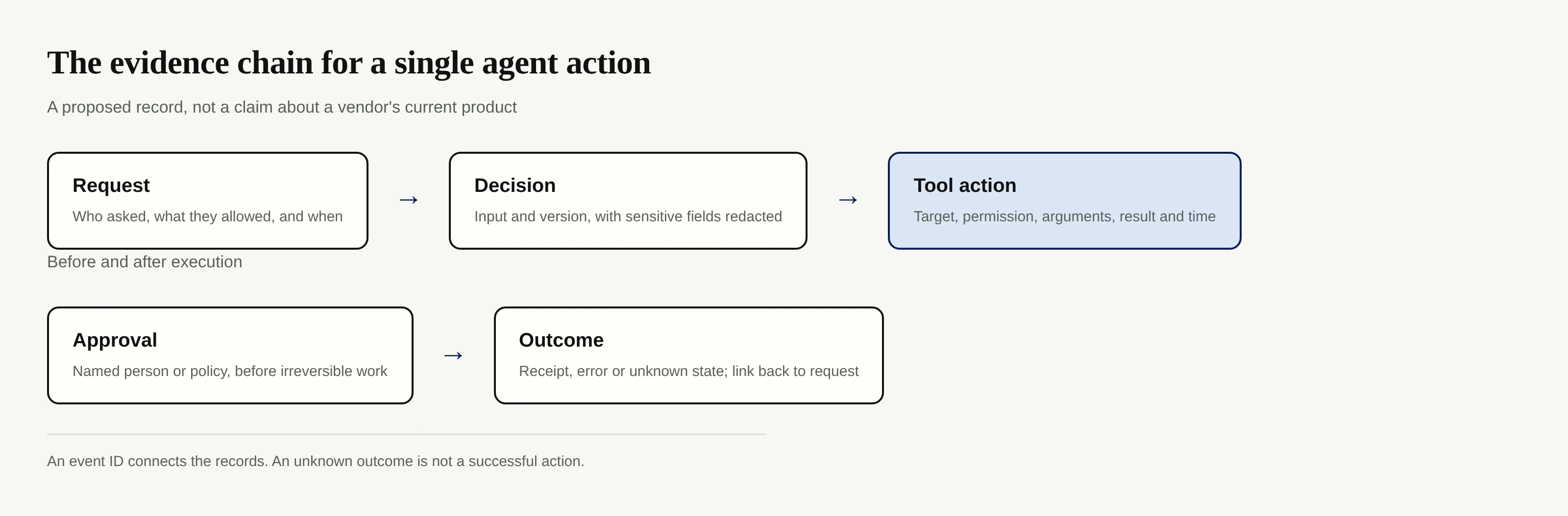
Start at the job boundary. Give the run an identifier and keep the user's request, permitted scope, timestamp, and the policy that applied. At each decision, capture the source or tool result the agent relied on, the model or workflow version, and the next action it proposed. For each tool call, keep the target, permission, safe representation of inputs, returned status, and a link to the run. The outcome should point back to the actual system of record, not merely the agent's claim that it succeeded.
Don't retain every private prompt verbatim. Restrict sensitive inputs while preserving stable identifiers; set access and deletion rules before logs accumulate. The NIST AI Risk Management Framework provides a broader governance frame for documenting and managing AI risk, though it does not certify this particular event format.
If the refund tool times out, store unknown, not success or failure. Check the payment system using the same request identifier before another call. A transport timeout tells you what your software saw; it does not tell you whether a refund happened.
A replayable trace is more than an attractive dashboard
A dashboard can count errors while concealing the one sequence you need. For replay, the reviewer should be able to walk from the initial request to each decision and resulting side effect in order. Show inputs and outputs at the right sensitivity level, the approval that preceded a consequential action, and the point at which the record stopped. If a tool has changed since the incident, preserve its old response or receipt rather than rerunning it and calling that history.
Hand a failed run to someone who did not operate it. Can they identify the source, approval, and external receipt? Their unanswered questions are your logging requirements.
The documented product is a workspace memory hub that carries context across AI tools through Zentor MCP. Portable memory is not, by itself, a replayable incident trace. If you use Zentor alongside an agent workflow, decide separately where action receipts, permission decisions, and approvals will live. Memory is not the system of record.
Keep work context available across your AI tools
Zentor keeps your workspace memory portable. Pair it with explicit approval and receipt records for actions that matter.
Get early access →
Human intervention is a boundary, not a cleanup crew
The most important choice comes before an agent uses a tool. Decide which actions it may do alone, which require a named person's approval, and which it must never do. Reading a permitted document and drafting a response have a different risk profile from sending the response, spending money, or changing access. In each case, record the decision to grant permission and the specific action it covers. “The owner approved the workflow” is too vague if the owner did not see the actual recipient or amount.
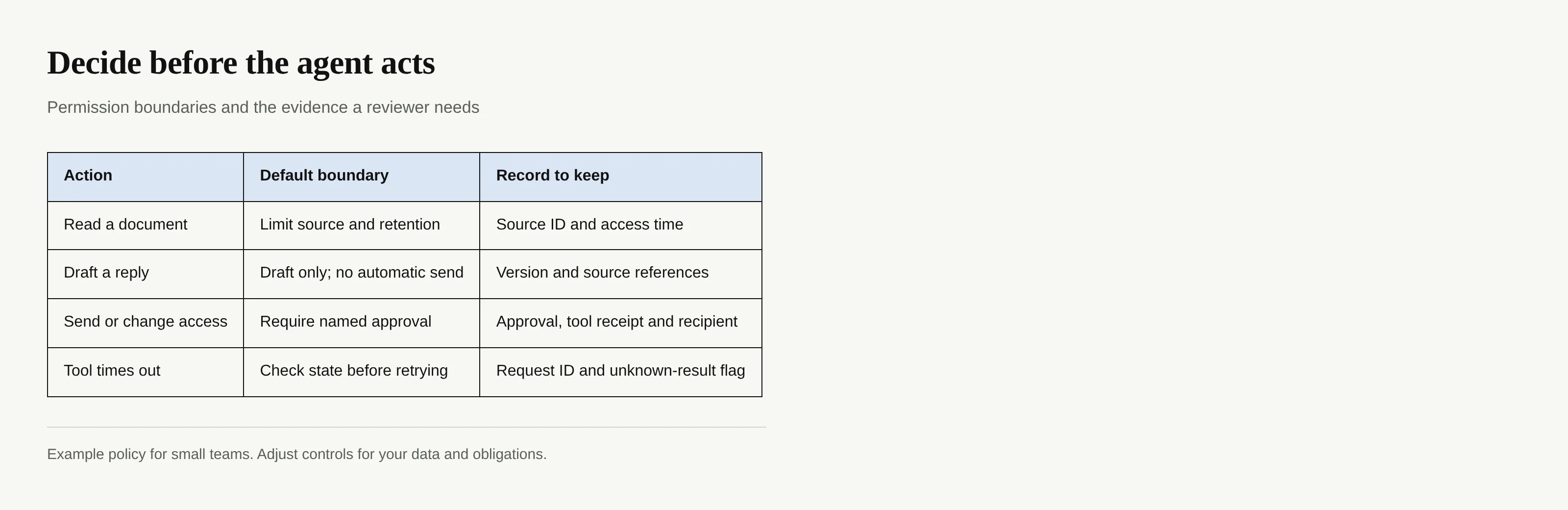
Use a short approval screen with the proposed action, target, material inputs, and a way to decline. A review after execution may help investigate an error, but it cannot stop an email that already reached the wrong customer. Expire approvals so yesterday's consent does not authorize another request.
A self-adaptive workspace does not imply a built-in policy engine or audit ledger. Verify what the connected services enforce before granting write access.
An accountability checklist a small team can run this week
Pick one existing workflow rather than designing a company-wide taxonomy first. A customer reply, an invoice follow-up, or a research digest will do. Draw the point where information becomes an outside action. Then check the following against a real test run:
- Scope: Write down what the assistant may read, draft, send, or change. Remove tool access that the job does not need.
- Identity: Assign a stable request ID and connect every tool call, approval, and final receipt to it.
- Evidence: Store source identifiers, versions, returned statuses, and redacted inputs. Decide who may see and delete the record.
- Control: Require a named review for money, external messages, or permissions. Make the approval specific to the target and action.
- Recovery: Simulate a timeout. Check the external state before retrying; make the unknown result visible to the operator.
If a reviewer cannot tell whether the action happened, add the missing receipt; if approval is unclear, move it earlier. Auditability is tested against an incident, not a feature label.
For people using Zentor's workspace, user-owned memory can carry context between tools, but action receipts must come from the connected services. See its current offer; no native immutable audit log, incident replay, or certification is claimed here.
FAQ: ai agent accountability in ordinary work
What is the difference between a transcript and an audit trail?
A transcript records conversation. An audit trail links the initiating request to policy, tool calls, approvals, and receipts, including outcomes the agent did not predict. One can help explain the other; neither automatically replaces a payment or access-system record.
Can an agent keep working without a human approving every step?
Yes. Limit autonomous work to an explicit scope, such as reading approved material or creating a draft, and pause at consequential actions. Record both the allowed boundary and the decision to cross it.
Does better observability prove an agent's decision was correct?
No. Observability gives a reviewer evidence of what the system saw and did. The reviewer still has to assess whether the source was sound, the action authorized, and the result appropriate.
Where should a solo operator begin?
Find the last task that made you ask, “Did that actually send?” Keep its request ID, approval, tool response, and external receipt together. If the response is missing, treat the outcome as unresolved and check the destination before repeating the action.

Zentor Research Public data on the AI ecosystem
Zentor Research publishes quarterly data studies on the AI tools ecosystem, drawing on public registries (npm, GitHub, Hugging Face, arXiv, Google Trends). All charts and datasets ship under CC-BY 4.0.
Turn insights into action.
Zentor automates the recurring work your analysis points to. No engineering required.