Anthropic Says One Agent Often Beats Many Subagents — When to Fold Them In

Single agent vs multi-agent on Claude: what Anthropic found, when subagents still help, and how to test a measured migration without breaking tasks.
For single agent vs multi-agent decisions on Claude, Anthropic's answer is to start with one loop and keep subagents only when a separate context improves the task. In its October 22 guidance, the company says a skills-equipped single agent frequently beat both a giant-prompt design and specialist subagents across several enterprise deployments; it does not publish a cross-customer benchmark table.
Key Takeaways:
- Fold a router, planner or domain specialist only after comparing completed tasks, cost and elapsed time against the existing design.
- Skills and tool search load instructions when needed; a single loop needn't carry every rule in its opening prompt.
- Keep separate agents when context grows harmful, independent work benefits from disposable contexts, or the main agent consistently chooses the wrong tools.
- Anthropic's migration kit is an Apache-2.0 reference implementation, not a maintained production service.
What Anthropic actually recommended
Anthropic's target is one model with one context window in an open-ended tool loop. The model plans, calls tools in batches, receives their results and revises its own plan. The surrounding software still sets turn and cost budgets and write gates. A subagent's procedure can become a skill; its live-data calls and actions can become tools. That is less like firing the specialists and more like changing where their instructions and permissions live.
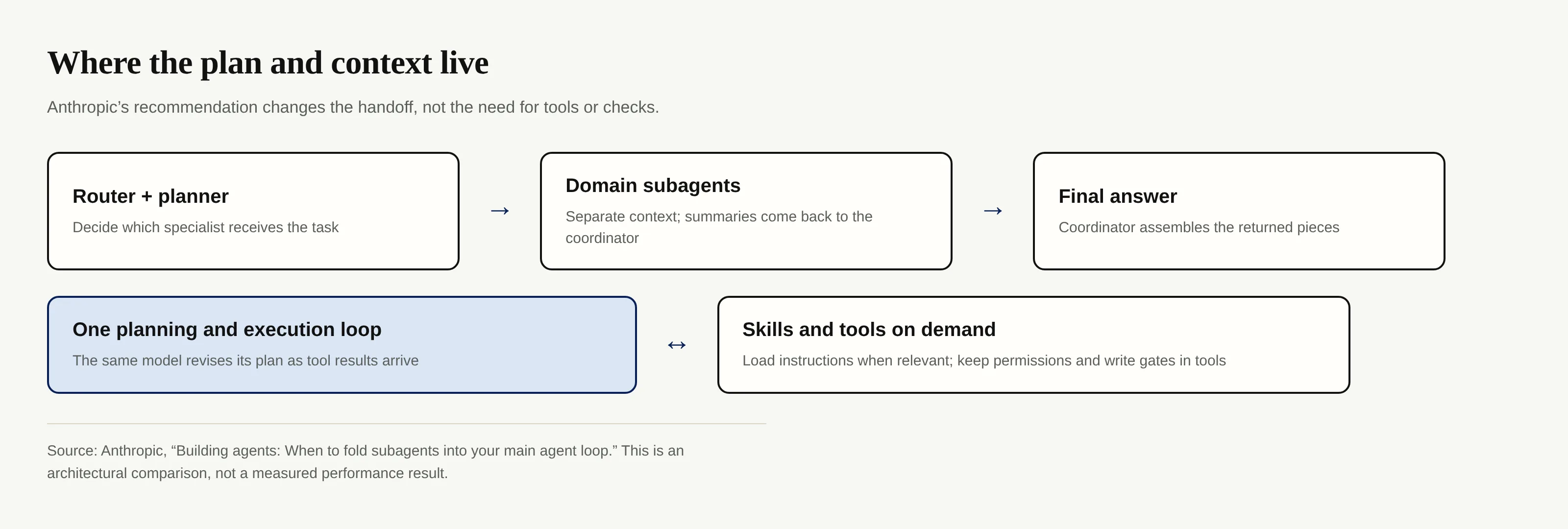
The distinction matters if you use an assistant to handle an order question, then draft a customer response. The second step needs the first step's details, not a thin summary passed between independent agents. Zentor's user-owned workspace memory, available to AI through Zentor MCP, makes retained context a useful design concern; it doesn't prove any particular agent topology wins.
Keep the context your work needs
Zentor keeps your workspace memory yours and available through Zentor MCP. Compare how a task gets done, not how many agents appear in the diagram.
Get early access →
What the quality, cost and latency evidence says
Anthropic describes comparisons in several enterprise deployments: a single agent with skills frequently won on answer quality and often cost and latency per task. One customer's single loop ran roughly twice as fast as its multi-agent harness. Those are vendor-reported observations, not independent randomized tests; Anthropic doesn't give the workloads, sample size or absolute cost figures needed to generalize the speed ratio. AiLookout's account makes the same evidence limit explicit.
A company with a dozen customer-facing specialist agents also struggled to keep its voice consistent, Anthropic reports. More handoffs meant more opportunities to discard the detail the final response needed. The claim isn't that a plain single prompt beats everything: the comparison includes a weaker one-prompt-for-everything baseline, while the stronger single-loop design loads skills selectively.
When to use subagents instead
Ask what a second context buys you. If a long-running loop's performance measurably drops as its context fills, a focused worker can return only the result. Independent research questions can run in parallel in fresh windows; an independent verifier can check an answer without inheriting the writer's assumptions. Anthropic also allows a split when the main agent can't reliably choose tools or reconcile conflicting instructions.
When a worker remains, the main loop can call it as a tool and keep the conversation. Reserve a full conversation handoff for work that requires the specialist to talk to the user. This is a different question from the platform capacity covered in our Claude Managed Agents limits article, which describes how many agents may run, not whether your particular task should split.
Inside the single-agent-loop-kit migration
The Apache-2.0 repository gives a sequence: measure, combine, fold. First, establish an end-to-end baseline that covers the real chains of agents and rules that must hold. Then merge specialists that routinely share data or follow one another. Finally, replace one remaining specialist's instructions with a skill and its actions with tools, rerun the same tasks and keep the change only if it holds up.
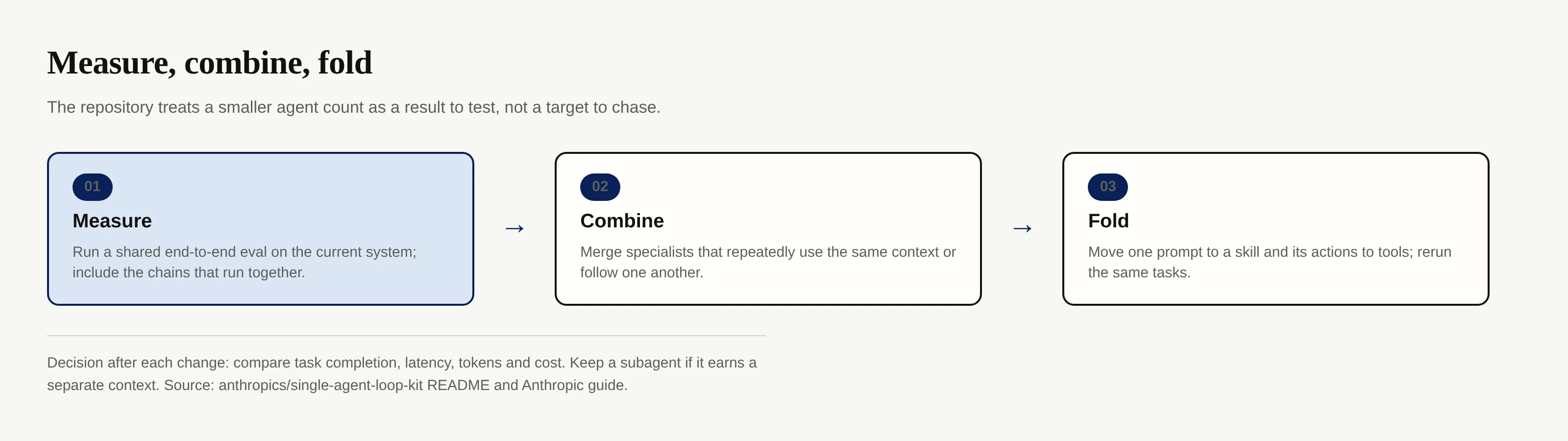
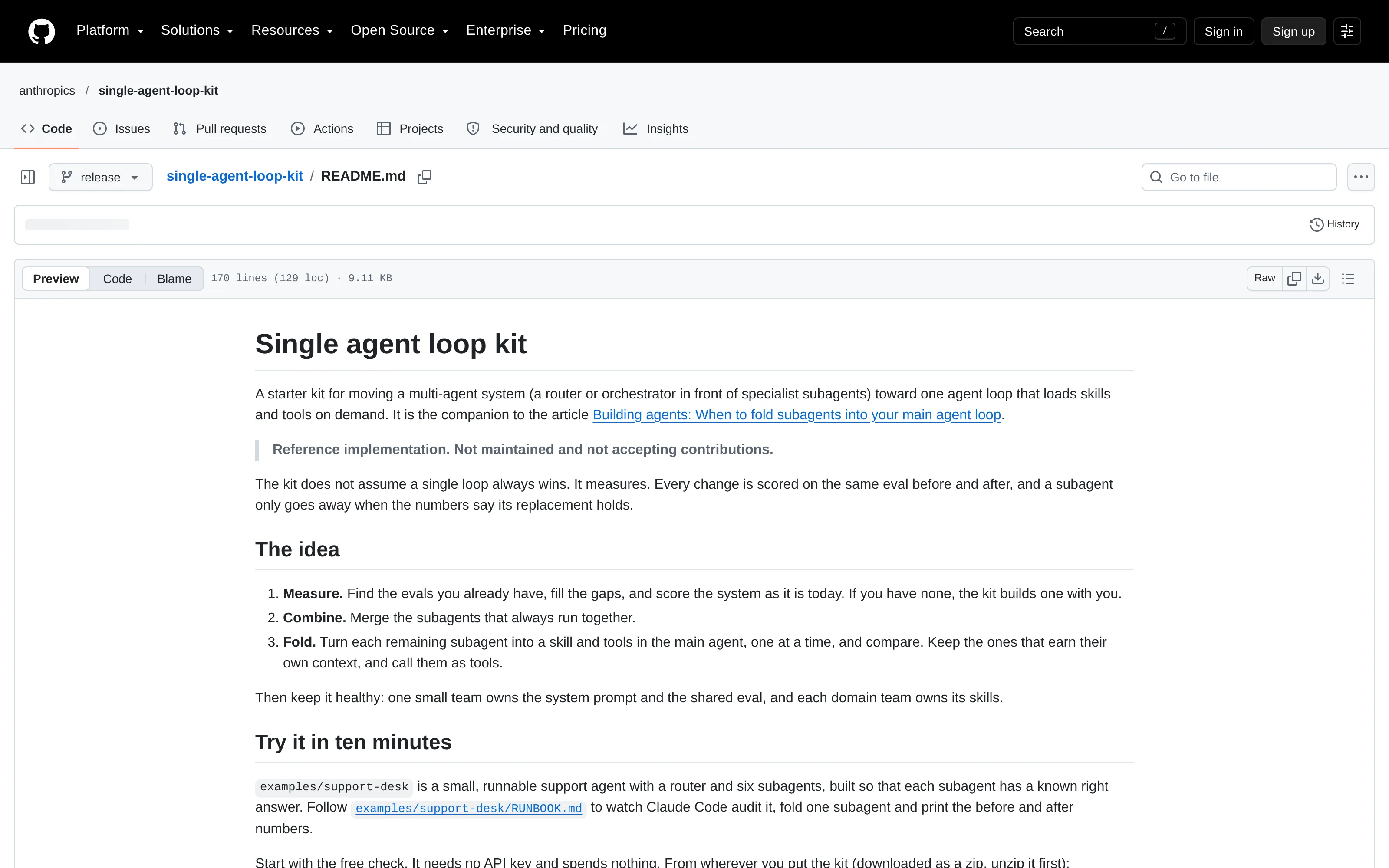
The kit points to Claude API skills called build-eval, prompt-audit, hillclimb and cost-optimize. Its example includes an offline stand-in test, but the README says only two example runs used a real model, and neither the merge nor upkeep step has had a real-model run. It labels the project a reference implementation that is not maintained. Don't read the demo as a published performance guarantee.
The catch: a faster fold can break a passing task
Anthropic's support-agent example supplies the useful counterexample. After a fold, latency fell, but the main agent answered from an order lookup instead of asking the shipping specialist for a delivery date. A previously passing process failed in one of two runs. Compare which tasks flip, not only the average score; run each task more than once and include the agent chains your customers actually use. The Decoder's report documents that warning too.
For a one-person shop, picture an assistant checking an order before replying to a buyer. If it finds the order but omits the delivery-date lookup, a shorter wait is no consolation. Zentor's self-adaptive workspace may organize work across tasks, yet the task's factual completion still needs checking against the underlying record, whichever agent design you choose.
What progressive disclosure changes for Claude teams
Progressive disclosure means the model initially sees compact descriptions and fetches full skills or tool definitions only when they become relevant. Anthropic says this helped it cut Claude Code's system prompt for advanced models by more than 80%; the reduction is about prompt size, not a measured 80% reduction in a customer's bill. Tool search also prevents an opening prompt from becoming a crowded menu. Neural Daily's coverage tracks the same shift.
The previous Anthropic dynamic-workflows guide asks when agents should orchestrate phases of work. Here the decision is narrower: when should coupled specialists be folded into the agent already holding the plan? For Zentor, the practical bridge is to choose the architecture that preserves useful task context and checks real outcomes, rather than counting agents as a proxy for quality.
FAQ: single agent vs multi-agent decisions
Is multi-agent dead?
No. Anthropic still uses subagents, including in its research system. Separate contexts can protect a verifier's independence or speed parallel, self-contained work; test the benefit against the handoff cost.
Should I migrate my Claude agent now?
Only if you can compare the current setup with one small change on representative tasks. Start with an end-to-end baseline; don't run the kit on live customer actions without a safe test environment and appropriate write permissions.
What is progressive disclosure for agent skills?
The agent sees short descriptions first, then loads a full skill or tool only when the task calls for it. That controls prompt growth without making every specialty a separate conversation.

Zentor Research Public data on the AI ecosystem
Zentor Research publishes quarterly data studies on the AI tools ecosystem, drawing on public registries (npm, GitHub, Hugging Face, arXiv, Google Trends). All charts and datasets ship under CC-BY 4.0.
Turn insights into action.
Zentor automates the recurring work your analysis points to. No engineering required.