Claude Cowork and Chat Are Now One Claude for Enterprise

Claude Cowork and chat now share one Enterprise experience. See what admins can control, how cloud sessions work, and what changes on November 16, 2026.
Claude Cowork and chat are now one Claude experience for Enterprise: a conversation starts as chat and moves into cloud-based file or code work when needed. Anthropic announced general availability on October 23, 2026, after bringing the two together for Pro and Max in September. For buyers, the questions are who enables that work, what it can reach, and who pays.
Key Takeaways:
- Claude Cowork Enterprise no longer requires members to choose a separate Cowork surface before asking for a task.
- Agentic sessions run on Anthropic-managed, isolated cloud VMs; Enterprise network egress is off by default, but other access routes need separate review.
- Efficient mode, model entitlements, spend limits, and pooled group budgets address different pieces of usage-based spend.
- General availability is live; the November 16 default enablement for existing organizations has prerequisites and an owner opt-out.
What the unified Claude experience actually changes
A member can ask a quick question on web, desktop, or mobile. If the same conversation needs to run code or process files, Claude carries the work into a cloud session and returns a document, analysis, or presentation for review. Chats, projects, connectors, skills, and plugins carry over, according to Anthropic's launch post. Existing permissions still need checking.
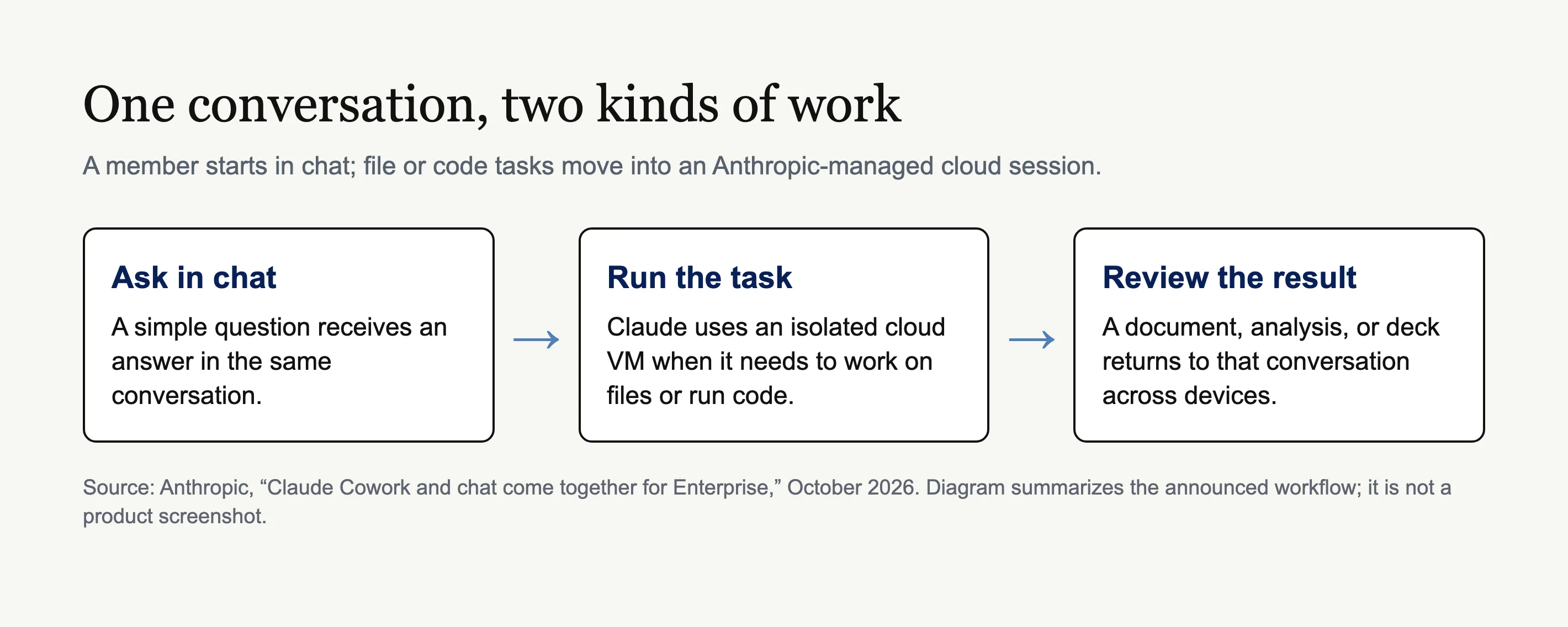
Suppose finance asks Claude to compare budget documents and return an editable report. Administrators must first decide which files and connectors it can reach.
Zentor's AI workspace guide addresses a different concern: user-owned memory that reaches compatible AI tools through Zentor MCP. Portability doesn't replace Claude Enterprise's role controls.
Keep your workspace context portable
Zentor keeps user-owned memory available through Zentor MCP across compatible AI tools. Compare that need with your enterprise execution and approval requirements.
Get early access →
How Claude Cowork Enterprise runs work in the cloud
Anthropic's admin guide says each conversation that needs agentic work gets its own virtual machine. The VM stops after idle time, and its encrypted sandbox snapshot expires after 30 days; conversation retention is a separate policy.
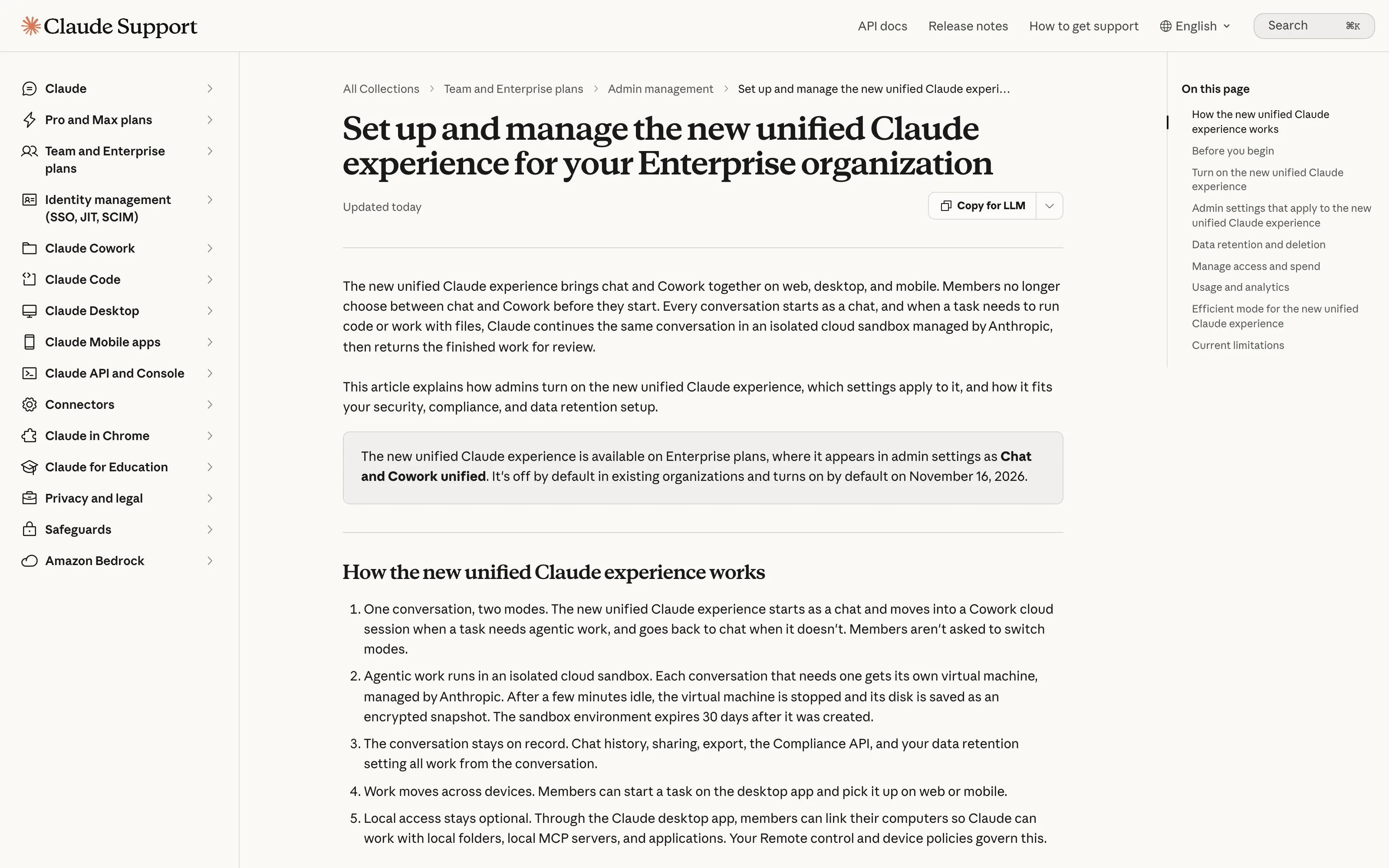
Work continues when a laptop closes, but local folders require an optional linked device to remain online. The Cowork architecture overview says accessed files are processed on Anthropic's servers; classify them accordingly.
Enterprise security: isolation is not the whole permission model
Existing Enterprise SSO, the Compliance API, and data-retention settings apply to the unified experience. Anthropic says it encrypts data in transit and at rest and doesn't use Enterprise content for model training by default. A sandbox's network egress is off by default for Enterprise; connector credentials stay outside it, and connector calls run server-side.
That does not mean every route to outside content is closed. Anthropic's safety guidance distinguishes sandbox egress from web search, web fetch, and MCP or connector tools, whose permissions need their own review. Untrusted material can still carry prompt injection. Review connector policies, linked devices, approvals, sharing, and retention separately. Enterprise starts in Manual approval mode, according to the unified experience help page.
In a pilot, give a restricted role a readable but unshareable document; verify the denial.
Four admin controls for access and cost
The pricing model remains usage-based. Anthropic says Opus 5.5 costs about 40% less to run than Opus 5 on typical workloads, while Sonnet 5.5 costs up to 30% less than Sonnet 5 for most work, billed through usage. As of October 2026, these vendor comparisons do not forecast your invoice; agentic tasks may use more tokens.
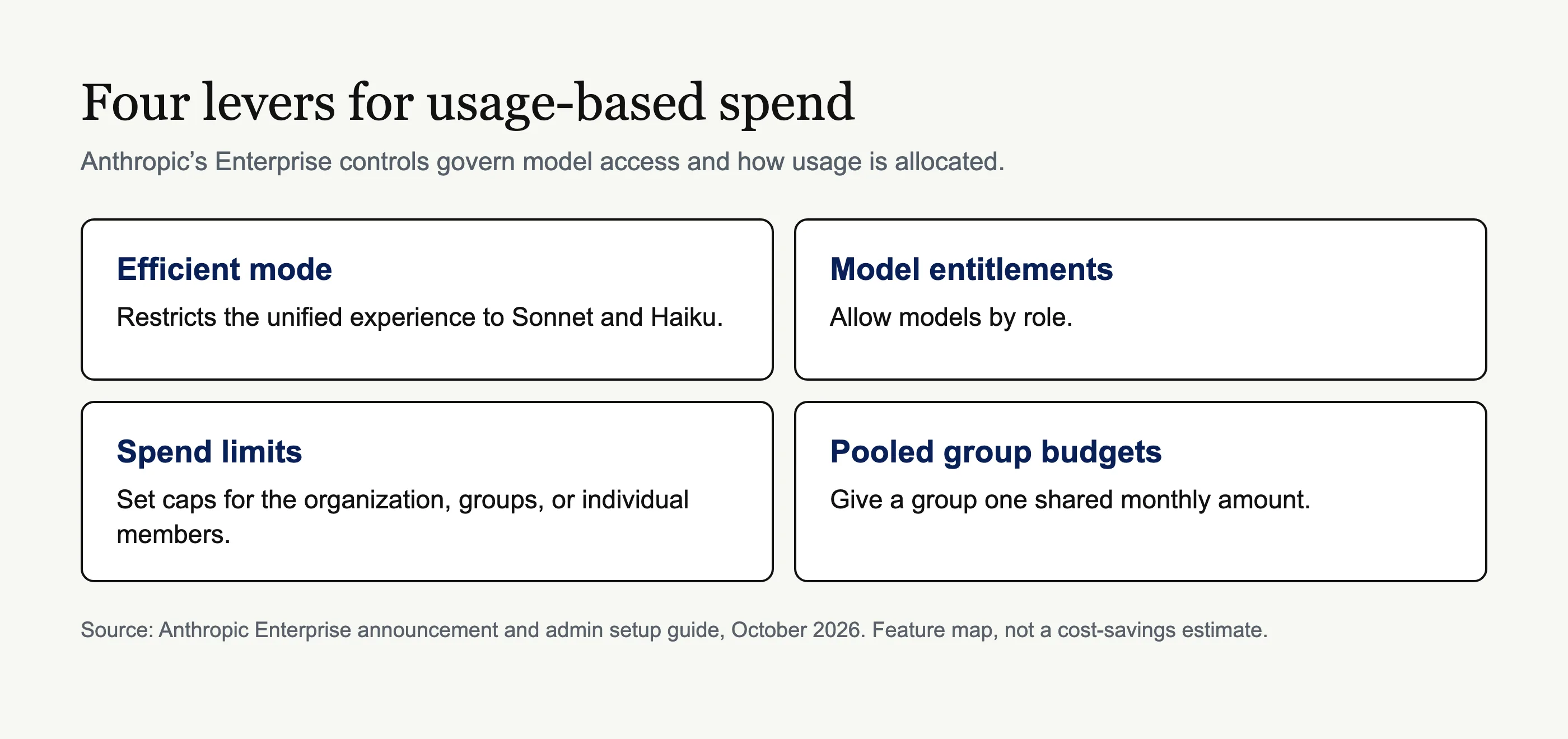
| Control | What an admin decides | What it does not prove |
|---|---|---|
| Efficient mode | Restrict the unified experience to Sonnet and Haiku; new sessions start on Sonnet 5.5 at low effort. | A fixed invoice or the best model for every task. |
| Model entitlements | Allow specific models by role. | That a permitted task is cheap. |
| Spend limits | Cap usage at organization, group, or member level. | An estimate of work completed. |
| Pooled group budgets | Set one shared monthly amount for a group. | Equal spending by every member. |
The admin setup guide adds an easy reporting trap: once a role gets access, its activity moves into a separate chat_cowork_unified usage category. Include it alongside chat and Cowork in cost reports to avoid mistaking relabeling for savings. Zentor's Smart Routing selects models by task, but doesn't replace enterprise budgets.
Rollout dates and exceptions for existing organizations
Anthropic says the unified experience is generally available now. For existing Enterprise organizations, its official admin instructions say the setting starts off and will turn on by default November 16, 2026, unless an Owner or Primary Owner chooses Keep disabled. If an owner already chose on or off, that choice remains. Both Chat and Cloud code execution and file creation must be enabled; without them nothing automatically turns on.
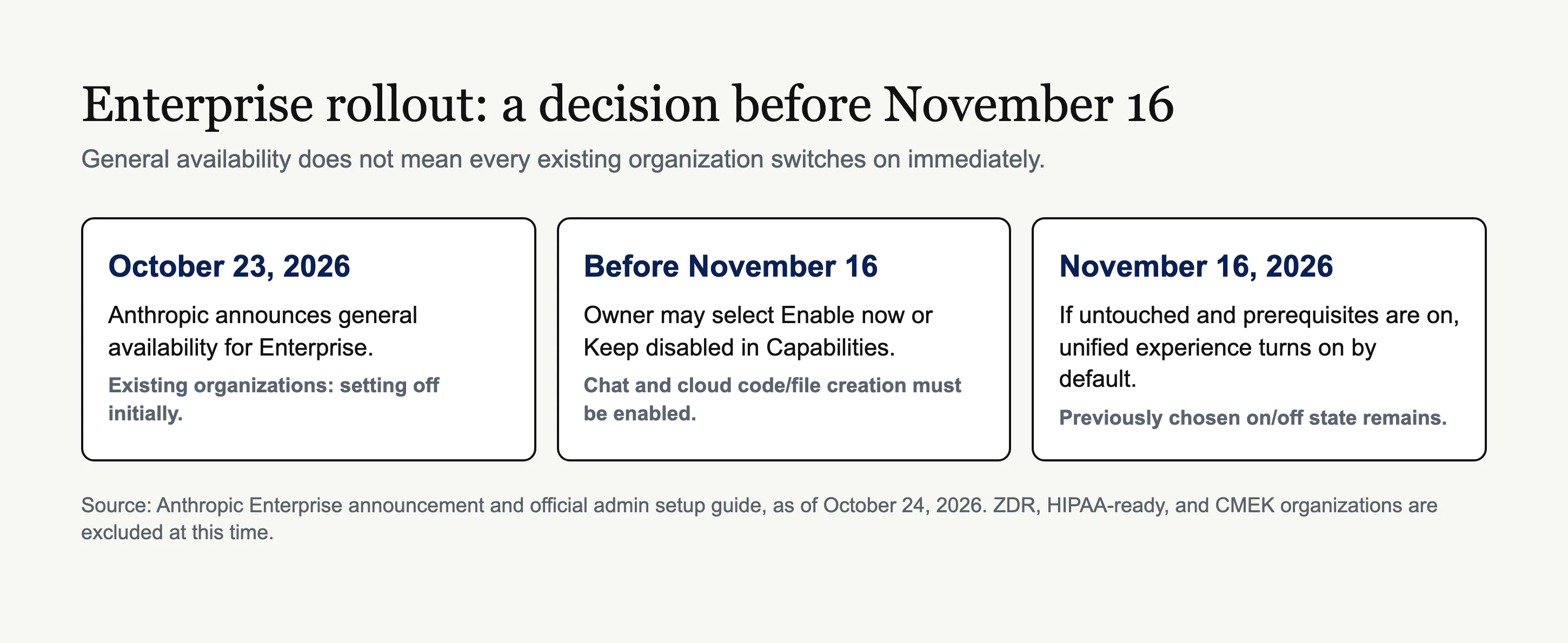
Before then, check Organization settings > Capabilities and pilot with limited roles. Built-in User, Admin, Owner, and Primary Owner roles get access once the organization setting is on; custom roles need the capability explicitly. The admin guide also says zero data retention, HIPAA-ready, and customer-managed encryption key organizations remain on their current configuration for now. General availability is not a waiver of those exclusions.
Procurement needs two sign-offs: security on reachable data and actions, finance on pilot usage. Zentor's agent memory guide distinguishes chat history from portable workspace memory; neither settles your Claude execution policy.
FAQ: Claude Cowork and Enterprise rollout
Is the unified Claude experience the same as the old Cowork app?
No. It begins with chat and uses a cloud session when the conversation needs file or code work. Existing Cowork settings and local execution have their own documentation; follow the new unified capability in Enterprise settings rather than assuming one toggle covers every path.
Does disabling network egress stop Claude from reaching connectors?
No. Egress governs sandbox code; connector calls and web tools use other routes and policies. Review each permitted tool separately.
Will every Enterprise organization switch on November 16?
No. The default applies to eligible existing organizations with the required Chat and cloud execution capabilities on, unless an owner keeps the unified capability disabled. ZDR, HIPAA-ready, and CMEK organizations are excluded as of October 2026.
Does Efficient mode make agentic work cost less by a fixed percentage?
No. It constrains the model choices to Sonnet and Haiku in this experience. Anthropic's model-to-model cost comparisons are workload-dependent and don't guarantee savings on a particular task.

Zentor Editorial Zentor editorial team
The Zentor editorial team writes about workflow automation, AI agents, and the tools we build. Default byline for industry overviews, listicles, and collaborative pieces.
Ready to put this into practice?
Zentor runs browser tasks, research, and schedules automatically. Try it free.