DeepSeek API Pricing Doubles 35 Hours a Week
DeepSeek API pricing doubles in two weekday UTC windows, and the model name you pinned was retired without an error. Current rates as of 2026-09-15.
If you budgeted your agent on DeepSeek's headline numbers, you budgeted for about four-fifths of the week. DeepSeek API pricing runs on a clock: two windows every weekday cost exactly double what the rest of the week costs, and the documentation states the schedule in UTC without telling you what that means where you live. The same page carries a second surprise that costs more than the first, which is that the model name most people still have in their config was retired, and DeepSeek kept accepting it anyway.
Both facts sit in footnotes on the Models & Pricing page. Neither shows up in your error logs, because nothing errors.
Key Takeaways
- Peak rates are exactly 2× off-peak, and peak runs 01:00–04:00 and 06:00–10:00 UTC, Monday through Friday. That is 35 hours out of 168, or roughly 21% of the week.
deepseek-v4-flashanddeepseek-v4-flash-vision-exphave been retired. Requests using those names still succeed; they get served by DeepSeek-V4.1-Flash and billed at the Flash price.- The canonical model name is now
deepseek-flash. - DeepSeek V4 Pro was scheduled to stop on September 14, 2026, and got a reprieve at the last minute, with billing unchanged.
- On OpenRouter, DeepSeek's own endpoint is the only one of 18 providers with time-of-day pricing. Everyone else quotes a flat rate, and several of them beat DeepSeek during peak.
What DeepSeek API pricing looks like as of 2026-09-15
Two models are on the price list, deepseek-flash (running DeepSeek-V4.1-Flash) and deepseek-v4-pro (running DeepSeek-V4-Pro-0813). Each has six numbers rather than three, because cache hits, cache misses, and output are all priced twice: once for peak, once for off-peak.
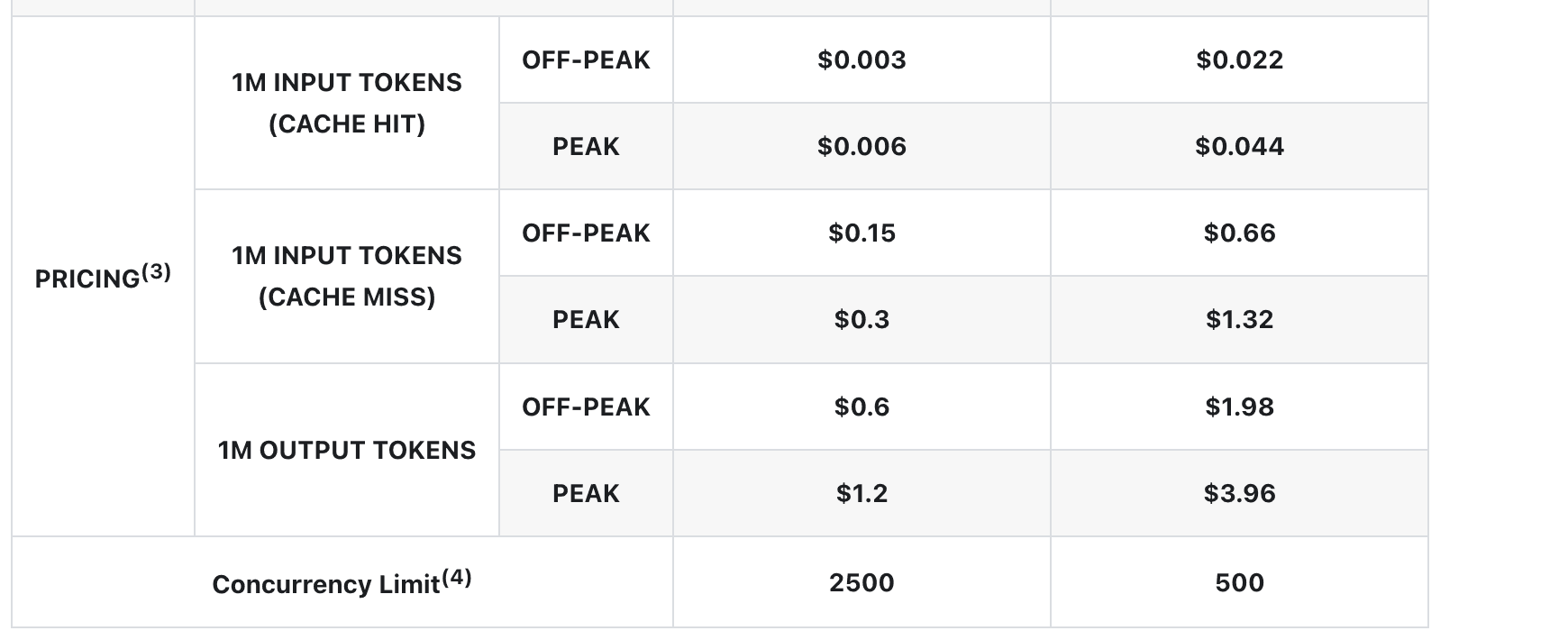
Per million tokens, deepseek-flash costs $0.15 off-peak and $0.30 at peak for uncached input, $0.60 and $1.20 for output, and $0.003 against $0.006 on a cache hit. The Pro tier scales the same way: $0.66 rising to $1.32 on input, $1.98 rising to $3.96 on output. Off-peak rates are half of peak, in every row, with no exceptions.
Take a job that reads a million tokens and writes two hundred thousand. Off-peak, on Flash, that's about 27 cents. Run the identical job at 02:00 UTC on a Wednesday and it's 54 cents. Nothing about the request changed; the wall clock did.
Stop paying attention to which hour your work runs in
Zentor is an AI assistant that does the job and puts the finished thing back in Notion, Airtable, Canva or your inbox, instead of handing you a raw API response to move yourself.
See it for developersPeak follows the Beijing workday, not yours
Convert the UTC windows and the logic stops being mysterious. At UTC+8, peak lands at 09:00–12:00 and 14:00–18:00: a Chinese office day with the lunch break cut out of the middle. DeepSeek is charging more when its home market is awake, which is reasonable capacity pricing and completely invisible if you read the schedule as a list of numbers rather than as somebody's working hours.
Now put yourself somewhere else. On US Pacific time, peak covers 18:00–21:00 and 23:00–03:00, so the expensive hours are your evening and the middle of your night. US Eastern gets 21:00–00:00 and 02:00–06:00. Central European time gets 03:00–06:00 and 08:00–12:00, which means a Berlin team pays peak through most of its morning. India sits at 06:30–09:30 and 11:30–15:30.
For anyone outside Asia this inverts the usual instinct. The overnight slot you'd naturally pick for a long batch job is precisely the doubled one, and the cheap hours are your own working afternoon.
One boundary detail earns its keep: the Monday-through-Friday rule applies to the UTC date, not yours. Friday evening in California is already Saturday in UTC, so it bills off-peak. Sunday evening in California is Monday in UTC, so it bills peak. A scheduler that thinks in local weekdays will get both of those backwards.
This is the part that turns a pricing question into a scheduling one, and scheduling is where most agent setups quietly leak money. Zentor takes a different position on it: you hand over the task, and what comes back is the finished document sitting in the tool your team already works in, so the question of which hour the tokens got spent in stops being something you have to hold in your head.
The model name in your config was retired without an error
Here is the line that matters most, and it's a footnote:
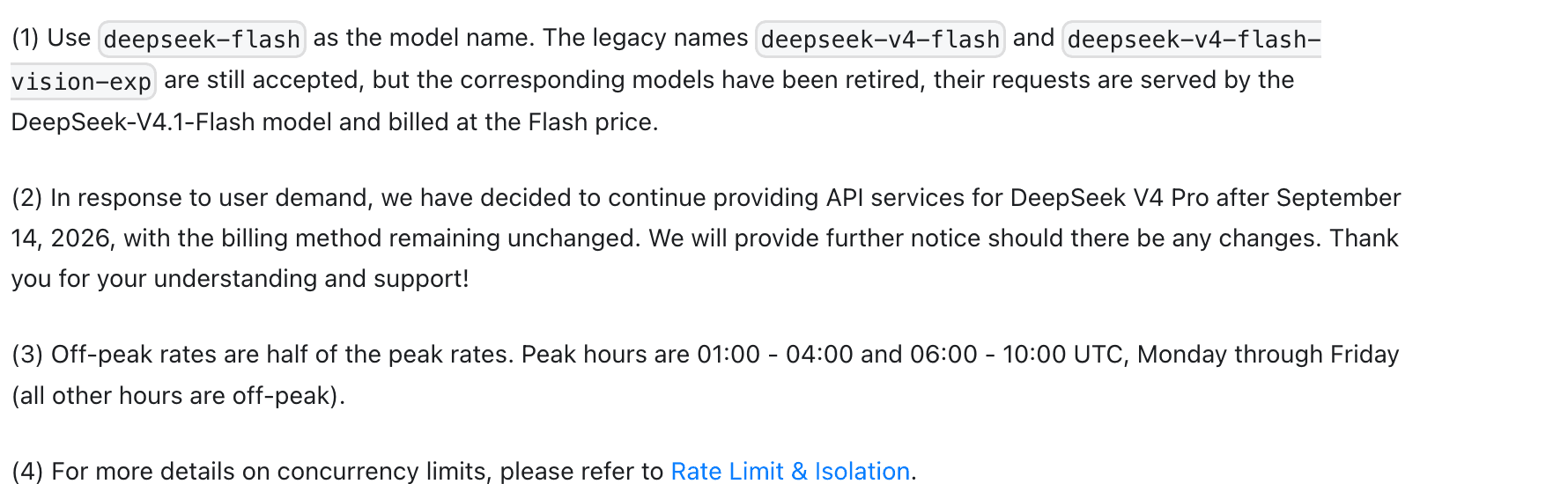
Use deepseek-flash as the model name. The legacy names deepseek-v4-flash and deepseek-v4-flash-vision-exp are still accepted, but the corresponding models have been retired, and requests against them are served by DeepSeek-V4.1-Flash at the Flash price.
Read that twice. The names still work. Your calls return 200. Your tests pass. And a different model answers them, one built on a different architecture, with different output behaviour and different benchmark numbers. If you pinned a model id specifically so your outputs would stay stable, pinning it achieved nothing, because the pin points at a redirect now.
A deprecation that throws an error is a Tuesday afternoon of work. A deprecation that silently substitutes a replacement is the kind you find in a diff three weeks later, after someone asks why the tone of your summaries changed. We wrote about the vision endpoint on that same V4 Flash line back when deepseek-v4-flash-vision-exp was the id to use; that id is now one of the two retired names, which is roughly how fast this moves.
The retirement itself, what it does to the V4 Pro tier and which id to send after it, is covered in full in our V4 Pro writeup. What follows here stays on the money: what the meter reads, and when.
What survives a substitution like this isn't the API call, it's the artifact. A finished brief in Notion or a populated Airtable row doesn't care which checkpoint produced it, and Zentor is built around that end of the pipe: the deliverable lands in the tool where the work continues, and the memory it accumulates about how you like things done belongs to you and exports out, so a vendor renaming a checkpoint doesn't reach into your process.
What the Pro tier costs after its reprieve
V4 Pro was scheduled to stop on September 14, 2026 and got a last-minute stay, which we covered when it landed. For budgeting purposes the only thing that matters is that its rates did not move: $0.66 per million input tokens off-peak against $1.32 at peak, and $1.98 output against $3.96.
That spread is worth sitting with, because Pro is where the peak multiplier actually hurts. Flash at peak costs $0.30 per million input; Pro at peak costs $1.32, so the same badly-timed hour is worth about 4.4× more on the Pro tier. A team running Pro on a European morning schedule is paying the widest version of this gap available.
OpenRouter quotes two different prices for the same model
Routing through OpenRouter doesn't get you out of the schedule, though it does change who you're buying from. Eighteen providers serve DeepSeek V4.1 Flash there, and pulling the endpoints list shows something worth knowing: DeepSeek's own endpoint is the only one of the eighteen that inherits DeepSeek API pricing with its time-of-day rule attached. Relace, DeepInfra, Fireworks, Alibaba, Together, SiliconFlow and the rest all quote one flat number.
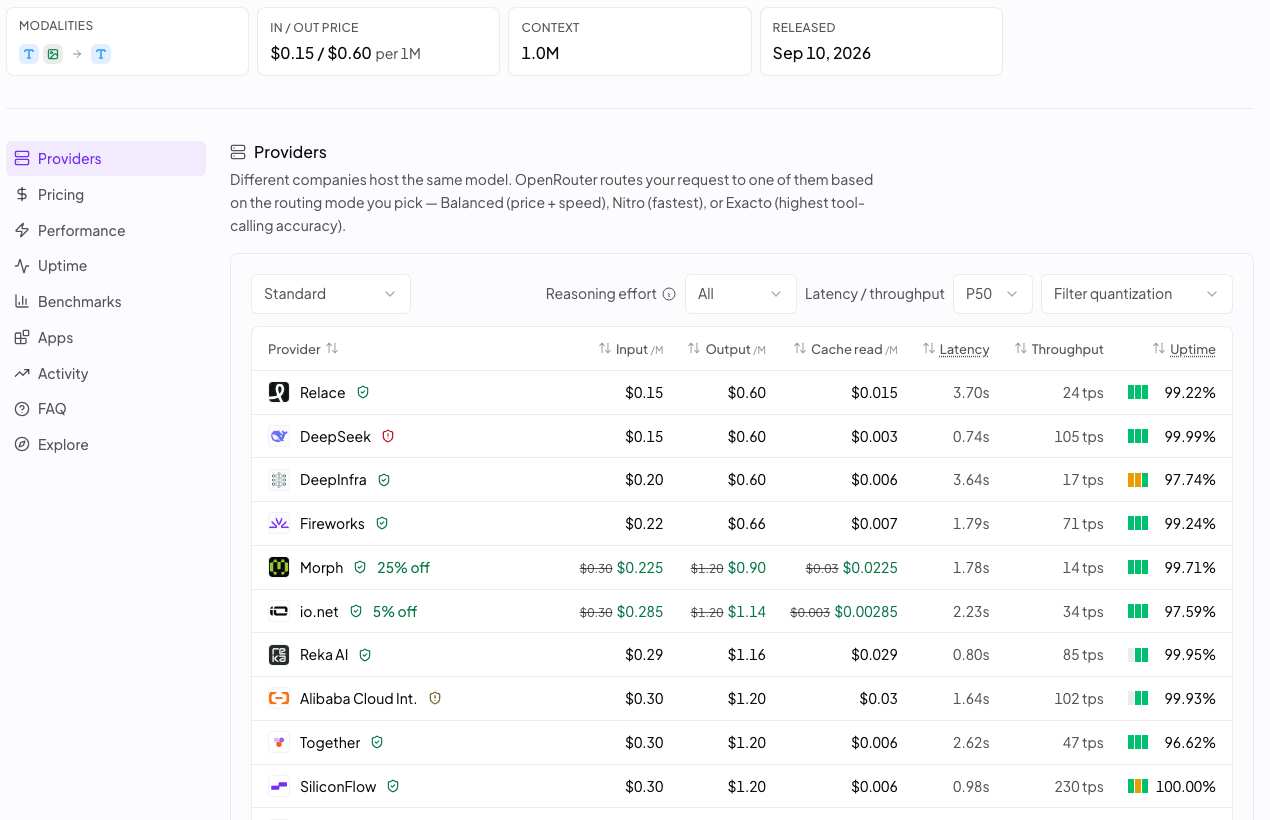
The model page headline reads $0.15 / $0.60 per 1M, which is the off-peak rate. Query the endpoints API during a peak window and DeepSeek's own row comes back at $0.0000003 per input token, twice the headline. Both numbers are correct; they just describe different hours, and only one of them is on the page you'd look at while choosing a model.
The practical consequence is a ranking that flips twice a day. Off-peak, DeepSeek direct is the cheapest way to reach the model. During peak, Relace at a flat $0.15 input and DeepInfra at $0.20 are both undercutting it, and Fireworks at $0.22 is close behind. If your traffic happens to cluster in European mornings, you are paying DeepSeek a premium to serve you a model that half the list will serve for less.
Provider choice has its own failure modes, and we've documented what an empty endpoint list looks like when a DeepSeek route goes missing on OpenRouter. Routing isn't free of edges; it just moves them.
What to change before the next invoice
Start by grepping your codebase and your environment files for deepseek-v4-flash and deepseek-v4-flash-vision-exp. Both still resolve, so nothing will tell you they're there. Replace them with deepseek-flash, which is the name DeepSeek says to use.
Then find out which hours your traffic actually lands in. Most teams have never looked, and the answer tends to be uncomfortable for anyone running nightly jobs from North America. Anything genuinely batch — nightly summaries, embeddings backfills, evaluation runs — can move to off-peak hours and cost half as much for zero engineering effort beyond changing a cron expression. Compute the UTC boundary, not your local one.
Cache hits are where the ratio gets interesting, since $0.003 against $0.15 is a fiftyfold gap that dwarfs the peak multiplier. Getting your prompt prefixes stable enough to hit cache is worth more than any amount of clock-watching.
And if you're routing through OpenRouter, pick the provider deliberately rather than taking the default. A flat-rate provider costs slightly more off-peak and meaningfully less during peak, which for most schedules is the better trade.
None of this is difficult. It's just invisible, which is the problem: DeepSeek API pricing changes under you on a schedule, model names change under you without a signal, and both facts live in footnotes. The failure mode isn't an outage you'd notice. It's a bill that's higher than your spreadsheet said and a model that isn't the one you chose. That gap between "the call succeeded" and "the work is right" is the one Zentor is pointed at, since what it returns is the finished thing in the place you'd file it, not a token count and a status code you still have to interpret.
Frequently asked questions
What are DeepSeek's peak hours?
01:00–04:00 and 06:00–10:00 UTC, Monday through Friday. Every other hour of the week, including all of Saturday and Sunday, bills off-peak. Weekdays are determined by the UTC date rather than your local one.
How much more does DeepSeek cost at peak?
Exactly double. Off-peak rates are half of peak in every row of the price table, so deepseek-flash goes from $0.15 to $0.30 per million input tokens and $0.60 to $1.20 on output, while deepseek-v4-pro goes from $0.66 to $1.32 and $1.98 to $3.96.
Is deepseek-v4-flash the same as deepseek-flash?
No. deepseek-v4-flash is a retired name that DeepSeek still accepts and routes to DeepSeek-V4.1-Flash, billed at the Flash price. deepseek-flash is the current name for that same V4.1-Flash model. The call works either way, but only one of them says what you mean.
What is the difference between DeepSeek V4 Pro and V4 Flash?
Pro runs DeepSeek-V4-Pro-0813 and costs roughly 4.4× more per token; Flash runs DeepSeek-V4.1-Flash, supports vision, and Pro does not. Both offer a 1M context window and a 384K maximum output. Pro's concurrency limit is 500 against Flash's 2,500.
Does peak pricing apply on OpenRouter?
Only on DeepSeek's own endpoint, which is one of eighteen providers serving V4.1 Flash there. The other seventeen quote flat rates that don't vary by hour, so routing away from the first-party endpoint opts you out of DeepSeek API pricing swings entirely.
Why did my DeepSeek bill go up without my traffic changing?
Check the hours. A workload that drifted later by a couple of hours can cross into a peak window and double its unit cost while every other number in your dashboard stays flat. DeepSeek API pricing has no notification attached to the switch; the rate simply changes at the boundary.
Pin the new name, then check your clock
Two changes are worth making this week, and neither takes long. Swap the retired model names for deepseek-flash so you know which model you're actually calling, and shift whatever batch work you can outside 01:00–04:00 and 06:00–10:00 UTC. The first protects your output from changing without warning. The second halves a fifth of your bill.
All figures here come from DeepSeek's Models & Pricing page and OpenRouter's models API as of 2026-09-15, and DeepSeek's page says outright that prices may change. Check it before you rebuild a budget on it.

Zentor Editorial Zentor editorial team
The Zentor editorial team writes about workflow automation, AI agents, and the tools we build. Default byline for industry overviews, listicles, and collaborative pieces.
Ready to put this into practice?
Zentor runs browser tasks, research, and schedules automatically. Try it free.
References https://api-docs.deepseek.com/quick_start/pricing · https://openrouter.ai/deepseek/deepseek-v4.1-flash · https://openrouter.ai/api/v1/models/deepseek/deepseek-v4.1-flash/endpoints