What Is NVIDIA OpenShell? Safe Runtime for AI Agents

What is NVIDIA OpenShell? See how its sandbox, policy proxy and Sentry reference architecture work, plus the approvals and budgets you must still manage.
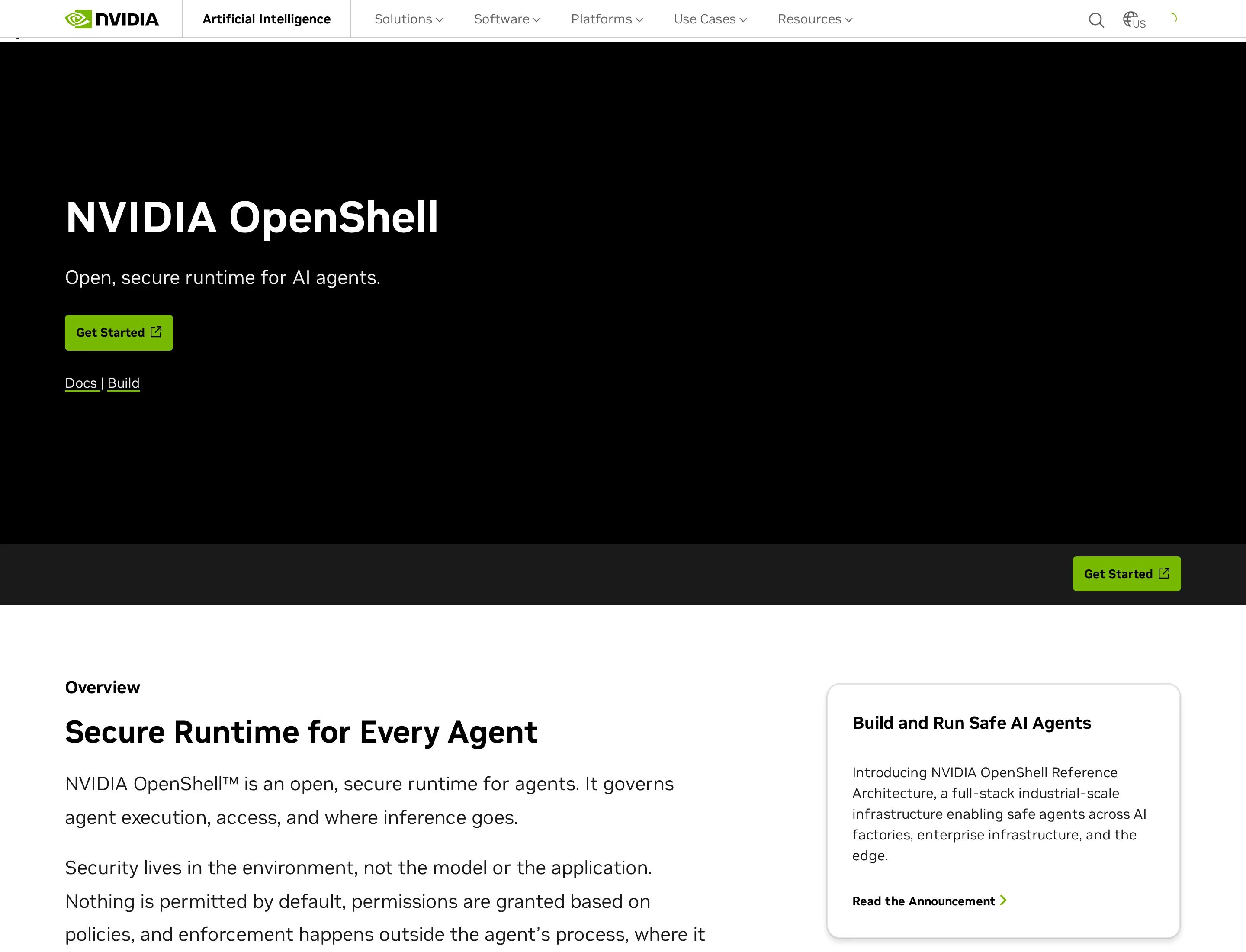
NVIDIA OpenShell is an open-source runtime that confines autonomous AI agents to isolated sandboxes and enforces access rules outside the agent process. NVIDIA’s September 28, 2026 Open Agent Safety Platform announcement made OpenShell broadly available; the October 21 Reference Architecture announcement added the full-stack infrastructure design. The repository API showed 18,501 stars as of October 23, 2026. Popularity is not a security test; the useful question is which boundary actually holds.
Key Takeaways:
- OpenShell governs the environment an agent runs in, not the truth of its answers.
- Landlock and seccomp restrict filesystem and process behavior; a policy proxy mediates outbound requests and credentials.
- Sentry adds a BlueField-4 hardware trust boundary in the Reference Architecture; it is not a feature of every standalone sandbox.
- A permitted connection still needs a separate decision about whether a particular business action should happen.
- OpenShell is infrastructure for teams building agents; it is not a ready-made assistant for a student or solo business.
What NVIDIA OpenShell actually is
Think of an agent asked to sort receipts. It may need to read a folder, call a model and save a draft, but it shouldn't automatically reach every file on your computer or send data to any website. NVIDIA OpenShell puts the agent inside a bounded environment while a separate control plane decides what that environment may touch. NVIDIA calls it a runtime, not an agent framework: you still need an agent and a workflow.
The distinction matters to nontechnical buyers too. If someone promises that an agent is safe because its instructions say “don't share private information,” ask who can enforce that instruction when the agent reads a hostile document. A rule outside the agent is harder for a prompt inside it to change. See our guide to agent security risks for the other failure modes to watch.
Why agents need a runtime they can't tamper with
If an agent reads hostile instructions in a document, its system prompt alone cannot be the final security barrier. NVIDIA explains that OpenShell separates policy enforcement from the agent workload. A compromised agent cannot edit the restrictions that govern it from inside its sandbox. That does not make the agent truthful; it means the enforceable rules live elsewhere.
How OpenShell works — Landlock/seccomp sandbox, policy proxy, OCSF audit
The OpenShell security guide identifies Landlock for filesystem limits and seccomp BPF plus reduced privileges for processes. A separate supervisor routes outbound connections through a default-deny policy proxy; approved services can receive real credentials injected outside the agent workload, only for authorized endpoints. HTTP method and path inspection requires a configured protocol and enforcement rule: the guide says REST request enforcement defaults to audit mode, so merely defining a rule does not necessarily block a write. NVIDIA documents OCSF-format audit events for network and policy decisions; full OCSF JSON export is configurable.
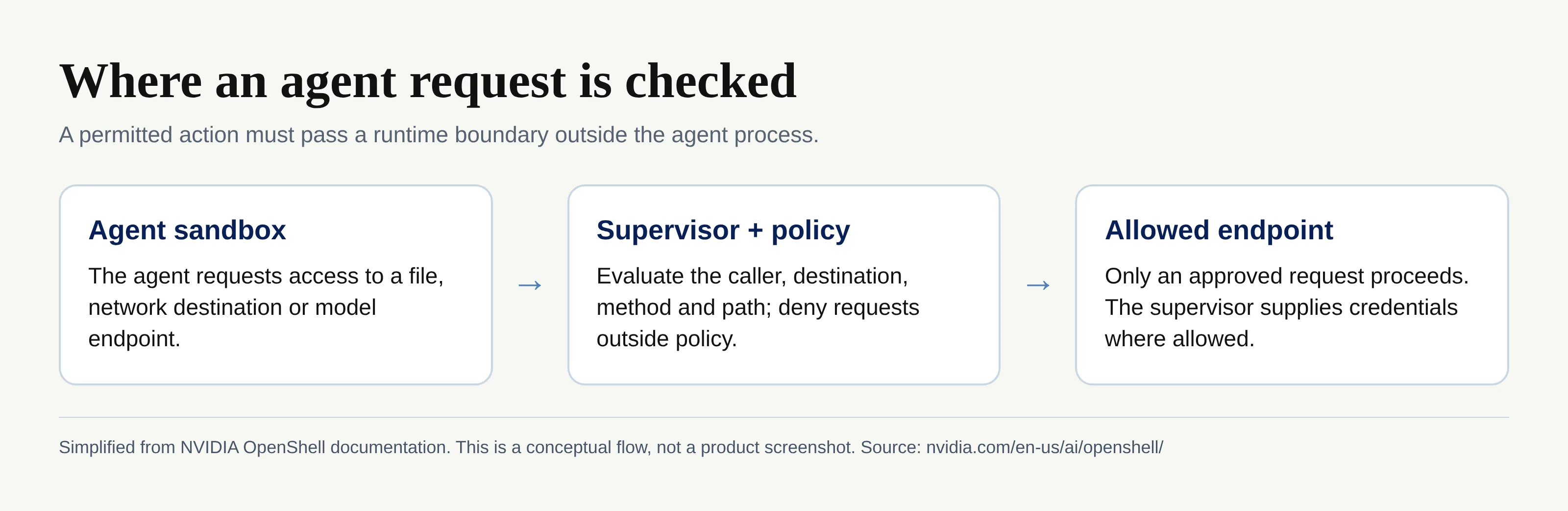
Suppose a receipt-sorting agent tries to post a document to an unknown domain. A properly enforced rule that allows only an approved model endpoint and receipt destination should deny that connection, even when the agent has been told to make the request. That is a hypothetical policy example, not a test we ran. Administrators still need to configure the boundary correctly and inspect the resulting logs.
What is Sentry and the reference architecture?
NVIDIA OpenShell software and Sentry are different layers. The October 21, 2026 Reference Architecture announcement describes Vera Rubin infrastructure for model inference, Vera CPUs for agent workloads, and BlueField-4 DPUs running Sentry for independent monitoring and enforcement. This was the GTC Berlin announcement of the Reference Architecture, not proof that every OpenShell installation has a DPU.
NVIDIA’s Sentry technical account says BlueField-4 sits on the agent’s path to the model. Sentry inspects agent-to-model communications from outside the host workload, correlates network requests with runtime context and can quarantine an agent using in-silicon enforcement within milliseconds. It describes those capabilities, not an independent benchmark of a particular deployment. NVIDIA also says Sentry's planned availability is early next year, so distinguish the available architecture from the planned Sentry offering.
What OpenShell does NOT do for you
A sandbox can decide whether an agent can reach a service. It does not set your spending budget, approve each payment or send, or certify the agent’s answers as honest. It cannot infer whether the draft invoice the agent prepared uses the right amount, or whether today's recipient should receive it. OpenShell's own FAQ says it does not replace surrounding identity, observability, governance or security tools. The repository also describes policy-change verification, which flags risky new access for human review; that is review of a permission change, not automatic approval of each invoice.
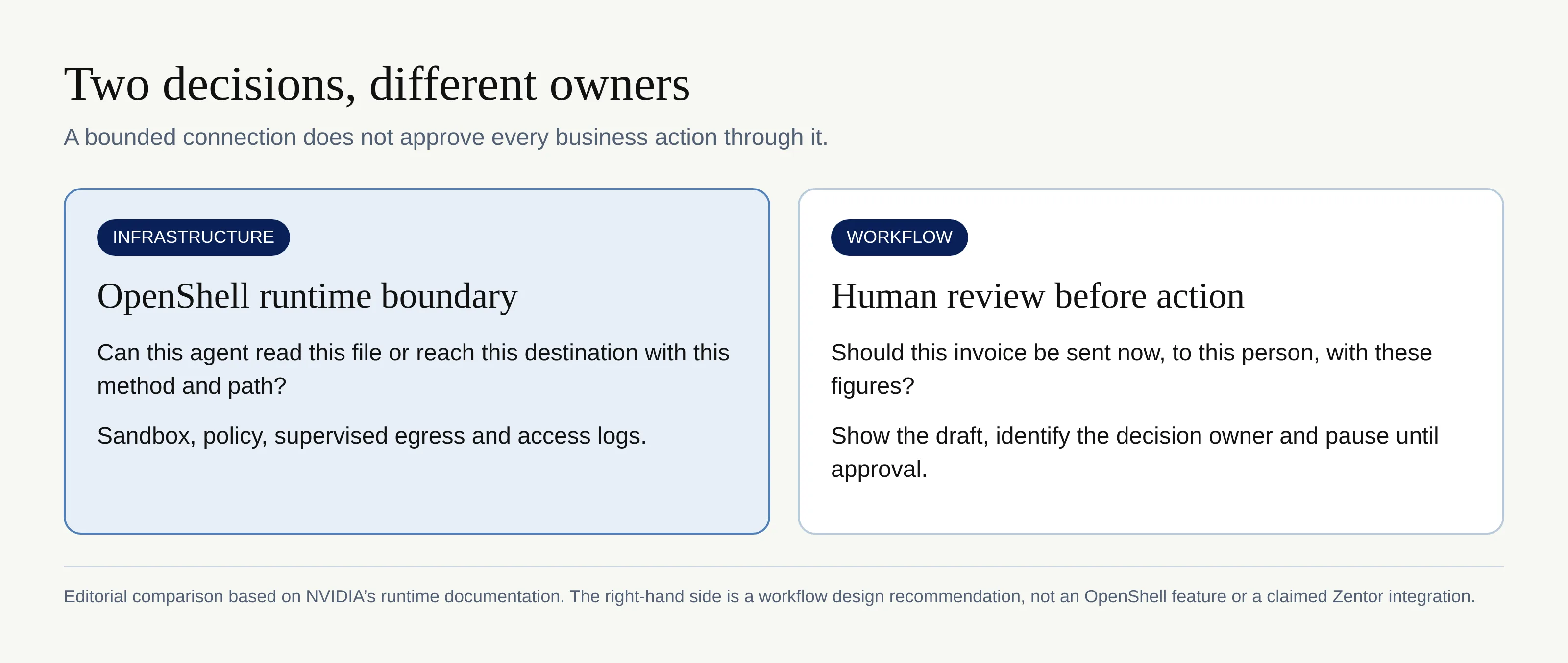
A deployment outside a supported Linux sandbox stack also needs its own enforcement design; the Reference Architecture mentions Windows through Microsoft Execution Containers, not automatic parity for a standalone non-Linux installation. For recurring work, that difference becomes visible at the stop point. You might want an assistant to prepare a weekly client update while you're in class or serving customers. Let it collect and draft; make it show the recipients, attachments and claims before sending. A blocked network call and an approval checkpoint solve different problems.
Give recurring work a place to pause and review
OpenShell addresses agent isolation at the infrastructure layer. Zentor is a workspace for delegating recurring tasks and reviewing what reaches the tools you use; we do not claim an OpenShell integration.
Get early access →
Who's backing it
OpenShell’s GitHub repository is licensed under Apache 2.0. NVIDIA’s September 28 platform release says over 100 organizations are working with Open Agent Safety Platform technologies. That is not a count of signed OpenShell customers or proof of a shipped integration.
The October 21 Newsroom release names Anthropic, AWS, Cisco, Google Cloud, Meta, Microsoft, OpenAI and SpaceX Super Intelligence among organizations working with the Reference Architecture. Its longer list also includes CrowdStrike, Dell Technologies, IBM, SAP and ServiceNow. These names span models, cloud, hardware and security; each relationship has a different scope. Ask what has actually been deployed before treating a partner list as validation of your own setup.
Who should consider it, and what to ask first
NVIDIA OpenShell is most relevant to teams operating agents that write files, call outside services or run for long periods. A student who only wants help organizing research should not have to operate a gateway to gain useful assistance. If you hire someone to build an agent for a one-person business, ask them to show the permitted destinations, what happens on denial, who owns credential storage and which actions wait for your sign-off. Those questions reveal more than a generic “secure agent” label.
The partner list above concerns the Reference Architecture, not a guarantee that a particular vendor has implemented every OpenShell control. If someone offers to deploy it for you, request an explicit policy, a denied-request log and an example of a business action that still waits for your approval.
Where a recurring agent workspace fits
The infrastructure and the daily work surface sit at different layers. Zentor's workspace memory connects to AI through Zentor MCP and belongs to the user; that is a context and portability proposition, not an OpenShell sandbox. Zentor's always-on approach speaks to the practical need to return to a recurring task after you close your laptop. Neither statement establishes a technical connection between the two products.
If your main question is which chores should become autonomous in the first place, read what autonomous agents should handle. Zentor's useful test here is narrower: can you inspect the draft in the tools where the result belongs, and identify a clear pause before a consequential action? NVIDIA OpenShell's separate test is whether an agent can reach the resources its runtime policy permits. Before choosing either type of product, write down the task you want repeated and the action you refuse to delegate. For a weekly update, the draft might run unattended while sending waits for your approval. For a research summary, the source list may matter more than a send button. A good boundary reflects the actual job, not a promise that one tool makes every agent safe.
FAQ
Is OpenShell open source?
Yes. NVIDIA publishes the OpenShell code on GitHub under Apache 2.0; Sentry's BlueField-4 architecture is a separate infrastructure layer.
Does it replace human approval?
No. Reviewing an OpenShell policy change is different from approving an invoice, a payment or a message to a client. Put a separate checkpoint at each consequential action.
Is it only for enterprise GPUs?
No. The repository quickstart lists Linux, Apple Silicon macOS and experimental Windows via WSL 2, with a container or virtualization backend. The Vera Rubin and BlueField-4 design belongs to the enterprise Reference Architecture, not the minimum requirement for trying the software; verify platform support and security properties before deployment.

Zentor Editorial Zentor editorial team
The Zentor editorial team writes about workflow automation, AI agents, and the tools we build. Default byline for industry overviews, listicles, and collaborative pieces.
Ready to put this into practice?
Zentor runs browser tasks, research, and schedules automatically. Try it free.