OpenAI Agent Builder Deprecated: 2026 Migration Guide
OpenAI Agent Builder shuts down November 30, 2026. Compare Agents SDK and ChatGPT Workspace Agents, export your workflow, and test a safer migration.
OpenAI Is Retiring Agent Builder. Here Is the Migration Decision You Actually Need to Make
As of September 2026, Agent Builder is scheduled to shut down on November 30. The first decision is not how to reproduce every node; it is where the workflow should live next.
If your team built a workflow in OpenAI Agent Builder, put November 30, 2026 on the migration calendar. OpenAI has announced the builder's deprecation and published an export-based migration guide. That does not mean every agent built with OpenAI stops working on that date, or that ChatKit is going away. It does mean a workflow whose maintenance depends on the Builder interface needs a new home. OpenAI's deprecations page is the source for the shutdown date and the explicit distinction about ChatKit.
What OpenAI actually announced
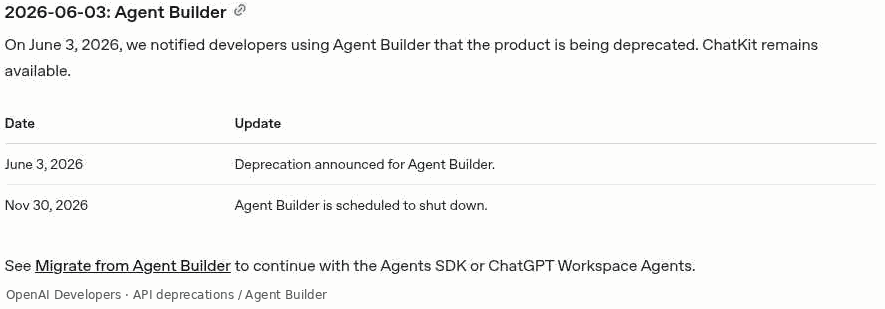
OpenAI says it notified Agent Builder developers on June 3, 2026 and schedules the product's shutdown for November 30, 2026. Its two named continuation paths are the Agents SDK and ChatGPT Workspace Agents. The same notice says ChatKit remains available. These are separate surfaces: retiring a visual workflow authoring tool is not the same announcement as retiring its chat UI toolkit, the SDK, or the underlying idea of agents.
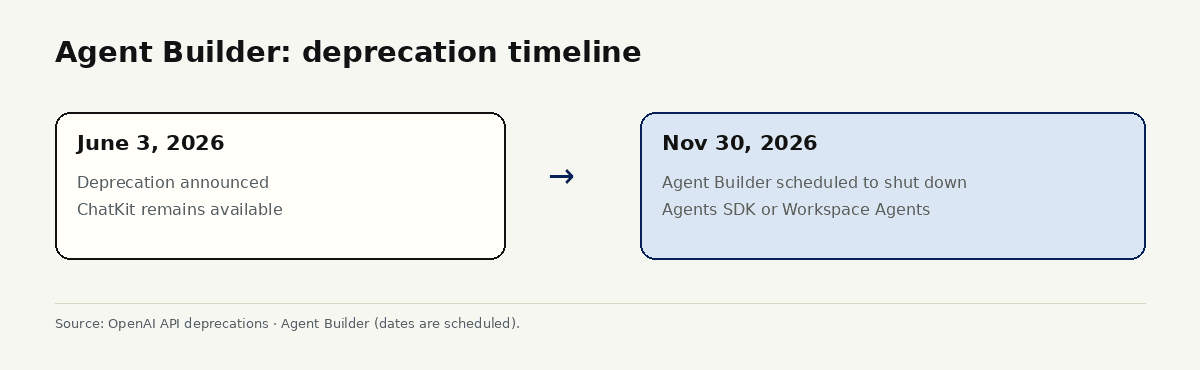
The practical catch appears in OpenAI's migration guide: export a workflow as Python or TypeScript Agents SDK code, then either run that code in your own application or use the export as input to recreate a workspace agent. The guide explicitly says the export does not convert the workflow graph or guarantee identical behavior. Preserve a record of the original workflow and its expected outputs before you change anything. Do not treat “exported” as “migrated.”
Why the backlash: shipped last November, cut now
The frustration is understandable: a developer who invested in a newly introduced builder faces another implementation decision less than a year later. The brief characterizes the community response as a backlash and places the launch last November; the cited deprecations notice and migration guide do not establish the scale of that reaction or the exact launch date. Rather than turning that characterization into an unsourced statistic, focus on the operational cost: inventorying workflows, re-establishing permissions, and retesting behaviors that an export cannot guarantee.
A timeline alone understates the problem. Teams do not purchase a builder only to make a diagram; they adopt its authoring model, debugging habits, and ownership process. Replacing it may alter who can edit a workflow and who is responsible when a tool call fails. That is a procurement and maintenance question, not merely a code-conversion exercise.
Your migration paths compared: Agents SDK vs ChatGPT Workspace Agents
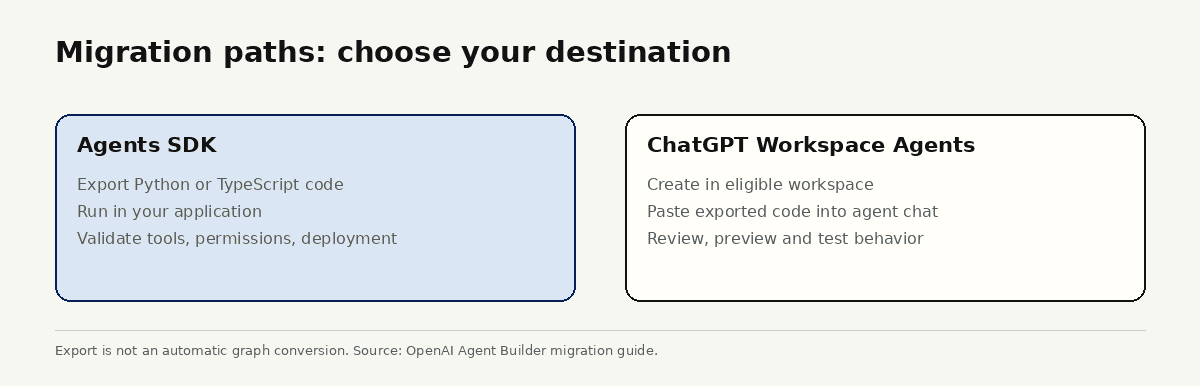
Choose the Agents SDK when the workflow belongs inside an application you build and deploy, or when engineering needs direct control over orchestration and runtime behavior. OpenAI's documented path is to copy the Python or TypeScript export, install the matching SDK, configure the application, and test in its actual runtime. Budget for tool wiring, authentication, permissions, deployment, and regression tests; exported code is a starting point, not a production sign-off.
Choose ChatGPT Workspace Agents when the goal is a team-shared agent built and maintained in the workspace through natural language. OpenAI says this path requires a ChatGPT Business, Enterprise, or Edu workspace with access and creation permission. You still start with the Builder's SDK export, but feed it into the workspace-agent creation flow and review what needs manual recreation. Preview representative inputs before creation; check instructions, tools, connected apps, authentication, and permissions. OpenAI cautions that strongly deterministic workflows may not transfer faithfully.
A quick selection test: who must own the runtime, and where must the agent be used? If your product depends on application-level controls and release processes, favor the SDK. If the workflow is an internal team assistant and the required workspace access exists, evaluate Workspace Agents. If neither choice meets a hard requirement, document that gap before committing. Neither route is described as a one-click, behavior-preserving migration.
The bigger pattern: platform churn is now a build risk
Builder shutdown is one form of change; price and distribution changes are others. The brief flags a contemporaneous OpenRouter pricing diff for moonshotai/kimi-k3 and two free-model removals. A live model catalog cannot prove a historical before-and-after price or the timing of a removal; its Kimi K3 listing also does not corroborate the brief's quoted endpoint of $3 per million input tokens and $15 per million output tokens. Do not use those figures as a procurement quote. For another example of the operational implications of provider changes, see our Assistants API migration coverage and analysis of variable API pricing.
The brief also points to a social post about a Microsoft Copilot “Autopilot” direction. Microsoft's Foundry documentation does describe hosted agent autopilots with their own identities and an admin-governed publishing path into Microsoft 365. It does not, on its own, verify the post's broader assertions about persistent memory, monitoring Teams and Outlook, or multi-day tasks. The defensible lesson is narrower: suppliers can change interfaces, prices, availability, or positioning while your workflow remains business-critical.
The risk is not “never use a platform.” It is making the platform's builder graph the only specification of what your agent is supposed to do. A workflow that cannot be independently described, tested, and costed will be harder to move when the next notice arrives.
How to de-risk against future deprecations
Start with a small migration ledger: each Builder workflow's owner, trigger, inputs, outputs, tool calls, connected data, approval points, failure handling, and expected results. Export while you still have access. Save the original configuration and a few representative runs, with sensitive data handled under your normal controls. Identify workflows that perform outward-facing or irreversible actions; their permission and approval checks deserve explicit retesting.
Then separate business rules from vendor wiring. Define a stable contract for each tool (input schema, output schema, errors, authorization scope), keep prompts and evaluation cases in version control, and place model-provider calls behind an adapter your team owns. This is an engineering recommendation, not a promise that providers are interchangeable: model behavior and tool semantics will still differ. A thin adapter reduces the number of places you must inspect; a regression suite tells you whether a replacement actually works.
Test the two migration candidates against the same fixture set. Include normal cases, missing inputs, failed tools, permission denials, and costly long-running paths. Measure both outcomes and operating cost in your environment. Assign an owner to watch deprecation notices and pricing changes, and set a review date well before November 30. A migration is finished when the new workflow passes the agreed tests and its access controls are checked—not when a code export exists.
If you are evaluating your next agent stack, the durable requirement is portable agent capability, not loyalty to a single builder. Explore Zentor as one starting point for that evaluation; assess any candidate against your own workflow contracts and test cases rather than assuming feature parity.
FAQ
Is OpenAI Agent Builder deprecated? Yes. OpenAI says deprecation was announced June 3, 2026 and shutdown is scheduled for November 30, 2026. Check the official notice for subsequent changes.
Is ChatKit being shut down too? No such shutdown is stated in this notice. OpenAI explicitly says ChatKit remains available. That does not automatically preserve a Builder workflow; they are different components.
Can I export an Agent Builder workflow to the Agents SDK? OpenAI's migration guide says to open the workflow, select Code → Agents SDK, choose Python or TypeScript, and copy the complete export. You must configure and test it in your application.
Can I move it to ChatGPT Workspace Agents? OpenAI describes using the exported code to help recreate a workspace agent, subject to eligible workspace access and creation permission. It is not a guaranteed graph conversion. Review capabilities and permissions and preview representative inputs.
What should I do before November 30? Inventory active workflows, export them, choose a destination based on runtime ownership and access needs, and test behavior and permissions before retiring the old path. Prioritize workflows that affect users or take consequential actions.

Zentor Editorial Zentor editorial team
The Zentor editorial team writes about workflow automation, AI agents, and the tools we build. Default byline for industry overviews, listicles, and collaborative pieces.
Ready to put this into practice?
Zentor runs browser tasks, research, and schedules automatically. Try it free.