What Is Microsoft Agensh? The 1,024-Agent Harness Explained
Microsoft Agensh coordinates up to 1,024 agents without a central dispatcher. Read the benchmark limits, MIT release details, and what you can run today.
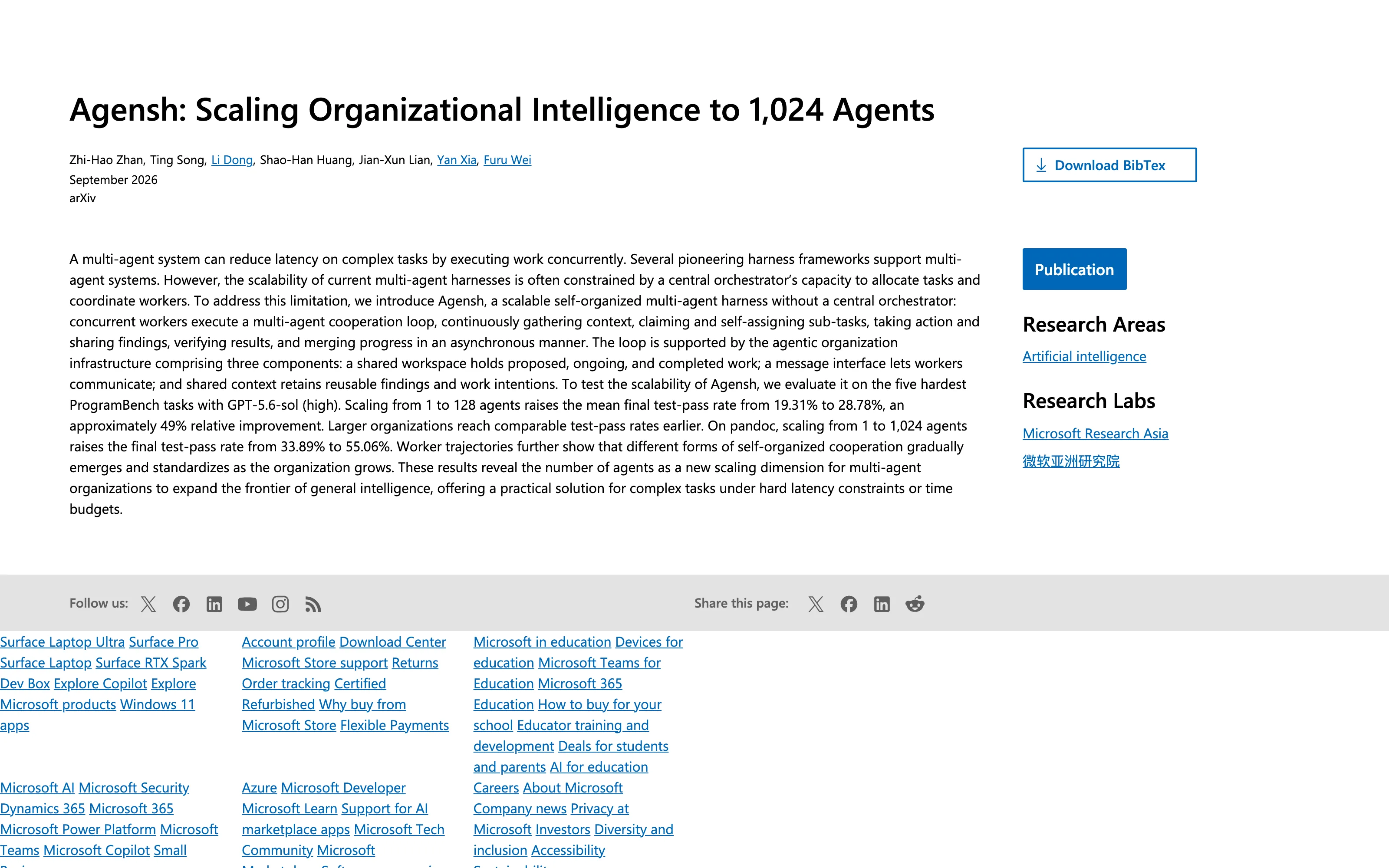
Microsoft Agensh is a research-grade, self-organizing multi-agent harness from Microsoft Research, not a ready-made service for delegating your work. On five hard ProgramBench tasks, the authors report a mean test-pass rise from 19.31% with one agent to 28.78% with 128 in a six-hour offline test (Microsoft Research). You can inspect the code; customer-work reliability is unproven.
Key Takeaways:
- Agensh coordinates workers through shared work, messages and reusable context rather than a central task dispatcher.
- The 1,024-agent score covers one Pandoc task, not every job.
- Its MIT-licensed repository includes a single-node Docker Compose setup and a reproduction guide. Running that experiment is different from buying a supported production service.
- For everyday work, agent count may be the wrong first question.
What is Agensh and who built it?
Microsoft Research describes Agensh as a harness: the working arrangement around AI agents, including how they find tasks, exchange information and combine results. The repository's October 24, 2026 announcement made the harness, experiment launch scripts and reproduction guide public. The underlying preprint appeared September 22. As of October 2026, this is an open research project with published code, not a promise that Microsoft operates a hosted Agensh service.
Imagine a long report. Instead of one editor handing out every paragraph, contributors claim sections in a common workspace and check the finished pieces. Microsoft Agensh tests that organizational idea on difficult programming tasks, not ordinary office requests.
Need your work to travel between AI tools?
Agensh studies teams of agents; Zentor focuses on user-owned workspace memory across tools. Agensh is not integrated with Zentor.
Get early access →
How can 1,024 agents work without a central orchestrator?
Each worker repeats a cooperation loop described in the README: gather the latest context, claim a sub-task, act, verify the result and merge progress. Workers run asynchronously. No central agent parcels out every assignment, but coordination has not disappeared; the shared state and messages still have to tell a worker what peers already attempted.
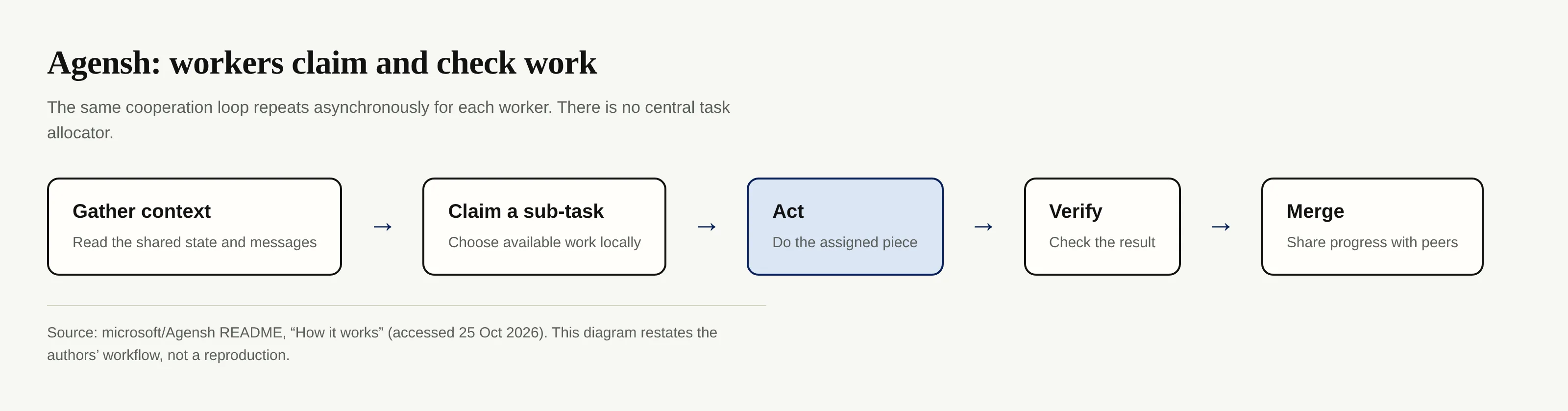
Local claims avoid a dispatcher bottleneck but raise questions about competing claims and wrong verification. The scores measure outcomes under the authors' conditions, not reliability on business workflows.
What do the ProgramBench and Pandoc scores show?
The authors used GPT-5.6-sol at high reasoning effort, a six-hour budget and no internet access. Across the five hardest ProgramBench tasks they selected, the mean final test-pass rate increased from 19.31% with one agent to 28.78% with 128. That is a 9.47-percentage-point difference, or about 49% relative to the starting score. For Pandoc alone, the reported rate went from 33.89% with one agent to 55.06% with 1,024 (research summary).
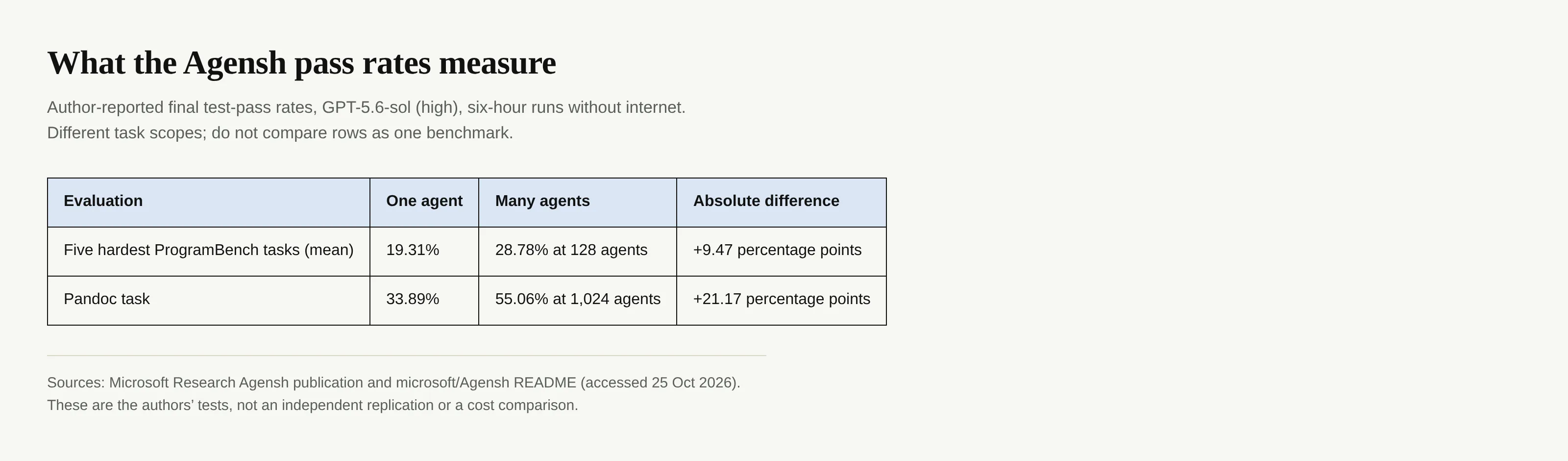
These differently scoped comparisons do not show that every extra worker helps. They lack a cost-per-completion comparison, production uptime record and independent replication; coordination itself consumes resources.
What runs underneath: Gitea, Mattermost and Copilot
Agensh gives workers three shared channels. Gitea holds proposed, ongoing and finished work; Mattermost carries messages; a shared-context mechanism, adapted from DeLM, retains useful findings and intentions. The team reports layering its multi-agent loop on the single-agent loop of the Copilot harness (repository overview). This is research infrastructure, not a consumer subscription.
Suppose you are a solo seller juggling supplier notes and campaign drafts. Before asking for more agents, ask where the context will live and whether an answer can follow you to a different AI tool. Zentor's user-owned workspace memory connects to AI through Zentor MCP; that solves a context-portability question, not Agensh's peer-coordination problem. The two systems have different jobs, and there is no stated Zentor–Agensh integration.
Is Agensh open source, and what can you run today?
Yes. The repository's LICENSE file is MIT, and its v1.0 release lists a single-node agent harness, paper, demo and reproduction guide. The REPRODUCE.md instructions describe a Docker Compose team and a standalone baseline, plus prerequisites such as Linux, Docker, ProgramBench and access to a model gateway. Its default example uses eight workers. Before trying Microsoft Agensh on a live task, pin the repository revision, isolate your model credentials and compare the result with a single-worker run. The released guide describes these operational controls; it does not perform your security review.
Open source and reproducible are not the same as turnkey production. You can clone the code and follow an experiment recipe; you still need to provision the environment, protect credentials, choose tasks, inspect scoring and maintain the setup. The guide even tells experimenters to record revisions and image digests when comparing results. If a tool will touch customer data, treat that operational work and its security review as part of the purchase decision. We did not run Agensh or independently repeat its benchmark.
How does Agensh compare with other agent harnesses?
The word harness hides different designs. Our Claude managed agents explainer covers hosted dynamic workflows that fan work out in phases and collect results. Agensh instead asks peers to claim work without a central orchestrator. The count in one project's headline cannot be compared directly with another project's total starts or concurrent-worker limit.
Google Harness² addresses yet another problem: changing the instructions and execution setup around an agent during a task. It is not Agensh's proposal for distributing sub-tasks. Zentor's self-adaptive workspace also concerns the shape of work around a task, but that doesn't mean it runs either research repository. Keep coordination, harness improvement and context portability separate.
When should you choose fewer agents instead?
If your task is small or inherently sequential, start with one assistant and verify its result. Scaling AI agents matters when independent pieces can be checked and combined within a deadline; the Agensh study deliberately tests hard programming tasks where that separation is plausible. For a student assembling a literature review, source tracking and a clear final check may matter more than assigning a worker to every paper.
Zentor's Smart Routing chooses a model suited to a task, a separate way of managing resources from Agensh's experiment in worker count. If the daily problem is losing the history of what you asked an AI to do, keep that history portable before considering a swarm. No benchmark here tells us how many agents your work needs.
FAQ: Microsoft Agensh and its limits
Is Agensh free?
Its source code is available under MIT terms, but an experiment still needs computing resources, dependencies and model access. The repository doesn't provide a free hosted service or a cost estimate for your run.
What license does Agensh use?
The public code is covered by the MIT license. Check the terms of any models, datasets and third-party services you add separately.
Does Agensh need the internet?
The reported ProgramBench evaluations ran without internet access. Setting up the released environment involves obtaining dependencies and a model route; don't treat the offline evaluation condition as a blanket claim that every installation runs disconnected.
How many agents do I need?
The guide defaults to eight workers for its example, while the paper reports results at other scales. Start with one baseline and measure whether dividing your actual task improves checked results enough to justify extra resources.

Zentor Research Public data on the AI ecosystem
Zentor Research publishes quarterly data studies on the AI tools ecosystem, drawing on public registries (npm, GitHub, Hugging Face, arXiv, Google Trends). All charts and datasets ship under CC-BY 4.0.
Turn insights into action.
Zentor automates the recurring work your analysis points to. No engineering required.