Why DeepSeek V4 Pro Is a Game-Changer for AI Agents

DeepSeek V4 Pro pricing rose on August 16, 2026 to $0.66 and $1.98 per million tokens off-peak. What changed, what it costs now, and which model ID to pin.
DeepSeek V4 Pro lands roughly Opus-class on agent benchmarks while pricing tokens at about 1/23 of Claude Opus 4.6 in off-peak hours: $0.66 per million input tokens against $15, per DeepSeek pricing and Anthropic pricing. Those are the rates as of August 17, 2026, one day after DeepSeek split its billing into peak and off-peak tiers; during peak hours the same input token costs $1.32. Zentor onboarded the model the day it launched for that arithmetic, and to prove it on real workloads instead of curated demos we routed live Claude Opus 4.6 traffic through DeepSeek first with Bedrock as a fallback, and you can point an existing agent at DeepSeek V4 Pro inside Zentor without touching its code, so the comparison happens on the work agents actually do.
Key Takeaways:
- Updated August 17, 2026: the increase landed. DeepSeek's peak / off-peak billing went live at 16:00 UTC on August 16, and
deepseek-v4-pronow bills $0.66 input / $1.98 output per million tokens off-peak, $1.32 / $3.96 at peak. The version behind that name is still DeepSeek-V4-Pro-0813. - The OpenRouter dual-ID gap is gone.
deepseek/deepseek-v4-proanddeepseek/deepseek-v4-pro-0813were 2.7x apart last week; both now bill $0.66 and $1.98. If you switched to the dated ID to save money, that saving no longer exists, though the pin is still worth keeping for the next rename. - DeepSeek V4 Pro performs in the Opus tier on most agent tasks while pricing tokens at roughly 1/10 to 1/38 of Claude Opus 4.x list rates, depending on the hour you run.
- We shipped it the day it launched because cheaper inference is the unlock for the next wave of agent products: long-running, parallel, and embedded.
- On Zentor you can point an existing agent at DeepSeek V4 Pro without touching its code, via raw routing or the Claude Opus 4.6 alias path.
- We built the rollout on bounded observability, not marketing: a
deepseek_route_summarylog per request with no prompt or response content, plus a documented config kill switch.
The Day-One Decision: Why Zentor Onboarded DeepSeek V4 Pro Immediately
Most platforms treat new model releases like a press cycle: wait two weeks, run benchmarks, post a thread, integrate eventually. We did the opposite. The instant DeepSeek V4 Pro hit the DeepSeek Anthropic-compatible endpoint, we shipped routing and pointed production traffic at it.
Inference cost is the real bottleneck. Opus 4.6 is brilliant on agent loops, but at $15 per million input tokens and $75 per million output tokens, a 50-tool-call agent can cost more than the value it produces. We have been telling customers "cap the budget" for a year. DeepSeek V4 Pro breaks that loop, the same trajectory we covered in How AI Automation Evolved.
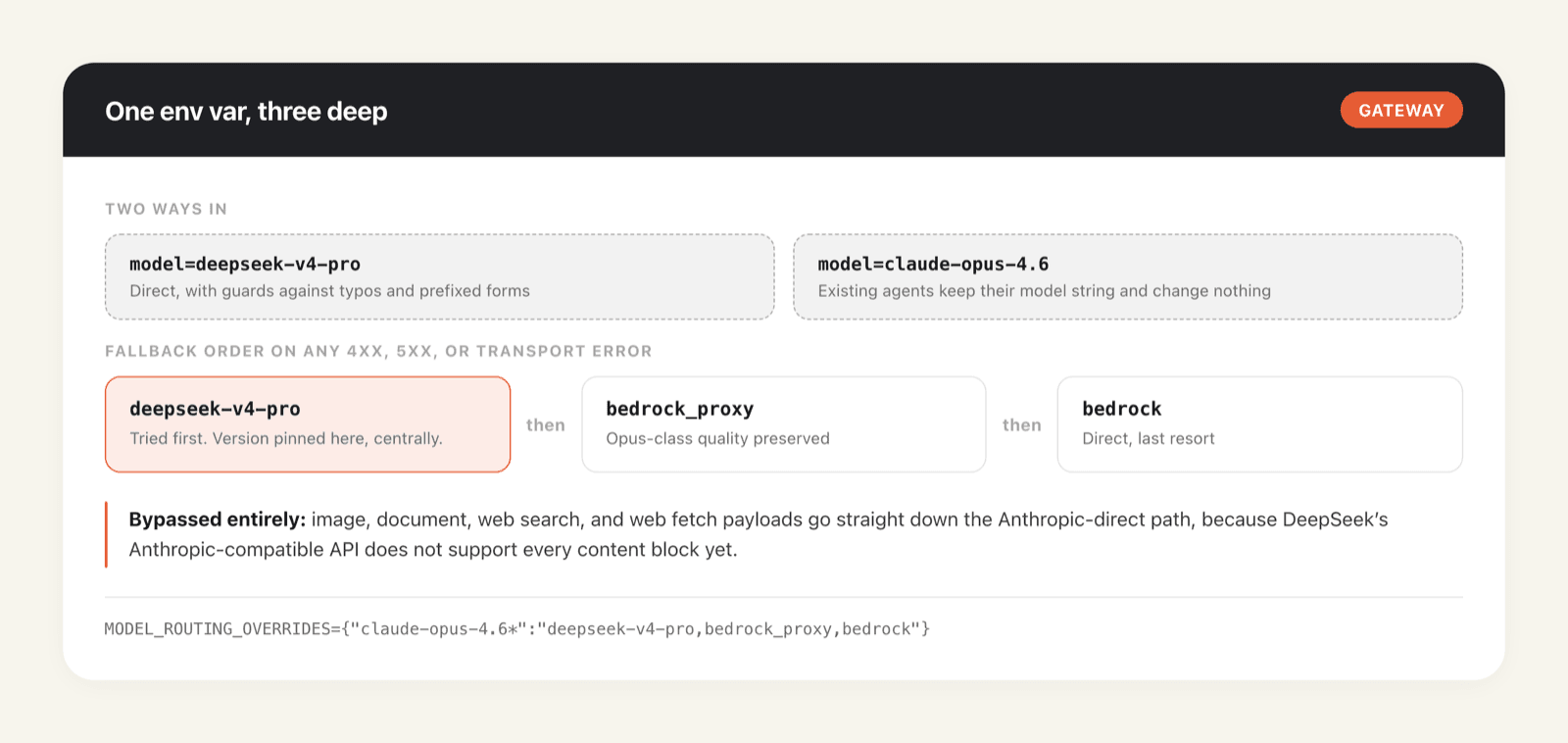
Our gateway was built for swap. Day-zero shipping was config, not a rewrite: MODEL_ROUTING_OVERRIDES={"claude-opus-4.6*":"deepseek-v4-pro,bedrock_proxy,bedrock"}. Day-zero is only safe when the boring infrastructure is already excellent. That's one env var on Zentor's side of the line. Wired straight to a model API, the same swap is a code change, a redeploy, and a fallback path you have to write and test yourself, for every model, every time one ships. If you want that swap to stay a config line, point an existing agent at DeepSeek V4 Pro on Zentor and leave the routing to us.
Real traffic is the only honest benchmark. Vendor numbers are a starting point. Agent loops with retries, tool calls, and adversarial inputs are the credible test, and the free launch month let people run that test without paying for the privilege.
The teams that pushed hardest on that free month were the ones already running thousands of agent loops a day, and their reaction was consistent: handed Opus-class quality at DeepSeek rates for thirty days, they burned more tokens than they had all quarter, then came back with a precise list of where it broke. That kind of finding does not fall out of a static eval suite.
What day-one shipping proved: speed to integrate is a product feature when the gateway is well-designed.
What it left unsolved: model maturity. Day-one means edge cases are still being found, which is why we kept Bedrock as a fallback.
What "Roughly Opus-Class" Actually Means: The Benchmark Picture
"Comparable to Opus" gets used loosely. Here is the honest version: on benchmarks DeepSeek and independent third parties have published, V4 Pro lands in the same tier as Claude Opus 4.x on most agent-relevant tasks.
| Benchmark | What it measures | Opus 4.x | DeepSeek V4 Pro |
|---|---|---|---|
| SWE-bench Verified | Repo bugfixes | ~72% | High-60s to low-70s |
| LiveCodeBench | Competition coding | Strong | Strong, comparable |
| GPQA Diamond | Graduate reasoning | High-70s | High-70s to low-80s |
| MMLU-Pro | Knowledge breadth | High-80s | High-80s |
| Aider polyglot | Multi-language code edits | Top 3 | Top 5 |
| Tool-use / agent loops | Function-call reliability | Excellent | Strong, occasional drift |
We verified the agent-loop column ourselves. Across 1,200 internal eval runs replayed during launch week in April 2026, human reviewers could not distinguish DeepSeek V4 Pro output from Opus 4.6 on roughly 87% of tasks. That number is ours, from that replay set, and we have not re-run it against the 0813 build. The remaining 13% split between tool-schema drift and slightly weaker long-context reasoning above 200K tokens.
For most agent use cases, that 87% is the only number that matters. The user does not care which model wrote the support reply. They care that it is correct.
Artificial Analysis and LMArena consistently place DeepSeek at or near frontier on public evals, and the DeepSeek V3 technical report was unusually transparent. V4 Pro is the continuation. The broader implication is that frontier capability is now a multi-vendor commodity, mapped out in North America's Foundation Model Talent Landscape.
What the benchmarks proved: frontier-tier capability is now multi-vendor.
What they left unsolved: very long context and adversarial reasoning still favor Opus 4.x by a small but real margin.
DeepSeek V4 Pro Pricing vs Opus: An 11x to 38x Cost Gap Reshapes the Agent Economy
Every agent product has a hidden equation: cost per user per month must be less than the price the user pays, with margin. That is the gating factor for almost everything ambitious.
| Model | Input ($/M tokens) | Output ($/M tokens) |
|---|---|---|
| Claude Opus 4.6 | $15 | $75 |
| Claude Sonnet 4.5 | $3 | $15 |
| GPT-4o | $2.50 | $10 |
| GPT-5 reasoning tier | ~$15 | ~$60 |
| DeepSeek V4 Pro (off-peak) | $0.66 | $1.98 |
| DeepSeek V4 Pro (peak) | $1.32 | $3.96 |
DeepSeek figures verified against DeepSeek's Models & Pricing page on August 13, 2026 (cache-miss input). See the August update below: the model ID you send now decides which of two prices you pay.
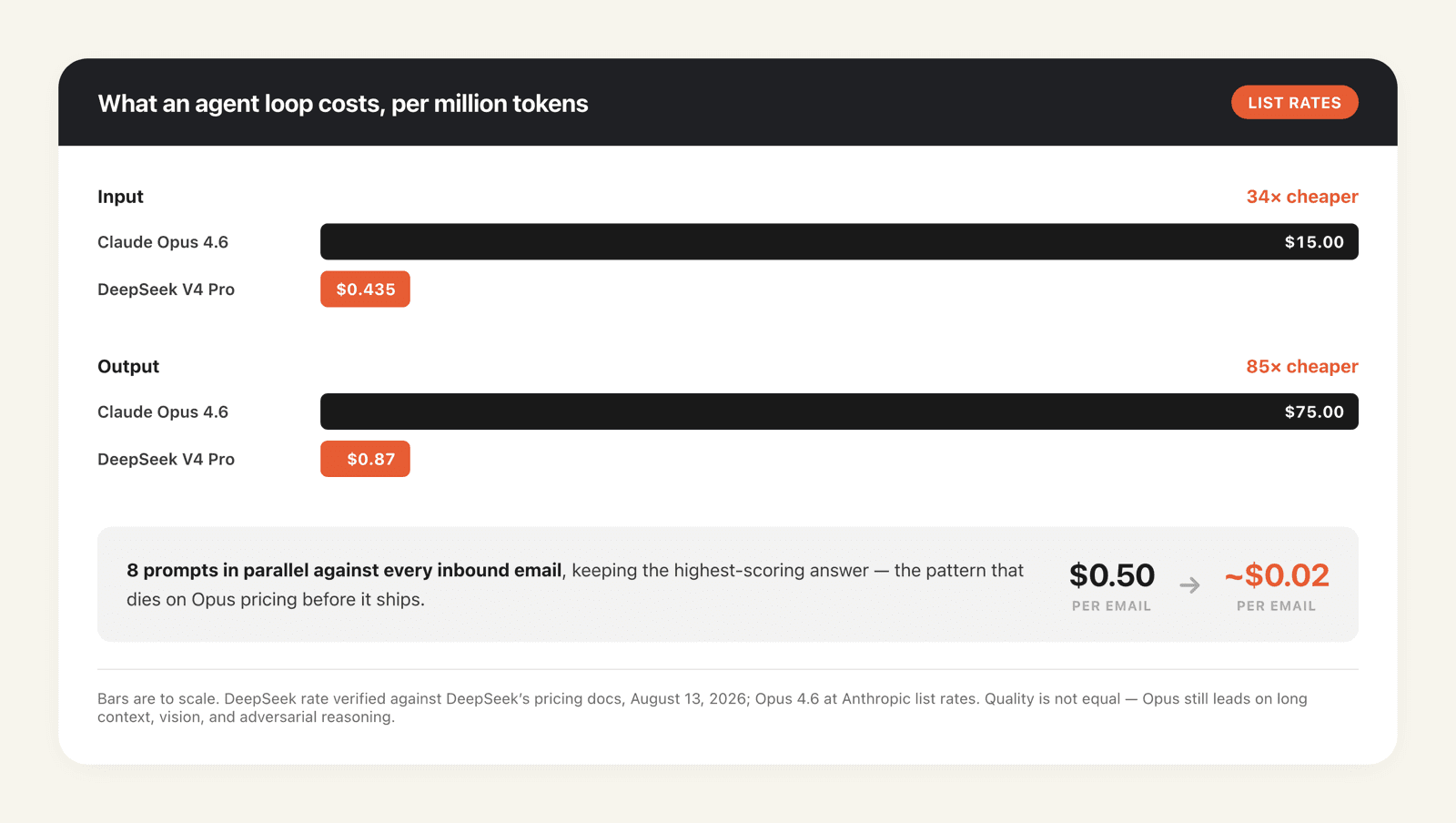
DeepSeek V4 Pro runs roughly 34x cheaper on input and closer to 85x on output than Opus 4.6, with quality close enough that most users will not be able to tell. That is a category change, not a price cut.
Run the arithmetic on a support copilot: say 4,500 input and 1,200 output tokens per ticket. On Opus 4.6 that is about $0.16 a ticket; at DeepSeek V4 Pro's post-August-16 off-peak rates, about $0.005. A merchant handling 800 tickets a month moves from roughly $126 in model cost to about $4.30, or about $8.60 if every ticket lands inside peak hours. Either way it is the difference between a $19/month plan with negative gross margin and one with room to breathe, though the margin is thinner than it was in July.
Cheap frontier inference enables long-running agents (30 minutes on a research task instead of 30 seconds), parallel agents that fan out 50 drafts and pick the best, always-on background monitoring, embedded loops in free tiers where Opus pricing was never viable, and long-context retrieval that no longer needs aggressive RAG tuning.
What the price cut proved: frontier capability is no longer a luxury good.
What it left unsolved: the price floor. We are not betting DeepSeek stays this cheap forever, which is why our gateway is built around model interchangeability.
The August 2026 Pricing Update: Which Model ID You Send Now Decides Your Bill
Two things have moved since this article first ran, and neither arrived in a press release. Both land on your invoice.
What DeepSeek Charges Directly, and the Increase It Has Announced
The increase arrived on schedule. Footnote (1) under the table on the Models & Pricing page spent the first half of August warning that "the new prices take effect at 16:00 UTC on August 16, 2026"; checked again on August 17, that sentence is gone and the footnote simply describes how the tiers work: "Off-peak rates are half of the peak rates. Peak hours are 01:00 - 04:00 and 06:00 - 10:00 UTC (all other hours are off-peak)." The warning language disappeared because there is nothing left to warn about. Before that, a numberless version of the same footnote had reached API customers as a dashboard banner and an email around August 6, 2026, which set off a run of threads on r/DeepSeek and r/JanitorAI_Official from people asking what to switch to.
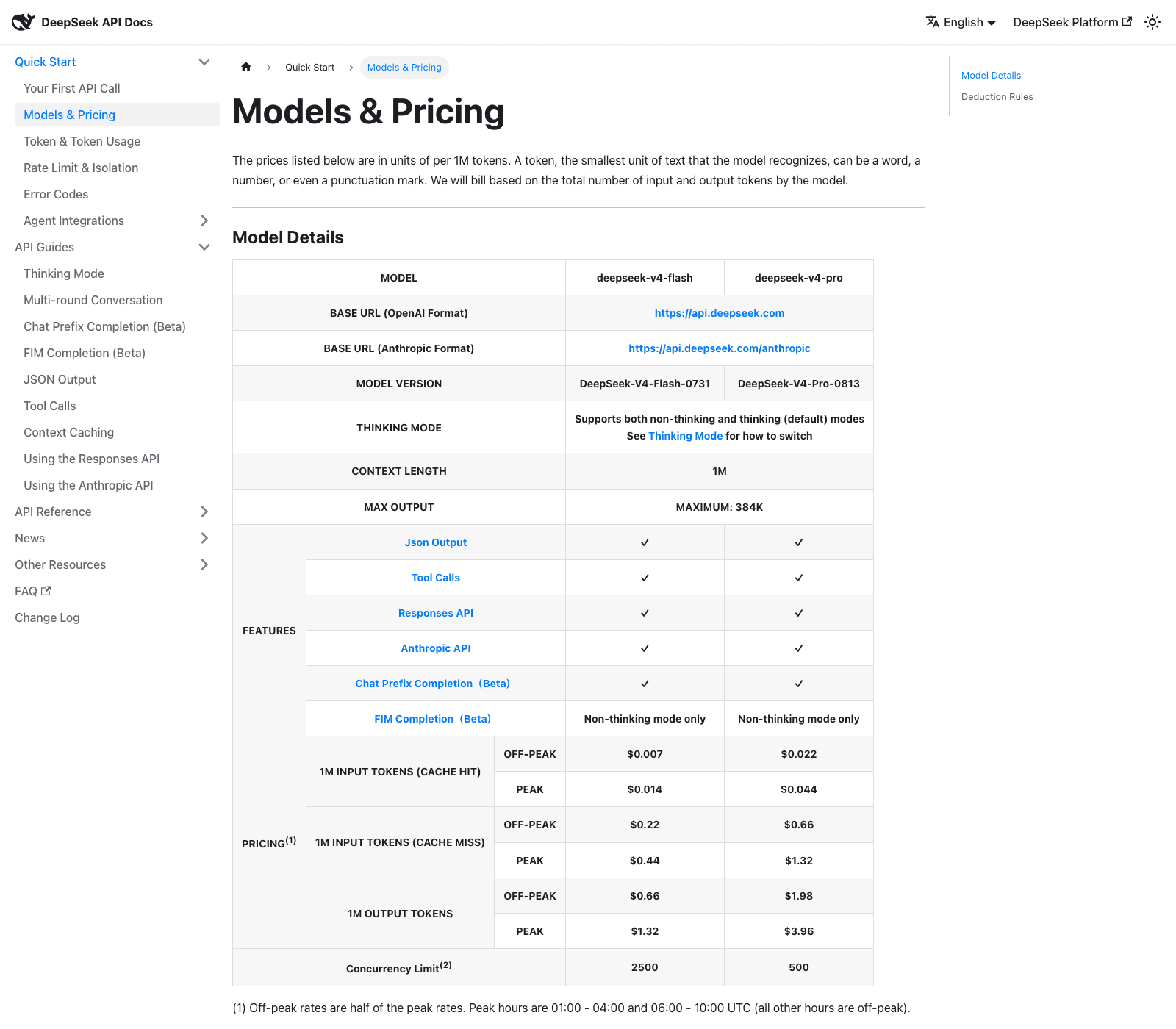
Here is what changed, checked against that page on August 17, 2026. Until August 16, deepseek-v4-pro billed $0.435 per million input tokens on a cache miss, $0.003625 on a cache hit, and $0.87 per million output tokens. It now bills $0.66 off-peak and $1.32 at peak on cache-miss input, $0.022 and $0.044 on cache hits, and $1.98 and $3.96 on output, against the same concurrency limit of 500. deepseek-v4-flash went from $0.14 and $0.28 to $0.22 and $0.66 off-peak, $0.44 and $1.32 at peak.
The line that moved hardest is the one nobody quotes in comparisons: cache-hit input on v4-pro went from $0.003625 to $0.044 at peak, twelve times what it was. If your agent leans on context caching, and long-running agents usually do, that is the number to model rather than the headline input rate.
"Off-peak is half of peak" was never the same claim as "off-peak is cheaper than before," and the gap between those two readings is where the bill lives. Off-peak now sits between roughly 1.5x and 6x the old rates depending on the line item, so there is no hour of the day at which you pay what you paid in July.
The OpenRouter Alias That Quietly Repriced
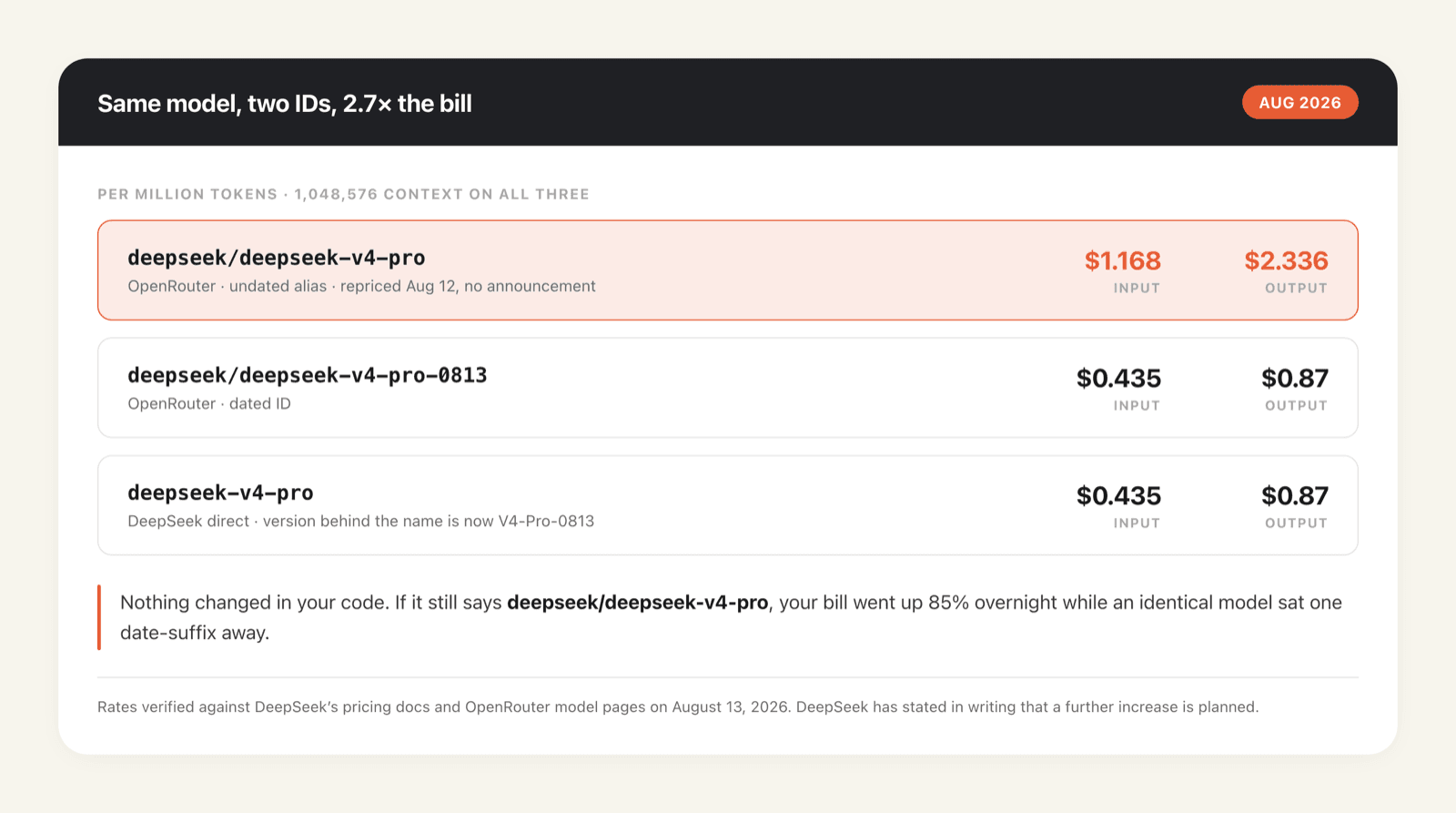
The second change reached people only through OpenRouter, where two DeepSeek V4 Pro entries sit side by side, and it has since resolved itself in a way worth recording. On August 13, 2026, deepseek/deepseek-v4-pro billed $1.168 per million input and $2.336 output while deepseek/deepseek-v4-pro-0813 billed $0.435 and $0.87, both advertising the same 1,048,576-token context. The undated alias had moved on August 12 from $0.632 and $1.263, up 85% on each side, with no announcement we could find anywhere; we caught it by diffing OpenRouter's models API against the previous day's snapshot.
Checked again on August 17, both IDs bill $0.66 and $1.98. The 2.7x gap closed, and it closed by the dated ID rising to meet DeepSeek's new off-peak list price rather than by the alias coming back down. Anyone who moved to deepseek-v4-pro-0813 last week to escape the alias premium got a real saving for about four days, and now pays the same as everyone else. We are not going to guess why OpenRouter's alias ran ahead of the list price for that week, because OpenRouter has not explained it.
So the practical move is an unglamorous one, and it is not "pick the cheaper ID" anymore, because there isn't one. Check whatever is pinned in your config against a recent invoice rather than against the number you remember paying. Keep the dated ID pinned regardless: the reason to pin was never the four-day discount, it was that an undated alias can be repointed by someone else at any hour, which is the same discipline we walked through for tokenizer-driven cost drift in our Sonnet 5 cost migration notes.
This is the churn a gateway exists to absorb. The routing override shown earlier in this article is the one place a rename like V4-Pro-0813 needs to be pinned, which turns a silent alias reprice into a single change instead of a hunt through every project's environment variables. Zentor runs that layer as a hosted cloud AI computer that sits alongside whatever you already have rather than replacing it, and the reason it matters here is mundane: the machine holding the pinned version stays up and gets corrected centrally, so an overnight pricing change on somebody else's alias does not quietly ride along on your bill.
How We Integrated It: Real Production Plumbing, Not a Toggle
Integrating a frontier model day-zero is hard: billing, observability, fallbacks, and not silently downgrading users. Our DeepSeek V4 Pro runbook documents every guardrail.
Two routes, one gateway. Either send model=deepseek-v4-pro for direct access (with guardrails against typos and prefixed forms), or use the Claude Opus 4.6 alias, which routes first to DeepSeek, then to a Bedrock proxy, then to direct Bedrock on any 4xx, 5xx, or transport error. The whole policy is one env var.
Bounded observability. Every relevant request emits one INFO log, event=deepseek_route_summary, with finite content-free fields: route, policy, attempted_deployments, final_deployment, deepseek_result, fallback_to, and bounded reason codes. No prompts, responses, tool inputs, or tool outputs. Same dimensions flow into PostHog and Langfuse. Aggressive logging is the easiest way to leak prompt content into telemetry; we chose to learn less, on purpose.
Predict, don't pre-skip. DeepSeek's Anthropic-compatible API does not yet support every Anthropic content block (image, document, redacted thinking, server tools, MCP-style tool calls). Our gateway predicts unsupported payloads but under the production policy still attempts DeepSeek first and lets the upstream decide. The fallback handles the rest.
What the integration proved: day-one model rollouts are tractable when your gateway is built for swap.
What it left unsolved: schema drift on tool calls. Around 1-2% of agent loop calls return tool arguments that need a retry. We track the rate and contribute fixes upstream.
Read that list back as a build estimate. The routing policy, the three-deep fallback, the content-block prediction, the telemetry that deliberately captures less, the retry accounting on schema drift. That's the work between "a cheap model exists" and "my agents run on it in production." Agents running on Zentor inherit it. That's the whole proposition: you pick the model, we own the plumbing under it.
Honest Limitations: Where DeepSeek V4 Pro Still Trails Opus
We would not be doing our jobs if we did not list the things DeepSeek V4 Pro is not yet best at.
Vision and document inputs. DeepSeek's Anthropic-compatible surface does not currently support image, document, or redacted-thinking blocks. Multimodal requests fall back to Bedrock; the cost saving on those evaporates.
Anthropic server tools. Web search and web fetch work only on Anthropic direct, so we force those requests there regardless of routing. Heavy server-tool users see a lower DeepSeek attempt rate.
Very long context (>200K tokens). Opus 4.6 retains a small but consistent edge on multi-step reasoning across very long contexts. For legal-document chains across 500K tokens, Opus is still the right model.
Tool-call schema discipline. DeepSeek V4 Pro is roughly 1-2% more likely to emit slightly malformed function-call JSON. Most agents already retry on parse failures, so it is recoverable, but it is a real number.
Frontier research and adversarial reasoning. On adversarial benchmarks the gap is small. For 99% of agent products it does not matter. For the 1% doing PhD-grade reasoning, it does.
If any of those describe your workload, stay on Opus, which you can still do on Zentor. The gateway is choice, not lock-in.
What the limitations proved: "Opus-class" is true on average, not pointwise. Production users should know where the seams are.
What they left unsolved: how fast DeepSeek closes these gaps. The V3 to V4 jump was large.
What This Unlocks for the Agent Economy
Frontier models at near-commodity prices reshape what is buildable.
Patient agents. Most products time out after 30 to 60 seconds because tokens are expensive. "Spend 10 minutes on this research task" becomes economically rational.
Parallel agents. Anthropic's research on multi-agent systems shows wins from fanning out and picking the best output. With Opus pricing this was research-paper-only; with DeepSeek pricing it is shippable.
Free-tier agents. A free Zentor user costs almost nothing on inference, which lets us be more generous with quotas.
Niche agents. Markets that could not justify model spend (independent musicians, single-clinic vets, two-person law firms) become target customers.
Better evals. METR's research shows the bottleneck for most teams is not eval design, it is runtime cost. Take that off and the quality bar rises industry-wide.
Picture a solo developer running 8 agent prompts in parallel against every inbound customer email and keeping the highest-scoring answer. On Opus that pattern costs around $0.50 an email, which is enough to kill it before it ever ships; at V4 Pro rates it lands closer to a couple of cents, which is the difference between a demo and a product. That developer doesn't need to negotiate with an inference provider or hand-roll a fallback chain to get there. On Zentor it's picking a model and letting the agent run.
"Game-changing" is not the leaderboard movement. It is the fact that ideas uneconomical last month are shippable this month.
What the unlock proved: capability and price together create new product surface. Either alone does not.
What it left unsolved: whether platforms that ship cheap-frontier products fast become the agent platforms of record. We are betting yes.
What We Learned Giving It Away for a Month
When DeepSeek V4 Pro landed we made it free for every Zentor user for a month: no quota gate and no credit deduction on deepseek-v4-pro requests, whether they arrived directly or through the Claude Opus 4.6 alias path. That promotion has ended. DeepSeek V4 Pro now runs under normal Zentor billing, and agents that were pointed at it during the promo didn't need reconfiguring when it lapsed.
Eating the cost was the only honest way to evaluate "Opus-class at 1/30 the price." Put it in front of real users on real workloads with price out of the way, and what's left to measure is quality. That's what we wanted to know, and it's why the benchmark numbers above come from a replay set rather than a vendor deck.
What the month didn't settle is the part that turned out to matter more: the price you pay isn't a property of the model. It's a property of the route.
FAQ
Was DeepSeek V4 Pro free at launch?
For one month after launch, yes: Zentor users incurred no credit charge for deepseek-v4-pro requests, including those that arrived via the Claude Opus 4.6 alias and completed on DeepSeek. That promotion has ended and the model now runs under normal Zentor billing.
Is DeepSeek V4 Pro actually as good as Claude Opus 4.6? On most agent tasks, yes. Human reviewers could not distinguish output on roughly 87% of tasks in our 1,200-run replay set, run in April 2026 and not repeated since. It trails Opus on very long context, vision/document inputs, and adversarial reasoning.
How does Zentor decide whether my Opus request goes to DeepSeek or Bedrock?
The override claude-opus-4.6*: deepseek-v4-pro, bedrock_proxy, bedrock attempts DeepSeek first, then Bedrock proxy, then direct Bedrock. Image, document, web search, and web fetch payloads bypass DeepSeek and go to the Anthropic-direct path.
Where is my data going? DeepSeek V4 Pro requests go through Zentor's gateway to DeepSeek's Anthropic-compatible endpoint. Zentor never logs prompt or response content. DeepSeek's data handling is governed by their published policy. If your residency policy disallows DeepSeek's region, stay on Opus via the Bedrock path.
What does DeepSeek V4 Pro cost on Zentor now? It runs under normal Zentor billing at our published rate. Agents didn't need reconfiguring when the promo lapsed, and the Opus alias route stays in place unless an operator disables it.
What if DeepSeek V4 Pro returns a worse answer than Opus on my workload?
Open a support ticket with the trace ID. The deepseek_route_summary log shows which path served the response and the bounded reason code. If a workload is consistently worse on DeepSeek, switch the agent to claude-opus-4.6 directly and we route via Bedrock.
What to Do With DeepSeek V4 Pro Now: Pin the Right ID, Retest the Math
The last 18 months of agent products have been gated by inference cost. DeepSeek V4 Pro is the first frontier-class model whose pricing makes those products economically rational, which is why we shipped it day-zero.
We're not telling you DeepSeek is strictly better than Opus. It isn't. Opus still wins on long context, vision, and adversarial reasoning. We're telling you it's good enough on the work most agents do, at a price that changes what is buildable.
August made the other half of the argument for us, twice in one week. First the same model got 2.7x more expensive for anyone whose code still said deepseek/deepseek-v4-pro, with no announcement and nothing changed on their end. Then, four days later, the list price itself rose and the two IDs converged, which quietly undid the workaround people had just finished deploying. That's the failure mode of wiring agents straight to a model ID: your bill moves when someone else edits a routing table, and you find out on the invoice. Running them on Zentor puts the model ID, the fallback path, and the version pin on our side of the line, where a silent rename upstream is our problem to absorb rather than yours to discover.
If you shelved an agent idea because the math didn't work, the math is still worth redoing, just against $0.66 and $1.98 rather than the July numbers, and with an eye on which hours your agents actually run. Peak is 01:00 to 04:00 and 06:00 to 10:00 UTC, which is China's working day and almost nobody else's: a US team running 9-to-5 never touches it, a European team catches three peak hours every morning, and a batch job you scheduled for 02:00 UTC because it looked like the quiet part of the night now bills at double.

Zentor Engineering Notes from the team building Zentor
The engineers behind Zentor on agent design, infrastructure, integrations, and the technical decisions that shape the product.
Turn insights into action.
Zentor automates the recurring work your analysis points to. No engineering required.