Claude Fable 5.2 Examples From Launch Week

Verified Claude Fable 5.2 examples from launch week: a playable kart racer, a same-prompt Opus 5.5 test, and the $642 effort sweep.
Wondering what Claude Fable 5.2 examples actually look like a week after launch? The most useful evidence is not the benchmark table, it is the demos people posted on X: a playable multiplayer kart racer, a same-prompt scene test against Opus 5.5, and an effort sweep that made the cost curve concrete. Below are the launch-week builds and cost tests we could verify directly, each linked to its source, and what they tell a non-developer about when to reach for the model.
Key Takeaways:
- Verified demos show Fable 5.2 finishing loosely-specified builds and out-detailing Opus 5.5 on scene renders
- The most instructive post is an effort sweep: one prompt from $24.31 to $642.42
- Verified evidence supports "higher ceiling at 2-4x cost," not "always worth it"
- Launch-week samples skew toward wins; the limit reports are the other half of the picture
- Every demo prompt is public and reproducible; the best eval is rerunning one on your own task
Claude Fable 5.2 examples: a playable multiplayer game
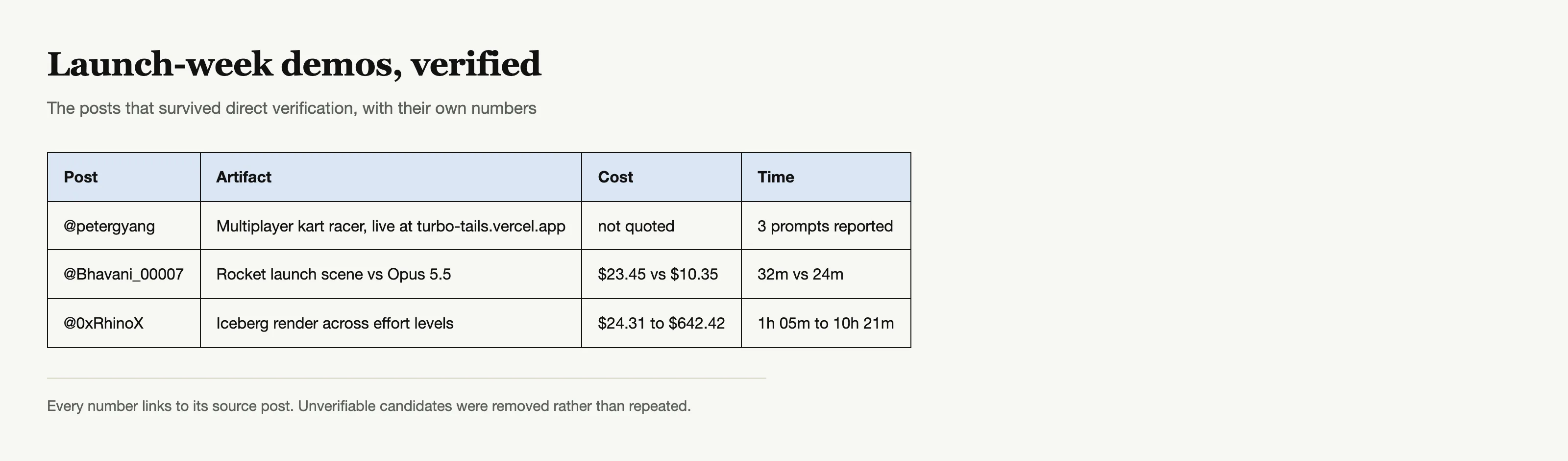
@petergyang's kart racer is the launch-week demo that traveled furthest: six racers, drifting, ramps, items, single-player and multiplayer, reportedly built in three prompts and playable at turbo-tails.vercel.app (post).
Why it matters: a multiplayer game is not a single-shot artifact. It needs an engine choice, state sync, an asset pipeline, and a deploy that serves, and it has to survive a human driving badly. That is exactly the "open-ended, multi-stage build" profile Anthropic positions Fable 5.2 for, and it is the shape of task where the community reports the biggest gap over Opus 5.5. Whether three prompts is the whole story is unknowable from the post, but the artifact is live, which is more than most demos offer.
A same-prompt scene test against Opus 5.5
@Bhavani_00007 ran a rocket-launch scene on both models: Fable 5.2 finished in 32 minutes at $23.45, Opus 5.5 in 24 minutes at $10.35 (post). Their verdict was that Fable's detail and realism were "incredible," but they had expected efficiency closer to Fable 5.1's.
This is the cleanest single data point for the pricing question: same prompt, same surface, 2.3x the cost for visibly better output. Whether that trade is worth it depends on whether the task is judged on quality or throughput, and it illustrates the split Anthropic's positioning predicts: Opus 5.5 the efficient daily driver, Fable 5.2 the quality ceiling (the head-to-head).
The effort sweep that defined the cost conversation
The most cited post of launch week is @0xRhinoX's sweep of one iceberg prompt through escalating effort settings: $24.31 and 1h 05m at High up to $642.42 and 10h 21m at his top setting (post). Same model, same prompt, a 26x price spread driven entirely by the effort dial.
The quality difference was real, the top run added an aurora and underwater detail the High run omitted, but the poster's own question, "is it 26x better," is the right frame for every Fable 5.2 buying decision. The post did more to shape "don't run Fable on max" advice than any benchmark, because it made the cost curve concrete in a way list prices cannot.
Try the same prompts on Fable 5.2
Every verified demo above is reproducible. Pick Ultra on Zentor and run your own version.
Try Zentor →
What the verified evidence does and does not support
Three claims hold up. First, the ceiling is real: the demos people could not get out of earlier models, playable games, hour-long coherent renders, went viral for a reason. Second, the cost multiplier is real and controllable: same-prompt tests cluster at 2-4x Opus 5.5, and the effort dial, not the model name, is the biggest lever. Third, the launch-week limit complaints trace to metering mechanics rather than a uniquely greedy model.
What it does not support: "always better." The iceberg sweep shows quality flattening long before cost does, and the rocket test shows a 2x price buy you might not need on a well-specified prompt.

The limit reports are part of the demo story too
The other half of launch week on X was Pro users hitting "usage limit reached" minutes into first runs. Those posts are not counter-evidence to the demos; they are the same mechanic seen from the billing side, high-effort runs on metered allowances. Anthropic's launch offers, Fable included up to 50% of weekly limits on Pro for the first week plus resets elsewhere, were effectively an acknowledgment that launch-week Fable burns limits at a new rate (launch offers).
Why so few posts made this list
This article keeps only demos we could open and verify directly, post, author, and the numbers as quoted. Launch week produced a much larger pile of claims, and a real share will not load, misquote themselves in screenshots, or compress a multi-session build into "one prompt." The demos that survive verification are the ones you can learn from: they quote dollar figures and wall-clock times, name the effort level used, and describe the prompt closely enough to reproduce.
Reading demo posts critically
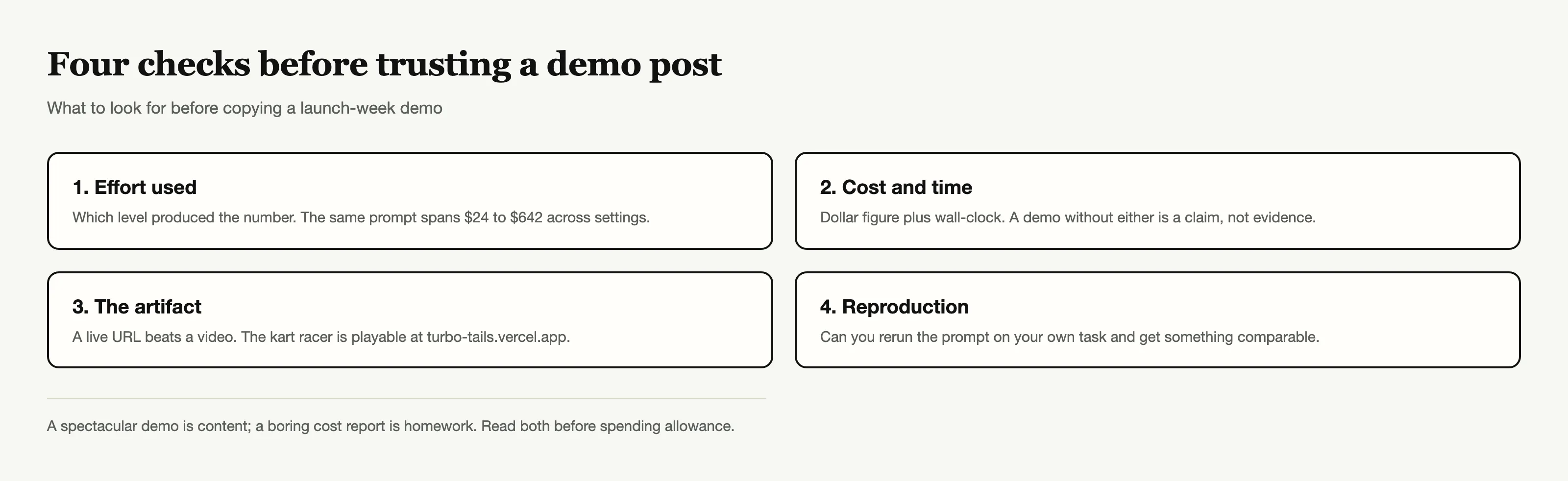
Launch-week posts have a consistent structure: a result screenshot or video, a dollar figure, a time, and a claim about prompts or effort. The ones worth trusting put all four in the open and link the artifact. Before acting on any demo, the questions are: what effort was used, what did it cost, and can you rerun it. It also helps to remember the incentive: a spectacular demo is content; a boring cost report is homework. That asymmetry is why the iceberg sweep and the limit complaints belong in the same reading diet as the game builds.
How to run your own version
Every prompt behind these posts is public or trivially recreatable:
- Pick the demo closest to your actual workload: a game build, a scene render, a long agent task.
- Run it at the effort level you would actually pay for, high, not the top setting that made the viral number.
- Log the usage draw, not just the output; thinking tokens are the real variable between models and levels.
- Compare against Opus 5.5 on the same prompt before deciding Fable's premium is justified.
The kart post is especially reproducible because the artifact is a live URL: open it, drive a lap badly, and you have a hands-on check on the claim. On Zentor's Fable 5.2 page, the Ultra tier runs the same model on plan credits if you would rather not manage a second billing account for the test.
What to watch in week two
The demos that matter next are the follow-ups: whether the kart racer survives real players, whether the scene tests reproduce on fresh accounts, and whether anyone publishes a Fable 5.2 run that failed where Opus 5.5 succeeded. That last category is the one launch week conspicuously lacks, and it is the most informative possible post.
The builds worth watching next
The demos that will matter in a month are the ones that compound: the kart racer becoming a remixable template, longer agent runs, video pipelines settling into workflows. Launch week proved capability; the follow-ups will prove durability. Bookmark the authors above, because the same accounts are already publishing week-two iterations.
Where to go from here
For the model-level picture behind these posts, read every access route first, then the effort levels that decide what a rerun costs. The verified demos above are the same prompts in three different stories; the takeaway is the same in each.
Reproducing the kart racer yourself
The kart post is reproducible in a way the render posts are not, because the artifact is a live URL, not a video. Open turbo-tails.vercel.app, drive a lap badly, and you have a hands-on check on the claim. To go further, describe the same game to Fable 5.2 at your own effort level and see whether you get a playable result in a comparable number of prompts; that is the real replication of the demo, not the hosted copy.
What the week actually proved
The verified launch-week evidence answers the question this article opened with. Fable 5.2 builds things previous models could not, it costs a predictable multiple of the mid-tier, and the multiplier is yours to control. Whether that is worth your allowance is a question only your own task list can answer, and this week is the cheapest week to find out.
The pattern across all three verified examples
Put the three kept posts side by side and a consistent picture forms. In every case the headline result came from the top of the effort range or a task built for it: the kart racer is open-ended orchestration, the rocket scene won on detail at 2.3x price, and the iceberg sweep is literally a tour of the same dial. Nothing verified shows Fable 5.2 dominating on a cheap, well-specified prompt, which is exactly the quadrant where Anthropic says to use Opus 5.5 instead.
The honest caveat on source reliability
X posts load unreliably, and launch-week posts are the most manipulated content on the site during a release. This article's bar was to open each post and confirm the author, the artifact, and the numbers as quoted; a dozen candidate demos failed that check and are simply absent rather than repeated. If a claim you saw elsewhere is missing, that absence is the verification doing its job, and it is worth applying the same bar before acting on any unreproduced number.
The prompt shapes these demos share
Look past the outputs and the kept demos share a structure: a loosely-specified goal, constraints the model has to invent its way through, and a long enough horizon that planning matters more than raw speed. That is the shape Anthropic built Fable 5.2 for, and it is also the shape where its price is hardest to justify on a per-task basis. A well-specified prompt, one where the work is extraction or transformation with a known endpoint, is precisely the task Opus 5.5 handles at half the price, which is why none of the verified demos are built that way.
Running the same test on Zentor
If you want to rerun one of these demos without a second billing account, Zentor's Ultra tier already serves Fable 5.2 on plan credits, and the Auto router is effectively a pre-run effort decision per turn. The cheapest version of the experiment is the kart racer prompt at default effort on a plan-credit meter, which lets you see what the top tier does on your own task before deciding what it is worth.
The three verified demos, side by side on cost
Put the three kept posts next to each other and a consistent picture forms. The kart racer shows the ceiling on an open-ended orchestration task; the rocket scene shows a 2.3x price for visibly better detail on a well-specified one; and the iceberg sweep shows the effort dial can move cost 26x while the model stays the same. Nothing verified shows Fable 5.2 dominating on a cheap, routine prompt, which is exactly the quadrant where Anthropic says to use Opus 5.5 instead.
FAQ
What are the best Claude Fable 5.2 examples so far?
The verified ones from launch week: a playable multiplayer kart racer by @petergyang, a rocket-scene comparison vs Opus 5.5 by @Bhavani_00007, and @0xRhinoX's effort-level cost sweep.
Did Fable 5.2 beat Opus 5.5 in public tests?
On output quality, yes in the verified comparisons. On cost-efficiency, Opus 5.5 won the same tests at roughly half the price.
How much do Fable 5.2 tasks actually cost?
The verified range runs from $10-25 for a well-specified scene at default effort to $642 for a ten-hour top-setting run on the same prompt.

Zentor Research Public data on the AI ecosystem
Zentor Research publishes quarterly data studies on the AI tools ecosystem, drawing on public registries (npm, GitHub, Hugging Face, arXiv, Google Trends). All charts and datasets ship under CC-BY 4.0.
Turn insights into action.
Zentor automates the recurring work your analysis points to. No engineering required.
References Kart racer by @petergyang · Rocket test by @Bhavani_00007 · Iceberg effort sweep by @0xRhinoX · Fable 5.2 launch offers · Fable 5.2 announcement · Effort docs