9 Cold Email Templates That Get Replies

Nine cold email templates for sales, freelance, job search and partnerships, each under 125 words, with the rules and data behind what gets a reply.
A cold email template works when it gives you the structure and leaves the specifics to you: one line about the reader, one problem, one offer, one small ask. The nine templates below cover sales, freelance, job search, partnership and press outreach, and each one fits in under 125 words.
That length isn't a style preference. When Backlinko and Pitchbox analyzed 12 million outreach emails, only 8.5% got any response at all, so the default outcome of a cold email is silence. The same study found that a personalized message body earned 32.7% more replies than a generic one. A template you send unchanged is the generic one.
Key Takeaways:
- A good cold email template has four parts: a specific opener, one problem, one offer with a real result, and a low-effort ask
- Keep it between 50 and 125 words, the range Boomerang found gets the most replies
- Fill every bracket with something true about the reader before you send
- One follow-up raises replies by 65.8% in Backlinko's data, so plan the second email when you write the first
- US law allows cold B2B email, but every message needs an honest subject line, a postal address and a way to opt out
What makes a cold email template work
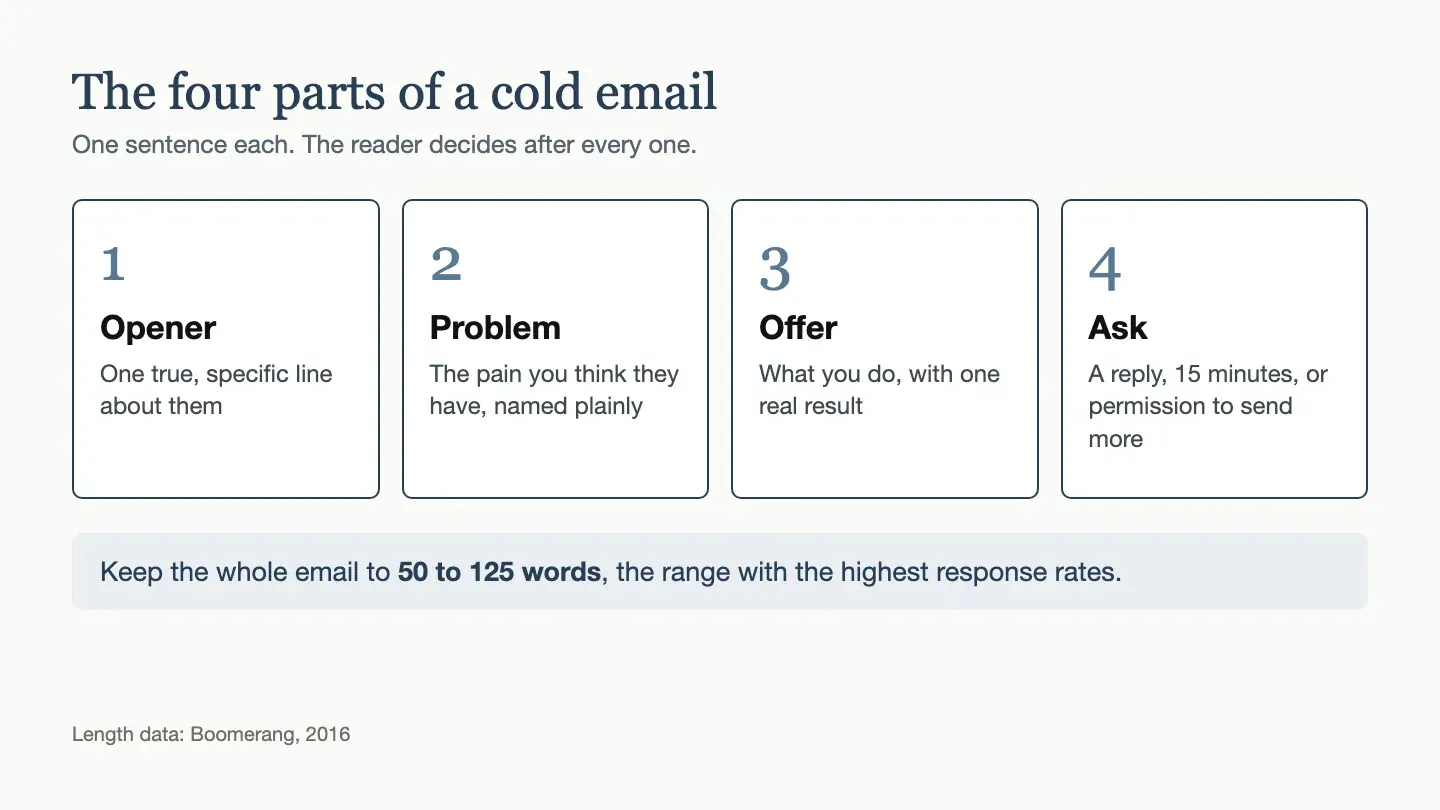
Every template in this article follows the same four-sentence shape, because the reader makes four decisions in order.
- The opener is about them. It proves you chose this person. A product they shipped, a role they posted, a talk they gave. If the line could be sent to anyone, it isn't an opener.
- The problem is one sentence. Name the thing you think is costing them time or money. If you can't name it, you're guessing, and they will know.
- The offer carries one real result. "We cut dispatch admin roughly in half for a logistics client" beats a list of features. If you have no result yet, say what you would do, not what you have done.
- The ask is small. A reply, fifteen minutes, permission to send something. Not a contract.
Length matters as much as structure. Boomerang's analysis of its users' email found that messages of 50 to 125 words had response rates above 50%, and that both shorter and longer emails did worse. The same analysis found that emails asking one to three questions were 50% more likely to get a reply than emails asking none. One question at the end is enough.
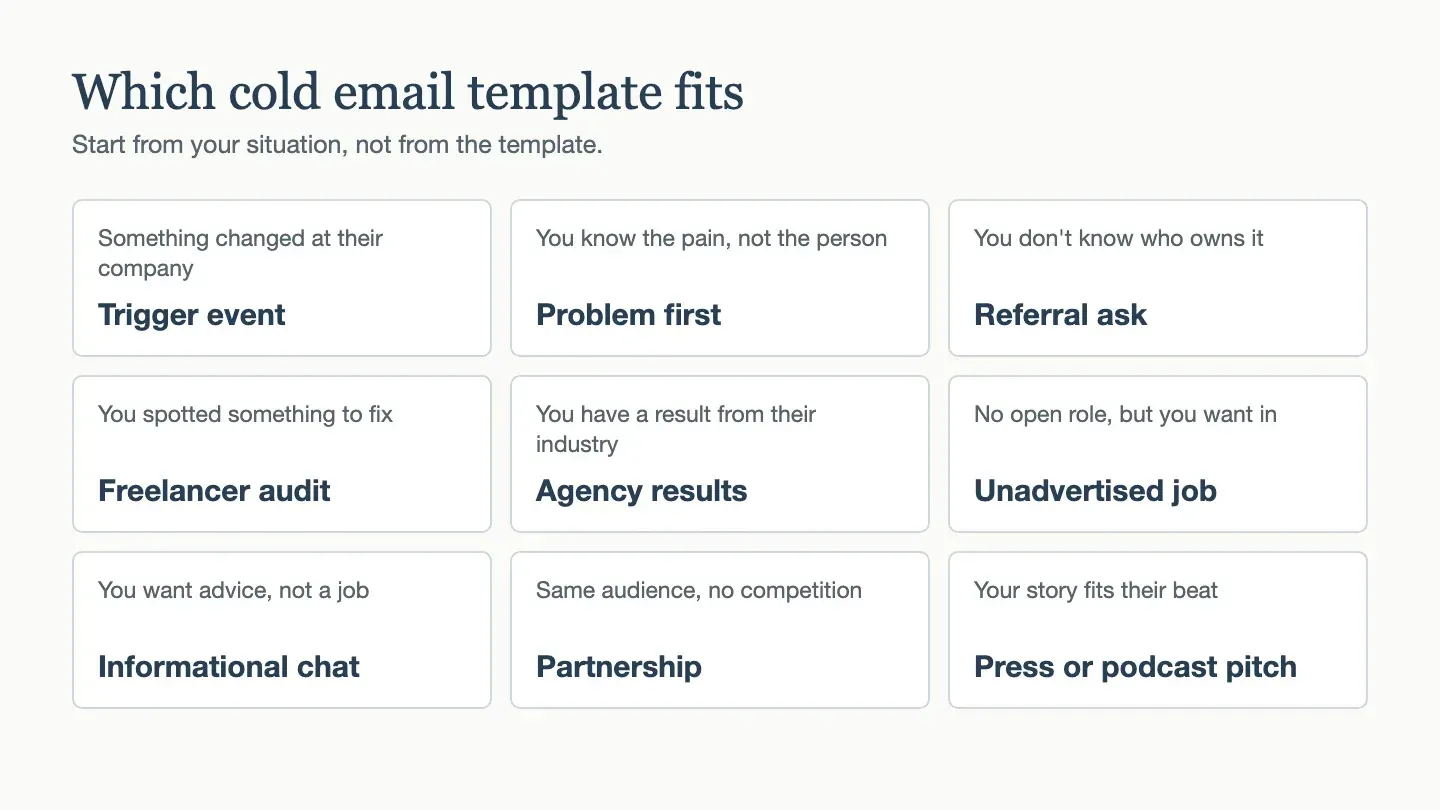
| Template | Use it when | The ask |
|---|---|---|
| Trigger event | Something changed at their company | 15-minute call |
| Problem first | You know the pain but not the person | A yes or no |
| Referral | You aren't sure who owns the problem | A name |
| Freelancer audit | You spotted something specific to fix | Permission to send ideas |
| Agency results | You have a relevant client result | Short call |
| Unadvertised job | You want to work there and no role is open | Permission to send a summary |
| Informational chat | You want advice, not a job | 20 minutes |
| Partnership | You serve the same audience | Quick chat |
| Press or podcast pitch | You have a story that fits their beat | A reply |
Send the first email. Let Zentor remember the follow-up.
Zentor works inside your Gmail, notices the threads that went quiet and drafts the next message in your voice. You approve before anything is sent.
Try Zentor →
Cold email templates for sales and B2B outreach
1. The trigger event. Use this when something public just happened: a funding round, a launch, a new office, a hiring push.
Subject: [Their company] and [what changed]

Hi [First name],

I saw that [company] just [trigger event]. Teams at that point usually run into [problem].

We help [type of company] with exactly that: [one-line offer]. For [similar customer], it meant [real result].

Worth 15 minutes to see if it applies to you?

[Your name]
2. Problem first. Use this when you know the pain well and have no particular hook for this person.
Subject: [Problem] at [their company]

Hi [First name],

Most [their role]s I talk to lose [time or money] every week to [problem].

We built [product] to fix that one thing. [Customer type] typically see [real result] in the first [period].

Is this on your list this quarter, or should I leave you alone?

[Your name]
3. The referral ask. Use this when you can't tell who owns the problem. A short question is easy to answer and easy to forward.
Subject: Right person for [topic]?

Hi [First name],

I'm trying to reach whoever looks after [area] at [company]. Is that you, or could you point me to the right person?

For context: we help [type of company] with [one-line offer].

Thanks either way,
[Your name]
If you would rather start from your own details than from a blank bracket, the cold email generator builds the same four-part email from a two-line description of you and the reader.
Cold email templates for freelancers and agencies
Freelance outreach fails for one reason more than any other: it opens with the sender. The two templates here open with the client's own work.
4. The freelancer audit. Use this when you have looked at their site, product or content and found something concrete.
Subject: An idea for [their page or product]

Hi [First name],

I was looking at [specific page] and noticed [specific thing]. It caught my eye because [why it matters to them].

I'm a [what you do] and recently did [similar work] for [client type], which [real result].

Want me to send two concrete changes I'd make to yours? No call needed.

[Your name]
5. Agency results. Use this when you have a result from a client in the same industry. One relevant number does more than a portfolio link.
Subject: [Result] for [similar company]

Hi [First name],

We work with [industry] companies on [service]. Last [period] we helped [similar company] [real result].

Looking at [their company], I think [one specific opportunity] is the first thing we'd look at.

Open to a short call next week?

[Your name]
Cold email templates for job seekers and networking
A cold email to a hiring manager is still a cold email. The reader owes you nothing, so the ask has to be even smaller than in sales.
6. The unadvertised job. Use this when you want to work somewhere and there's no open role to apply to.
Subject: [Your role] interested in [team or company]

Hi [First name],

I've followed [company]'s work on [specific project], and the problem you're solving there is the kind I want to work on.

I'm a [role] with [years] years in [field]. Most recently I [one concrete achievement].

If your team expects to hire this year, could I send a short summary of my work?

Thank you,
[Your name]
7. The informational chat. Use this when you want to learn how someone got where they're. Ask for advice and mean it. Asking for a job in the same email turns the conversation into a favor.
Subject: Question about your move into [field]

Hi [First name],

I read your [post or talk] on [topic], and [one specific thing you took from it].

I'm [your situation] and trying to work out [specific question]. Would you have 20 minutes in the next few weeks for a call? I'll keep to time.

Thanks for considering it,
[Your name]
Cold email templates for partnerships and press
8. The partnership. Use this when you and the reader serve the same audience and don't compete.
Subject: [Your company] + [their company]?

Hi [First name],

We both work with [shared audience]: you on [their side], us on [your side].

I think there's a simple way to help each other: [specific idea, such as a joint guide or a referral swap].

Open to a quick chat to see if it fits?

[Your name]
9. The press or podcast pitch. Use this when you have a story or a guest that fits what they already cover. Reference a specific piece, and make the angle one sentence.
Subject: Story idea: [angle in a few words]

Hi [First name],

Your piece on [topic] covered [specific point]. I have something that extends it: [the angle in one sentence].

I can share [data, access or a guest], and I'm happy to send details in whatever format helps.

Is this a fit for [publication or show]?

[Your name]
How to personalize a cold email template without rewriting it
You know this from the receiving end. An email arrives that opens with your first name, praises "your company" and asks for thirty minutes, and you've deleted it before the second line. What would have kept you reading is one detail the sender could only have found by looking.
The templates save you the structure. They don't save you the research, and the research is where replies come from. In the Backlinko data, personalizing the subject line alone raised responses by 30.5%.
Three places carry most of the weight:
- The subject line. Put their company or their project in it. "Checkout drop-off on your pricing page" is a subject. "Quick question" isn't.
- The first sentence. Spend five minutes finding one true, specific thing: a product page, a job post, a quote from an interview. If you can't find one, this person may not be the right target.
- The result. Match it to their industry and size. A result from a company like theirs is evidence. A result from a company ten times bigger is a brochure.
Then read it at the level a busy person reads. Boomerang found that emails written at a third-grade reading level got 36% more responses than those written at a college level. Short words and short sentences aren't unprofessional. They are the ones that get answered.
What a template can't do is tell you who to write to. Ten emails to people you chose carefully are a better bet than two hundred sent to a purchased list, and the purchased list creates the problems in the next section.
Cold email rules: CAN-SPAM, Gmail limits and UK B2B law
Cold email is legal in the United States, including to businesses, but it's regulated. The FTC is direct on this point: the CAN-SPAM Act "makes no exception for business-to-business email."
For a cold email that means:
- an honest From name and subject line
- a valid physical postal address in the message
- a clear way to opt out, honored within 10 business days
Each email that breaks the rules can be penalized up to $53,088, according to the same FTC guide.
Mailbox providers set their own bar on top of the law. Google's email sender guidelines tell all senders to keep the spam rate reported in Postmaster Tools below 0.3%. Anyone sending more than 5,000 messages a day to Gmail accounts must also set up SPF, DKIM and DMARC and support one-click unsubscribe. If recipients mark your email as spam, future emails stop arriving, whatever the template says.
The UK draws a different line. The Information Commissioner's Office says the electronic mail marketing rule "does not apply to corporate subscribers," so you can email a limited company without prior consent as long as you identify yourself and give a valid opt-out address. Sole traders are treated as individuals and need consent or an existing customer relationship. This is a summary, not legal advice, and other countries differ again.
Following up on a cold email that got no reply
Most replies don't come from the first email. In Backlinko's analysis, sending one additional follow-up raised replies by 65.8%. Woodpecker, which makes cold email software, reports from its own campaigns that the most effective number is two to three follow-ups, spaced at least two to three days apart.
A follow-up should be shorter than the original and add one new thing: a result, a relevant link, a simpler question. "Just checking in" adds nothing, and the reader can tell. We keep a separate set of follow up email templates for that second message.
The harder part is remembering. A cold email sent on Tuesday needs a follow-up the next week, and by then there are thirty new threads on top of it. This is the gap Zentor's AI email assistant is built for: it works inside Gmail, notices the threads that went quiet, drafts the follow-up in your voice and waits for your approval before anything is sent.
FAQ
What is a cold email template?
A cold email template is a reusable structure for a first email to someone who doesn't know you. It fixes the order (opener, problem, offer, ask) and leaves brackets for the details that have to be specific to each reader.
How long should a cold email be?
Between 50 and 125 words. That is the range with the highest response rates in Boomerang's data, and it's short enough to read on a phone without scrolling.
Is cold email legal?
In the United States, yes, including to businesses, provided you follow the CAN-SPAM Act: honest headers and subject lines, a postal address and a working opt-out. Rules in the UK and EU are stricter for individuals and sole traders.
How many cold emails should I send per day?
Fewer than you think. Deliverability depends on recipients not marking you as spam, and Google asks senders to stay below a 0.3% spam rate. A small number of researched emails protects your domain and gets more replies.
Should I use the same cold email template for everyone?
Use the same structure, not the same words. The subject line, the first sentence and the result should change for every reader.
How many times should I follow up?
Two to three times, a few days apart, each adding something new. After that, send one closing note and stop.
Pick one cold email template and send ten, not a thousand
The data points the same way from every direction. Few cold emails get answered, personal ones get answered more, short ones get answered most, and a second email raises your odds by about two thirds. None of that rewards volume.
So choose the template that matches your situation, write ten versions for ten people you picked on purpose, and put the follow-up in your calendar before you press send. If the brackets are the slow part, describe yourself and the reader to the cold email generator linked above and edit what comes back.

Zentor Editorial Zentor editorial team
The Zentor editorial team writes about workflow automation, AI agents, and the tools we build. Default byline for industry overviews, listicles, and collaborative pieces.
Ready to put this into practice?
Zentor runs browser tasks, research, and schedules automatically. Try it free.
References 12 million outreach emails · 50 to 125 words · makes no exception for business-to-business email. · email sender guidelines · does not apply to corporate subscribers, · most effective number is two to three follow-ups