Follow Up Email After No Response: 8 Templates
When to send a follow up email after no response, how to write it, and eight templates for sales, proposals, interviews, clients and unpaid invoices.
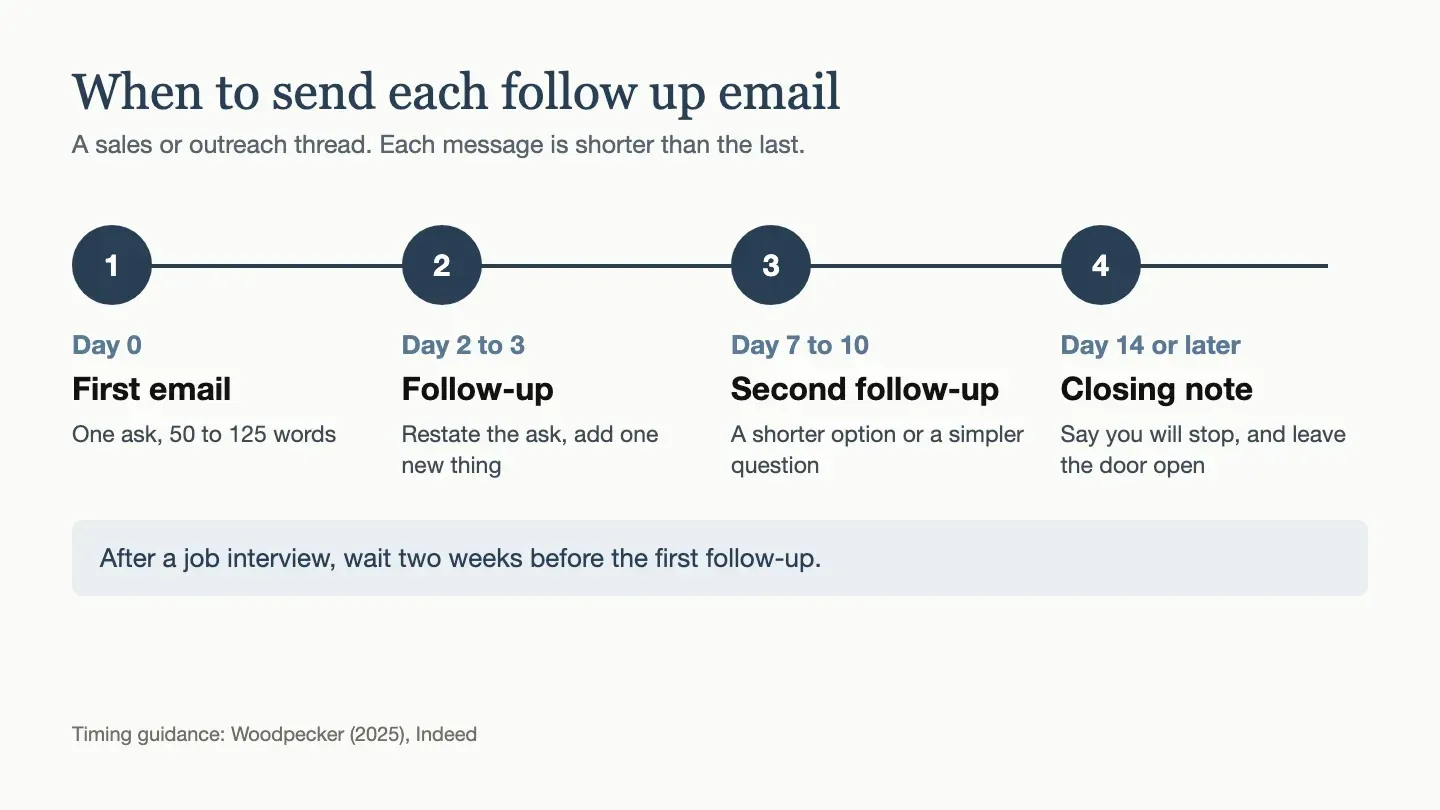
The best time to send a follow up email after no response is two to three business days after a sales or outreach email, and about two weeks after a job interview. Keep it shorter than the original, restate the one thing you need, and make it possible to answer in a single line.
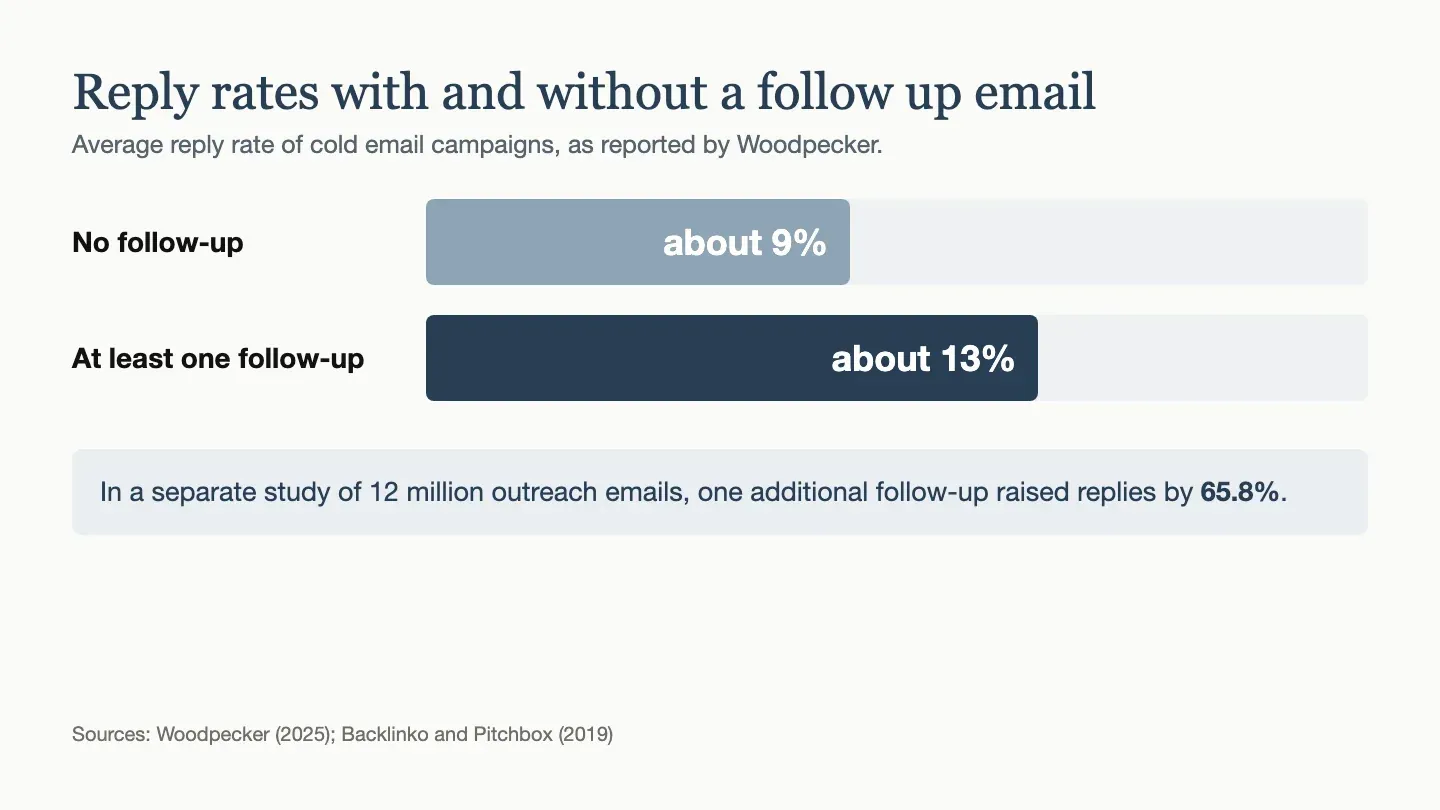
Silence is the normal result of a first email, not a verdict on it. When Backlinko and Pitchbox studied 12 million outreach emails, 91.5% got no reply. In the same data, sending just one more message raised replies by 65.8%. Most people never send it.
Key Takeaways:
- Wait two to three business days after outreach or sales email, and two weeks after an interview, before following up
- A follow-up should be shorter than the first email and add one new thing
- Reply in the same thread so the context travels with you
- Two to three follow-ups is the useful range, then send a closing note and stop
- The eight templates below cover sales, proposals, interviews, clients, invoices and colleagues
When to send a follow up email after no response
Timing depends on what you asked for and how long a reasonable person needs to answer it.
| Situation | First follow-up | Then |
|---|---|---|
| Cold outreach or sales email | 2 to 3 business days | Again after 4 to 7 days |
| After a demo or meeting | 3 to 4 days | A week later |
| Proposal or quote | 5 to 7 business days | A week later |
| Job interview | 2 weeks, or after the date they gave you | Once more, after their deadline |
| Job application | 1 to 2 weeks | Once more, then move on |
| Unpaid invoice | The day after it's due | Weekly |
| Colleague or internal request | 1 to 2 days | Ask in person or by chat |
Two of these rows come from published guidance. Woodpecker, which makes cold email software, advises waiting at least two to three days between messages, because following up sooner "will make you look pushy and intrusive." Indeed's career guide says to check in if you haven't heard back after two weeks since an interview. The other rows are working defaults: long enough that the reader has had a fair chance, short enough that they still remember you.
The day of the week matters less than people think. Woodpecker looked at its own campaign data and found no day with a meaningful advantage.
Stop relying on memory for follow-ups.
Zentor keeps track of the threads where you are waiting on someone and drafts the follow-up in your voice, inside Gmail. You approve before anything is sent.
Try Zentor →
How to write a follow up email after no response
A follow-up has one job: make it easier to answer than to ignore. Four parts do that.
- One line of context. "Following up on my email from Tuesday about the proposal." The reader shouldn't have to scroll.
- The ask, in one sentence. Restate what you need. Don't paste the first email again.
- One new thing. A result, a date, a shorter option, an answer to a question they might have. This is what separates a follow-up from a nag.
- An easy way out. "A yes, a no or a not-now all help." Giving permission to decline gets more replies than pressure does.
Keep it short. Boomerang's analysis of its users' email found the highest response rates for messages of 50 to 125 words, and a follow-up should sit at the low end of that range. The same analysis found that emails asking one to three questions were 50% more likely to get a response than emails asking none, so end on a question.
What to leave out: "just checking in," "bumping this," and any sentence about how busy they must be. None of them tell the reader what you need.
If you would rather describe the situation and get a draft back, the follow up email generator writes the subject line and body from two sentences of context.
Follow up email templates for sales and proposals
1. After a cold or outreach email. Use this two to three business days after a first message that got no reply.
Subject: Re: [original subject]

Hi [First name],

Following up on my note from [day] about [topic].

One thing I didn't mention: [new, relevant detail or result].

Is this worth a short call, or is the timing wrong?

[Your name]
2. After a demo or meeting. Use this when they said they would discuss it internally and no next step was set.
Subject: Next steps after [meeting]

Hi [First name],

Thanks again for your time on [day]. You mentioned you'd talk it over with [team or person].

To make that easier, here is the summary in two lines: [what you offer], [the result they care about].

Would it help to set a short call for [day] to answer anything that came up?

Best,
[Your name]
3. After a proposal or quote. Use this five to seven business days after you sent it.
Subject: Re: [proposal name]

Hi [First name],

I wanted to check that the proposal I sent on [date] reached you.

If the scope, the timing or the price isn't quite right, tell me which and I'll adjust it. If it's simply not the moment, that's useful to know too.

Should I keep the dates I pencilled in, or release them?

Thanks,
[Your name]
If your first message was a cold one, the structure of that email matters as much as the follow-up. Our cold email templates cover the first touch.
Follow up email templates after an interview or application
A thank-you note and a follow-up are different emails. Indeed advises sending the thank-you within 24 hours of the interview. The follow-up below is for later, when the date they gave you has passed.
4. After an interview with no response. Use this two weeks after the interview, or a few days after the decision date they mentioned.
Subject: Following up on the [job title] interview

Hi [First name],

Thank you again for speaking with me on [date] about the [job title] role. I'm still very interested, especially after hearing about [specific thing from the interview].

Do you have an update on the timeline? I'm happy to send anything else that would help.

Thank you,
[Your name]
5. After a job application. Use this one to two weeks after applying, and only when you can find a named contact.
Subject: Application for [job title]

Hi [First name],

I applied for the [job title] role on [date] and wanted to make sure my application reached you.

In short: I'm a [role] with [years] years in [field], and most recently I [one concrete achievement].

Is there anything else I can send?

Thank you,
[Your name]
Follow up email templates for clients, invoices and colleagues
6. A client who owes you something. Use this when your work is blocked by files, feedback or a decision.
Subject: Still need [item] to keep [project] on schedule

Hi [First name],

A quick reminder that I'm waiting on [item] to move ahead with [project].

If it reaches me by [date], we stay on track for [deadline]. After that, the delivery date moves by the same number of days.

Is anything holding it up that I can help with?

Thanks,
[Your name]
7. An unpaid invoice. Use this the day after the due date. State the facts and attach the invoice again.
Subject: Invoice [number], due [date]

Hi [First name],

Invoice [number] for [amount] was due on [date], and I haven't seen the payment come through yet. I've attached it again in case it was missed.

Could you let me know when it's scheduled?

Thank you,
[Your name]
8. Closing the loop. Use this as your last message, after two or three follow-ups with no answer. It gives the reader one clear thing to respond to.
Subject: Should I close this out?

Hi [First name],

I've reached out a few times about [topic] and haven't heard back, so I'll assume the timing isn't right and stop here.

If I've got that wrong, reply to this email and we'll pick it up where we left off.

All the best,
[Your name]
For a colleague, skip the template. After one emailed reminder, walk over or send a chat message. Email is the slowest channel inside a company.
How many follow up emails to send before you stop
Two to three. Woodpecker's data on its customers' campaigns puts "the most optimal number" at two to three follow-ups, and reports that a fifth, sixth or seventh adds only a small increase. In the same data, campaigns with at least one follow-up averaged about a 13% reply rate, against about 9% with none.
The limit isn't only about returns. Every unwanted email is a chance for the reader to mark you as spam, and Google tells senders to keep the spam rate reported in Postmaster Tools below 0.3%. For sales email in the United States, the FTC also requires you to honor an opt-out request within 10 business days. If someone asks you to stop, stop.
So the sequence is: first email, two or three follow-ups a few days apart, each adding something, then the closing note in template 8.
Follow up email subject lines and threading
Reply in the same thread. The original message sits below yours, the subject line already has "Re:" on it, and the reader doesn't have to work out who you're. Start a new thread only when the first subject was wrong for the conversation, or when you're writing to a different person.
When you do write a new subject, keep it short. Boomerang found that subject lines of three to four words got the most responses, and that messages with no subject line at all were answered only 14% of the time.
A subject that works names the thing, not the act of following up:
- "Proposal for the March launch"
- "Invoice 1042, due Friday"
- "Next steps after Tuesday's demo"
"Following up" on its own tells the reader nothing they can act on.
Why follow up emails get forgotten
Writing a follow-up takes two minutes. Remembering to write it's the part that fails. The email you sent on Monday is buried by Wednesday, and nothing in your inbox tells you that a reply never came. Sent mail is a list of things you did, not a list of things still open.
People solve this with calendar reminders, a spreadsheet, or a label called "waiting." All three work until the week gets busy, which is the week they matter.
This is what Zentor's AI email assistant does inside Gmail. It keeps track of the threads where you're waiting on someone, drafts the follow-up in your voice when the time comes, and holds it for your approval. Nothing is sent without you.
FAQ
How long should I wait before sending a follow up email after no response?
Two to three business days for sales and outreach email, five to seven for a proposal, and about two weeks after a job interview unless they gave you a decision date.
How do I politely follow up on an email?
Give one line of context, restate what you need in one sentence, add one new piece of information and offer an easy way to say no. Keep it under 100 words.
Should I reply in the same thread or start a new email?
Reply in the same thread. The reader sees the original message without searching, and your subject line is already familiar.
How many follow up emails is too many?
More than three, in most cases. Woodpecker's campaign data shows two to three follow-ups is the most effective range, with little gained after that.
What should the subject line of a follow up email be?
If you reply in the thread, keep the original subject. If you start fresh, use three or four words that name the topic, such as the proposal or the invoice number.
Is it rude to follow up after no response?
No. Most unanswered emails were buried, not rejected. A short, specific follow-up helps the reader as much as it helps you.
The follow up email after no response is the one that gets answered
The first email starts the conversation. In the data, the second and third are where a large share of the replies come from, and they're the ones most people never send.
Pick the template that fits, change every bracket, and send it in the same thread. Then decide now when the next one goes out, or let something else remember for you.

Zentor Editorial Zentor editorial team
The Zentor editorial team writes about workflow automation, AI agents, and the tools we build. Default byline for industry overviews, listicles, and collaborative pieces.
Ready to put this into practice?
Zentor runs browser tasks, research, and schedules automatically. Try it free.
References 12 million outreach emails · waiting at least two to three days · haven't heard back after two weeks · 50 to 125 words · below 0.3% · within 10 business days