Gemini 2.5 Pro Shutdown Date: Which Is Right?
Google publishes two different Gemini 2.5 Pro shutdown dates. What each says as of 2026-09-20, the 404 hitting new projects, and what to do before Oct 20.
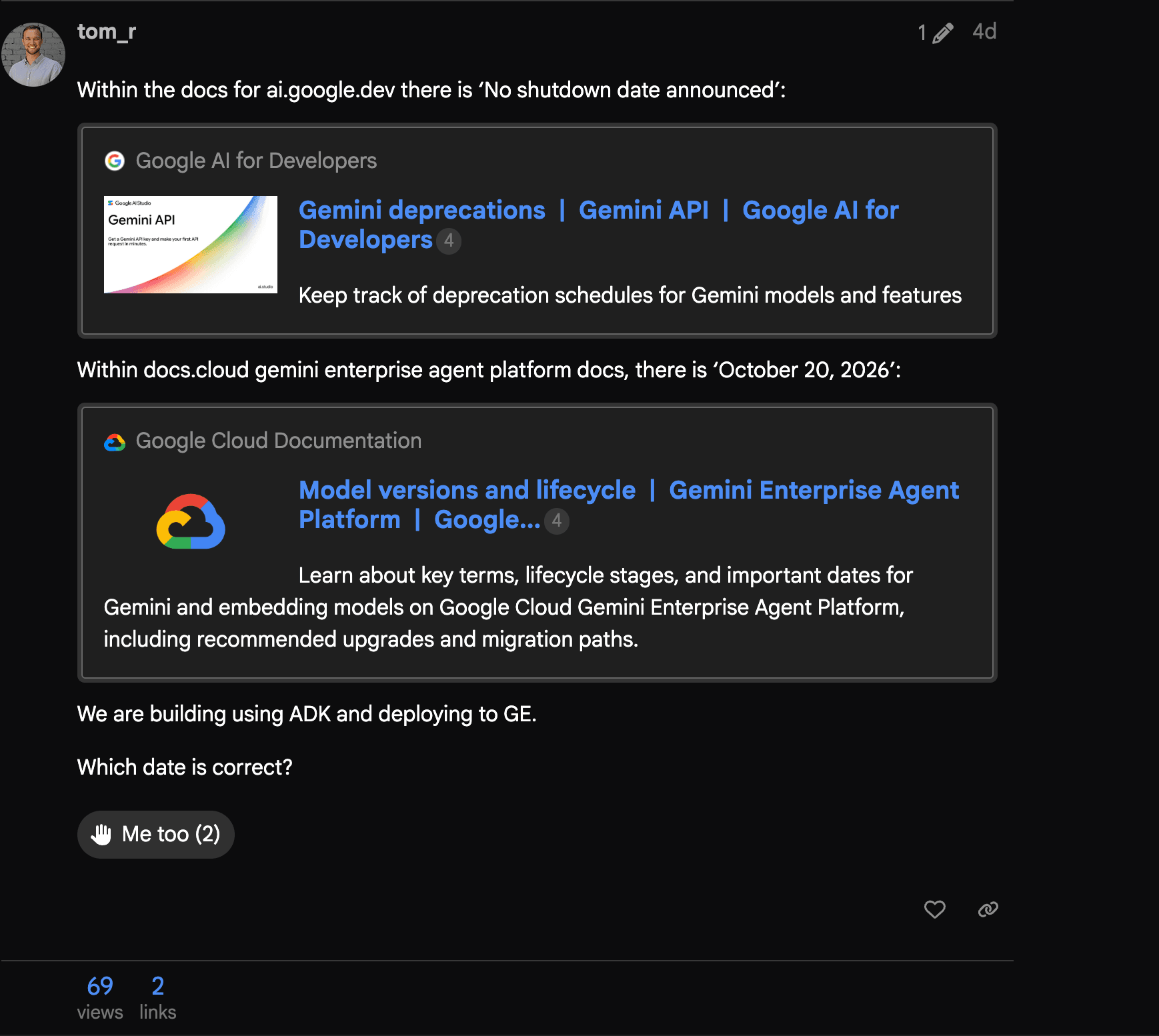
Ask Google when gemini-2.5-pro gets turned off and you'll get two answers, both of them official. The Gemini API deprecations page says no shutdown date has been announced. Google Cloud's model lifecycle page, describing the same model ID, says October 20, 2026. A developer posting as tom_r put screenshots of both pages side by side on Google's own forum on September 16 and asked which one to trust; as of September 20 nobody from Google has replied. So if you want a gemini 2.5 pro shutdown date you can actually plan a migration around, the honest starting point is that Google is publishing more than one.
Key Takeaways
- Google Cloud's lifecycle page lists a retirement date of October 20, 2026 for
gemini-2.5-pro,gemini-2.5-flashandgemini-2.5-flash-lite(as of 2026-09-20). - The Gemini API deprecations page lists the same three models with "No shutdown date announced" and no recommended replacement.
- OpenRouter has already committed: its
/api/v1/modelsresponse carriesexpiration_date: 2026-10-20on all three, plus the:batchvariants. - New Google Cloud projects have been locked out of 2.5 since late July with a 404, months ahead of any published gemini 2.5 pro shutdown date.
- Google's suggested replacements are Gemini 3.5 Flash for Pro, and Gemini 3.1 Flash-Lite or Gemma 4 for Flash-Lite.
Three pages, three answers
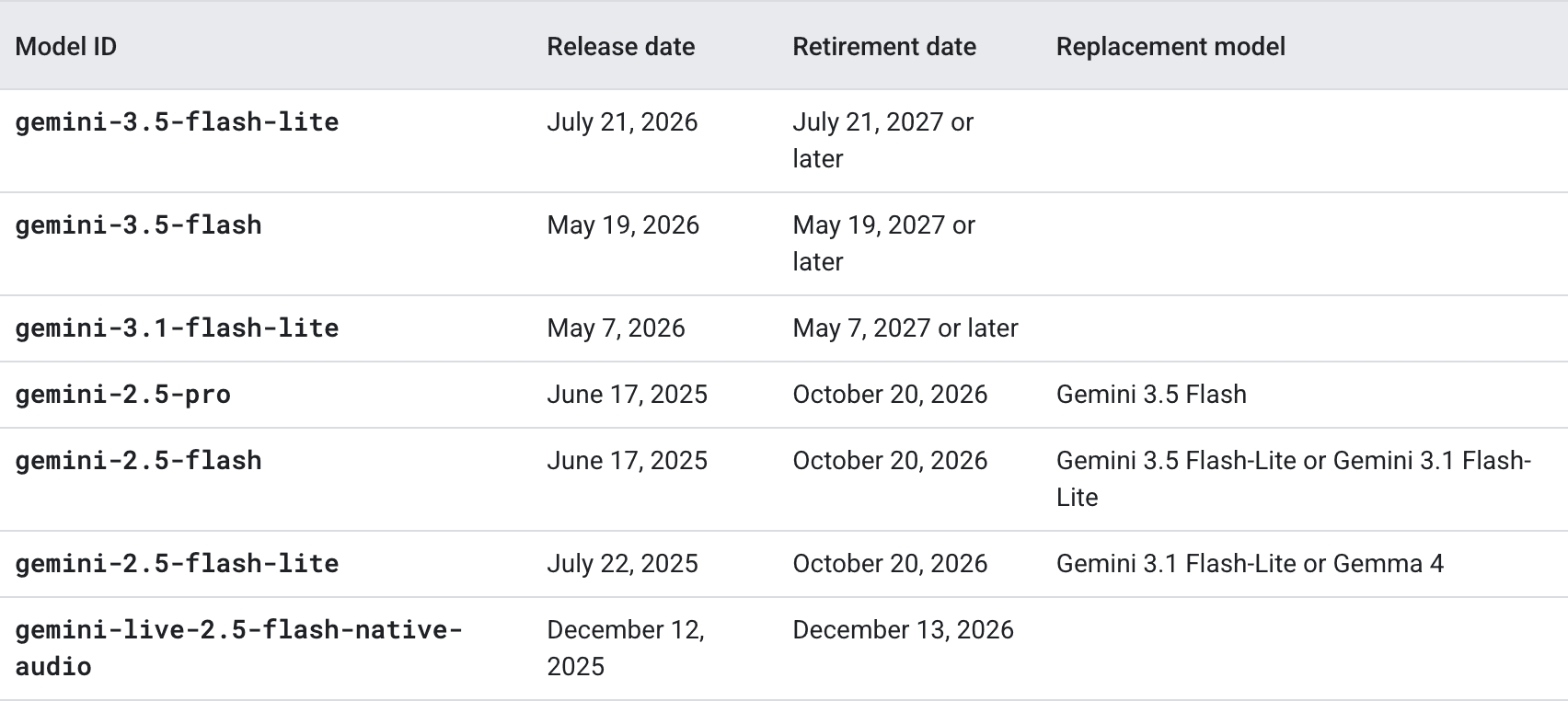
Start with the one that has a number on it. Google Cloud's "Model versions and lifecycle" page for the Gemini Enterprise Agent Platform gives gemini-2.5-pro a release date of June 17, 2025 and a retirement date of October 20, 2026, with Gemini 3.5 Flash named as the replacement. The two Flash models sit on the same date.
Now the Gemini API deprecations page, which is where most people building against generativelanguage.googleapis.com will look first. Same model, same release date of June 17, 2025, and under "Shutdown date" it reads: No shutdown date announced. The replacement column is empty.
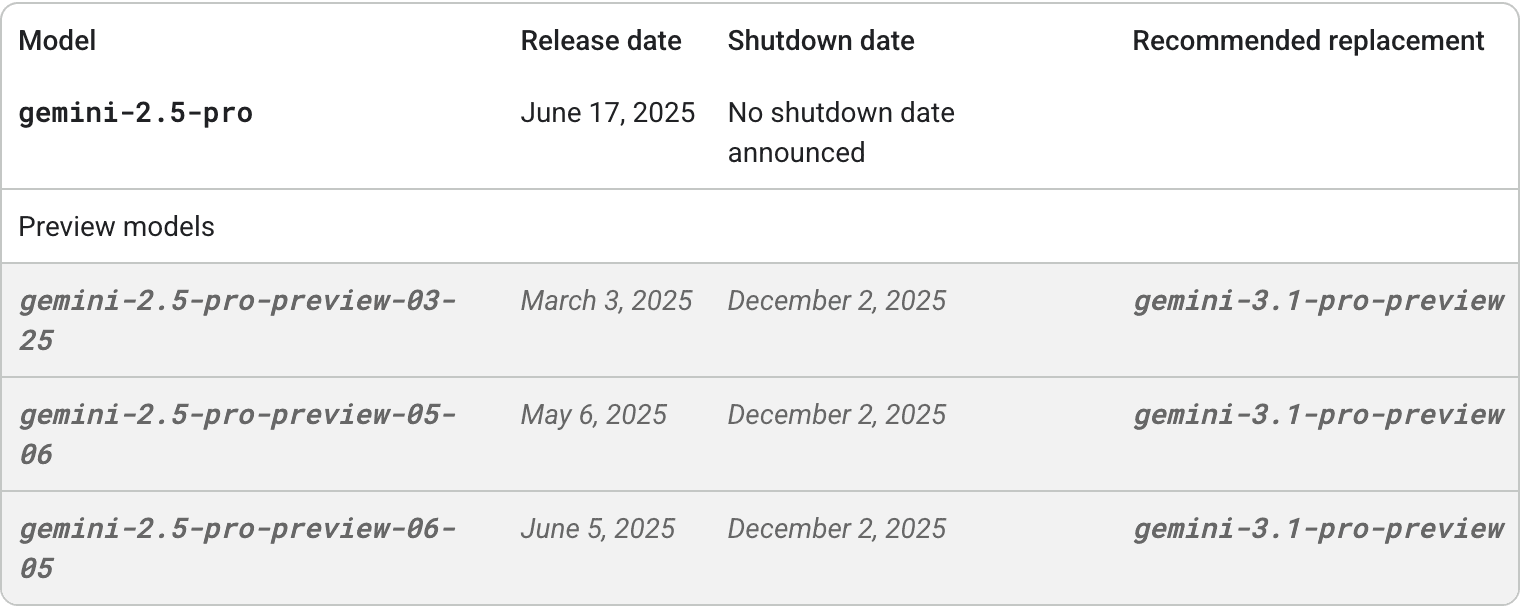
That page does carry a caveat worth reading: the dates in its tables are "the earliest possible dates on which a model might be retired," and Google says it will communicate exact shutdown dates with advance notice. Fine. But a blank cell isn't an early date, it's an absence, and it sits next to a Google Cloud page that has already picked a day in October. The two documents disagree about whether a decision exists at all.
There's a third answer in the archaeology. The forum thread that kicked this off in July is titled around an official deprecation date of October 16, 2026 — a date that no longer appears on either page. Somewhere between late July and now, Google moved off October 16 without a changelog entry explaining it. The one image model in the family shows the same drift in miniature: gemini-2.5-flash-image is listed as October 2, 2026 on the Gemini API page and March 15, 2027 on Google Cloud, a gap of five months for a single model ID.
The 404 that showed up months early
The dates are the boring half of this. The interesting half is that for a large class of users, 2.5 is already gone.
On July 28 a developer called c-endo reported on Google's forum that calling gemini-2.5-pro from a newly created GCP project returned a 404:
{
  "error": {
    "code": 404,
    "message": "This model models/gemini-2.5-pro is no longer available to new users. Please update your code to use a newer model for the latest features and improvements.",
    "status": "NOT_FOUND"
  }
}
Two days later a Google community manager confirmed it was deliberate: access to the 2.5 models is being limited to accounts that have actively used them before, to keep capacity available for legacy workloads. The same reply insisted the models "are not deprecated and will continue to be served until further notice," and pointed new projects at 3.1 Flash-Lite or 3.5 Flash.
Read that carefully, because it's the operative fact for anyone standing up new infrastructure. The model is not deprecated, has no announced shutdown date on one page and an October date on another, and also cannot be called from a project you created this morning. Whether your code works depends on the usage history of the specific project it runs in. That isn't a schedule you can put in a runbook.
The model ID underneath shouldn't be your problem
Zentor does the work inside the tools you already use and hands the finished thing back to Notion, Airtable, Slack or your inbox. Free for 3 days with 1,000 credits, no card needed.
See it for your stack
The gap this exposes is ownership. When you pin a model ID, you've taken on a dependency whose retirement calendar is written by somebody else and published inconsistently across their own docs. Zentor sits on the other side of that line: you describe the job, the finished work lands back in the tool where the work already lives, and which model produced it is not a field you maintain.
What OpenRouter decided on your behalf
While Google's two pages argue, the routing layer has already moved. Pull https://openrouter.ai/api/v1/models today and every Gemini 2.5 entry that matters carries a hard date:
google/gemini-2.5-pro→expiration_date: 2026-10-20google/gemini-2.5-flash→2026-10-20google/gemini-2.5-flash-lite→2026-10-20google/gemini-2.5-pro:batchandgoogle/gemini-2.5-flash:batch→2026-10-20google/gemini-2.5-flash-image→2027-03-15
OpenRouter has sided with Google Cloud's calendar rather than the Gemini API's silence, which is a reasonable bet and also a decision made for you if you route through them. One oddity survives even there: google/gemini-2.5-flash-lite:batch has expiration_date: null while its non-batch twin expires in October, so the inconsistency propagates rather than getting cleaned up in transit.
If you've been through this before on another provider, the shape will be familiar from Kimi K2.5's deprecation and from the DeepSeek endpoints that emptied out on OpenRouter: the aggregator's date is the one your code actually meets, regardless of what the upstream vendor's docs say.
What Google says to move to
The replacement column on Google Cloud's lifecycle page is more opinionated than most people expect, and it isn't a like-for-like ladder:
gemini-2.5-pro→ Gemini 3.5 Flashgemini-2.5-flash→ Gemini 3.5 Flash-Lite or Gemini 3.1 Flash-Litegemini-2.5-flash-lite→ Gemini 3.1 Flash-Lite or Gemma 4gemini-2.5-flash-image→ Gemini 3.1 Flash-Lite Image
Google is routing Pro users to a Flash-tier model, which is a real change in the shape of what you're buying rather than a version bump. Developers on the July thread pushed back on exactly this, arguing that the suggested replacements don't reproduce what they were getting from 2.5 Pro, and one noted that search grounding behaves differently on the free tier across generations. Whether you agree with them or not, budget for re-testing rather than a find-and-replace on the model string.
This is the part that quietly costs the most. Swapping a model means re-checking every prompt, every tool definition and every output format you'd tuned, and the knowledge of how you wanted the work done usually lives in a pile of saved prompts nobody owns. Zentor keeps that context as memory that belongs to you and exports cleanly, so the accumulated "this is how we do it here" survives a model swap instead of being re-derived from scratch each time the vendor reshuffles.
Finding what you're actually pinned to
Before October you need an inventory, and it's rarely just your application code. The places a 2.5 model ID tends to hide:
- Hardcoded strings in backend services and Cloud Functions
- Agent frameworks with a default model in config, including ADK deployments
- No-code automations in Zapier, Make or n8n where the model is a dropdown someone set once
- Notebooks, evaluation harnesses and cron jobs that nobody has opened since spring
- Third-party tools that route through Gemini and never told you which version
A grep for gemini-2.5 across your repos takes a minute and gets maybe 70% of it. The dropdowns are the ones that bite, because they fail silently in a workflow that only someone in ops looks at. Worth noting: the latest aliases are not a safe harbour either, since Google has repeatedly repointed them, most recently switching gemini-pro-latest to a 3-series preview.
When that audit is done, the output has to land somewhere the team actually reads. Zentor finishes this kind of sweep and writes the result straight into the Airtable base or Notion page where your migration tracking already lives, rather than handing you a transcript to copy across by hand.
What to do before October 20
Treat October 20, 2026 as the working gemini 2.5 pro shutdown date until Google says otherwise, because it's the only published number and the routing layer has already adopted it. Concretely:
- Inventory every call site, including the dropdowns.
- Pin explicit versioned IDs, never
latest, so a silent realias doesn't move you unannounced. - Run your evaluation set against 3.5 Flash and 3.1 Flash-Lite now, while you still have both to compare.
- Check whether your Google Cloud projects are on the allow-list at all; a new project can't call 2.5 today.
- Re-read both Google pages in early October. The October 16 date already vanished once without a changelog entry, so this one can move too.
That last item is the tell. Between now and the cutoff you'll be re-reading two vendor pages that contradict each other and hoping you catch the day one of them changes. That watching is unpaid work with no product to show for it, and it's the kind of standing job Zentor takes over: it checks on a schedule, and when something actually moves, the note arrives in the channel your team already watches instead of in a tab you forgot to open. Similar reasoning applied when Whisper-1 was deprecated and the real cost turned out to be the monitoring, not the migration.
FAQ
Is Gemini 2.5 Pro still available?
Yes, if your Google Cloud project has used it before. Projects created after roughly late July 2026 get a 404 reading "This model models/gemini-2.5-pro is no longer available to new users." Google has confirmed that restriction is intentional.
What is the official gemini 2.5 pro shutdown date?
There isn't a single one as of 2026-09-20. Google Cloud's lifecycle page says October 20, 2026; the Gemini API deprecations page says no shutdown date has been announced. An earlier date of October 16, 2026 appeared on Google's docs in July and was later removed.
Can I still use Gemini 2.5 Flash after October 2026?
Plan on no. Google Cloud lists October 20, 2026 as its retirement date and OpenRouter has already set expiration_date: 2026-10-20 on the model, so requests routed through it will stop resolving on that day regardless of what the Gemini API docs say.
What replaces Gemini 2.5 Pro?
Google Cloud names Gemini 3.5 Flash. That's a move from a Pro-tier to a Flash-tier model, so re-run your evaluations rather than assuming parity.
Does this affect Gemini in the consumer app?
No. These dates apply to API model IDs on the Gemini API and Google Cloud. The consumer Gemini app picks its own models and isn't versioned this way.

Zentor Editorial Zentor editorial team
The Zentor editorial team writes about workflow automation, AI agents, and the tools we build. Default byline for industry overviews, listicles, and collaborative pieces.
Ready to put this into practice?
Zentor runs browser tasks, research, and schedules automatically. Try it free.
References https://ai.google.dev/gemini-api/docs/deprecations · https://cloud.google.com/vertex-ai/generative-ai/docs/learn/model-versions · https://openrouter.ai/api/v1/models · https://discuss.ai.google.dev/t/gemini-2-5-pro-returns-no-longer-available-to-new-users-contradicts-official-deprecation-date-oct-16-2026/176380 · https://discuss.ai.google.dev/t/deprecation-shutdown-date-for-gemini-2-5-pro-conflicting-information/183251