Infisical's $40M Raise and the New Market for Agent Secrets

Infisical's $40M Series B puts ai agent secrets management on buyers' radar. Examine agent access, the 1,300-organization claim, and controls to check.
Infisical's new financing puts ai agent secrets management in the procurement conversation, but it doesn't prove that a funding round has solved agent access. Founder Vlad Matsiiako announced a $40 million Series B at a $600 million valuation on October 27, 2026, led by Elad Gil; the useful question for a buyer is who can stop an agent after it has been given a credential.
Key Takeaways:
- Infisical's founder links the round to autonomous agents entering sensitive systems and says more than 1,300 organizations trust the company with infrastructure security.
- A stored secret alone doesn't decide which task may use it, for how long, or who can reverse an action.
- Treat identity, narrow permissions, expiry, approval and audit evidence as separate purchase questions.
- The funding signals investment in the problem; it isn't proof of a distinct market size or of any product's security outcomes.
What Infisical raised, and why this timing matters
Matsiiako's public announcement states the round, valuation and lead investor directly. He also argues that AI has made code and vulnerability discovery easier and given autonomous agents access to sensitive systems. His "10x" language is the founder's framing, not an independently measured industry statistic, so it shouldn't serve as a buyer's benchmark.
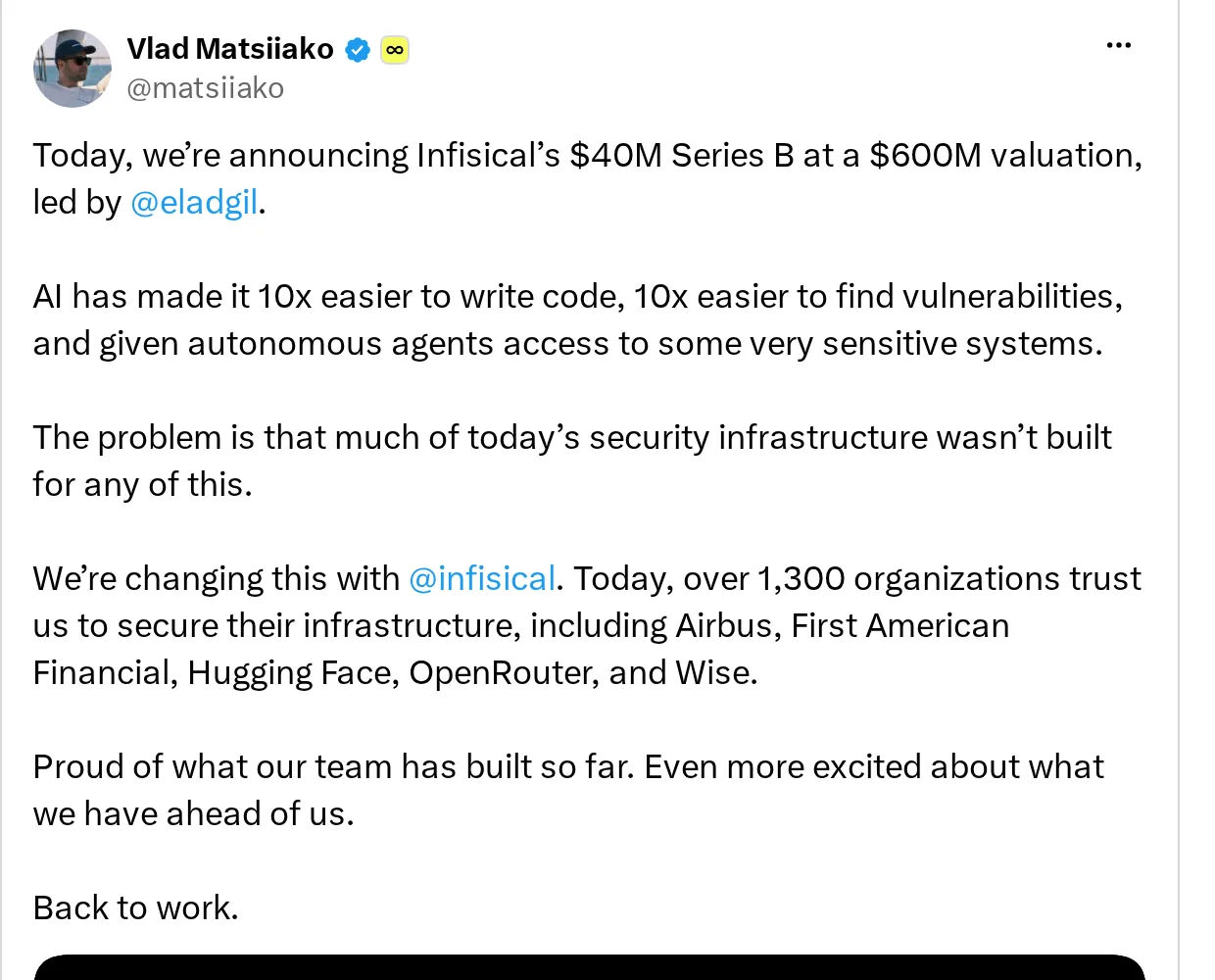
The financing matters because the sales question has changed. A team once asked whether a secret lived safely in a vault. Now it must ask whether an assistant reading a calendar, sending a draft, or updating a customer record receives access only for the job at hand. That problem spans the credential and the action taken with it.
Give an agent a useful job, not a blank check
Explore how Zentor connects work and workspace memory. Ask about access controls for any tool before delegating sensitive actions.
Get early access →
Why autonomous agents strain traditional secrets management
A password vault solves custody: it keeps a credential out of a document or chat message. Ai agent secrets management asks what the holder may do after access is granted. Infisical's secrets-management documentation describes a system for managing application secrets. An agent adds a different problem: the credential may be used repeatedly while the agent makes choices about which data to read and what to do next. Storing it safely doesn't make every downstream choice safe.
Imagine an assistant allowed to find unpaid invoices. If its connection can also change bank details, the access boundary is wider than the instruction. If the assistant shares a human account, the activity record may say only that the owner made the change. NIST's AI Risk Management Framework offers a broader governance lens; it is not a certification that any particular vault handles agent decisions. The practical remedy is to tie identity and permission to a task, then review the actions separately.
What agents accessing sensitive systems means on a Tuesday
Sensitive systems aren't limited to infrastructure consoles. For a one-person business, a shared inbox may carry refunds, addresses and bank correspondence; a client database can change who receives a quote. Suppose you ask an agent to prepare a reply to a cancellation request. Reading the relevant thread is one permission. Sending an email, issuing a refund and editing the customer record are three different permissions, and a mistake in one can outlive the original task.
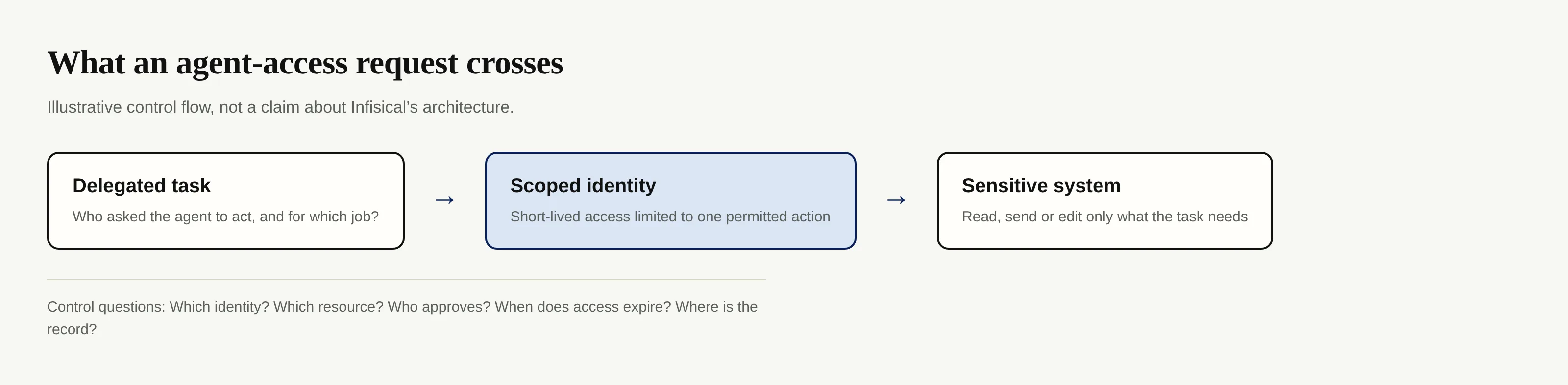
The Infisical Agent Vault overview shows how its own documentation frames the agent-access product. Don't mistake a product category for a guarantee about your workflow. The useful connection is workspace memory that stays portable through Zentor MCP; that isn't a claim that Zentor sells a secret vault or enforces permissions on every external system. The team granting access still owns that decision.
Does the 1,300-organization signal make this a category?
Matsiiako says over 1,300 organizations trust Infisical to secure their infrastructure. He does not say in that post that all 1,300 bought agent-specific secrets tooling, so the figure cannot establish agent-vault adoption, enterprise-only demand or a market total. The round and the firm's dedicated Agent Vault page do show that a vendor and investors see a product opportunity around machine identities and delegated access.
There is a useful distinction for buyers: a category name can organize a shortlist, but it doesn't answer which product can show the exact identity behind a task, constrain one action, and revoke access after a mistake. Infisical's audit-logs documentation illustrates one piece to investigate. Ask whether the log captures the agent's consequential action as well as the secret being accessed. Those aren't necessarily the same event.
Checks before an agent receives system access
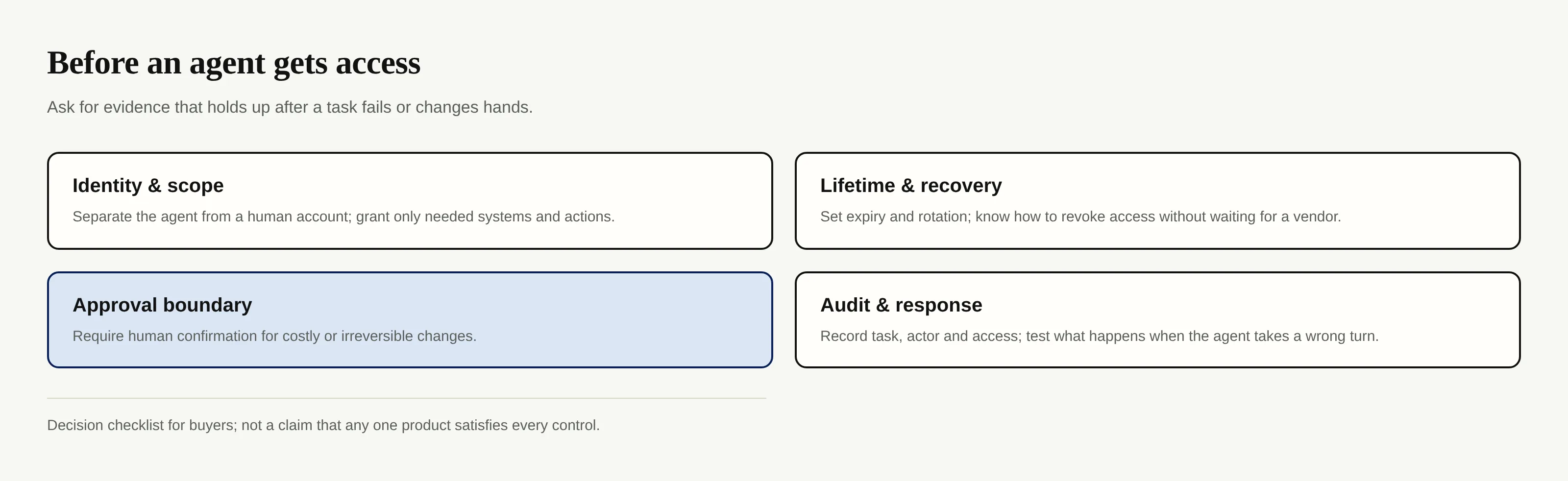
First write down the smallest job: “prepare the reply” is narrower than “manage my inbox.” Then ask the tool owner or vendor to demonstrate what happens when the task changes midway. A useful purchase review has concrete answers:
- Identity and scope: Does the agent have its own identity? Can it read without being allowed to send, delete or edit?
- Expiry and reversal: Can you end access after the task, rotate the credential and undo an unintended change?
- Approval: Which costly or irreversible steps stop for your confirmation?
- Records: Can you connect the request, the credential use and the resulting action without relying on a shared login?
Infisical also documents dynamic secrets, which may address credential lifetime; assess the particular connection and permissions, not a feature label. If a supplier cannot demonstrate an access boundary, start with a read-only task. Zentor's always-on workspace is useful when work doesn't depend on your laptop remaining open, but that convenience makes the stop-and-review question more urgent, not less. Our agent security framework covers broader governance, while the agent security risks guide examines failure modes rather than this financing event.
FAQ: Agent secrets management after Infisical's raise
Is this only for enterprises?
No. A small shop connecting an assistant to a shared inbox faces the same permission distinction as a large company, even if its buying process is shorter. The founder's organization count doesn't tell us how many customers are small firms.
How is agent secrets management different from a password vault?
A vault protects the credential. Agent access also needs a clear answer to who or what may use it, on which task, under which permissions, until when, and how the resulting action will be recorded. Those functions may live in separate products.
What should a small team do now?
Choose one low-risk, read-only workflow and keep write or send actions behind human confirmation. Check revocation and activity history before expanding access. You can explore Zentor for portable workspace memory and task delivery; evaluate the permissions of each connected service separately. Funding is a prompt to ask better questions, not a reason to skip them.

Zentor Research Public data on the AI ecosystem
Zentor Research publishes quarterly data studies on the AI tools ecosystem, drawing on public registries (npm, GitHub, Hugging Face, arXiv, Google Trends). All charts and datasets ship under CC-BY 4.0.
Turn insights into action.
Zentor automates the recurring work your analysis points to. No engineering required.