Why JPMorgan Is Blocking AI Agents From Bank Accounts

Why is JPMorgan restricting AI agents bank account access? See what read-only sharing still allows and how to keep payments under your control.
JPMorgan is blocking outside AI agents from logging into retail accounts and acting for customers, not banning every authorized data connection. The distinction matters if you're weighing AI agents bank account access: on its October 13, 2026 earnings call, CEO Jamie Dimon called unrestricted outside-agent access “too risky for clients and for JPMorgan,” according to the bank's earnings transcript.
Mateo· built by the Zentor team
Get help with the tasks around your money, not your bank login
Mateo checks your inbox and calendar, finds the trial, the refund and the form you forgot, and handles them. Works in any browser, anywhere.
Ask Mateo →
Free in early access
Key Takeaways:
- Chase's reported restriction targets agents logging in and moving money for retail customers; authorized read-only data sharing remains possible.
- Reading a balance is different from sending a payment, but transaction histories still reveal private habits.
- For financial work, start with the smallest available permission, inspect every proposed action and keep the bank's own confirmation step.
- A capable model doesn't make a broad login safe. The actual connector and its revocation controls determine what the agent can do.
What JPMorgan Actually Said About Outside AI Agents
Dimon's remarks came during the third-quarter earnings call, not in a standalone written policy announcement. The official transcript records him distinguishing JPMorgan's own agent use from “just any outside agents.” CFO Jeremy Barnum specifically discussed services that ask customers for banking credentials, then log in or scrape screens to move money. He said the bank blocks those routes where it can. That distinction makes AI agents bank account access more precise than “all AI access is banned.”
A bank spokesperson told CNBC it currently blocks external agents from operating for retail customers, supports secure customer-authorized data sharing through open-banking providers, and has given no date for enabling agents to interact directly with accounts. Dimon's warning about a “liability transfer” isn't a legal determination of who pays for every disputed transaction.
What Can External Agents Still Read or Do?
For Chase accounts, CNBC reports that an agent using an authorized connector such as Plaid can still receive some data, including balances, on a read-only basis. The same report says it cannot send money or pay bills through that access. Read-only doesn't mean no access, and “Plaid supports payments elsewhere” doesn't mean a particular Chase-to-agent connection includes payment authority. Check the specific institution, app and permission screen.
| Route discussed here | What it permits in this account context | What it does not establish |
|---|---|---|
| Authorized read-only sharing | Access to approved Chase data such as balances | Permission for that external agent to transfer funds |
| Bank login handed to an outside agent | A route Chase says it blocks for retail customers | A sanctioned workaround or a safe way to delegate payment |
| Bank's own customer-facing tools | Separate development and pilots | Availability of an external-agent payment connection |
If you run a small shop and only want to see whether a client invoice cleared, don't supply your full bank login to get an answer the bank's own app can give. More detail may be exposed than the balance you asked for; Plaid's description of Muse lists transactions, holdings and mortgage information among data a person may choose to share.
Why Muse and Other Personal Agents Changed the Conversation
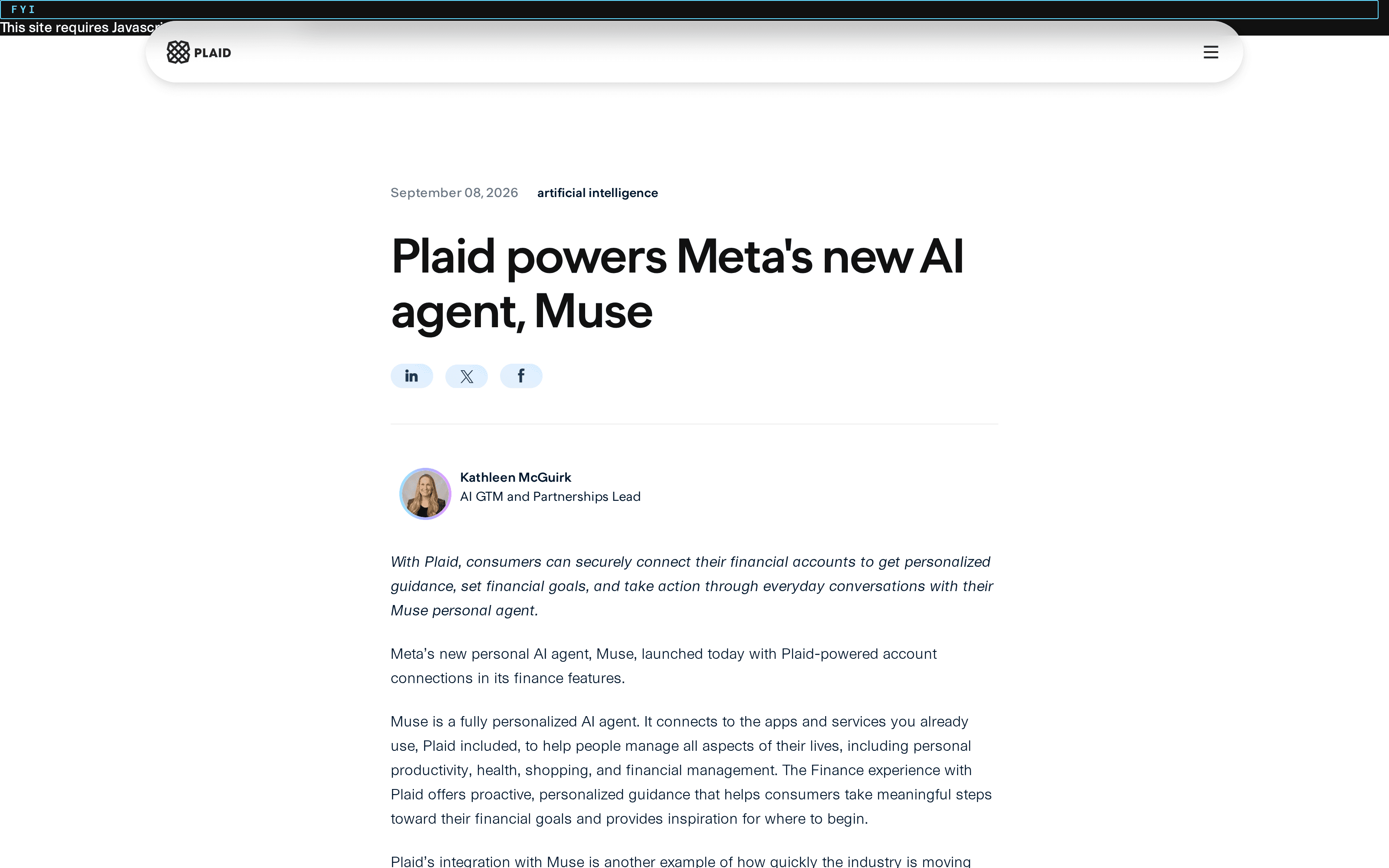
Plaid announced in September that Muse's finance experience can connect financial accounts for contextual guidance. Its public page is pictured below; it describes a permissioned connection, not proof that Muse can transfer Chase money. Financial context can inform advice without granting payment authority.
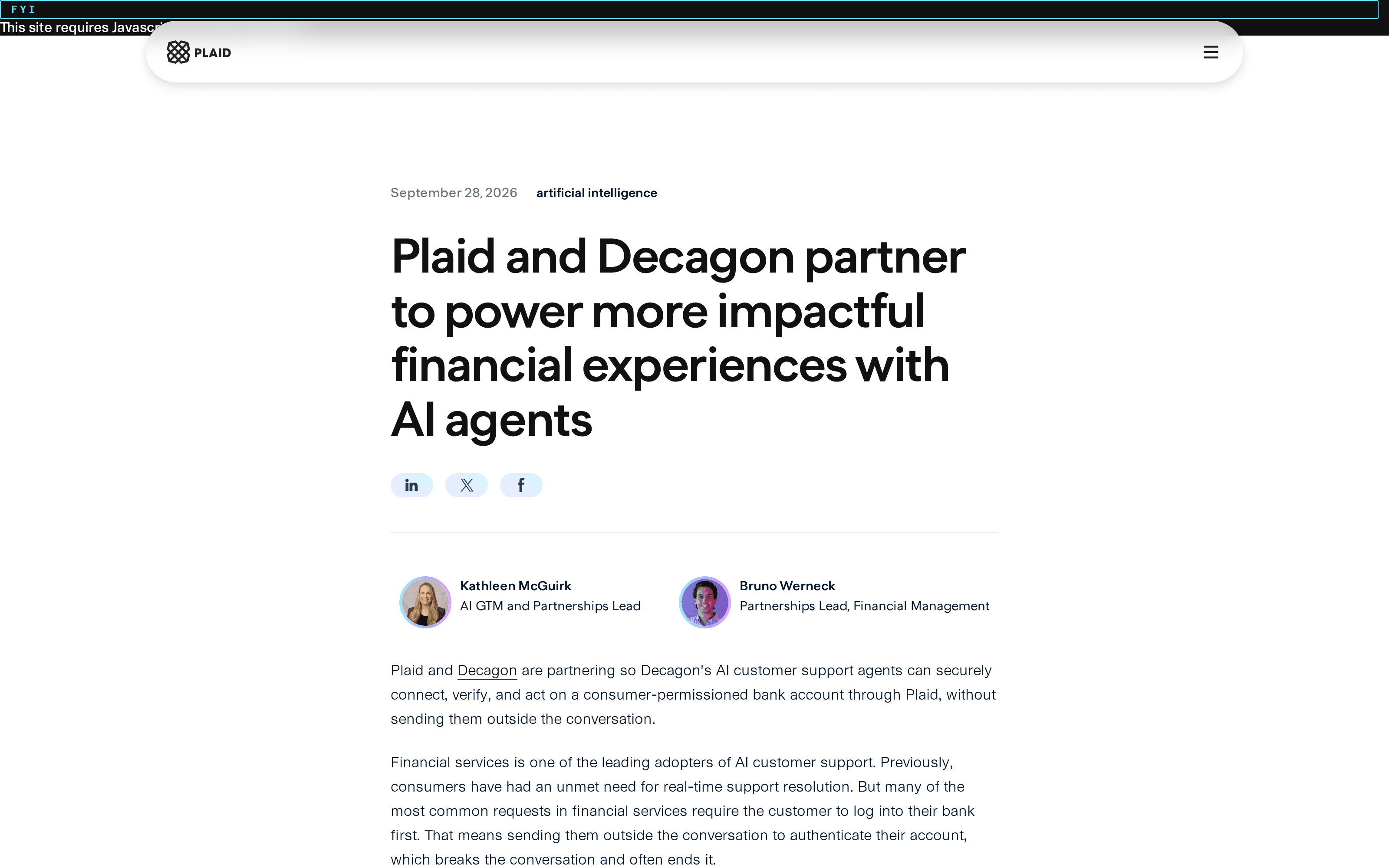
In a separate Plaid announcement about Decagon, Plaid describes agents in permissioned financial-service support workflows; that partnership does not reverse Chase's retail-agent restriction.
For personal agents generally, our 2026 safety guide asks the practical question: what does the connector allow after the pleasant conversation ends?
The Real Risk Is Authority, Not Model Intelligence
Suppose an assistant reads an invoice email that says “pay the new account today.” Even if it extracts every digit correctly, the email may be fraudulent or simply wrong. A read-only connection can summarize a payment due; a tool with transfer rights could turn that untrusted message into a real debit. OWASP's excessive-agency guidance traces this class of failure to excessive functionality, permissions or autonomy. It recommends limiting tools and requiring approval for high-impact actions.

Zentor's workspace memory can preserve the context of a recurring task across AI tools through Zentor MCP; memory portability is not a bank authorization system. Zentor's Smart Routing chooses a model for a task, but a different model cannot shrink a bank connector's scope. And Zentor's always-on workspace shouldn't become a reason to leave a sensitive session open indefinitely. Treat the permission screen, action log and ability to disconnect as separate questions from whether an assistant remembers your preferences. Our memory-versus-history explainer covers that distinction.
A Safer Way to Use an Agent Near Your Finances
Keep the money movement with you. Ask an assistant to sort receipts or draft a question about a disputed charge, then verify amounts against the bank's records yourself. For a finance app, read the categories and duration, choose the narrowest scope and find the disconnect control. Plaid says its Portal manages Plaid-powered connections; disconnecting doesn't guarantee every app deletes previously received data.
Where an agent proposes a payment, require a separate review showing the recipient, account, amount and source document. Approve through the bank's own supported flow, if one exists, rather than treating an agent's “done” message as a receipt. If a service insists on your bank password or asks you to evade Chase's restrictions, stop. No public timetable exists for an external-agent payment path at Chase, per CNBC.
The adjacent personal-agent job is less risky: find a trial-ending notice or a refund email before it slips by. Mateo, built by the Zentor team, works on the inbox-and-calendar side of that problem. It is not presented here as a way to log in to Chase, read balances or pay bills. You can let an assistant surface the reminder while retaining the decision and the bank action yourself.
Keep useful context without handing over the keys
Zentor carries your workspace memory across AI tools. Review each connection and keep financial approvals in your own hands.
Get early access →
FAQ: AI Agents and Bank Account Access
Can an AI agent move my money?
Some services and banks support authorized payment workflows, but CNBC reports that an outside agent cannot send Chase payments through the read-only access discussed here. Never infer transfer rights from an app's ability to show a balance.
Is read-only bank access safe?
It reduces the risk of an unauthorized payment through that connection, but exposes sensitive financial data. Check exactly which categories the app receives, what it retains and how you revoke its access.
What should I never connect?
Don't give an outside agent your full Chase banking login as a supposed shortcut around the restriction. Avoid any connection whose permissions, storage or disconnect process you cannot explain to yourself before approving it.

Zentor Research Public data on the AI ecosystem
Zentor Research publishes quarterly data studies on the AI tools ecosystem, drawing on public registries (npm, GitHub, Hugging Face, arXiv, Google Trends). All charts and datasets ship under CC-BY 4.0.
Turn insights into action.
Zentor automates the recurring work your analysis points to. No engineering required.