What Is ThoughtSpot AgentSpot? Multiplayer AI

What is ThoughtSpot AgentSpot? Learn how multiplayer AI lets teams share agents and how conversation, workflow, and app usage changes budgets.
ThoughtSpot AgentSpot is a shared enterprise workspace where people build and use goal-based AI agents, workflows, and interactive apps together. Announced on October 22, 2026, it pitches “multiplayer AI” and charges for conversations, workflow runs, and app sessions instead of counting seats or model tokens. That makes the usage event, rather than the number of people invited, the first budget question.
Key Takeaways:
- AgentSpot turns a colleague’s agent or workflow into something others can reuse under access controls.
- The building blocks are agents, recurring workflows, and prompt-built interactive apps.
- Building and testing are free; unlimited users and agents do not mean unlimited usage.
- Buyers should forecast the conversations, executions, and app loads that work generates, then verify credit rules in the current product terms.
What is ThoughtSpot AgentSpot?
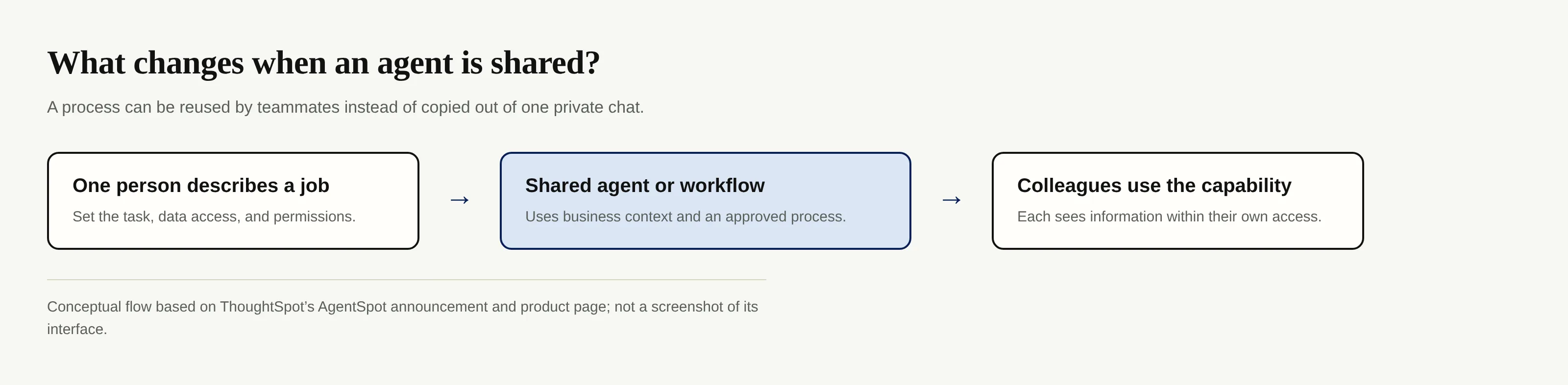
AgentSpot is ThoughtSpot’s workspace for people and goal-based agents to work on shared business tasks. In the launch announcement, ThoughtSpot says a person can describe a job in natural language, build an agent, automate a process, or make an interactive application and share it with colleagues. Its product page also describes teammates joining the same agent conversation, with answers subject to each person’s data access.
The distinction is the reusable process. A private chatbot thread leaves colleagues reconstructing your instructions; AgentSpot aims to let them run the shared capability with company context. Whether that saves time needs testing.
How multiplayer AI differs from a copilot
“Multiplayer” describes how work moves between people and agents, not a claim that a bigger language model sits behind the screen. Suppose your operations lead repeatedly investigates why two departments report different revenue figures. In a private copilot chat, the explanation may die in that conversation. In a shared workspace, a reusable agent can draw from agreed metric definitions; other authorized colleagues can ask it a follow-up without rebuilding its instructions.
ThoughtSpot says definitions come from its semantic layer, while memory operates at company, agent, user, and agent-user levels. Test whether changed definitions reach the next workflow within access limits; sharing a transcript cannot establish that.
Zentor approaches a different part of this problem: its AI workspace guide explains how persistent context, approved tools, and a delivered result differ from an answer trapped in chat. Zentor is aimed at an individual’s work across connected apps, not presented here as an AgentSpot integration or a replacement for enterprise-wide governance.
Work across tools, then deliver the result
For work that crosses your own apps, Zentor keeps the memory yours and puts the output where it belongs. No ThoughtSpot connection is implied.
Get early access →
What can teams build in AgentSpot?
The launch groups work into agents that investigate and act within permissions; workflows that repeat on schedules or triggers; and apps that combine connected data with agent-powered actions. A sales team might share an account-research agent; finance might run a recurring variance investigation. Those are ThoughtSpot’s own examples, not reported customer outcomes.
Pilot one owned process with a checkable output. Specify the figures’ source, the agent’s permissions, and who reviews surprises. Do teammates reuse it or fall back to their own prompts? ThoughtSpot’s agent-building guidance recommends hand-checking outputs before wider sharing.
How does outcome-based AI pricing change a budget?
ThoughtSpot’s press release says building and testing cost nothing and users and agents are unlimited; it calls the chargeable units a conversation, a workflow run, or an app session. The AgentSpot product FAQ adds an important detail: its Data to Outcome (DO) credits apply when a new conversation starts, a workflow runs, or an agentic app loads; activity extending beyond a continuous 24-hour period can incur another credit. “Outcome” here is a billing category, not a promise that the business result was successful.
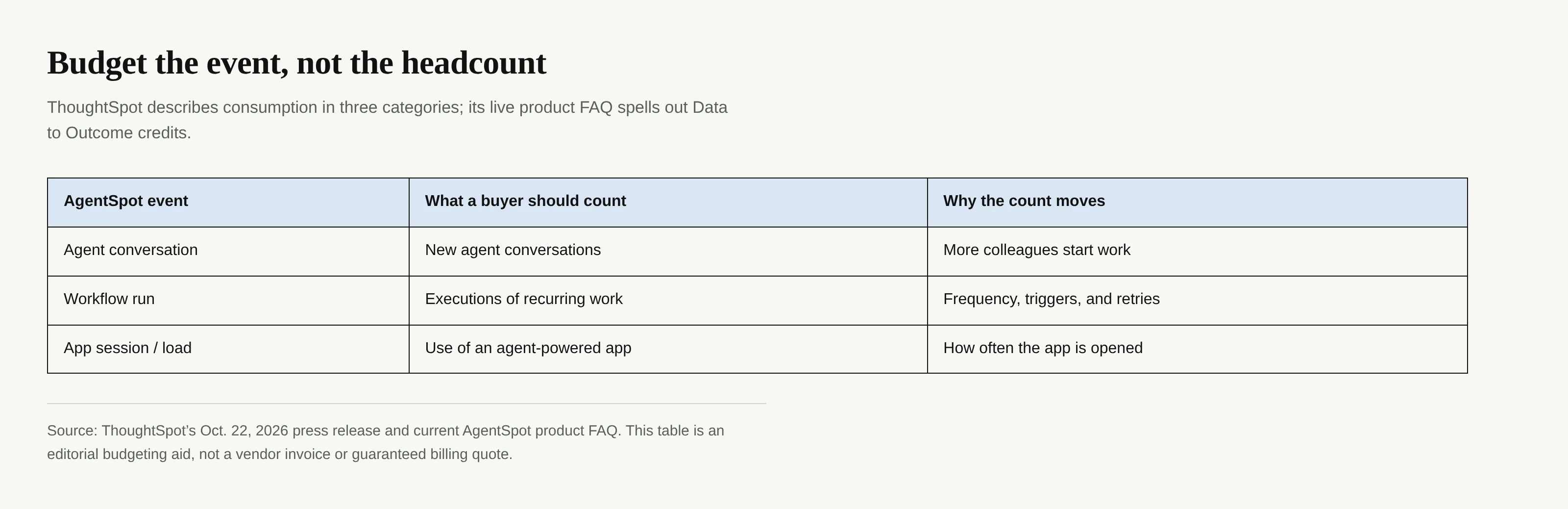
Unlimited seats remove one procurement hurdle, but extra people may start more conversations and open more apps. For a recurring workflow, count planned executions and restarts; ask ThoughtSpot how app loads, long-lived sessions, and plan allowances appear on an invoice. Forecast from a usage sample, not the marketing phrase.
This model also differs from other consumption systems in its unit of account. Microsoft’s Copilot Studio billing guide assigns varying Copilot Credit rates to different kinds of answers and actions. Comparing vendors by “price per agent” alone would hide those distinct meters. Request a usage export and price the same pilot workload under each contract.
Governance and memory before a rollout
Shared capabilities carry shared mistakes. ThoughtSpot’s administrator documentation describes access roles, connector-tool permissions, audit logs, and organization memory. Ask who approves memory changes, who can publish, and what an auditor sees after a bad action.
Zentor’s Notion integration guide makes a narrower, useful point for its audience: work can use live workspace context through a connector rather than endless copying into a chat. That does not grant Zentor ThoughtSpot’s organizational semantic layer or its permission model. Keep the two products’ claims separate.
Who should care, and what else should they compare?
AgentSpot makes the most immediate sense when colleagues repeat a data-grounded process and need to share the agent, its context, and its controls. A solo operator with a few tools may care more about whether the result lands back in the right place than about a company-wide agent catalog. That is the bridge to Zentor: it keeps workspace memory that belongs to the user and delivers work into connected tools. Neither product should be assumed to connect to the other.
Shared agents are not unique to ThoughtSpot. Glean’s sharing documentation distinguishes viewer, editor, and owner access, as well as sharing from publishing. Compare actual access boundaries, data definitions, change approval, and billing events; “multiplayer” by itself cannot settle a buying decision.
ThoughtSpot AgentSpot FAQ
Is there a free AgentSpot plan?
Yes. ThoughtSpot announced a no-time-limit, no-credit-card free plan on October 22, 2026, with a weekly allowance for agent conversations, workflow runs, and app sessions. Check current plan terms before committing a production process.
Does AgentSpot charge for every token or user?
ThoughtSpot says no: building and testing are free, and plans include unlimited users and agents. Usage still consumes DO credits for chargeable conversations, workflow executions, and app loads, under the current product rules.
What counts as an “outcome” for billing?
It is an event category rather than a verified commercial outcome. The product FAQ says a new conversation, a completed workflow execution, or an app load uses a credit, with extra credits possible for activity continuing beyond 24 hours. Confirm exceptions and contract terms directly with ThoughtSpot.
Does Zentor integrate with ThoughtSpot AgentSpot?
No integration is claimed here. Zentor’s workspace memory and connected-app delivery offer a separate route for personal or small-business work; AgentSpot targets shared enterprise agent operations.

Zentor Editorial Zentor editorial team
The Zentor editorial team writes about workflow automation, AI agents, and the tools we build. Default byline for industry overviews, listicles, and collaborative pieces.
Ready to put this into practice?
Zentor runs browser tasks, research, and schedules automatically. Try it free.