The AI Agent Context Problem (Not an Intelligence Problem)

The AI agent context problem explains why longer task horizons do not guarantee trustworthy action. See what a system of record for agents would need.
The AI agent context problem is the gap between what a capable model can do in a test and what it knows, may do, and can verify inside real work. In an October 2026 a16z essay, Databricks CEO Ali Ghodsi argues that agents lack a dependable record of those conditions, even as the length of software tasks they can handle has roughly doubled every seven months. The question: who owns the facts and authorizes the next action?
Key Takeaways:
- The seven-month trend measures a model's human-equivalent software task horizon, not how long it runs or how well it handles every office job.
- Ghodsi proposes a “system of record for agents” that makes organizational facts, authority and feedback usable by agents.
- More relevant context can reduce avoidable mistakes; it cannot replace reasoning, permission or a way to check the result.
- For personal work, portable workspace memory is useful, but it is not the same thing as an enterprise's authoritative customer database.
A context problem, not an intelligence problem
Ghodsi's line in the a16z profile of Databricks is blunt: “AI does not have an intelligence problem,” Ali explains. “It has a context problem.” The authors contrast long coding tasks with companies that still won't trust an agent to update Salesforce. They name missing data, permission, feedback and unwritten employee knowledge. It is Ghodsi's diagnosis, not proof models have stopped mattering.
Suppose you ask an assistant to change a customer's delivery date. It may understand the request perfectly yet lack the latest order record or the authority to alter it. A smarter model alone cannot supply the missing record. For individuals, Zentor lets workspace memory travel to different AI tools through its MCP. That isn't your employer's approved order ledger.
Keep your work context available across AI tools
Zentor gives your workspace memory a home you control. See what it can carry into the next task.
Get early access →
The doubling data: what the clock actually tracks
The METR research on long software tasks estimates a model's “time horizon” by relating its success rate to the time a skilled human would spend on a task. At a 50% horizon of an hour, the model succeeds on tasks of roughly that human length half the time. That isn't an hour of agent runtime or proof of unsupervised office work.
The a16z essay says that in 2022 ChatGPT handled coding tasks requiring a person around 30 seconds, whereas frontier agents now complete coding tasks that take a skilled engineer a full workday. It attributes the roughly seven-month doubling, tracked back to 2019, to METR; a16z's own post repeats the comparison. METR's current time-horizons page explains both 50% and 80% success thresholds and the underlying software-task benchmark. Those distinctions matter more than the catchy endpoints.
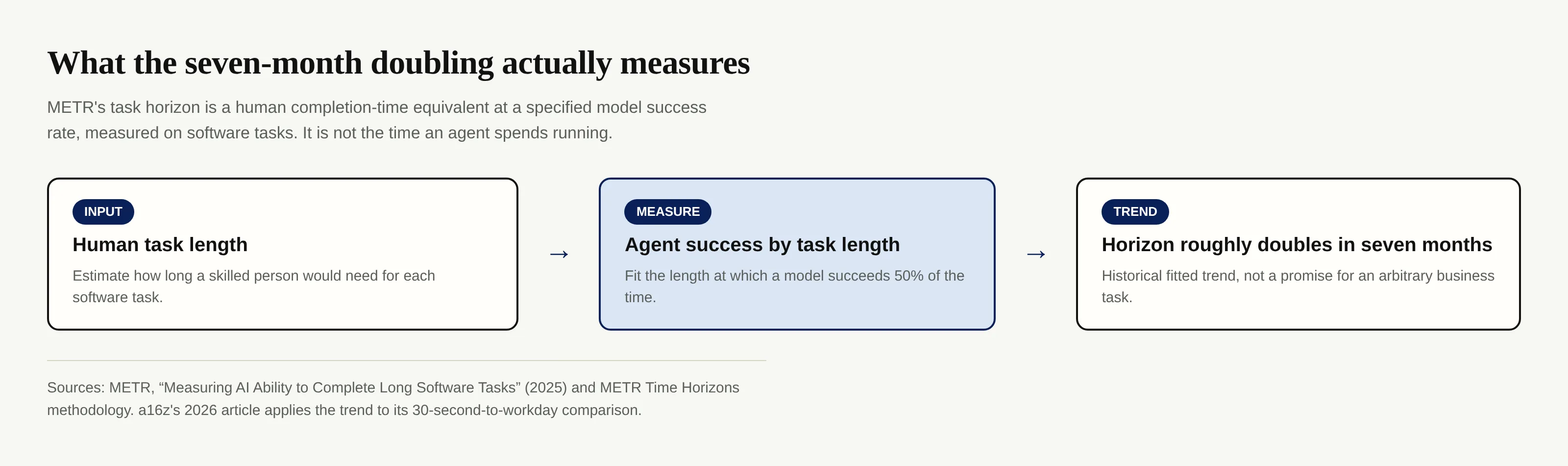
A draft reply differs from one sent under your name. The benchmark doesn't establish performance on refunds, bookings or customer records.
Why propose a system of record for agents?
A system of record holds the authoritative order status, rather than whichever copy last appeared in chat. The a16z authors argue that agents also need to know which source wins a dispute, who approves a change and how to judge the outcome. Much of this remains unwritten.
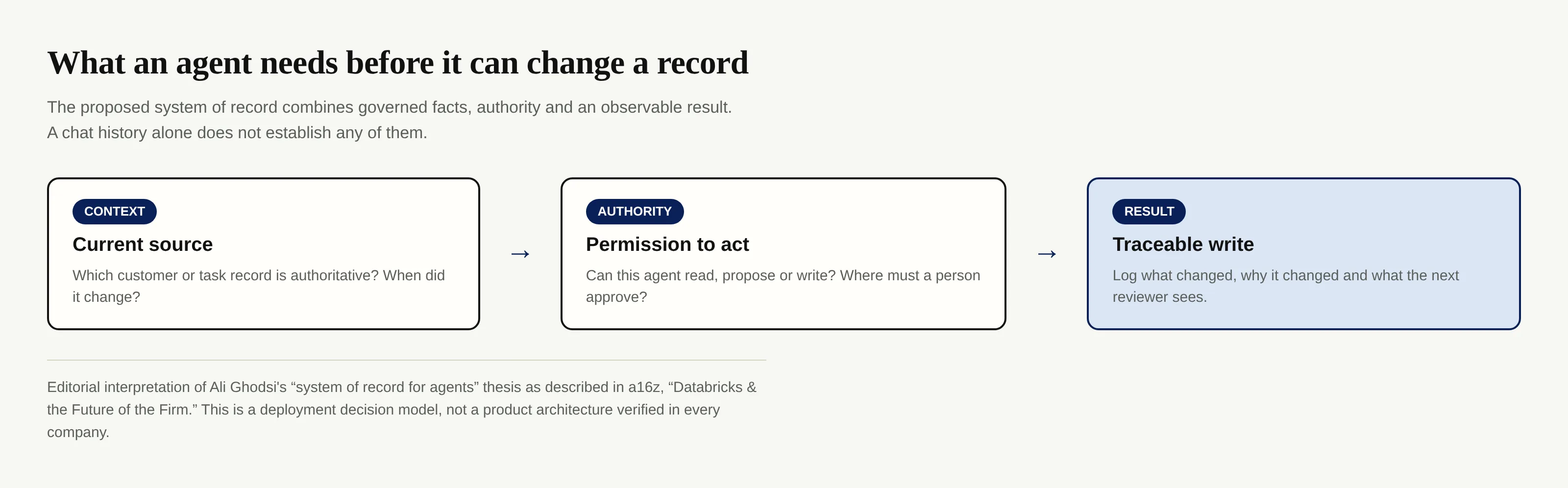
The proposed system of record for agents would make that operational knowledge available for both reading and writing. The diagram is an editorial model of the thesis, not proof that Databricks has solved every part of it. Databricks' Unity Catalog documentation describes governed access and discovery for data and AI assets; the wider claim that such a foundation becomes the agent's organizational memory remains a strategic argument in a16z's essay.
Zentor's portable memory speaks to the personal version of the issue. If you change AI tools halfway through a course project or a one-person business campaign, your working context shouldn't have to start over. The existing guide to context engineering for AI agents covers how to shape the information an agent receives. For a complementary personal-memory question, see what MyContext means. This article asks which information deserves to count as the record.
What this changes when teams deploy agents
The AI agent context problem changes the purchasing question: can the agent see the right task version, respect its authority and leave an inspectable change? NIST's AI Risk Management Framework offers a broader risk-governance framework; it doesn't certify this particular architecture.
Imagine an agent preparing a stock update when a supplier email contradicts the spreadsheet. It should surface the conflict before changing the sheet. Zentor's self-adaptive workspace and self-learning skills support continuity for your own work; neither grants authority over someone else's records.
Where the thesis is strongest, and where it remains a claim
Measured: METR reports a historical increase in the human-length of software tasks agents can complete at a specified success threshold. Attributed: a16z reports the 2022-to-2026 coding comparison and quotes Ghodsi's diagnosis. Proposed: a system of record for agents could turn company knowledge, permissions and feedback into a stable working substrate. None of those statements establishes that an arbitrary agent can run a business process safely today.
Databricks sells governed-data infrastructure, and a16z makes a case for its place in the future firm. The thesis needs different evidence from METR's measurement: ask for success rates, correction costs, access controls and reversals before agents write important facts. Anthropic's agent-building discussion likewise separates a model-led agent from more constrained workflows; the distinction is useful when deciding where autonomy is worth the trouble.
The AI agent context problem is not solved by making the prompt longer; someone remains responsible for deciding which instruction is authoritative.
FAQ
What is a system of record for agents?
In Ghodsi's proposal, it is an authoritative working layer agents can consult and update under defined permissions, with shared meanings for records and feedback on results. It goes beyond storing a long conversation; the architecture and its effectiveness remain to be demonstrated across organizations.
Does more context mean more capability?
Not automatically. Relevant, current facts can prevent a capable agent from acting on the wrong order or rubric; extra stale material can confuse it. The model still needs to reason, respect permissions and check its work.
Is the seven-month doubling trend reliable?
It is a historical fit to measured software-task horizons, with success thresholds and benchmark choices that affect interpretation. The trend is evidence of rapid improvement in that test family, not a forecast that every business process will double in reliability on the same schedule.

Zentor Research Public data on the AI ecosystem
Zentor Research publishes quarterly data studies on the AI tools ecosystem, drawing on public registries (npm, GitHub, Hugging Face, arXiv, Google Trends). All charts and datasets ship under CC-BY 4.0.
Turn insights into action.
Zentor automates the recurring work your analysis points to. No engineering required.