Claude Fable 5.2 Pricing, Broken Down
Claude Fable 5.2 pricing explained: $8/$40 API rates, fast mode, caching, batch discounts, plan access, and what real tasks cost vs Opus 5.5.
Claude Fable 5.2 pricing is simpler than it looks once you separate the plan you are on from the model's API sticker: on a Max, Ultra, or premium seat it is included in your subscription; on Pro it runs on metered usage credits; and through November 16, Pro gets a free launch week up to half of weekly limits. The $8/$40 per-million-token API number is what developers pay, not what most subscribers will ever see on a bill.
Fable 5.2 launched November 9, 2026 at $8 per million input tokens and $40 per million output, 20% below Fable 5.1's $10/$50 (the launch page). This guide walks the cost on every plan, the launch-week offers, and what a typical session actually costs.
Key Takeaways:
- Fable 5.2 is bundled on Max, Ultra, and premium seats with its own weekly limit; Pro meters it via usage credits after Nov 16
- Launch week (through Nov 16): Pro and standard Team seats get Fable included up to 50% of weekly limits, plus a reset; Max/Ultra/premium get 1-3 resets
- API reference: $8/$40 per million tokens, cache read $0.20, batch 50% off, fast mode $16/$80
- Effort is the hidden multiplier: the same prompt ran $24 to $642 across settings in one public test
- On Zentor, Ultra is the Fable tier on plan credits, no second bill
Fable 5.2 cost on every plan
Free plan: no Fable access at all. The picker does not show it.
Pro ($20/month tier): through November 16, Fable is included up to 50% of your weekly usage limits, at no extra cost, plus one Fable reset. After the window, it meters through usage credits at standard API rates, so a heavy Fable habit on Pro can cost more than a Max subscription (plan help).
Max and Ultra: Fable is bundled, with a separate weekly Fable limit distinct from the general pool. Verified Ultra accounts additionally have no five-hour window at all. Launch gift: one to three resets by subscription age.
Team and Enterprise: premium seats get bundled Fable like Max; standard seats meter it like Pro. Admins can disable the model organization-wide.
Launch week pricing, the part that expires
The launch offers are the cheapest Fable access that will exist (launch offers):
- Pro and standard Team seats: all Fable models included for one week up to 50% of weekly limits, plus one reset expiring November 16.
- Max, Ultra, and premium seats: one to three resets by tenure (under six months one, six to twelve months two, over a year three), usable until March 8, 2027.
A reset restores the Fable portion of weekly usage and refills the five-hour window; it does not raise caps. Pro users who have been waiting for a reason to test the top tier have exactly one window, and it is already running.
API pricing, kept as the reference it is
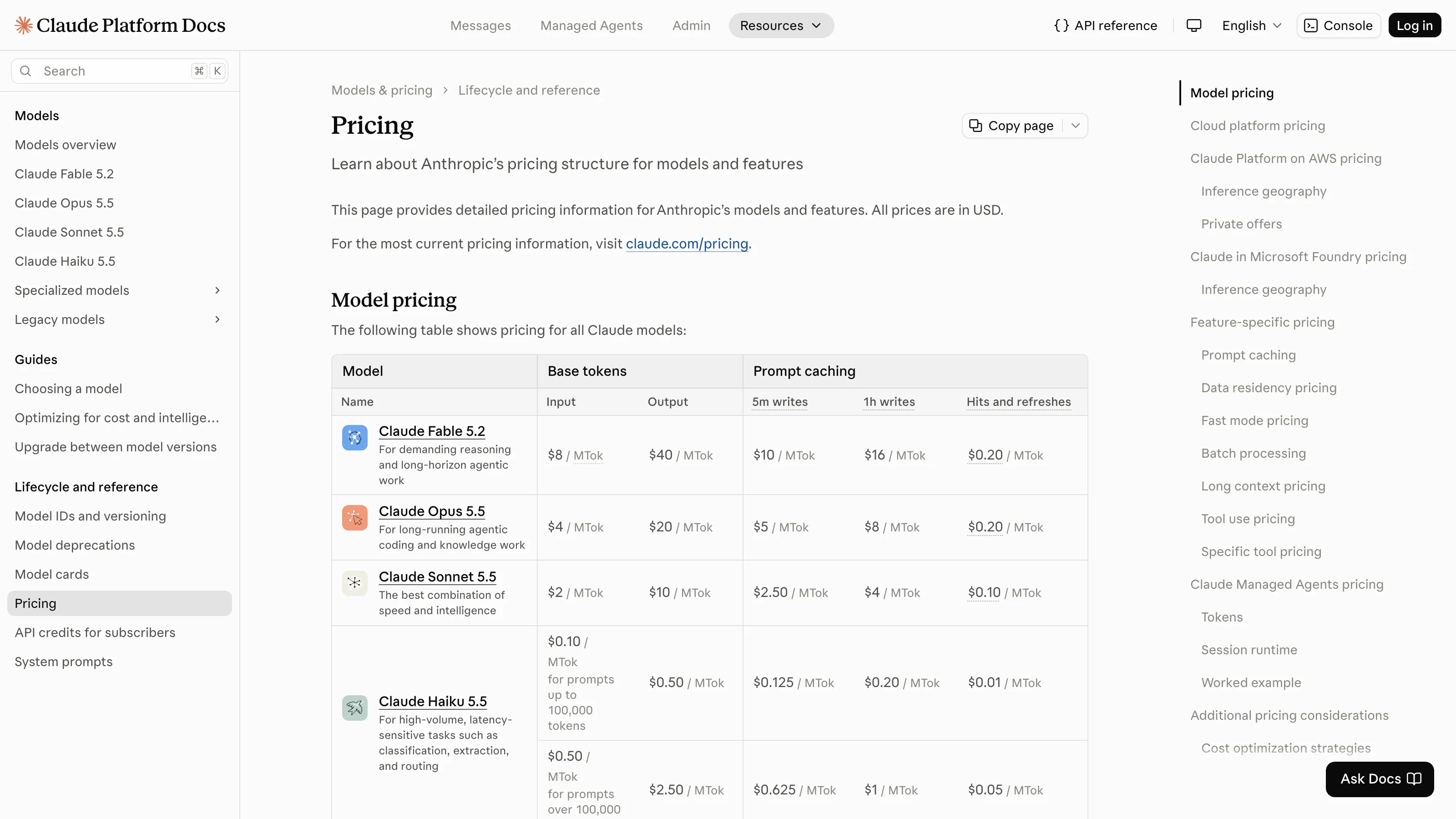
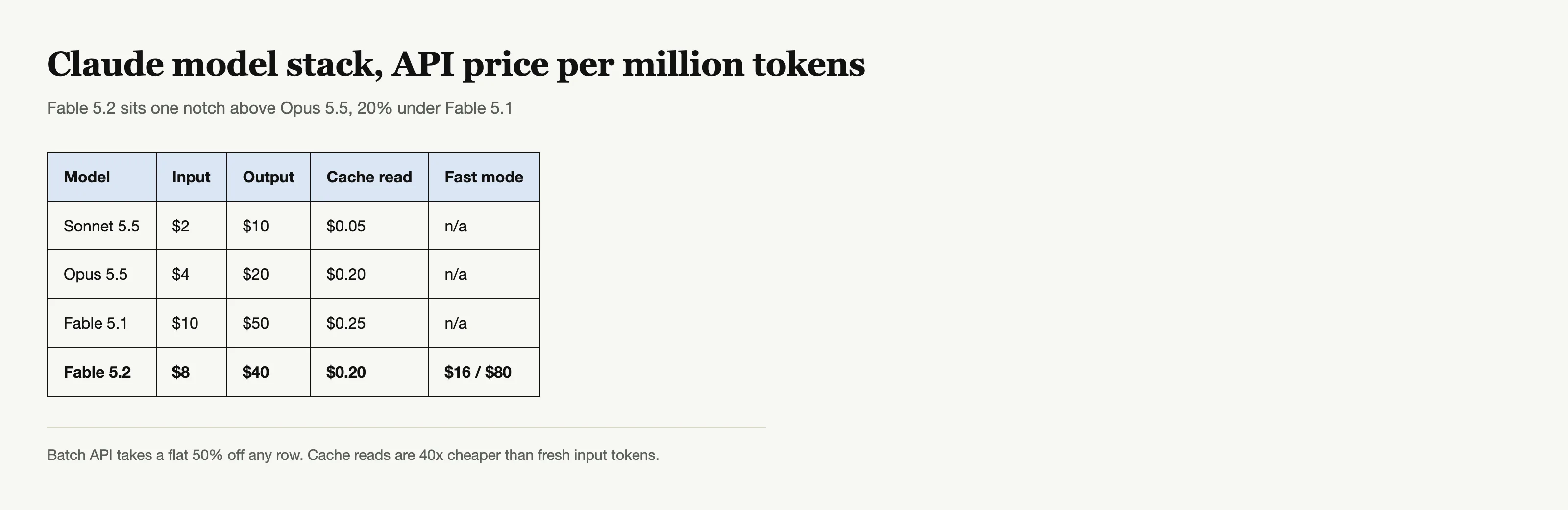
| Meter | Fable 5.2 | Fable 5.1 | Opus 5.5 |
|---|---|---|---|
| Input / MTok | $8 | $10 | $4 |
| Output / MTok | $40 | $50 | $20 |
| Cache read | $0.20 | $0.25 | $0.20 |
| Batch API | 50% off | 50% off | 50% off |
| Fast mode | $16 / $80 | n/a | n/a |
Cache reads at 2.5% of input price are the quiet bargain: long conversations cost almost nothing to re-send as long as the prefix stays stable (model overview).
One meter for every model
On Zentor, Fable 5.2, Opus 5.5, and the rest share one plan-credit balance. Auto picks the tier; you watch one bill.
Try Zentor →
Claude Fable 5.2 pricing in practice: the effort multiplier
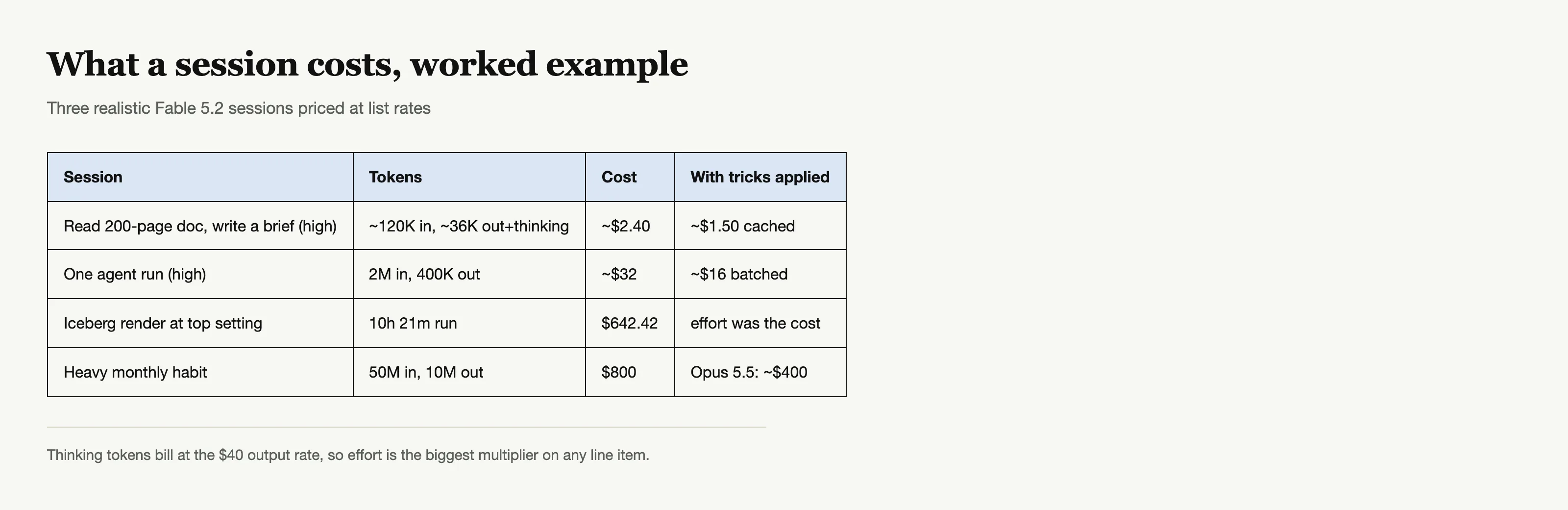
List price is per token; effort decides how many tokens a task emits. Fable 5.2 defaults to high, adaptive thinking cannot be switched off, and thinking bills at the $40 output rate, so a hard prompt produces a pile of thinking tokens before the first visible word.
The cleanest public measurement: one iceberg prompt ran $24.31 at High, $43.79 a step up, $87.99 at Max, and $642.42 at the tester's top setting, same model and prompt, a 26x spread on the effort dial alone (post). Against Opus 5.5, same-prompt tests land at 2x to 4x per task ($23.45 vs $10.35 on a rocket scene, post).
Worked cost examples
A research pass reading a 200-page document (120K tokens in) and writing a 4,000-word brief (36K out with thinking at high): about $0.96 input + $1.44 output, roughly $2.40. Repeat it with a warm prompt cache and the second run drops toward $1.50.
A full agent run, say 2M input and 400K output+thinking at high effort: $16 + $16, about $32. The same shape on Opus 5.5 at medium lands near $12, and at max effort on Fable it can triple again. That is the real spread behind the 2x headline.
A monthly habit for a heavy user (50M input, 10M output): $800 on Fable 5.2, $400 on Opus 5.5, $200 on Sonnet 5.5.
Cheaper ways to run Fable 5.2
- The launch offer itself: free allowance on Pro through Nov 16, resets elsewhere.
- Batch API for non-urgent work, a flat 50% off.
- Prompt caching: cache reads are 40x cheaper than fresh input.
- Effort discipline: medium is dramatically cheaper than the high default.
- Opus 5.5 for the 80% of work that does not need the ceiling.
- On Zentor, the Ultra tier runs Fable on plan credits with Auto deciding which turns deserve it, so the top-tier spend lands where it earns (the integration page).
The thinking-token line item people miss
Fable 5.2's adaptive thinking is always on, and thinking tokens bill at output rates. On a prompt that triggers a long reasoning pass, the thinking share can exceed the visible output by 5x or more, so a "$40 per million" model produces bills that look nothing like a 1:1 input-output ratio. The iceberg effort sweep is the clearest public example: the difference between $24 and $642 on one prompt was pure thinking time.
Prompt-level instructions like "answer directly" do not suppress thinking at medium effort and above on Fable 5.2, per Anthropic's migration notes, so the only reliable lever on that line item is the effort parameter itself.
Subscription pricing vs what your receipt shows
The plan prices and the meter are two different conversations. A Pro subscriber pays $20 a month for the plan, then pays usage credits on top for Fable after the launch window, billed at standard API rates against a monthly cap you set. A Max subscriber pays more for the plan but Fable comes out of the bundled allowance with its own weekly limit. For a consumer deciding between them, the real question is whether a month of occasional Fable use through credits costs less than upgrading, and for occasional use it almost always does.
Usage credits themselves are pay-as-you-go at standard API rates, non-refundable once purchased, and expire 12 months after purchase for credits bought on or after December 7, 2026 (usage credits). The spend cap in Settings > Usage is the control that keeps a Fable habit from becoming a surprise line item.
What the competition costs for context
The headline number only makes sense against the rest of the picker. Sonnet 5.5 at $2/$10 handles most production work, Opus 5.5 at $4/$20 is the quality sweet spot Anthropic recommends as the daily driver, and Fable 5.2 at $8/$40 is the ceiling. On the consumer side, the equivalent spread is the plan ladder itself: Pro is the entry, Max is where Fable stops being metered, Ultra is where the limits loosen furthest. Choosing where to spend is the same decision at both levels: how often does your work actually need the top of the stack.
Is Fable 5.2 priced fairly?
Against the lineup it sits exactly one notch above Opus 5.5 and two above Sonnet 5.5 while undercutting its predecessor by 20%, an unusual move for a flagship launch. The complaint from the community is not the list price but the effective price: generous defaults, self-spawned subagents at high effort, and a Pro metering scheme that feels free until the credits run dry. Priced deliberately, it is reasonable; priced naively, it is the most expensive way to learn what effort does. See also Claude Fable 5.2 vs Opus 5.5 and the usage-limit breakdown.
Claude Fable 5.2 pricing and the "expensive" reputation
Launch-week takes like "Fable 5.2 is too pricey" mostly describe unmanaged usage: default-high effort, no caching, no batch, runs that spawn subagents. Priced deliberately, the right effort level with stable cached prefixes and batch for async work, the same model lands near Fable 5.1's old economics while doing more per task. The list price went down; the bill is a habit problem.
Fable 5.2 vs Fable 5.1 on price alone
The 20% cut deserves its own line because it changed the tier's logic. Fable 5.1 at $10/$50 was priced like a special-occasion model; Fable 5.2 at $8/$40 is priced like a model Anthropic expects people to actually use. Combined with up to 30% faster output generation, the cost per finished task improved roughly twice over, so long as effort stays comparable. In practice effort is where the savings leak away, which is why watching the dial matters more than the headline cut.
Where Zentor fits in the pricing picture
Zentor meters Fable 5.2 through its own plan credits rather than Anthropic's app limits, and Auto routing only spends the Ultra tier on turns that need it. For people who want occasional Fable-class runs without a second subscription's usage anxiety, that is the lower-friction path: one bill, one meter, and routing that already assumes the top tier is a scarce resource.
The line item most people miss: thinking
Adaptive thinking is always on, and thinking tokens bill at the $40 output rate. A prompt that triggers a long reasoning pass can produce more thinking than visible output, which is why the effective price of a Fable task is the task's depth, not the list price. The only consumer-facing lever on that line item is effort, which is why the effort guide is the companion piece to this one.
Is Claude Fable 5.2 pricing worth it for you
Whether Fable 5.2 is worth it for you collapses to a simpler question than the per-token arithmetic: how many tasks a month actually need the top of the stack. The plan math follows from that count. Occasional use through launch week, then metered credits on Pro, covers most solo users; Max is the answer when the count gets high enough that metering anxiety costs more than the tier difference.
Where the plan and the meter meet
The subscription and the API price only coincide on the metered surfaces. On Pro and standard seats, post-launch Fable bills at standard API rates through credits, so the $8/$40 table is literally what your Fable habit costs there. On bundled seats it never appears on a receipt at all, it just draws the separate weekly Fable limit. Knowing which side of that line your plan sits on is most of what this page exists to answer.
FAQ
How much does Claude Fable 5.2 cost?
$8/$40 per million tokens on the API, down 20% from Fable 5.1. On Claude plans it is bundled on Max/Ultra/premium seats and metered via usage credits on Pro after launch week.
Is Fable 5.2 included in Max?
Yes. Max, Ultra, and premium seats bundle it with a separate weekly Fable limit.
What does Fable 5.2 cost on Pro?
Through November 16 it is included up to 50% of weekly limits; after that it runs on usage credits at standard API rates.
What does fast mode cost?
$16/$80 per million tokens, double the base rate, for up to 2.5x faster output.
Why is my Fable 5.2 bill higher than expected?
Effort. High is the default and thinking tokens bill at output rates; long runs and self-spawned subagents multiply the total.

Zentor Editorial Zentor editorial team
The Zentor editorial team writes about workflow automation, AI agents, and the tools we build. Default byline for industry overviews, listicles, and collaborative pieces.
Ready to put this into practice?
Zentor runs browser tasks, research, and schedules automatically. Try it free.
References Claude Fable pricing · Fable 5.2 model overview · Fable models on your plan · Effort sweep by @0xRhinoX · Rocket scene test by @Bhavani_00007 · 17506494 · 12429409-usage-credits