Gemini Deep Research Agent Deprecated: Migrate

Gemini Deep Research agent preview retires as early as October 23, 2026. See which Interactions API calls to change and how to test replacements.
As of October 2026, Google has deprecated the deep-research-pro-preview-12-2025 Gemini Deep Research agent and lists October 23, 2026 as its shutdown date. The October 8 release note tells developers to change the agent value in interactions.create; it does not say Deep Research as a service is ending. Google's table calls that date the earliest possible shutdown.
Key Takeaways:
- Search for the exact retired agent ID in Interactions API calls and configuration, including queued jobs.
- Replace it with
deep-research-preview-04-2026for Google's speed-oriented option ordeep-research-max-preview-04-2026for its deeper option. - Keep background execution; test completed results, failures, citations and stream reconnection with your actual tasks.
- Treat October 23 as an action deadline, not proof that the endpoint has already stopped working.
What Google announced about the Deep Research agent
Google's release notes name one deprecated managed agent, deep-research-pro-preview-12-2025, and direct requests to either April 2026 version. The deprecations table records its December 11, 2025 release, October 23, 2026 shutdown date and deep-research-preview-04-2026 as the recommended replacement. Google's old model page carries a warning naming both alternatives.
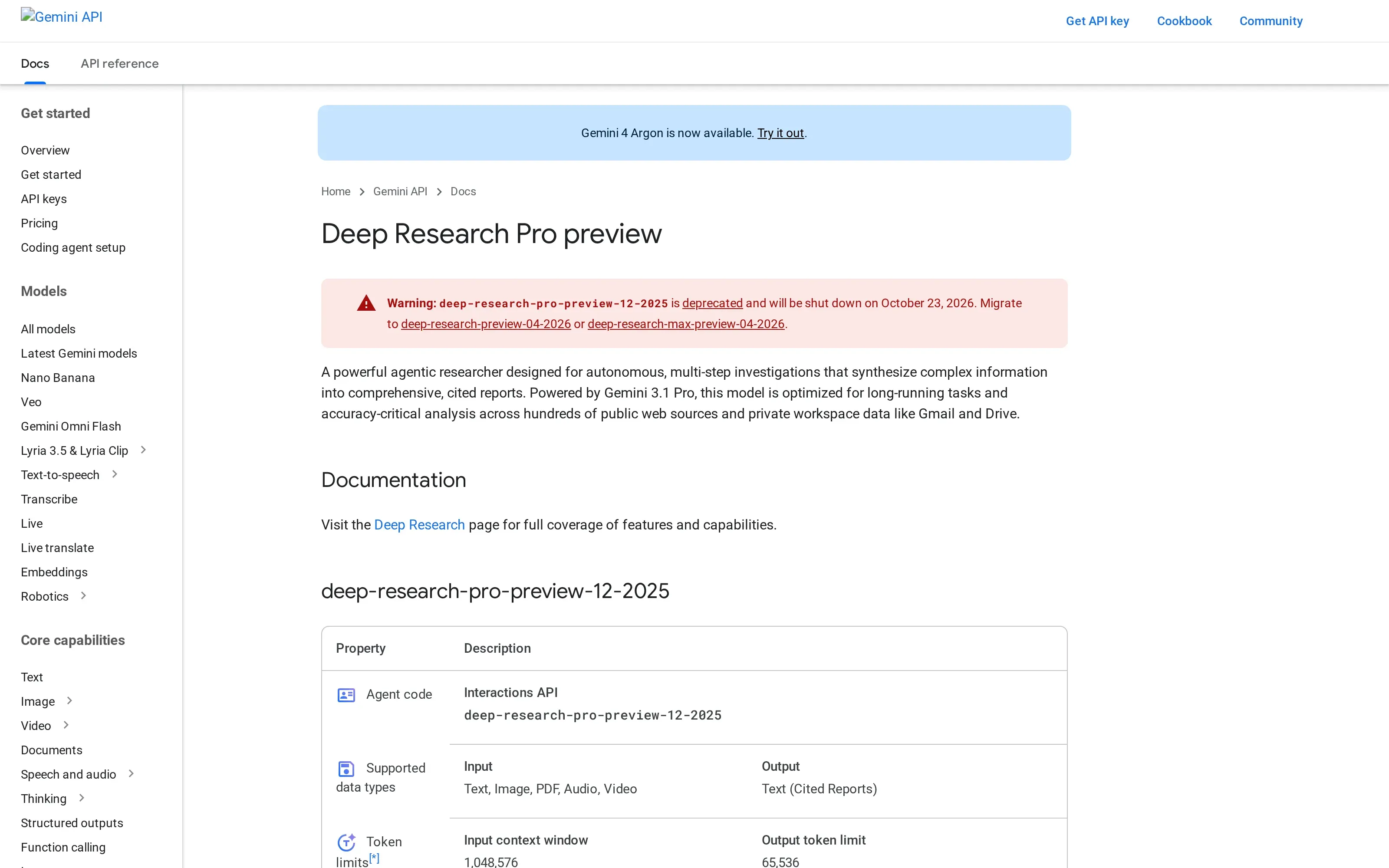
The announcement is about an identifier, not every report produced with Gemini. If your deployment has pinned that string, a scheduled research run could eventually fail at request creation. Google hasn't documented a fallback that silently remaps this agent ID, so don't plan around one. Zentor's own Assistants API migration write-up is a useful comparison: it separates a named retired interface from the broader ability to build agents.
Keep your research workflow under your control
Zentor keeps workspace memory portable across AI tools through Zentor MCP. A provider agent ID still needs its own migration plan.
Get early access →
Which integrations can actually break?
Google's Deep Research guide says this managed agent works exclusively through the Interactions API, not generate_content. An ordinary generate_content call doesn't use the retired agent ID merely because its prompt asks for research. Conversely, an Interactions API call that sets agent="deep-research-pro-preview-12-2025" is in scope, even if a user sees only a finished report and never sees the model name.
Check config as well as code: a scheduled worker might read an old ID after the web handler changes. Test both paths and inspect queued jobs.
Choose between the two replacement agents
The replacement choice is a product description, not an independent benchmark. Google's Deep Research guide describes deep-research-preview-04-2026 as optimized for speed and efficiency, suitable for streaming to a client UI. It describes deep-research-max-preview-04-2026 as aiming for maximum breadth of context gathering and synthesis. The deprecations table lists the first as its recommended replacement, while the changelog explicitly permits either.
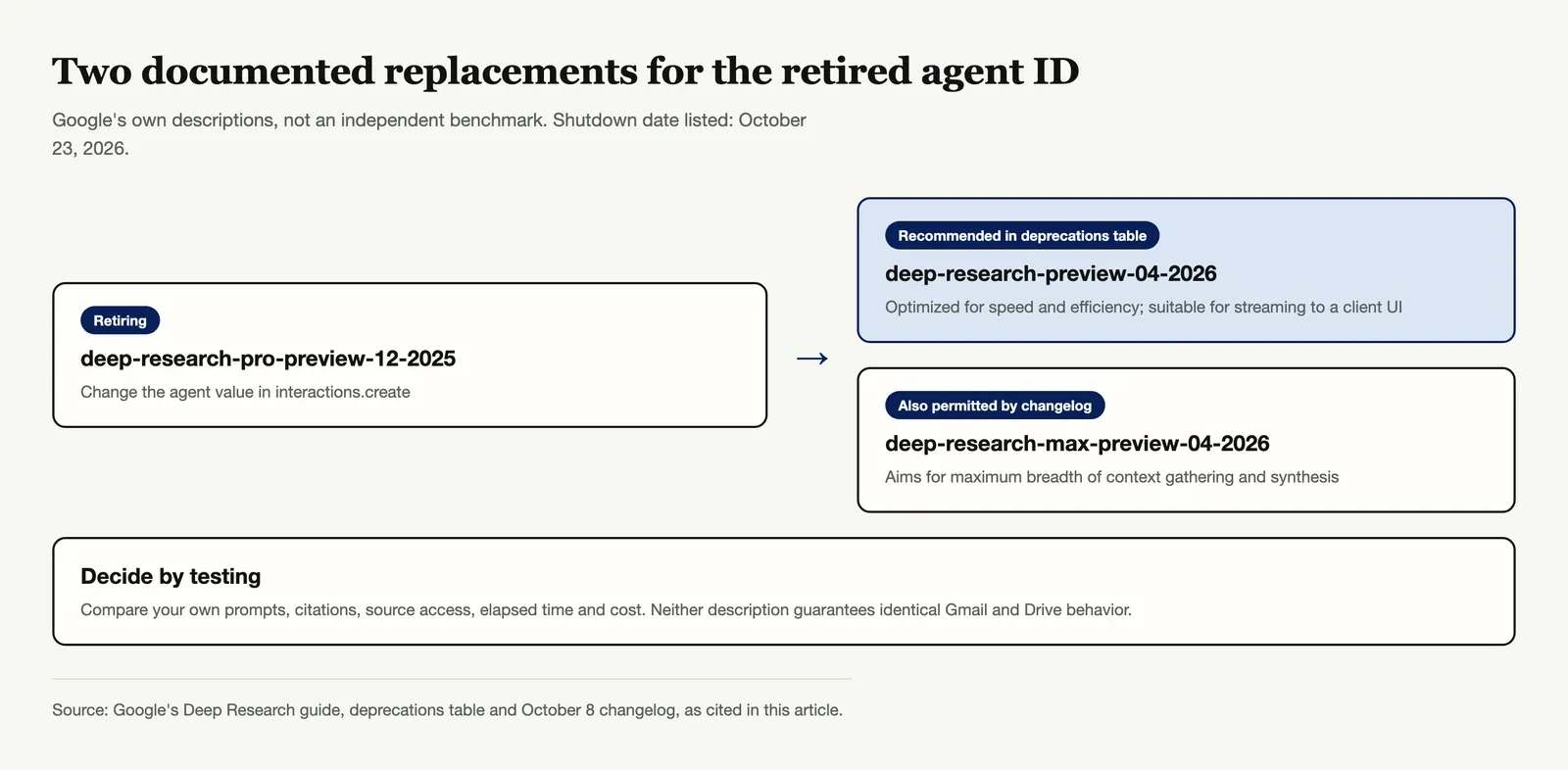
Neither description guarantees identical Gmail and Drive behavior. Compare each candidate using your own prompts, citations, source access, elapsed time and cost.
Change the agent parameter, then retest the run
Google's change instruction is narrow: update the agent argument of interactions.create. Its guide's Python example uses this shape:
interaction = client.interactions.create(
    input="Research the supplied topic.",
    agent="deep-research-preview-04-2026",
    background=True,
)
Use the Max ID instead if your comparison calls for it. This is a minimal illustrative request, not a production migration script; it omits polling, failure handling and any permissions your application may need. Keep background=True because the research guide requires asynchronous execution for these long tasks. The Interactions API documentation explains that an interaction has its own ID and execution steps; save the ID so the job can retrieve its result later.
Re-run an existing fixture and inspect its final state, citations and source access. A replacement that starts but loses a required source hasn't passed.
Background streaming needs a reconnect test
If you stream progress to a client, Google's Deep Research guide requires stream=True alongside background=True. It warns that a streaming connection can drop or expire and shows a reconnect pattern tracking interaction_id and last_event_id. Test that behavior after the ID swap; don't assume reconnect logic remains sound because the agent still emits a finished answer in a short local trial.
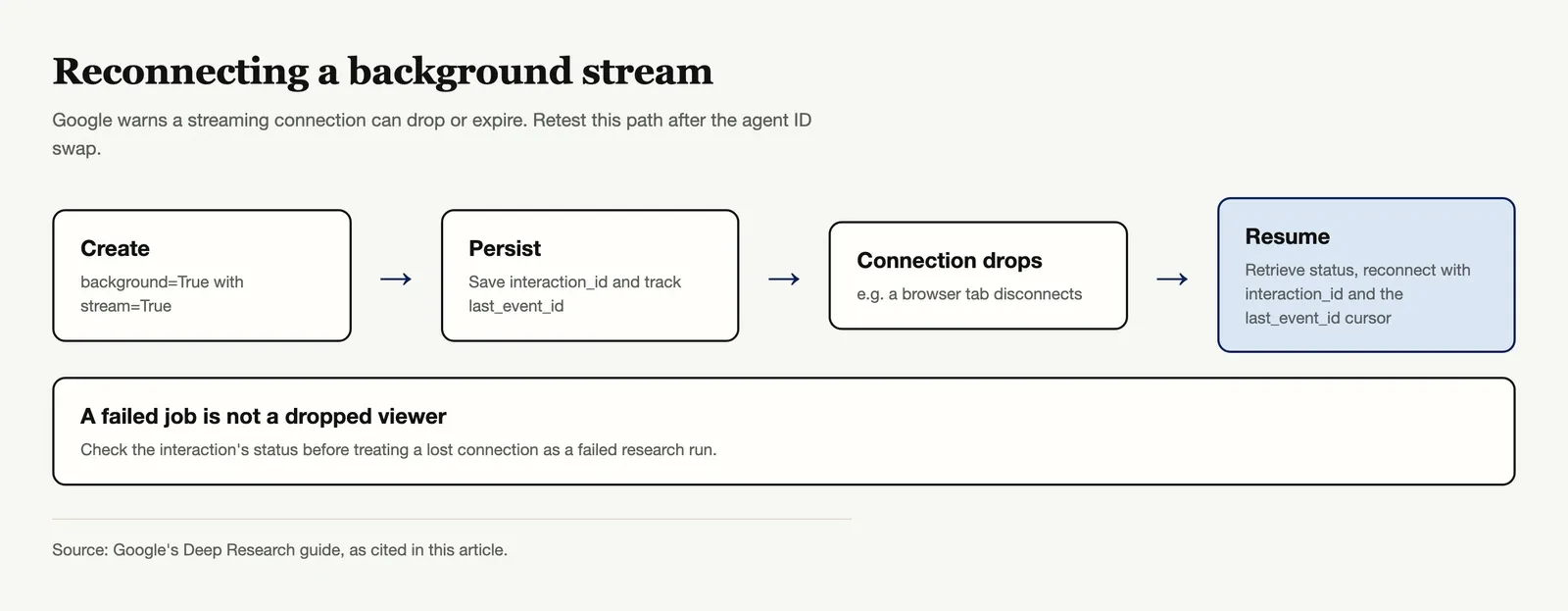
If a browser tab disconnects, persist the interaction ID, retrieve status and reconnect with the documented event cursor. Distinguish a failed job from a dropped viewer connection.
Is October 23 a guaranteed switch-off day?
No. Google's deprecations page says shutdown dates in its table are the earliest possible dates a model might be retired and says it will communicate an exact date with advance notice. Meanwhile, both the October 8 changelog and the model-page warning say the old agent will shut down on October 23. Those texts aren't interchangeable: the notice gives an urgent scheduled date; the table qualifies how to read listed dates.
Act before October 23, but verify the current table, release notes and any notice to your account before claiming the service has actually switched off. As of October 19 we cannot report observed shutdown behavior, nor promise an extension. Our Copilot Studio retirement coverage makes the same operational distinction between a published replacement path and a tested result.
Prepare for the next managed-agent retirement
Put the chosen agent ID in one configuration or adapter instead of scattering it across request handlers and scheduled jobs. Store regression fixtures containing prompts, expected source access and required report fields; compare results, not just HTTP success. Assign someone to watch the official release notes and deprecations table. These are engineering controls, not advertised features of the replacement agents.
If you also move workspace context between AI tools, Zentor's user-owned memory through MCP can reduce dependence on one AI surface. It won't preserve an expired Google agent identifier or independently prove feature parity. Migrate the call, exercise a full-length background run and keep the evidence with the release.
FAQ: Gemini Deep Research migration
Is the whole Gemini Deep Research agent going away?
No. Google identifies deep-research-pro-preview-12-2025 for retirement and documents two newer Deep Research agent versions. Its general Deep Research guide still describes the managed agent.
What replaces deep-research-pro-preview-12-2025?
Google recommends deep-research-preview-04-2026 in its deprecations table; its changelog also allows deep-research-max-preview-04-2026. Choose by testing your own reports rather than assuming the names prove performance.
Do I lose Gmail or Drive grounding?
The retired model page names Gmail and Drive among its private-data sources. The checked deprecation notices do not guarantee identical grounding or permission behavior for each replacement. Check the current guide and test authorized access with both candidates; don't promise equivalence.
Will my generateContent code break?
Not from this agent-ID retirement alone. Google's guide says Deep Research is available through Interactions API and cannot be accessed through generate_content. If another part of your app makes Interactions API calls with the old ID, migrate that path separately.

Zentor Editorial Zentor editorial team
The Zentor editorial team writes about workflow automation, AI agents, and the tools we build. Default byline for industry overviews, listicles, and collaborative pieces.
Ready to put this into practice?
Zentor runs browser tasks, research, and schedules automatically. Try it free.