What Is Google AX? Open-Source Orchestrator
Google AX is an open-source runtime for stateful agents on Kubernetes. See its architecture, limits, use cases, and how it differs from a framework.
Google AX is Google's open-source control plane for running stateful agent workloads on Kubernetes-based infrastructure, not a framework for writing an agent's reasoning loop. Google published AX v0.3.0 on September 20, 2026; its repository labels the API v1alpha1 and warns that breaking changes are likely before a stable release.
Key Takeaways:
- AX manages execution infrastructure around agents: isolated tasks, prepared workspaces, outbound network rules, model configuration, and lifecycle commands.
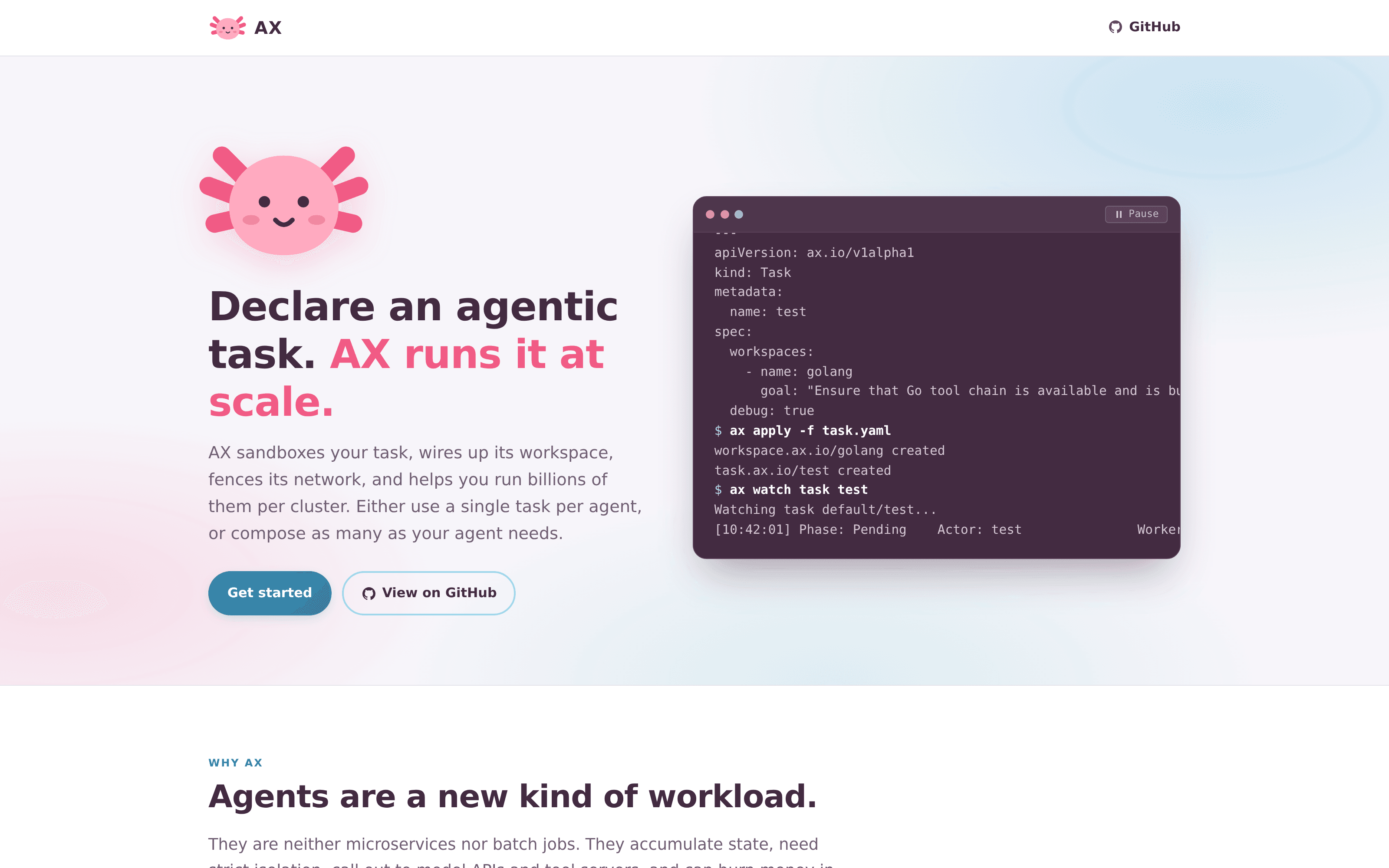
- Your framework or harness still decides what the agent does. AX decides where and under what operational controls it runs.
- The current production path needs Kubernetes plus Agent Substrate, Redis,
ko, and a container registry. - Claims about billions of tasks and sub-second resumption come from Google and the AX project. No independent AX benchmark was available at publication.
Google AX Is a Runtime, Not an Agent Framework
A framework supplies the logic inside an agent: prompting, tool selection, memory patterns, planning, and handoffs. AX sits below that code. Its job is to provision a sandbox, prepare files and tools, apply network boundaries, store control-plane state, and expose operations such as apply, watch, suspend, resume, and ssh.
“Agent orchestrator” can suggest a visual workflow builder. AX is closer to an agent-specific workload control plane. Google's launch post calls it a runtime standard for execution, resumption, and distributed deployment; the official AX site describes a declarative system for agentic tasks.
Explore Zentor if you want an end-user AI workspace that completes work inside your existing tools, rather than Kubernetes infrastructure for deploying agent runtimes. Zentor and AX address different layers, and Zentor does not claim an AX integration.
How the Google AX Architecture Works
AX presents four ax.io/v1alpha1 resources. A Task defines isolated execution, resource requests, a command, workspaces, and a gateway. A Workspace prepares repositories, MCP servers, and skills. A Gateway declares listeners and an outbound host-and-port allowlist. A Model centralizes a provider, model identifier, parameters, and a Kubernetes Secret reference.
The design document describes four Go binaries. The ax CLI sends manifests to ax-server, which stores state in Redis. Redis Streams feed ax-controller workers; those call Agent Substrate to create actors, assign workers, and apply egress controls. Inside each container, ax-task-runner prepares the workspace and launches the command.
AX keeps task records out of Kubernetes custom resources. Its maintainers argue that many short-lived CRDs would strain etcd, so Redis holds task hashes and event streams instead.
What AX Replaces in an Agent Stack
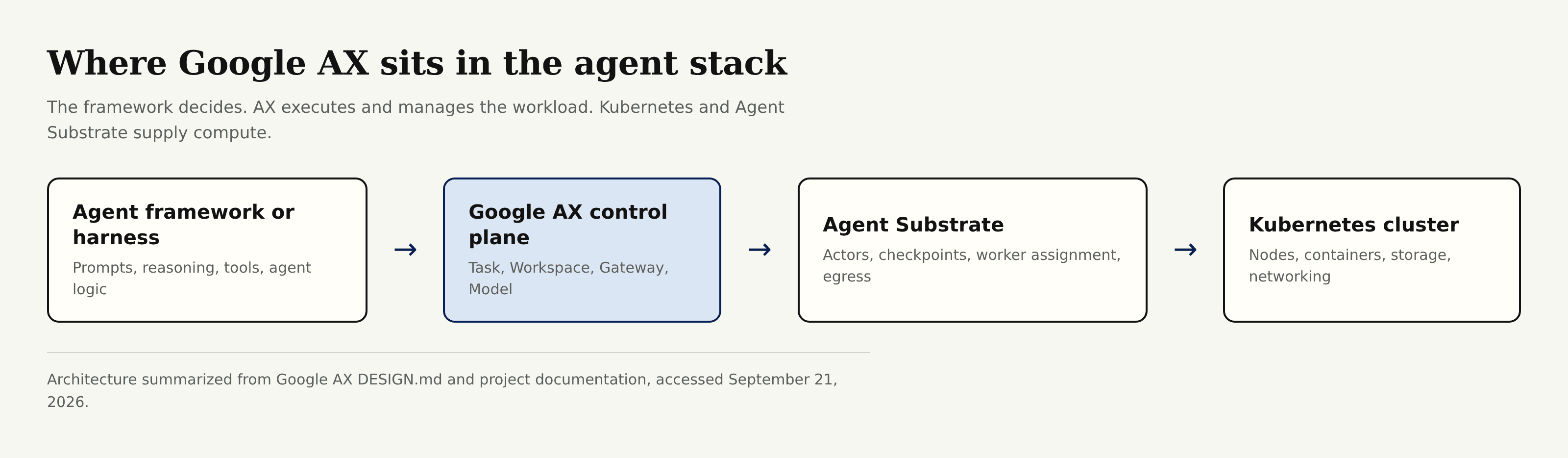
Without AX, an infrastructure team may build a job launcher, workspace setup scripts, sandbox lifecycle services, status streaming, egress controls, and model-secret distribution around each agent product. AX turns those pieces into one declarative API.
It does not replace the model, an agent framework, Kubernetes, or the sandbox runtime beneath it. A task may run one agent process or serve as one node in a larger tree.
This split reflects an ecosystem trend: agent tooling is separating “how an agent thinks” from “how an agent stays alive safely.” Kubernetes describes Pods as relatively ephemeral and disposable. AX and Agent Substrate add agent-shaped lifecycle concepts above that base.
Suspend, Resume, Sandboxing, and Network Policy
The attractive claims need careful labels. AX exposes suspend and resume RPCs, and its quick start shows a file surviving a suspend-resume cycle. The project says Agent Substrate checkpoints actor state before pausing and restores it later. Google's launch post also describes event logs, snapshotting, session consistency, and connection recovery.
Those are vendor and project claims, not results we independently benchmarked. The site says AX can support billions of tasks per cluster and resume in under a second; the public repository doesn't publish an AX benchmark suite that substantiates those figures. Treat them as design targets until your own load and failure tests say otherwise.
Security needs the same restraint. AX's Gateway offers host-and-port egress rules, while Agent Substrate supplies actor isolation. Kubernetes NetworkPolicy only works when the network plugin implements it. Operators must still verify the sandbox class, secret handling, and default-deny behavior.
Who Should Care About Google AX
Platform teams already operating Kubernetes should pay attention if they expect long-running or bursty agents, especially ones that execute generated code or wait for human approval. AI research teams may value reproducible workspaces across evaluation runs.
Most small teams shouldn't install AX merely to run an occasional assistant. The quick start requires a Kubernetes cluster, ko, a registry, Redis, and a reachable Agent Substrate Control API. That means upgrades and incident response.
For students, creators, and one-person businesses, the useful lesson is the direction: serious agent products are acquiring a dedicated runtime layer. Zentor packages operational work as a managed, always-on workspace while keeping reusable context in workspace memory. Its AI workflow examples show the user-facing layer; AX exposes machinery to platform operators.
Current Status, License, and Practical Limits
The GitHub repository is public under Apache License 2.0, and GitHub reports Go as the primary language. On September 21, 2026, the latest release was v0.3.0, with no packaged assets. The README warns that core concepts and protocols remain under development.
The API is alpha, upgrades may break manifests, and installation expects you to build images. External contributions were temporarily paused while maintainers stabilized the architecture. Test AX in a non-production cluster first.
Google AX FAQ
Is Google AX free and open source?
Yes. The code is public under the Apache License 2.0. Running it still incurs whatever compute, storage, registry, model API, and operations costs your deployment creates.
Does Google AX require Kubernetes?
The README describes AX as compute-agnostic in direction, but the current recommended production deployment runs on Agent Substrate on Kubernetes. Its quick start explicitly requires a Kubernetes cluster.
What does agent orchestration mean in AX?
It means managing agent execution as a workload: creating isolated tasks, preparing workspaces, controlling egress, configuring models, watching state, and suspending or resuming execution. It does not mean choosing the agent's next reasoning step.
How is Google AX different from an agent framework?
A framework defines agent behavior, tools, prompts, and coordination logic. AX runs that harness under infrastructure controls. In one sentence: the framework decides; AX executes.
Evaluate AX as Infrastructure, Not as a Framework
Google AX makes the runtime layer explicit: keep agent logic portable, express operational needs declaratively, and move high-volume lifecycle work through Agent Substrate rather than forcing every task through Kubernetes objects.
Evaluate it with a failure drill. Run a representative harness, interrupt it during a tool call, test checkpoint recovery, deny an outbound host, rotate a model secret, and measure resume latency under your own concurrency. AX's claims set hypotheses; your cluster supplies the evidence.

Zentor Editorial Zentor editorial team
The Zentor editorial team writes about workflow automation, AI agents, and the tools we build. Default byline for industry overviews, listicles, and collaborative pieces.
Ready to put this into practice?
Zentor runs browser tasks, research, and schedules automatically. Try it free.
References https://agentexecutor.io · https://github.com/google/ax · https://github.com/google/ax/blob/main/DESIGN.md · https://github.com/google/ax/blob/main/docs/concepts.md · https://github.com/google/ax/blob/main/docs/sandbox.md · https://cloud.google.com/blog/products/ai-machine-learning/agent-executor-googles-distributed-agent-runtime · https://cloud.google.com/blog/products/containers-kubernetes/bringing-you-agent-sandbox-on-gke-and-agent-substrate · https://kubernetes.io/docs/concepts/workloads/pods/ · https://kubernetes.io/docs/concepts/services-networking/network-policies/