Meta Muse Glimmer 30B: Local Agent Model
Muse Glimmer 30B targets one-GPU local agents. Compare it with Muse Spark Open, check 4-bit hardware needs and read Meta's benchmark claims critically.
Meta Muse Glimmer 30B is a local agent model that Meta says can run on one GPU, unlike the much larger Muse Spark Open setup it showcased on two M5 Ultra Mac Studios. Meta's model card lists roughly 30 billion parameters and 4-bit variants targeted at 24 GB and 32 GB hardware; that is a hardware target, not proof that any particular computer will run it well.
Key Takeaways:
- Glimmer and Spark Open belong to the same Muse family, but they are different models with different licenses and hardware demands.
- Glimmer accepts text and images and outputs text; its agent abilities depend on the tools and permissions around it.
- Meta's claims about leading its size class haven't been independently checked here.
- An August launch predates the research page dated October 19, 2026; don't mistake the latter for the first release.
What Muse Glimmer 30B actually is
The Meta research entry describes a causal language model with a perception encoder, trained on data from more than 100 languages. It takes text and images as input and returns text. The official model page describes a single-GPU local deployment and lists Apache 2.0. The license applies to Glimmer's released artifacts, according to the model card; don't carry over the custom Muse Model License from Spark Open.
The distinction matters if you plan to modify or distribute a model: Apache's license text grants copyright and patent permissions subject to its terms. It doesn't certify that your own workflow is private. If a connected tool sends a document to an outside service, local inference alone won't prevent that transfer. Ask where each tool reads and writes before granting it access, especially when the files contain a client brief. A permissive model license is not a permission policy for an agent.
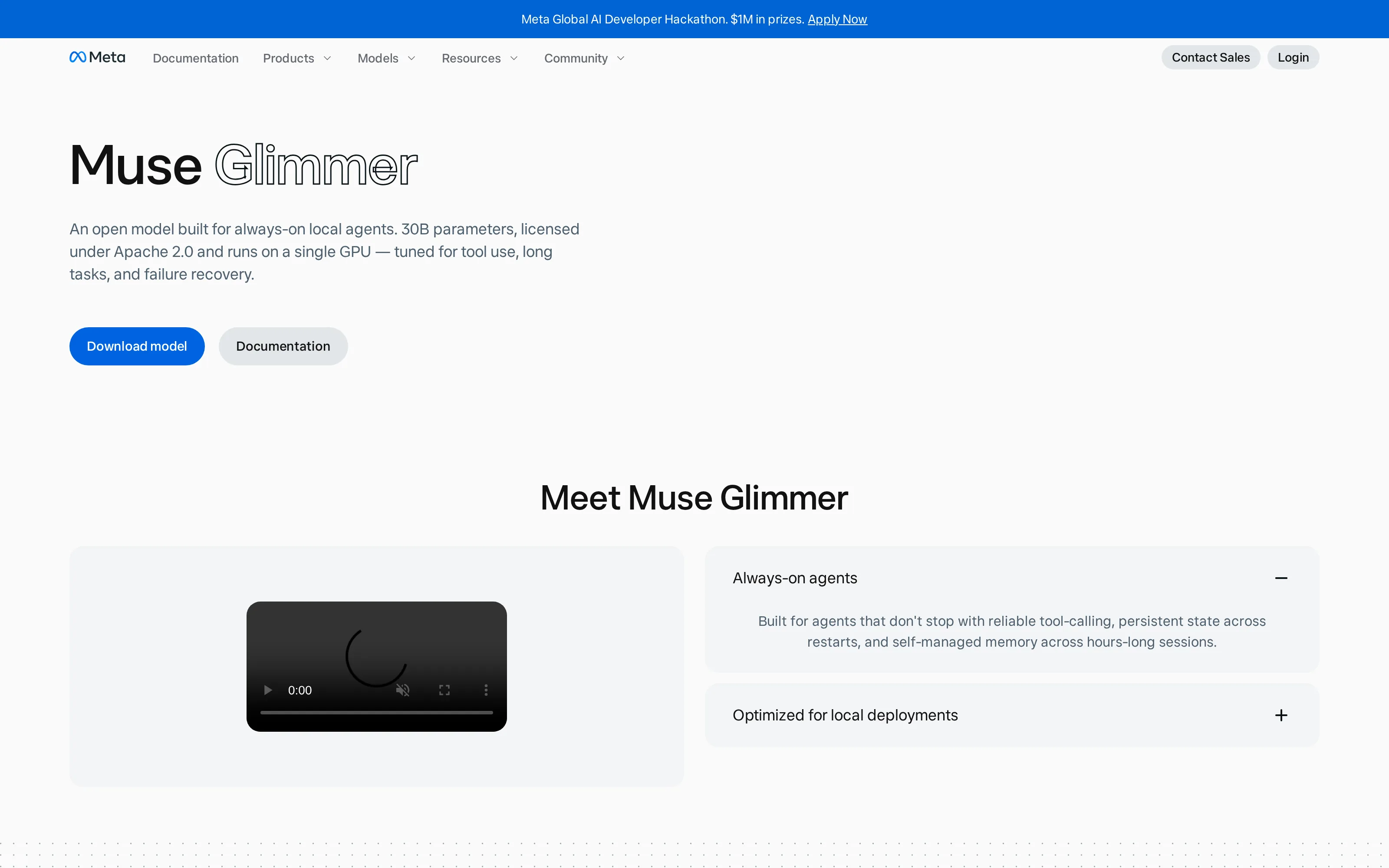
One date needs untangling. Meta's launch post is dated August 10, 2026, and the model card says August 2026, while the research publication page shows October 19. This is a new research-page date, not evidence that the weights first appeared on October 19.
Keep your work context beyond one local model
Zentor keeps workspace memory portable through MCP, so switching AI tools does not mean starting your notes over.
Get early access →
The local-hardware gap with Muse Spark Open
Read our separate Muse Spark Open explainer for its hardware and license details. The two are same-family, different models: Spark Open has 816 billion total parameters, with 42 billion active per token, and Meta showcased local use on two M5 Ultra Mac Studios. Glimmer is a dense model of about 30 billion parameters, distilled from Spark according to its model card. Spark's two-Mac demo is not an absolute minimum for every quantized variant; it is the right comparison for Meta's flagship local demonstration.
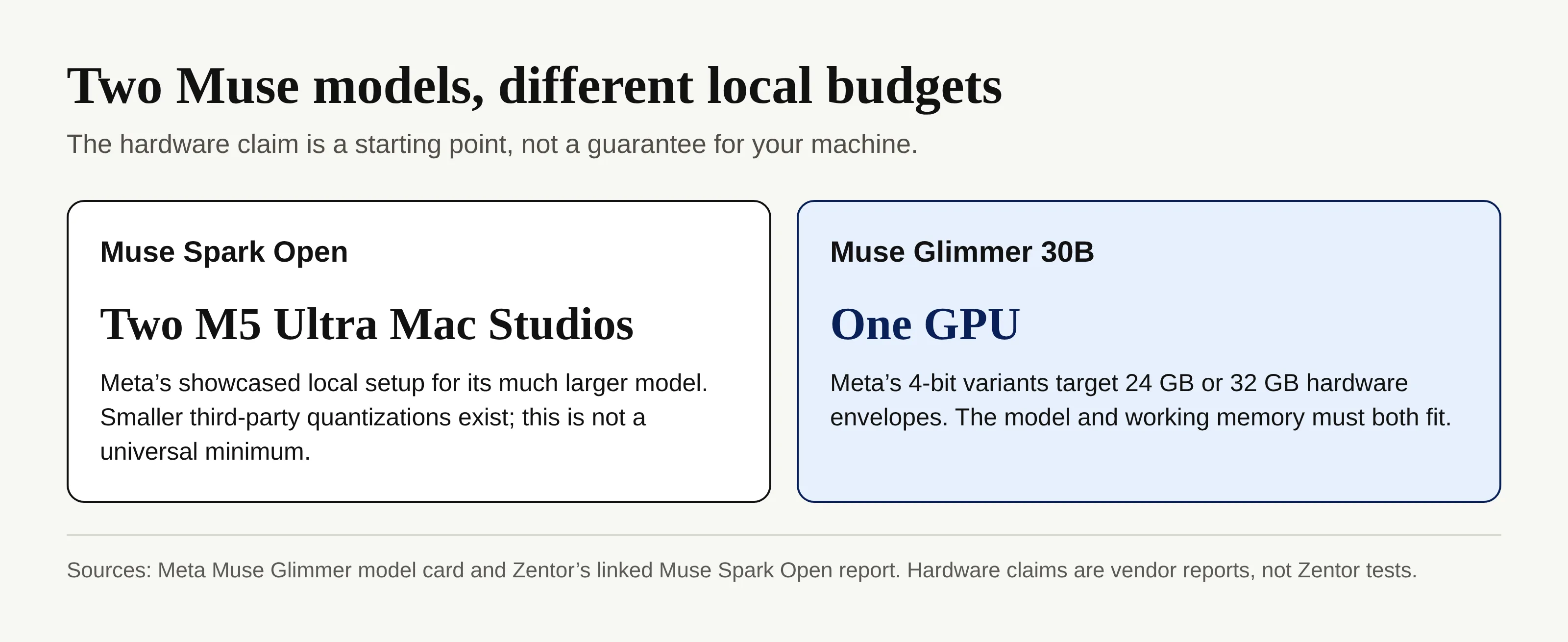
For Glimmer, Meta says approximately 4-bit quantization brings the language model's weights below 20 GB; a 24 GB or 32 GB envelope also has to accommodate the image encoder, working-memory cache and optional drafting component. Check your available memory, not just the name on the GPU. No local setup or throughput was tested for this article.
What its agent abilities do, and don't, give you
Meta says it trained Glimmer for multi-step reasoning, structured tool calls and recovery after tool errors. Image input lets it read a screenshot or chart while planning; it does not give the model independent permission to send an email or change a file. An agent application must provide those tools, decide which actions need confirmation and retain enough task state to make a retry safe. The Meta model card warns that novel multi-step tasks can still fail.
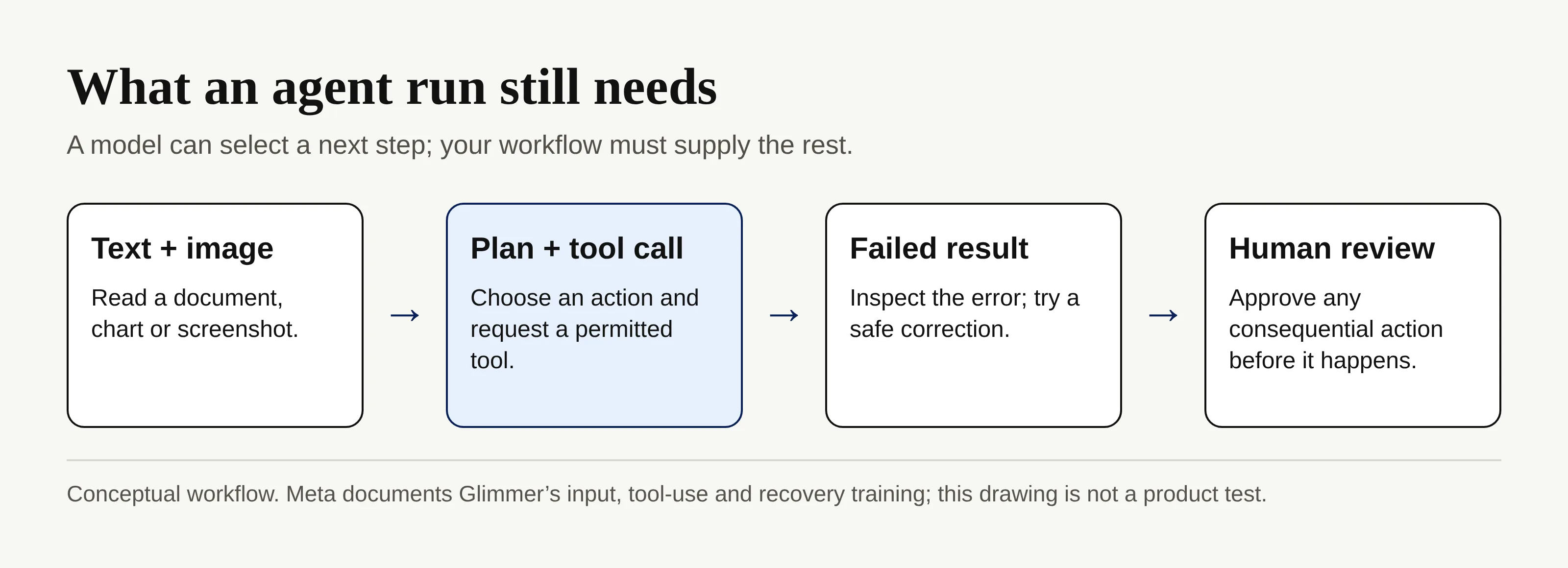
Suppose you want an assistant to sort photos of product listings and draft descriptions. It may read the images, but you still need to check its descriptions and approve what goes live. Zentor's self-adaptive workspace solves a different part of that job: arranging the work around the task, rather than promising that Glimmer is its underlying model.
How to read Meta's benchmark claim
Meta's research abstract calls Glimmer state of the art for its size and says it beats Gemma4-31B and Qwen3.6-27B on agentic tasks. That is a vendor claim, not an independently replicated result. The Meta comparison table itself is mixed: Glimmer leads both named peers on MCP Atlas, yet Qwen scores higher on OSWorld-Verified and TerminalBench 2.1. Different tasks, settings and reasoning budgets can change the ranking. We didn't rerun any benchmark or measure quality after quantization.
Who should choose a local agent model?
A local model makes sense if you have suitable hardware, want control over where files are processed and can manage the surrounding application. A student with private notes might prefer local processing; that alone does not establish the security of whichever tool gets access to those notes. Meta publishes model artifacts and documentation, not a ready-made assistant that handles account permissions for you.
If the real problem is keeping research from last week available across different AI tools, Zentor's user-owned workspace memory through MCP addresses continuity rather than model ownership. For tasks that must continue while your computer is off, its always-on workspace also answers a constraint a purely local run cannot. These are separate choices; Zentor does not claim to run Glimmer. Its pricing page describes the separate hosted service.
FAQ
Is Muse Glimmer 30B the same as Muse Spark Open?
No. Glimmer is a smaller, dense member of the Muse family released under Apache 2.0. Spark Open is a much larger mixture-of-experts model distributed under Meta's custom Muse Model License.
Can I run Glimmer on any single GPU?
No. Meta targets 24 GB and 32 GB envelopes for its 4-bit variants. Your usable memory, runtime and workload still matter.
Does it take video or produce images?
Its documented inputs are text and images, and its output is text. Don't assume native video input or image generation.
Was Muse Glimmer released on October 19?
The research page bears that date, but Meta's launch post is dated August 10, 2026. Treat October 19 as a publication-page date unless Meta clarifies the timeline.
Should I trust the leaderboard claim?
Treat Meta's results as a starting point. Compare the specific task you care about and seek independent tests before replacing a working setup.

Zentor Research Public data on the AI ecosystem
Zentor Research publishes quarterly data studies on the AI tools ecosystem, drawing on public registries (npm, GitHub, Hugging Face, arXiv, Google Trends). All charts and datasets ship under CC-BY 4.0.
Turn insights into action.
Zentor automates the recurring work your analysis points to. No engineering required.