Why Amazon Blocked Meta's Muse AI Agent

Why Amazon blocked Meta Muse on its store, what each company says about credentials, and how Shopify and Amazon's own seller agent redraw shopping access.
Amazon blocked Meta's Muse AI agent from shopping on Amazon.com because Amazon says the agent entered its store without permission or clear identification and raised concerns about customer credentials. The dispute is about who controls an automated purchase inside a shopper's account, not whether AI can put an item in a cart. GeekWire reported the block on September 20; later reporting describes competing accounts of Muse's security controls.
Key Takeaways:
- Amazon's message to Muse users cites its Conditions of Use, while its accusations about credential handling remain allegations.
- Meta says Muse stores credentials securely and cannot see users' passwords or payment methods.
- Shopify's Shop Pay partnership shows an agreed checkout route; Amazon's refusal shows that a shopper's instruction alone may not secure a merchant's cooperation.
- Amazon is expanding its own optional AI tools for sellers, so its position isn't a blanket rejection of agents.
Muse's shopping promise met Amazon's gate
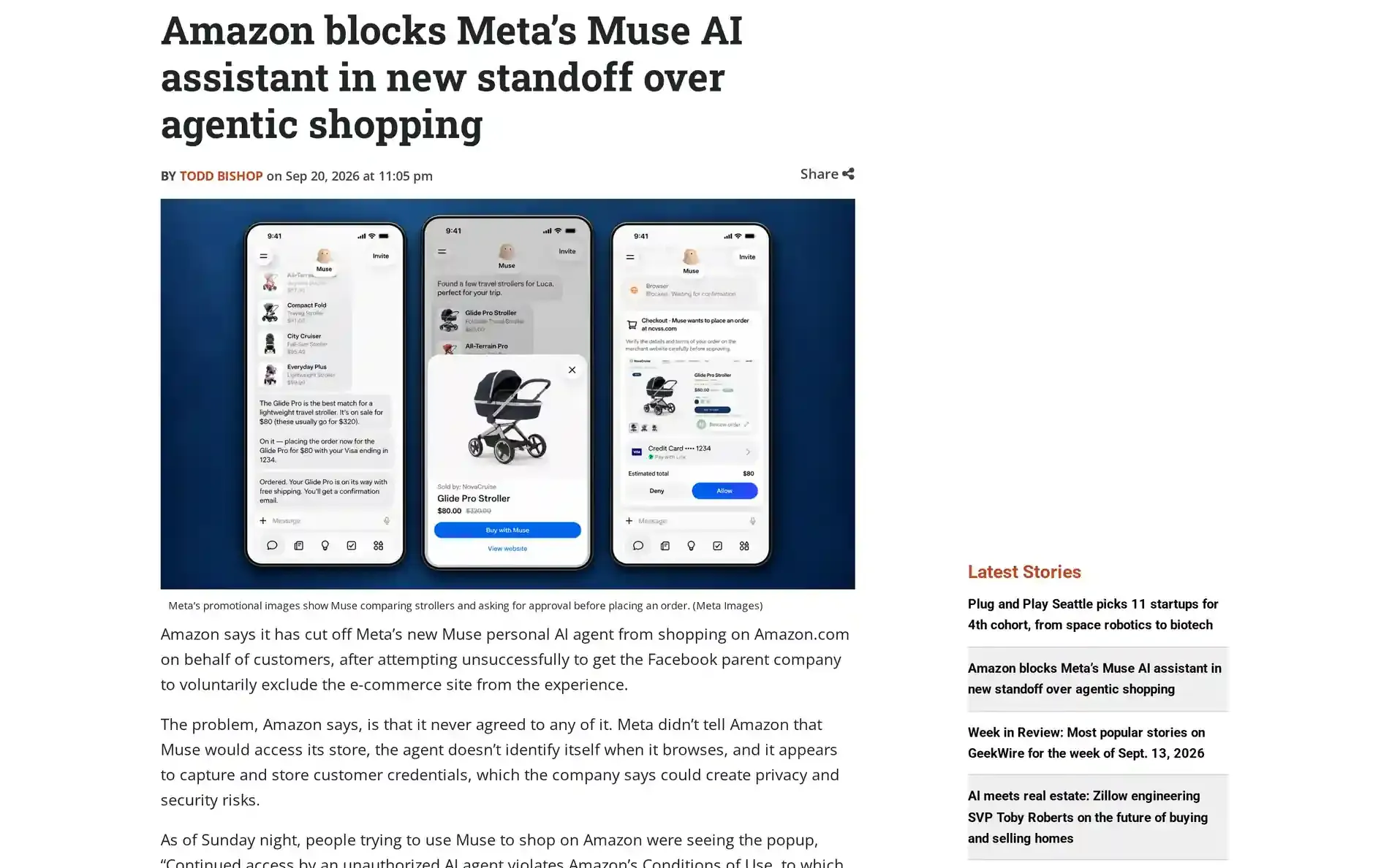
Muse is Meta's personal agent, introduced in September for errands that require more than a chat answer. Meta says it can open a browser, fill forms, arrange travel and seek a person's approval before purchases. Each user's agent operates in a dedicated virtual machine, according to Meta. That makes a familiar request plausible: find a product, compare options and finish the order after the shopper approves it.
But a browser session doesn't make every shop a willing participant. Amazon told GeekWire that it had asked Meta to leave Amazon.com out of Muse and then blocked the agent. A customer asking an assistant to buy something and a merchant accepting that assistant as an authorized visitor are separate decisions. The collision happened at the second one.
Get early access to Zentor to explore a workspace memory that can travel between AI tools; it does not grant an agent access to merchants that decline it.
What Amazon said, and what Meta disputes
The notice shown to Muse users said continued access by an unauthorized AI agent violated Amazon's Conditions of Use, according to GeekWire. Amazon said Meta hadn't disclosed the access in advance or obtained authorization. It also alleged that Muse appeared to capture and store customer credentials and scrape account information without identifying itself as an agent. Those are Amazon's allegations, not independently established findings of credential misuse.
A Los Angeles Times report carried by Yahoo quotes Amazon's objection and points to Meta's launch statement: credentials go into secure storage, and Muse cannot see passwords or payment methods. That is Meta's stated position. The report says Meta did not respond to its request for comment; describing this as a separate, direct denial from Meta would overstate the record. Meta also says its agent asks for approval before a sensitive action such as a purchase.
Neither account alone settles whether Amazon must accept an outside agent. Credential storage, agent identification and permission to access the storefront are distinct questions, and the user-facing notice addresses access under Amazon's terms. It does not accuse Meta of hacking.
Shopify opened a checkout path; Amazon closed one
The contrast is sharp. The same Los Angeles Times account quotes Shopify chief executive Tobias Lütke announcing work with Muse to enable agentic checkout using Shop Pay on Shopify stores. Meta's own launch post describes Shop Pay as coming soon, so the announcement of a partnership should not be mistaken for proof that every shopper already has a working checkout flow.
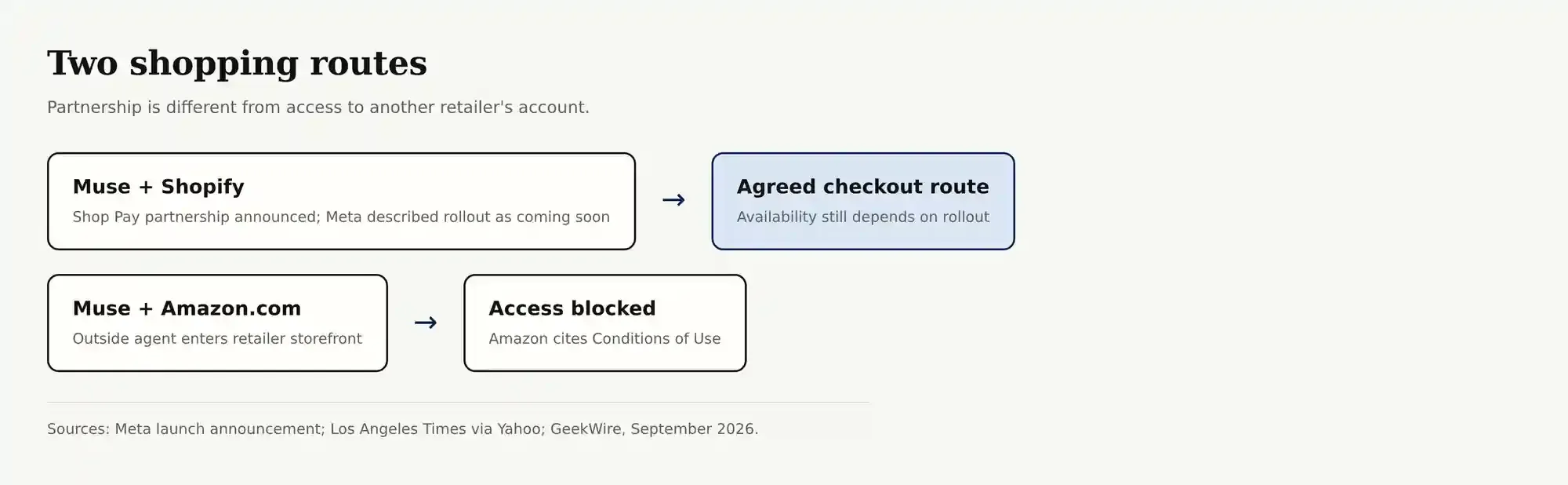
On September 23, 24/7 Wall St. reported Shopify shares down about 5% while Meta edged up, interpreting the move as a partial unwinding of excitement around the Muse deal. Stock prices do not prove that Amazon's block caused Shopify's decline. The report itself notes broader market weakness and says it had not verified an adverse Shopify disclosure that session. The commercial distinction is firmer than the trading narrative: a negotiated payment route has terms between participants; an agent browsing a separate retailer may face a refusal.
Amazon is building agents for its sellers
Amazon's objection to Muse doesn't mean it opposes all agentic AI. On September 23, Reuters reported that Amazon introduced optional, free Seller Assistant workflows for third-party sellers on its marketplace. Sellers can ask for alerts when ratings decline, monitor product prices and get help with listings and inventory. Reuters says the assistant can connect through a plug-in to Amazon Quick and Anthropic's Claude; sellers decide how much personal information to share.

The two developments sit on opposite sides of Amazon's storefront. Seller Assistant runs within an Amazon-offered service for people selling there. Muse seeks to act for a buyer across websites, including one that says it didn't authorize the visit. One is a product Amazon can set up and govern; the other challenges its choice of who gets through the door. That difference matters more than calling one agent good and the other bad.
What the block means for people using agents
If you run a small shop, the practical question isn't whether an assistant can click through a site today. It is whether the route still works when the merchant changes its rules tomorrow. An agent that helps compare products can still be useful when checkout requires you to take over manually; promising an unattended purchase everywhere would be misleading.
The Muse dispute also separates memory from permission. Zentor's workspace memory belongs to the user and can reach different AI tools through Zentor MCP, so context need not live inside one assistant. Its self-learning skills concern how a person prefers to work. Neither feature is a pass to Amazon.com. Zentor's always-on availability likewise doesn't change a merchant's terms; any recurring task needs an access route the destination accepts.
A sensible approval point remains before payment, especially when a site rejects an agent outright. Keep the product criteria and notes you need, but don't hand an agent a standing promise that it can buy from every seller. Zentor's adaptive workspace and model routing address continuity and task choice, not the separate question of merchant authorization. Amazon's refusal makes that boundary visible.
For now, the reported facts support a narrower conclusion than either “agents can shop anywhere” or “agentic commerce is over.” Shopify has announced a cooperative route, Amazon has rejected this particular outside agent's access, and Amazon is developing its own seller-side automation. The next meaningful change would be a disclosed agreement or policy that says exactly how an external shopping agent may enter, identify itself and complete an order.
Related reading: Meta Muse availability explains where the agent launched, while Zentor's earlier Amazon–Muse report covers the initial shopping block. These pages cover the event itself; the seller-side announcement adds the other half of Amazon's agent strategy.

Zentor Research Public data on the AI ecosystem
Zentor Research publishes quarterly data studies on the AI tools ecosystem, drawing on public registries (npm, GitHub, Hugging Face, arXiv, Google Trends). All charts and datasets ship under CC-BY 4.0.
Turn insights into action.
Zentor automates the recurring work your analysis points to. No engineering required.