Why Amazon Blocked Meta's Muse AI Agent

Why Amazon blocked Meta Muse, how Stripe Link checkout works, and what the dispute reveals about platform control in agentic shopping today.
Amazon blocked Meta Muse from shopping on Amazon.com after Meta declined Amazon's request to remove the agent. The dispute is less about one failed checkout than about who controls the customer relationship when software searches, chooses, and buys on a shopper's behalf.
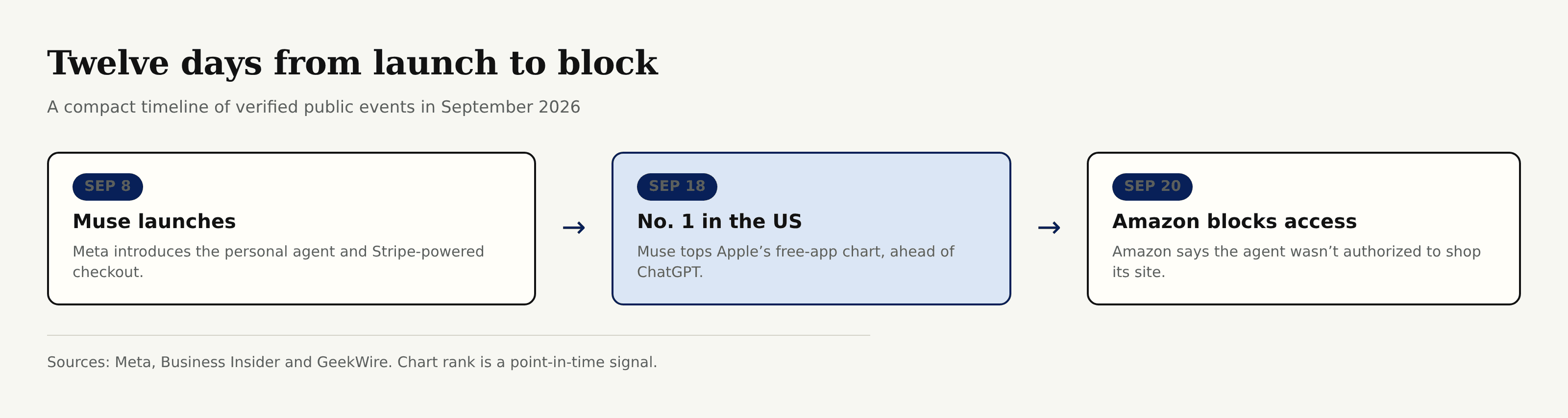
GeekWire reported the block on September 20, 2026, twelve days after Meta introduced Muse. Amazon cited security, privacy, and transparency concerns; Meta's public materials describe approval and payment controls, but those controls don't grant merchant permission.
Key Takeaways:
- Amazon says Muse accessed its store without prior notice or authorization.
- Muse reached No. 1 on Apple's US free-app chart about ten days after its September 8 launch.
- Stripe's Link asks the user to approve the total, then uses a saved payment method or a purchase-scoped virtual card.
- The fight sets user delegation against a platform's right to decide which outside agents may transact on it.
What Happened: Amazon Blocked Muse on Amazon.com
Amazon started blocking Muse on Sunday night, according to Amazon's statement reported by GeekWire. Shoppers saw pop-ups saying continued access by an unauthorized AI agent violated Amazon's Conditions of Use. Amazon said it hadn't received advance notice, hadn't authorized Muse, and believed the agent didn't identify itself while browsing.
Meta declined Amazon's request to remove Amazon from the Muse experience, Bloomberg reported. Neither report shows that Meta agreed with Amazon's account of how Muse handled credentials or account data, so those details remain Amazon's claims rather than settled findings.
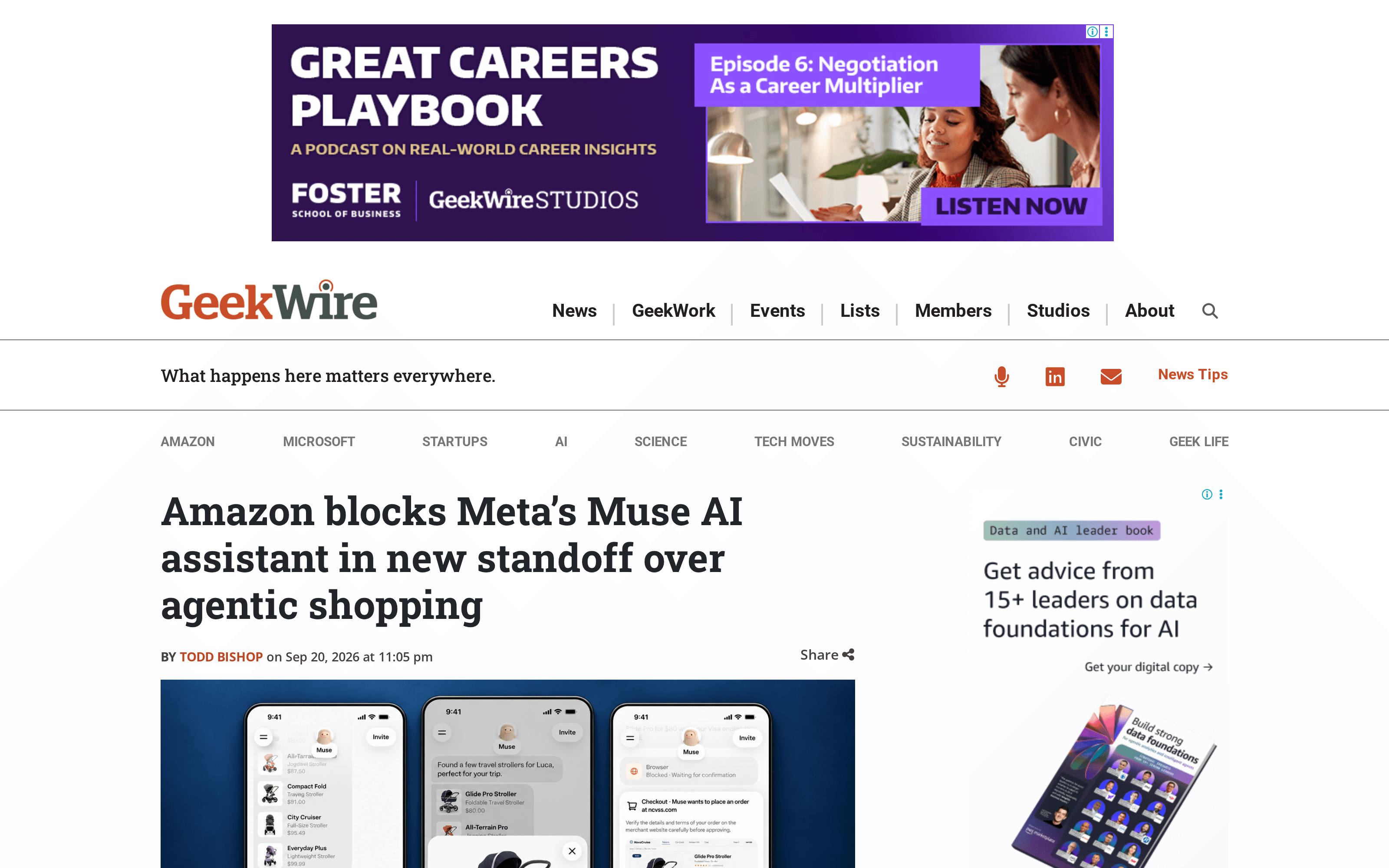
The immediate result is narrow: Muse users can't rely on the agent to shop on Amazon.com while the block remains. This article doesn't offer steps to evade it.
What users need is agent capability, not lock-in to one entry point. Visit Zentor to see how user-owned workspace memory can stay available across AI through Zentor MCP. Muse isn't a Zentor-integrated product.
What Is Meta Muse and Why Did It Reach #1?
Meta launched Muse on September 8 as a personal agent that can work through a browser, fill forms, book travel, and prepare purchases. It runs in a dedicated virtual machine and asks for approval before sensitive actions, according to Meta. That makes Muse different from a chatbot that stops after recommending a product.
About ten days later, Muse reached No. 1 on Apple's US free-app chart ahead of ChatGPT, Business Insider reported. The ranking shows intense early interest, not retention, revenue, or long-term satisfaction.
Claims circulating on X put Muse at 1.8 million iOS downloads in twelve days versus 1.3 million for ChatGPT in comparable launch windows. TechCrunch attributed those figures to Appfigures estimates, limited to iOS in the US and Canada. Meta hasn't published matching internal figures, and Zentor couldn't independently confirm the estimate, so it shouldn't be read as an audited global comparison. Read our separate Muse availability report for the rollout boundary.
How Muse's Agentic Checkout Works
Muse's checkout uses Stripe's Link rather than exposing a person's card details to the agent. At a business that accepts Link, Muse can use the US consumer's saved preferred payment method. At another business, Link can issue a single-use virtual card scoped to the approved purchase.
In both cases, Stripe says the shopper approves the transaction total in chat, and Muse doesn't see the underlying payment details. Approval is therefore a distinct step, not blanket permission to spend.
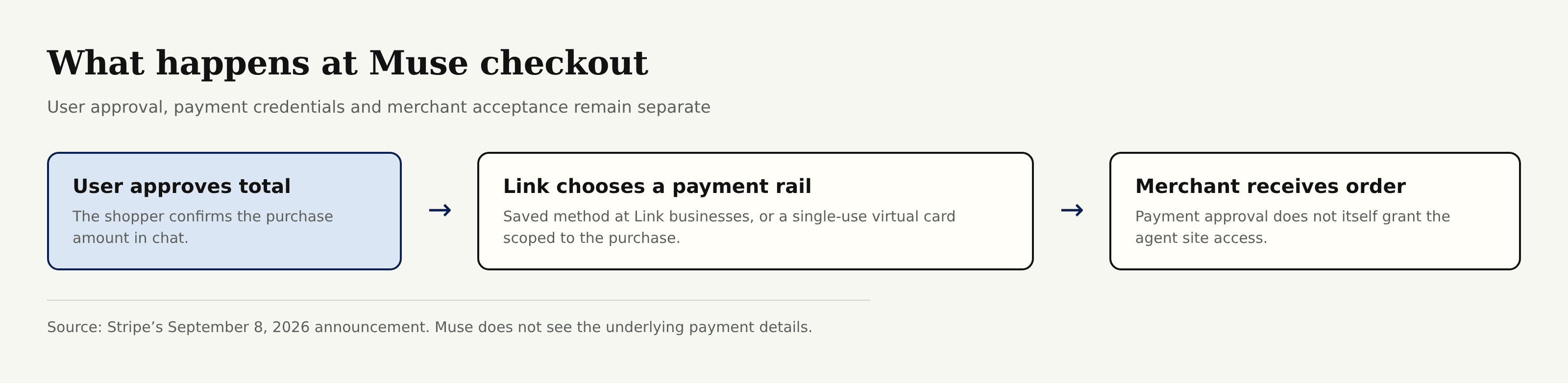
These payment controls answer “may this amount be paid?” They don't answer “may this agent enter this store?” Amazon's objection sits at that earlier access layer.
Why Amazon Pushed Back: Platform vs. Agent
Amazon's stated case concerns identification, security, and control. A retailer may want an outside shopping agent to announce itself, follow agreed access rules, and give the merchant a way to decline participation. Amazon contrasted Muse with its own Buy for Me service, which it says identifies itself and allows brands to opt out.
The commercial tension runs alongside those safety claims. An agent can compare products before a shopper sees a marketplace's sponsored placements, recommendations, or loyalty prompts. That could turn a rich shopping interface into a catalog and fulfillment endpoint. It doesn't prove advertising motivated Amazon's block; no public evidence establishes that. It does explain why control of discovery matters.
The split is awkward because both sides can claim a legitimate permission. The shopper authorized Muse to act, while Amazon says the site owner never authorized Muse to shop. Payment approval doesn't settle the conflict between those two permissions.
What This Means for the Future of Agentic Commerce
Agentic commerce needs negotiated access, not hidden automation. Merchants need agent identity and participation rules; shoppers need a clear total, narrow payment authority, and a record of what the agent did. Payment providers can constrain a card, but they can't create a commercial agreement between an agent maker and a retailer.
For independent sellers and creators, the practical signal is simple: product data, delivery terms, return rules, and agent permissions will become part of distribution. Our Anthropic commerce agents analysis covers another model for dividing responsibility among the user, agent, merchant, and payment provider.
Zentor's relevance is the portability question, not the Muse integration. Zentor keeps workspace memory owned by the user and accessible to different AI through Zentor MCP, which reduces dependence on one conversational surface. It doesn't override a merchant's terms or confer access where none was granted.
The winners won't be agents that browse most aggressively. They'll be services that earn permission on both sides of the transaction.
FAQ
Can Muse still shop?
Muse can still perform shopping tasks where participating sites and payment methods permit them, but Amazon.com blocked Muse shopping as reported on September 20. Availability can change, so users should rely on current in-app notices and merchant rules.
Is Muse available everywhere?
No verified source supports worldwide availability. Meta's launch announcement said Muse was rolling out in the US on iOS, Android, and muse.ai. Stripe described its Link checkout for US consumers. Availability outside those stated boundaries couldn't be independently confirmed.
How does Muse compare with ChatGPT?
Muse launched around browser-based task execution and approved actions, including purchases. ChatGPT offers its own agent features, but this article doesn't claim a full feature winner. The No. 1 App Store position and third-party launch-download estimate capture a brief early window, not enduring product quality.

Zentor Research Public data on the AI ecosystem
Zentor Research publishes quarterly data studies on the AI tools ecosystem, drawing on public registries (npm, GitHub, Hugging Face, arXiv, Google Trends). All charts and datasets ship under CC-BY 4.0.
Turn insights into action.
Zentor automates the recurring work your analysis points to. No engineering required.
References Amazon blocks Meta’s Muse AI assistant · Amazon Blocks Meta’s Muse AI Agent From Its Retail Site · Introducing Muse · Meta’s Personal AI Agent Muse Soars to Top of App Store · Stripe helps Muse shop across the internet with Link · Meta’s Muse is outpacing ChatGPT’s early mobile launch