Airtable AI Credits: Limits, Packs and Costs

Airtable AI credits explained: 500 to 25,000 per user a month by plan, pooled across the workspace, $20 per 10,000 extra, and what uses them.
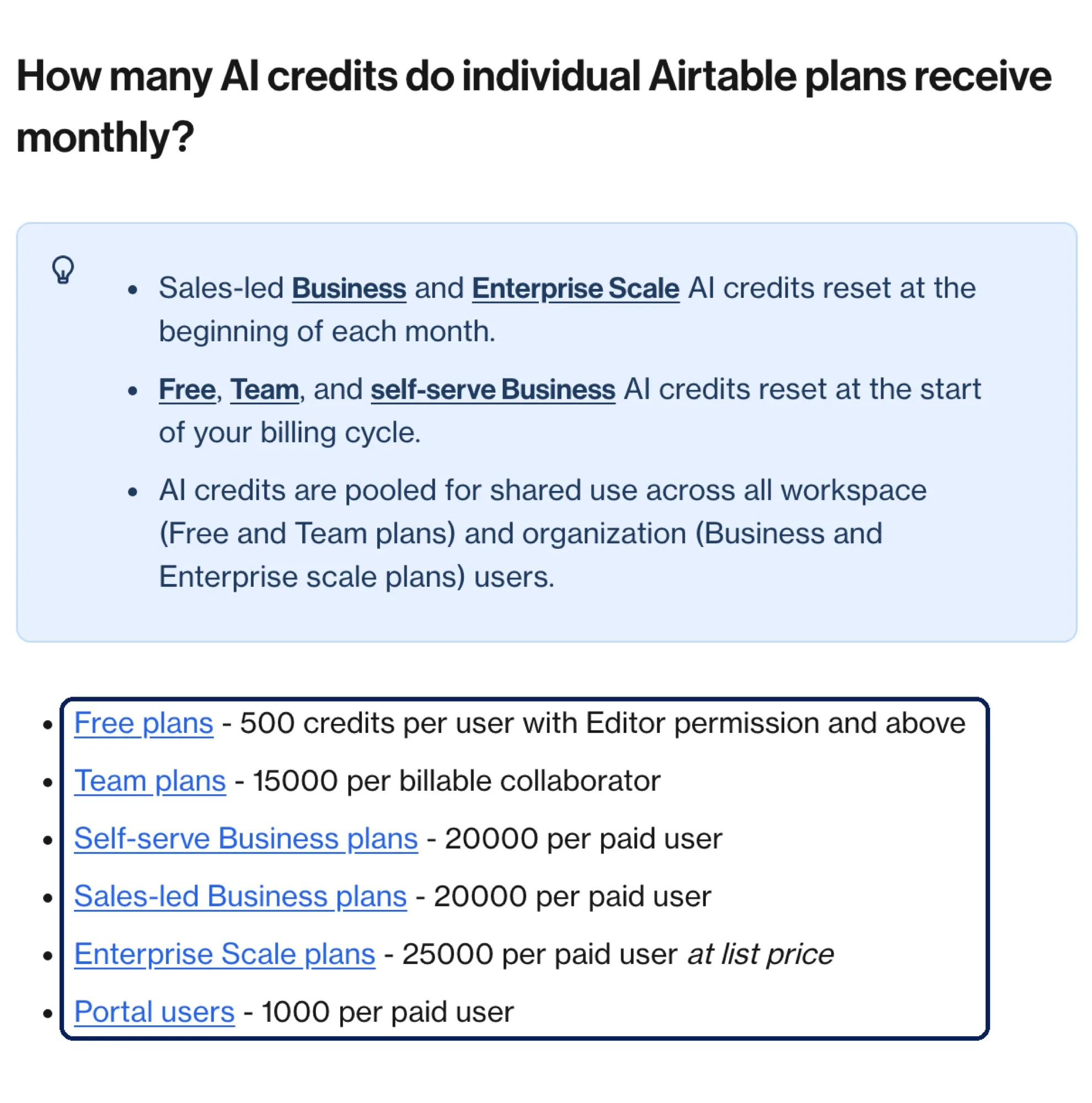
Airtable AI credits are a monthly allowance that every Airtable plan includes: 500 per editor on Free, 15,000 per billable collaborator on Team, 20,000 per paid user on Business and 25,000 per paid user on Enterprise Scale at list price. The credits are pooled across the workspace or organization, they expire at the end of each cycle, and when they run out you either buy a credit pack or wait for the reset.
Those figures come from Airtable's own AI billing help article, which we checked on October 20, 2026. Third-party pricing guides still disagree with each other on some of these numbers, so the article and screenshots below stick to what Airtable publishes.
Key Takeaways:
- Allowances scale with seats: a 5-person Team workspace gets 5 × 15,000 = 75,000 credits a month, shared by everyone in it.
- Credits are pooled, not personal. One heavy user running document analysis can drain the month for the whole workspace.
- Extra credits cost $20 per 10,000 a month (about $2 per 1,000), in packs from 10,000 up to 400,000. Free plans must upgrade to Team before they can buy any.
- Field agents, AI automations and Omni questions use credits. Building with Omni and creating or updating records do not.
- Airtable's MCP server carries "no additional Airtable charges," though API rate limits still apply.
Disclosure: This guide is written by the Zentor team, and Zentor connects to Airtable. Every Airtable number below comes from Airtable's own help pages, linked inline, checked October 20, 2026. We have not metered Airtable's credit usage ourselves.
Airtable AI Credits by Plan in 2026
Here is the allowance table as Airtable publishes it, with the reset rule for each plan.
| Plan | AI credits included each month | Counted per | Resets |
|---|---|---|---|
| Free | 500 | User with Editor permission or above | Start of billing cycle |
| Team | 15,000 | Billable collaborator | Start of billing cycle |
| Business (self-serve) | 20,000 | Paid user | Start of billing cycle |
| Business (sales-led) | 20,000 | Paid user | Start of each month |
| Enterprise Scale | 25,000 at list price | Paid user | Start of each month |
| Portal users | 1,000 | Paid user | Per plan |
Source: Airtable AI billing, Airtable Help Center.
For context on the seat side, Airtable's pricing page lists Team at $20 per user a month and Business at $45 per user a month, both billed annually, with Enterprise Scale priced on request. AI used to be a separate add-on. It is now bundled into every plan, which is why the allowance is tied to seats.
Viewers are the one wrinkle. Collaborators with Viewer permissions get no allocation of their own, but the help article notes they "can utilize credits through Omni," which means they draw on the same shared pool.
Work across Airtable, Notion and Slack from one assistant
Zentor reads your bases and docs, does the work, and writes the result back where your team already looks.
Get early access →
Pooled Credits: Why One Workflow Can Drain the Whole Workspace
Airtable's wording is direct: "AI credits are pooled for shared use across all workspace (Free and Team plans) and organization (Business and Enterprise scale plans) users."
Pooling is generous when usage is uneven, because light users subsidize heavy ones. It is also the reason a single automation can surprise everyone. Suppose you set up a field agent that analyzes every incoming contract. At roughly 200 credits per 10-page contract, 75 contracts a month is 15,000 credits, which is one full Team seat's allowance gone before anyone else has asked Omni a question.
There is no per-person cap in the help article, so the practical control is the workspace owner. Owners can turn Airtable AI on or off per workspace, and admins on Business and Enterprise Scale have an AI settings panel. By default, Airtable AI is on for every plan, including legacy plans. EU and GDPR customers are the exception and opt in.
What Uses Airtable AI Credits, and What Doesn't
Airtable says credits are consumed by actions such as "deploying Field Agents, launching AI automations, asking deep research questions, categorizing feedback, analyzing documents, or generating images," and that each action's cost depends on input data, the selected model and the output. Text pulled in from the internet when web access is on is also charged.
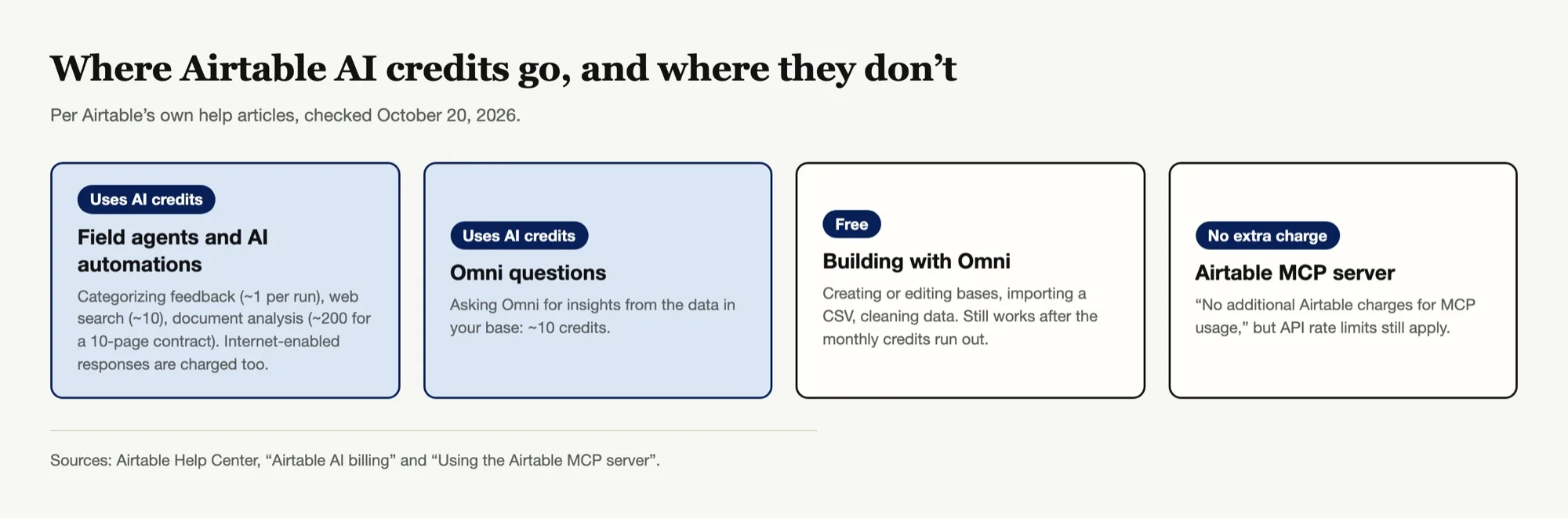
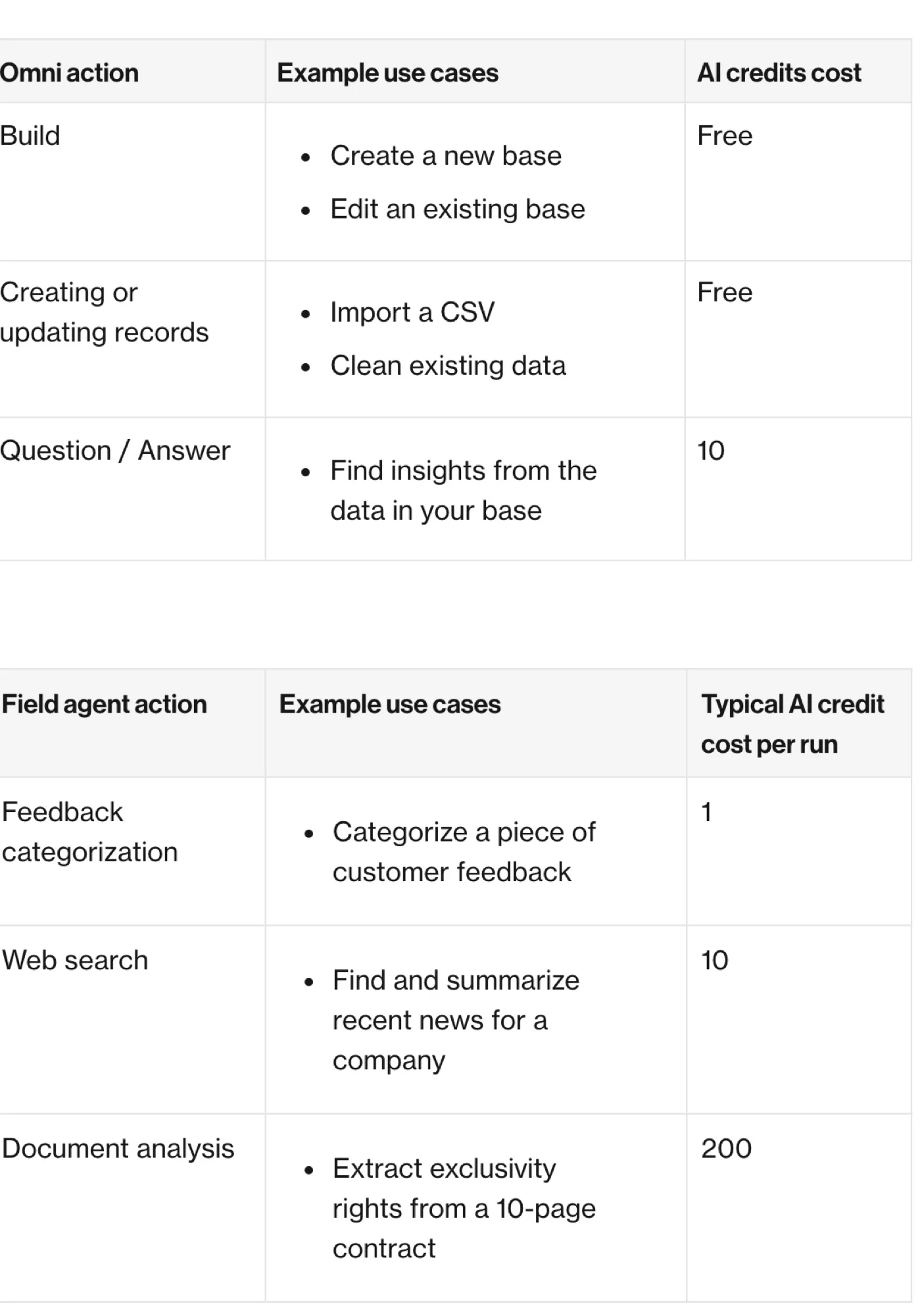
The published examples are the most useful numbers on the page:
| Action | Example | Typical credits per run |
|---|---|---|
| Omni build | Create or edit a base | Free |
| Omni records | Import a CSV, clean existing data | Free |
| Omni Q&A | Find insights in your base | 10 |
| Field agent | Categorize one piece of feedback | 1 |
| Field agent | Web search and summarize company news | 10 |
| Field agent | Analyze a 10-page contract | 200 |
For long documents the spread gets wide. Airtable estimates 500 to 1,500 credits for documents of 50+ pages or 25,000+ words, and 2,000 to 5,000+ credits for jobs over 100,000 words, depending on the model. Its own advice is to run a small test batch first, and that is the right instinct: the same field agent can cost ten times more on a newer, larger model.
One more detail worth knowing: building apps and agents with Omni is free and keeps working "even if your AI credit allotment has expired for the month." Running out stops the AI work, not the building.
How Far a Month of Airtable AI Credits Goes
Dividing a pool by Airtable's per-run estimates gives a ceiling you can plan around.
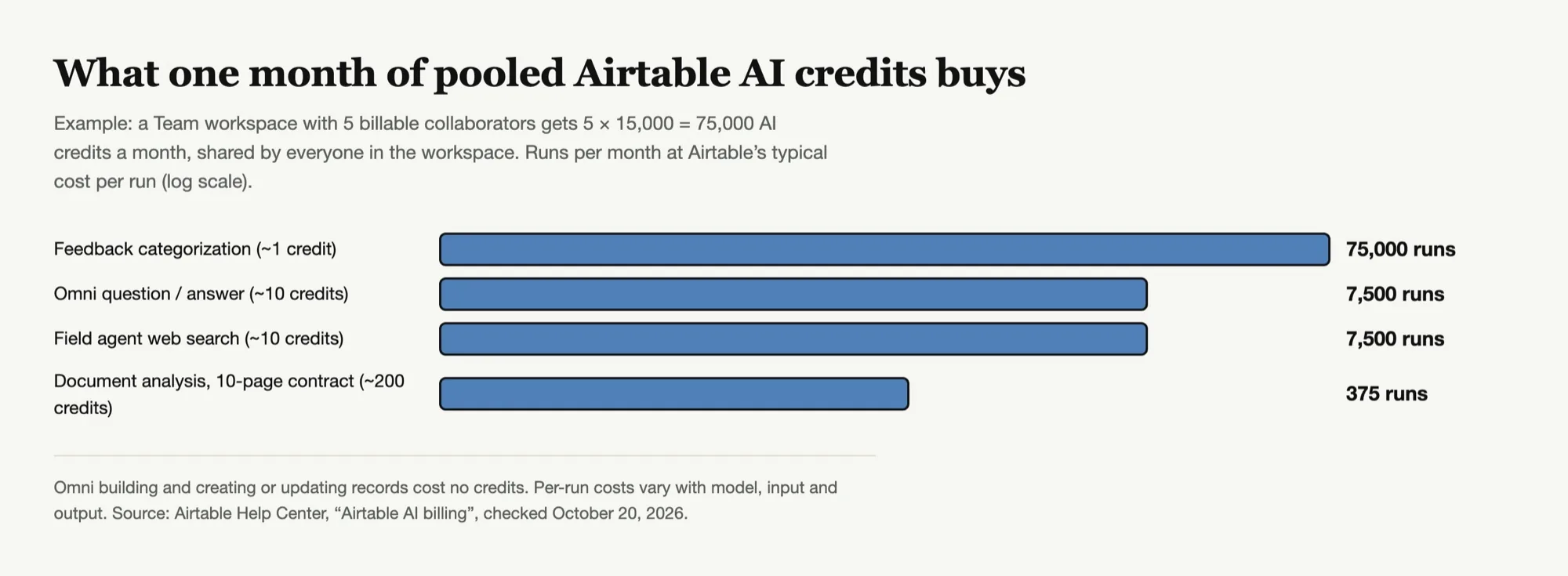
The pattern is the same on every plan. Cheap classification jobs are effectively unlimited, mid-weight questions and searches are comfortable, and document analysis is where pools disappear. If your team's AI use is mostly tagging and routing records, the included credits will probably cover it. If it is contracts, transcripts or research reports, budget for packs from the start.
You can see the current balance under the workspace's billing settings. The help article also has a section on reviewing AI credit usage, which is the place to check before a big batch.
Buying More Airtable AI Credits: Pack Prices
When the pool runs dry, self-serve customers can add packs from Account overview → Workspace settings → Change credits. Sales-led Business and Enterprise customers go through their rep, and Free plans have to move up to Team first.
| Monthly credits | Monthly plan | Annual plan |
|---|---|---|
| 10,000 | $20 / month | $200 / year |
| 20,000 | $40 / month | $400 / year |
| 50,000 | $100 / month | $1,000 / year |
| 100,000 | $200 / month | $2,000 / year |
| 200,000 | $400 / month | $4,000 / year |
| 300,000 | $600 / month | $6,000 / year |
| 400,000 | $800 / month | $8,000 / year |
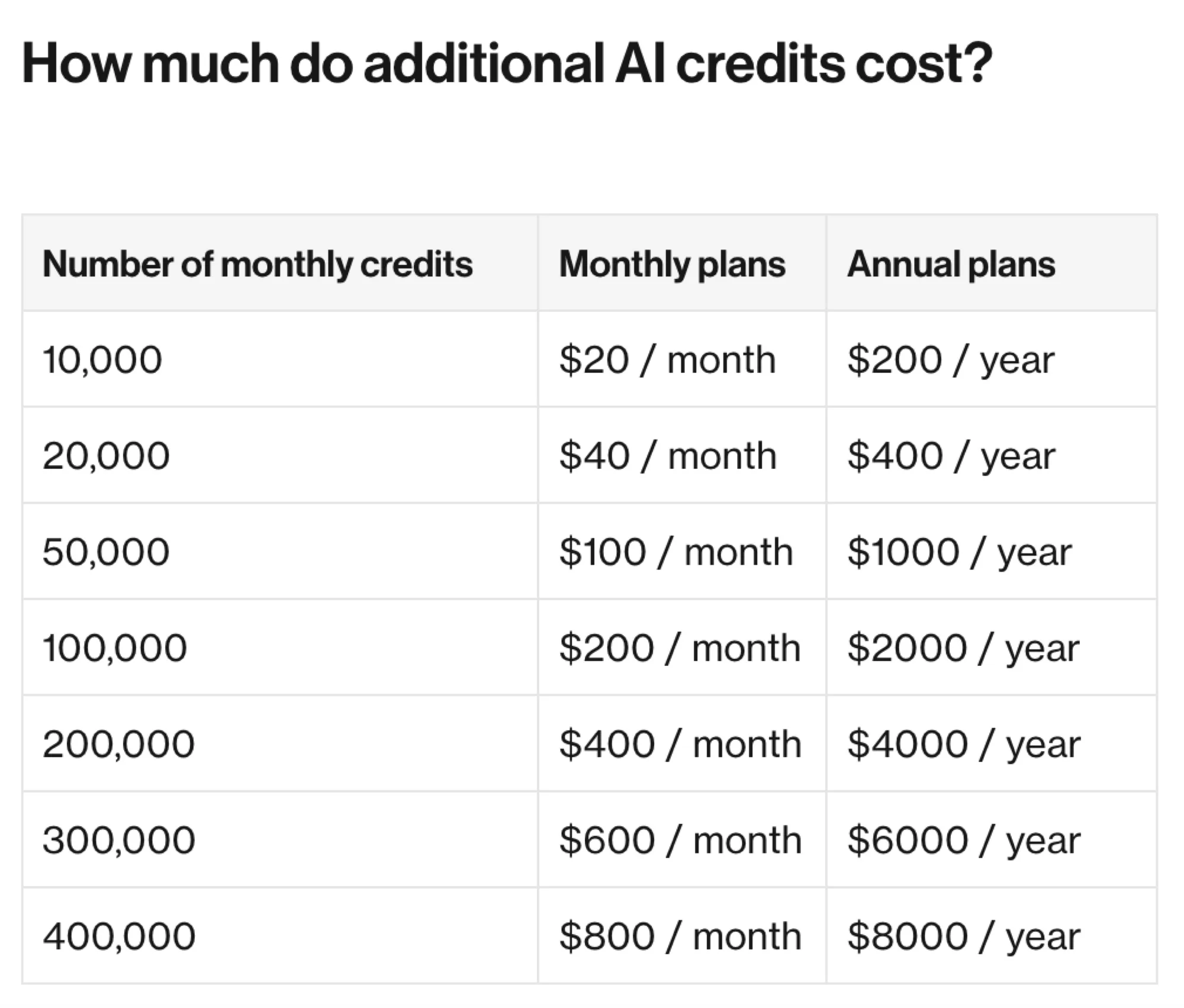
Every tier works out to the same $2 per 1,000 credits monthly, and annual billing takes about two months off. There is no volume discount on the larger packs, so buy the size you will actually use. In practice one extra 10,000-credit pack covers about 50 contract analyses at Airtable's estimate.
A caution from the community forum: in a January 2026 thread, users reported buying extra credits that could not be used until the next month began. Airtable's documentation does not describe that behavior, and we could not confirm it, but it is worth checking with support before you buy mid-crunch.
Airtable MCP and AI Credits
Many teams now reach Airtable from outside tools, such as Claude, ChatGPT or an agent, rather than from Airtable AI itself. Airtable runs an official hosted MCP server for this, available on all plans, and its MCP help article answers the cost question in one line: "There are no additional Airtable charges for MCP usage, but existing API rate limits remain."
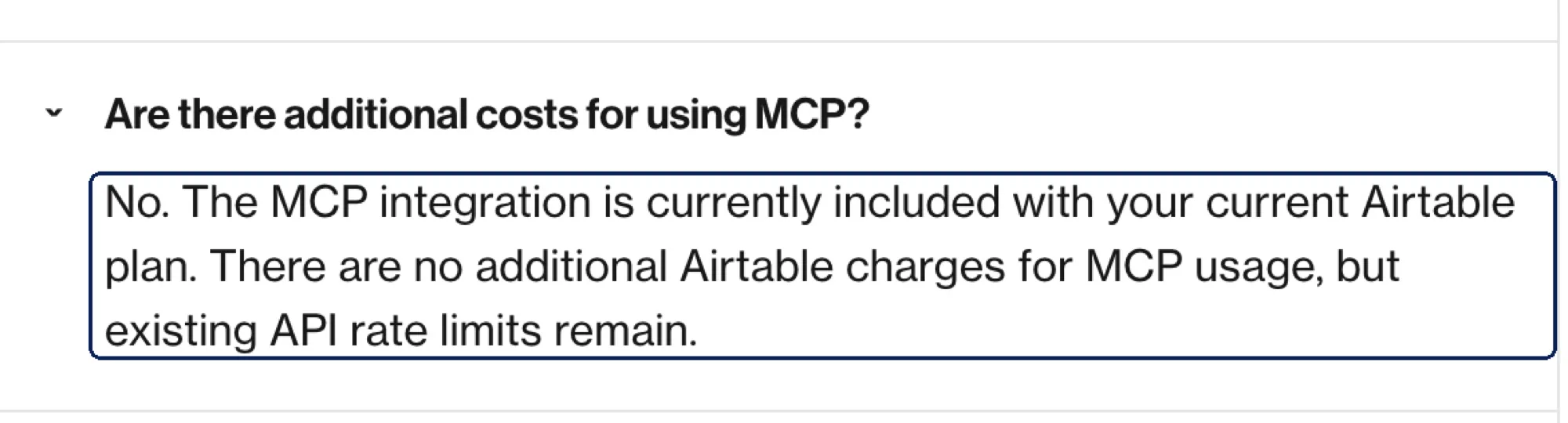
That sentence does not mention AI credits by name, so read it narrowly: Airtable is not billing extra for MCP calls. The thinking in those workflows happens in the outside tool and is paid for there. Through MCP, an assistant can search and read base data, create and update records (10 per request), create bases, and draft automations, all within your existing permissions. Airtable announced in its MCP update that the server can now build interfaces and automations too.
This is where Zentor fits. Zentor connects to Airtable over MCP (setup on the Airtable integration page), so it can read records, run the analysis on its own models and write results back to the base, alongside Notion, Slack and Google Workspace in the same request. It is not free: Zentor is $20 a month for 1,000 Zentor credits, with a 3-day trial, so you are choosing which meter to spend, not escaping meters. It makes the most sense for work that spans tools, like turning new Airtable records plus a Notion brief into a Slack update. For a single-table classification job, Airtable's own field agents at about 1 credit a run are hard to beat.
The Bending Spoons Acquisition: What It Could Mean (Unconfirmed)
On August 4, 2026, Bending Spoons announced a definitive agreement to acquire Airtable for an enterprise value of $1.285 billion in cash. The deal is expected to close later this year, subject to regulatory approval, and both companies say they will operate independently until then.
As of October 20, 2026, Airtable has announced no change to AI credits or plan prices tied to the deal. Anything beyond that is speculation, and we will keep it labeled as such.
What people point to is Bending Spoons' track record with Evernote, which it agreed to acquire in late 2022. In November 2023, TechCrunch reported that Evernote was testing a free plan capped at 50 notes and one notebook. That is one data point about a different product, not a forecast for Airtable. If you are planning a year of heavy AI usage, the sensible hedge is modest: keep track of your monthly consumption now, so you have your own baseline if allowances or pack prices change after the deal closes.
We will update this page if Airtable announces changes.
FAQ
How many AI credits does Airtable give per month?
Free plans get 500 credits per editor, Team gets 15,000 per billable collaborator, Business gets 20,000 per paid user, and Enterprise Scale gets 25,000 per paid user at list price. Portal users get 1,000 per paid user.
Are Airtable AI credits shared across the team?
Yes. Credits are pooled across the workspace on Free and Team plans and across the organization on Business and Enterprise Scale. There is no per-person balance.
How much do extra Airtable AI credits cost?
Packs start at 10,000 credits for $20 a month or $200 a year and go up to 400,000 credits for $800 a month. Every tier is $2 per 1,000 credits monthly.
Do Airtable AI credits roll over?
No. Included credits expire at the end of each month or billing cycle, depending on your plan.
What happens when Airtable AI credits run out?
AI actions that consume credits stop until the reset unless you buy a pack. Building with Omni and creating or updating records keep working, since they do not use credits.
Does the Airtable MCP server use AI credits?
Airtable says there are no additional Airtable charges for MCP usage, but existing API rate limits apply. It does not name AI credits explicitly, so check your usage view if you run high volumes.
Plan Your Airtable AI Credits Around the Expensive Jobs
Most Airtable AI usage is cheap. Tagging a record costs about a credit, and the included pool covers tens of thousands of those. The budget problem is concentrated in a few job types, mainly document analysis, deep research and anything with web access turned on, and in the fact that the pool is shared.
So the useful move is to find your expensive workflows before they find you. Run a small test batch, multiply by your monthly volume, and decide whether that belongs in Airtable's credits, in a pack at $2 per 1,000, or in an outside tool that works on your bases through MCP. Related reading: Airtable automation limits, Airtable Omni for data analysis, and how Notion handled the same shift in Notion AI credits.

Zentor Editorial Zentor editorial team
The Zentor editorial team writes about workflow automation, AI agents, and the tools we build. Default byline for industry overviews, listicles, and collaborative pieces.
Ready to put this into practice?
Zentor runs browser tasks, research, and schedules automatically. Try it free.
References https://support.airtable.com/articles/3378106230-airtable-ai-billing · https://support.airtable.com/articles/9897799762-using-the-airtable-mcp-server · https://www.airtable.com/articles/mcp-server-interfaces-automations · https://www.placera.se/pressmeddelanden/bending-spoons-bending-spoons-has-entered-into-a-definitive-agreement-to-acquire-airtable-for-1-285-billion-20260804 · https://techcrunch.com/2023/11/27/evernote-pushes-users-to-upgrade-with-test-of-a-free-plan-limited-to-only-50-notes/ · https://community.airtable.com/airtable-ai-66/cant-upgrade-ai-credits-46052