What Is Meta Muse Charm? What We Know So Far
Meta Muse Charm is a pocket device for talking with Muse. See what Meta has confirmed, what remains unknown, and what to watch before release.
What Is Meta Muse Charm? What We Know So Far
Meta Muse Charm is a pocket-sized device Meta introduced for talking and interacting with its Muse agent. Meta's written announcement confirms a real-time voice model; its Connect keynote describes additional features of an early device and a December shipping goal. The presentation does not establish final retail specifications.
Key takeaways
- Meta's written announcement confirms Charm's purpose, pocket-sized form, and real-time voice model.
- In the official keynote, Zuckerberg described Muse's avatar stack and said tapping a fingerprint sensor on Charm starts a conversation without unlocking a phone or opening an app.
- Zuckerberg said Meta planned to have Charm ready to ship in time for the December holidays. That is a goal, not a confirmed sale or delivery date; the two official sources do not provide final connectivity, price, or battery specifications.
As of October 3, 2026, this preview draws on Meta's written Connect recap and official keynote. It separates statements about the early device from specifications that still require confirmation. It is not a hands-on review.
What Meta Has Confirmed So Far
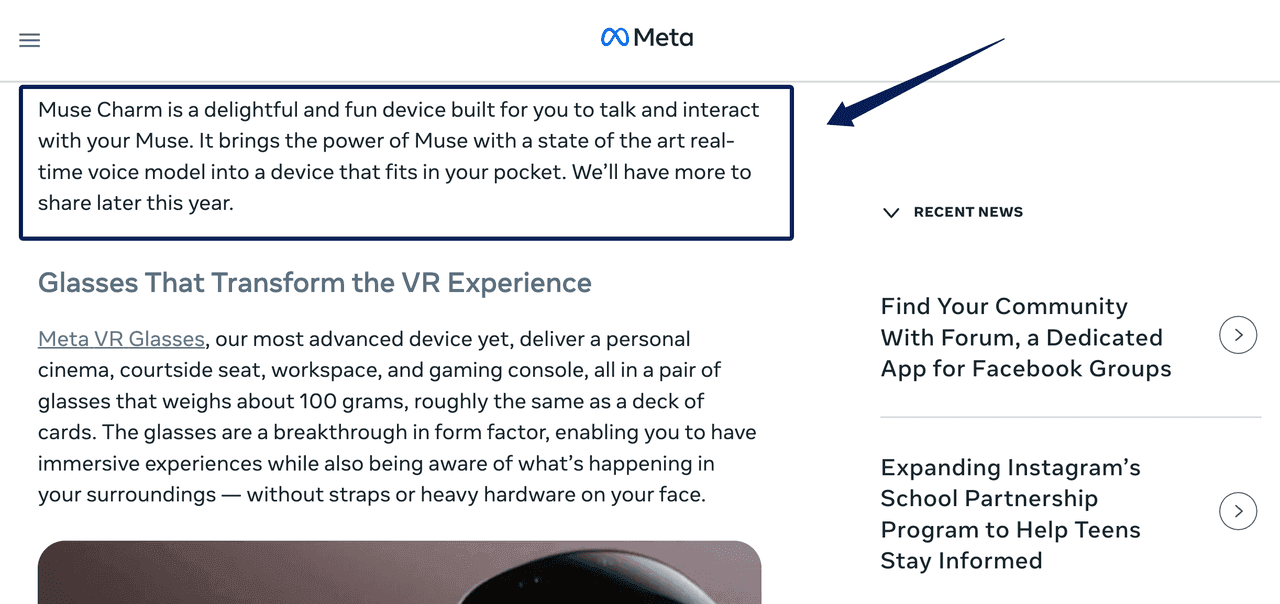
Meta's written Connect recap confirms that Charm fits in a pocket, lets people talk and interact with Muse, and uses a real-time voice model. The official keynote (53:18–54:20) adds Zuckerberg's description of an avatar stack and a corner fingerprint sensor used to start talking. He said Meta had built only a few units, was still finalizing parts of the hardware, and planned to have Charm ready to ship in time for the December holidays. Those statements document the presentation and its target; neither source supplies final retail specifications, a price, or a confirmed order date.
Pocketable Hardware for Talking to Muse
Charm is presented as a physical way to reach Muse. At Connect, Zuckerberg said tapping a fingerprint sensor in the device's corner lets a user start talking without unlocking a phone or opening an app. He also described Muse's avatar stack as part of the early device. The presentation does not establish the final display specifications or explain how listening ends, approvals work, or a task moves between Charm and the Muse app.
A Real-Time Voice Model
Meta's written recap and keynote describe a real-time voice model, but the reviewed sources provide no measured response times, interruption-handling results, or performance in noisy environments. They also do not specify where Charm's voice processing runs. Those details would need later documentation and testing on a shipping unit.
Why Meta Is Giving Muse Its Own Device
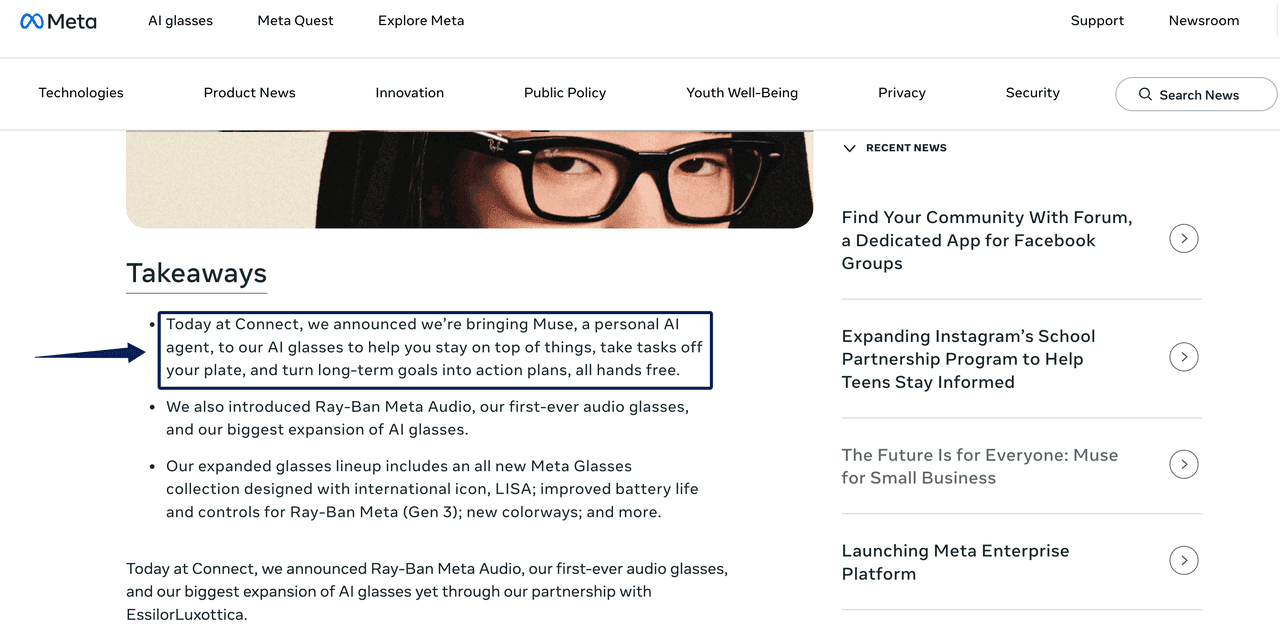
Why give Muse another object when a phone already handles voice? Meta is also bringing Muse to AI glasses for hands-free access. On stage, Zuckerberg described the fingerprint tap as a way to begin talking without unlocking a phone or opening an app. The presentation does not show whether that would be faster or more dependable in daily use, or whether a phone would be needed for setup or approvals. Those comparisons require a shipping unit.
Imagine leaving a meeting and asking Muse to pick up a task. We do not know whether Charm could resume it, what context it would receive, or where the answer would appear. Those handoffs matter more than a lively demo. Nothing establishes that Charm replaces a phone. In a useful future test, I would repeat the same request on both and check where each result lands.
How Charm Fits the Wider Muse Experience
Meta presented Charm alongside plans to bring Muse to AI glasses. That does not confirm synchronized conversations or shared permissions. The software-side explanation of Muse covers the agent; Charm poses a narrower question: what changes when a conversation starts through dedicated hardware?
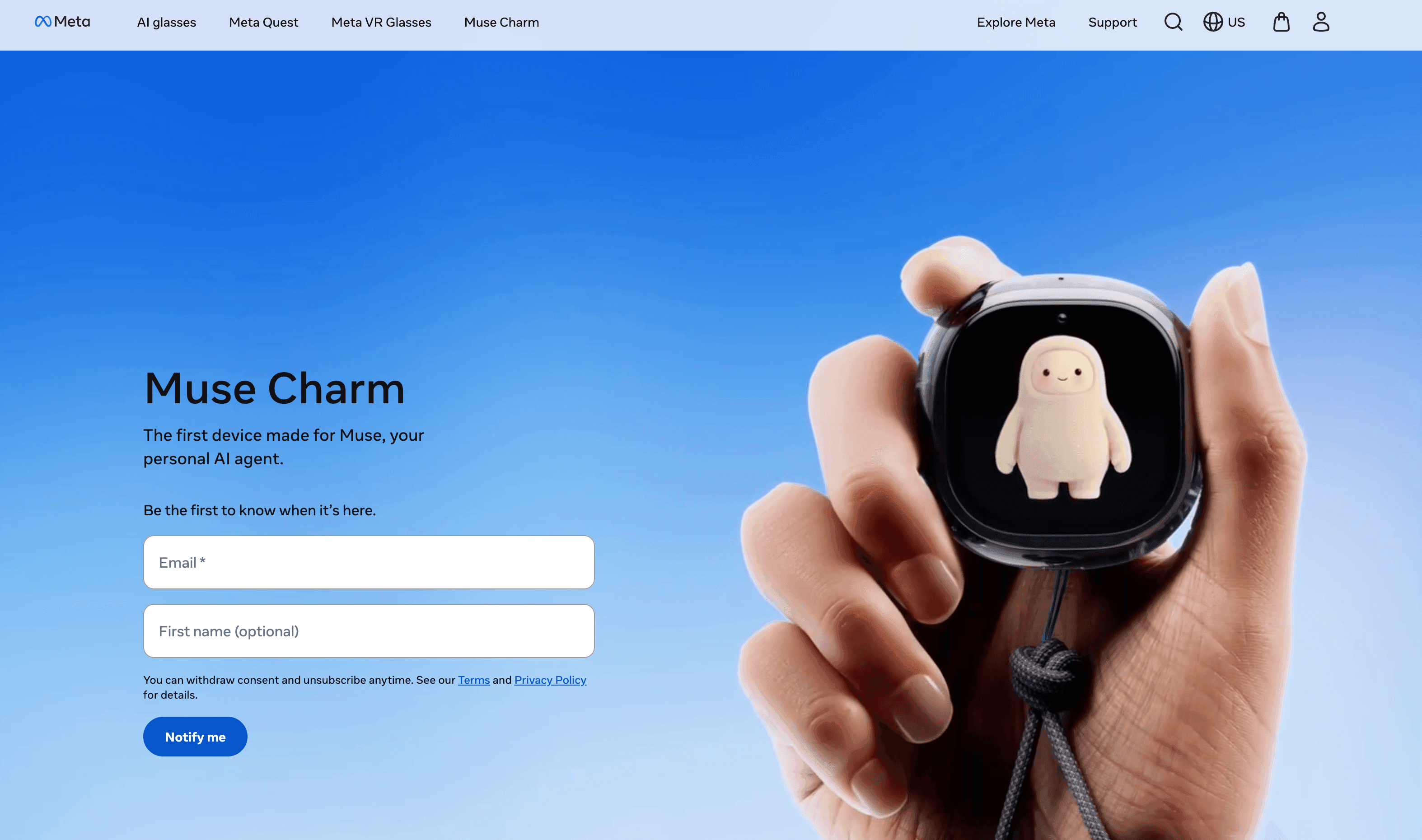
Muse's existing app lets people review proposed actions and see an activity trail. I would want a Charm request to leave a clear task record and somewhere to review proposed actions. That is a test for later, not a confirmed feature. If a voice exchange ends before the work does, a person needs a way to find the unfinished task again. Muse voice hardware should make the agent easier to reach without making its actions harder to inspect. Meta's Muse Charm page currently lets visitors leave an email address to be notified when the device arrives; it is not a preorder form.
What to Watch at the Next Product Update
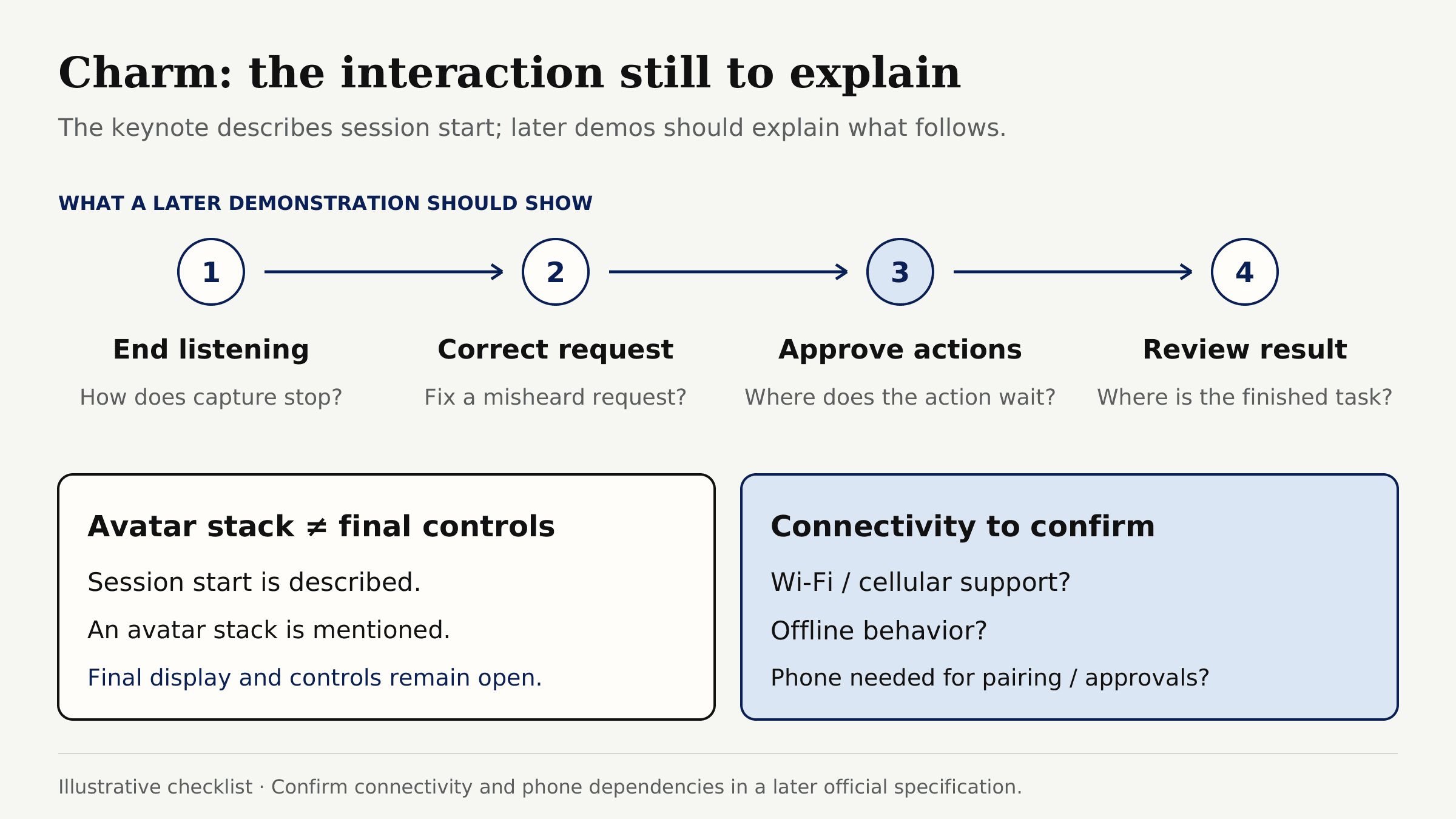
The keynote describes a way to start talking, but not the full interaction. A later demonstration should show how listening ends, how a user corrects a misheard request, where an action waits for approval, and where the finished task can be reviewed. Meta's mention of an avatar stack does not settle the final on-device display or controls.
Connectivity remains an open question. Neither the written recap nor the keynote specifies Wi-Fi or cellular support, offline behavior, or whether a phone is needed for pairing or approvals. A later official specification should answer those questions before Charm is described as usable away from a phone or Wi-Fi.
Audio quality, battery life, and task reliability would need testing on a shipping unit. A later demonstration could show how Charm responds to a dropped connection or a misunderstood name; longer use would be needed to judge whether those responses are reliable.
FAQ
When will Meta Muse Charm be released?
Meta has not announced a firm release date. In the Connect keynote, Zuckerberg said Meta planned to have Charm ready to ship in time for the December 2026 holidays. That is a target, not a confirmed preorder, sale, or delivery date.
How will Muse Charm work with Meta Muse?
In the Connect keynote, Zuckerberg said tapping a corner fingerprint sensor starts a conversation and described Muse's voice and avatar stack as part of the early device. The reviewed official sources do not explain Charm's final display, pairing, approvals, task history, or data-handling flow.
How is Muse Charm different from using Muse on a phone?
Zuckerberg described a fingerprint tap that starts a Muse conversation without unlocking a phone or opening an app. That does not establish whether Charm works independently of a phone or saves time in daily use. A fuller comparison needs setup and approval details, plus a way to check where completed work appears.
What Meta Muse Charm Still Has to Prove
Charm's premise is clear: put a voice entry point to Muse in a pocket. Whether that becomes useful hardware depends on controls, continuity, and review. The next official update matters more than an early glimpse.
This article is based on currently available information about an unreleased product. Details may change, and we will update this page when official information becomes available.

Zentor Research Public data on the AI ecosystem
Zentor Research publishes quarterly data studies on the AI tools ecosystem, drawing on public registries (npm, GitHub, Hugging Face, arXiv, Google Trends). All charts and datasets ship under CC-BY 4.0.
Turn insights into action.
Zentor automates the recurring work your analysis points to. No engineering required.