Wix Symphony Can Now Pay Your Bills: What to Check First

Wix Symphony agentic payments let agents pay after owner approval. Check Link card limits, the 10-minute approval window, retry safeguards and US rollout.
Wix Symphony agentic payments now let a small-business agent complete a purchase after its owner approves that specific spend through Stripe's Link wallet. Announced on October 15, 2026, the integration can cover a supplier invoice or stock reorder, but it doesn't give an agent open-ended permission to spend. The useful question is whether its approval and reconciliation steps fit your actual purchasing process.
Key Takeaways:
- The owner approves each purchase before Link shares a transaction-specific payment credential.
- Wix says the owner can approve within an approximately 10-minute window by WhatsApp or SMS; a changed merchant or amount needs fresh approval.
- A one-time card is capped at the approved amount, while Symphony checks Link before retrying an uncertain payment.
- As of October 2026, rollout covers Symphony users with a US-based Link account making US-dollar payments.
What did Wix Symphony and Stripe actually launch?
Wix announced that Symphony by Wix, its coordinated system of business agents, can use Link's wallet for agents to finish an owner-approved purchase. Previously, the agent could identify a bill or find stock to buy; the owner still had to take over at checkout. The integration joins the recommendation to the payment without transferring the owner's underlying card details to the agent.

This is a purchasing workflow, not a promise that every bill on every supplier site is automatically payable. Wix's press announcement gives examples such as inventory, invoices and registration fees; those are described use cases, not evidence of completed customer transactions. If you run a one-person shop, the difference matters: finding a low-stock item is useful, but your inventory only changes when the supplier actually receives a paid order.
How does an agent pay without seeing your card?
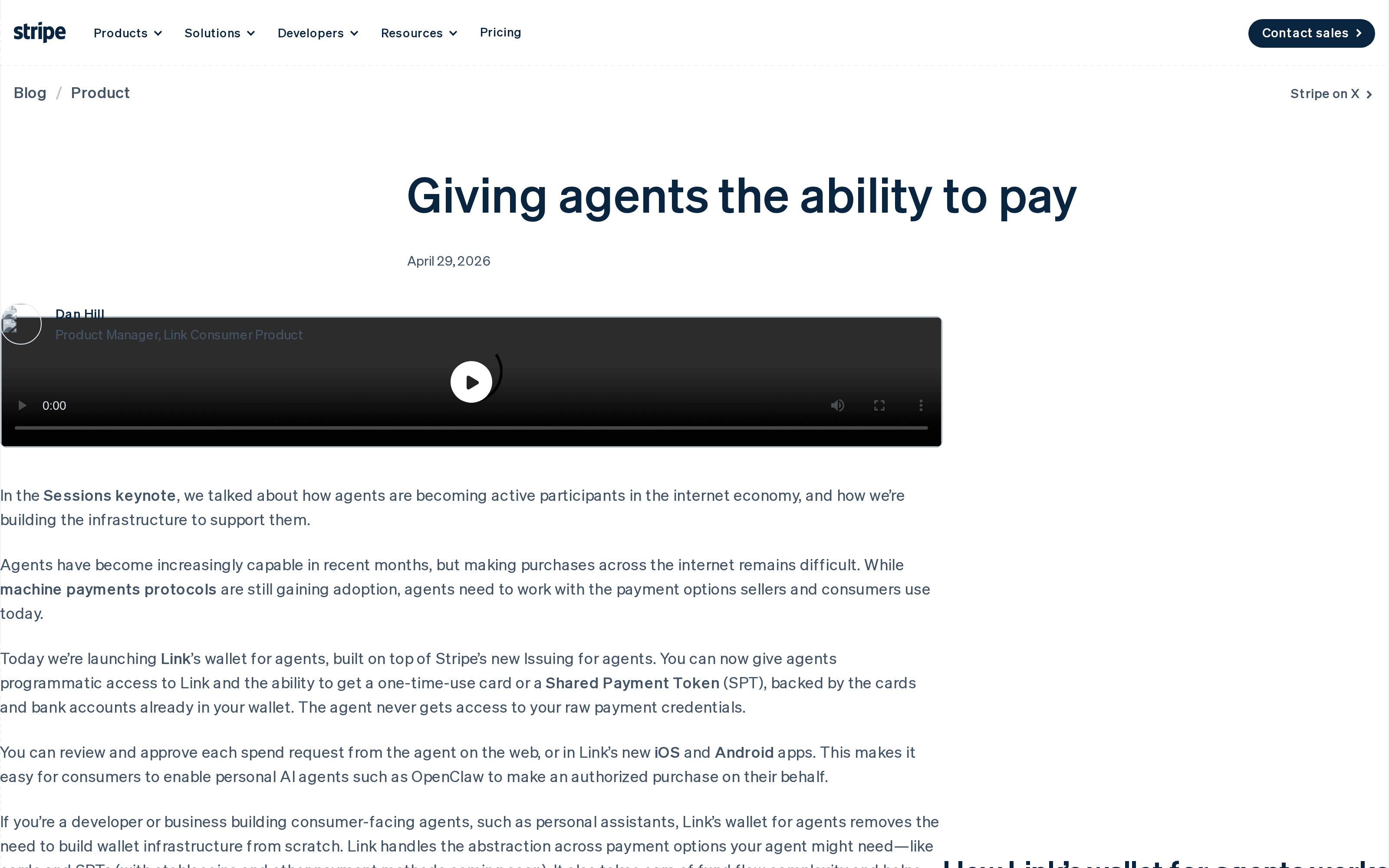
Link is the payment boundary. Stripe explains that an approved spend request can return a one-time-use virtual card or Shared Payment Token backed by a saved payment method. The agent gets the credential needed for that transaction, not your raw card number. Wix says its card is capped at the exact amount you approved. Don't confuse that constraint with insurance against a wrong product: an authorized payment for the wrong size of packaging is still a purchasing mistake.
Who approves each purchase, and how fast?
The business owner does. According to Wix's press release, approval can happen from any device through WhatsApp or SMS in an approximately 10-minute window. The Wix blog also describes review through Link, including its app. Treat these as descriptions of the available experience, not a guarantee that every notification channel works in every account.
If a supplier adds shipping at checkout, the amount on the approval request must match the final amount. Wix says a changed amount or merchant requires fresh approval; don't approve a screenshot of an earlier cart and assume it authorizes a later total. Stripe separately describes incremental authorization for higher totals, which still means the buyer must approve the increase; it isn't silent budget expansion. When you're away from your phone, an approval window is a practical bottleneck, not a minor interface detail.
Which jobs can Symphony's agents already pay for?
Wix names five agent roles in its examples. Launcher covers business-registration fees; Store Operator orders replacement stock; Bookkeeper deals with invoices; Opportunity Hunter covers application or fair entry fees; Concierge can send a gift to an unhappy customer. Each example needs an owner-approved purchase under this Link flow. Wix hasn't published a supplier-by-supplier success rate in the sources reviewed here, so don't translate these examples into universal compatibility.
Picture your usual Friday invoice: you would still check the supplier name, amount, purchase-order match and due date. The agent may have found the invoice and prepared payment, but the approval is where you catch an unexpected bank or merchant change. Our agent governance guide explains why approval should name the exact action rather than offer blanket permission.
What stops a duplicate or runaway charge?
Before retrying a payment, Symphony says it asks Link whether the purchase already went through. That check addresses an ugly edge case: a checkout hangs after submission, and an impatient retry could otherwise produce a second charge. Wix also says it can fall back to a remote browser session that the owner can watch when the automated flow doesn't fit. Neither safeguard proves that every merchant will accept an agent-initiated payment, or that a charge can never be disputed.
The spending cap is per approved card, not a published monthly business budget. Because each request needs the owner's review as of October 2026, you retain a meaningful stop point but also inherit an approval task. Stripe says automatic spending within a preset budget is planned, not a control to rely on in the present Symphony rollout. Keep your existing accounting reconciliation even after a successful checkout.
Who can use it right now?
The Wix press announcement says this integration is rolling out to Symphony users with a US-based Link account and US-dollar payments; Dealroom's report repeats those boundaries. Rolling out doesn't mean every eligible account already has the switch. Check your own eligibility and the merchant's payment route rather than treating a headline as an availability notice. Wix has not given a universal rollout completion date in the cited material.
What should a small business verify before switching it on?
Test one low-stakes purchase using a supplier you already know. The goal isn't speed; it's to learn where approval, payment confirmation and your books disagree. Before expanding, check:
- Does the request show the exact merchant, item and final amount, including tax and shipping?
- Who can approve it, on which device, and what happens if the window expires?
- Where can you see a paid receipt and match it against the invoice or order?
- Can you stop access, and who handles a failed checkout or an unexpected charge?
If your real need is to inspect Stripe customer payments and prepare a controlled action, don't mistake Symphony's Link buyer wallet for an integration with your own Stripe merchant account. Zentor's Stripe MCP integration connects your workspace to Stripe data, with access scoped to the permissions you grant; its page recommends human confirmation for write-capable actions. Zentor helps you inspect billing context before a decision, not claim to reproduce Wix's Link purchasing flow.
Review Stripe work before an agent acts
Zentor connects to Stripe through its MCP server so you can inspect payments and invoices. Keep write-capable work behind human confirmation.
Get early access →
FAQ: Wix Symphony agentic payments
Does the agent see my card number?
No. In the Link wallet flow described by Wix and Stripe, the agent receives a transaction-specific credential, not your underlying card information. Still review the merchant and item before approving.
Can I set a spending budget instead of approving every purchase?
Not for the currently described Symphony flow. Stripe has discussed future budget-based approvals, but says each spend request now requires human review. Don't assume another Stripe product's controls apply to your Symphony account.
What happens if a payment fails?
Wix says Symphony checks Link for an existing payment before retrying and can fall back to a watchable remote browser flow when needed. If a payment status remains unclear, confirm it with the merchant and your payment records before authorizing another attempt. For a wider explanation of agent handoffs and reviewable outputs, read personal AI agents explained.

Zentor Research Public data on the AI ecosystem
Zentor Research publishes quarterly data studies on the AI tools ecosystem, drawing on public registries (npm, GitHub, Hugging Face, arXiv, Google Trends). All charts and datasets ship under CC-BY 4.0.
Turn insights into action.
Zentor automates the recurring work your analysis points to. No engineering required.