Meta Muse Share Links Exposed Private Chats

Meta Muse share links exposed private chats through discoverable DNS records. See what Claroc found, Meta's response, and how to limit personal agent access.
Meta Muse share links made some private chats discoverable to people who had never received a link. Security firm Claroc found more than 6,800 share hostnames in one passive-DNS dataset, then opened a few hundred pages; a minority held sensitive personal or business material. That number counts discovered hostnames, not verified victims or all Muse shares.
Mateo· built by the Zentor team
Need help with life admin? Check access before you delegate.
Mateo checks your inbox and calendar, finds the trial, the refund and the form you forgot, and handles them. Works in any browser, anywhere.
Ask Mateo →
Free in early access
Key Takeaways:
- Claroc discovered over 6,800 share hostnames in one dataset, not 6,800 confirmed sensitive chats.
- Muse put a conversation title and random ID into a hostname; a DNS record could preserve both.
- Meta paused sharing while reviewing the report. A pause doesn't erase historical DNS records.
- Before giving any personal agent accounts, check its sharing defaults, permissions and revocation controls.
What happened to Meta Muse share links?
People deliberately created Muse share pages, but the pages were easier for strangers to find than an ordinary unlisted link suggests. Claroc calls the problem “GhostShares.” Its researchers checked content on October 7 and 8, reported the issue through Meta's bug-bounty program on October 8, and published their account on October 18. Ars Technica's October 20 report brought Meta's response into public view.
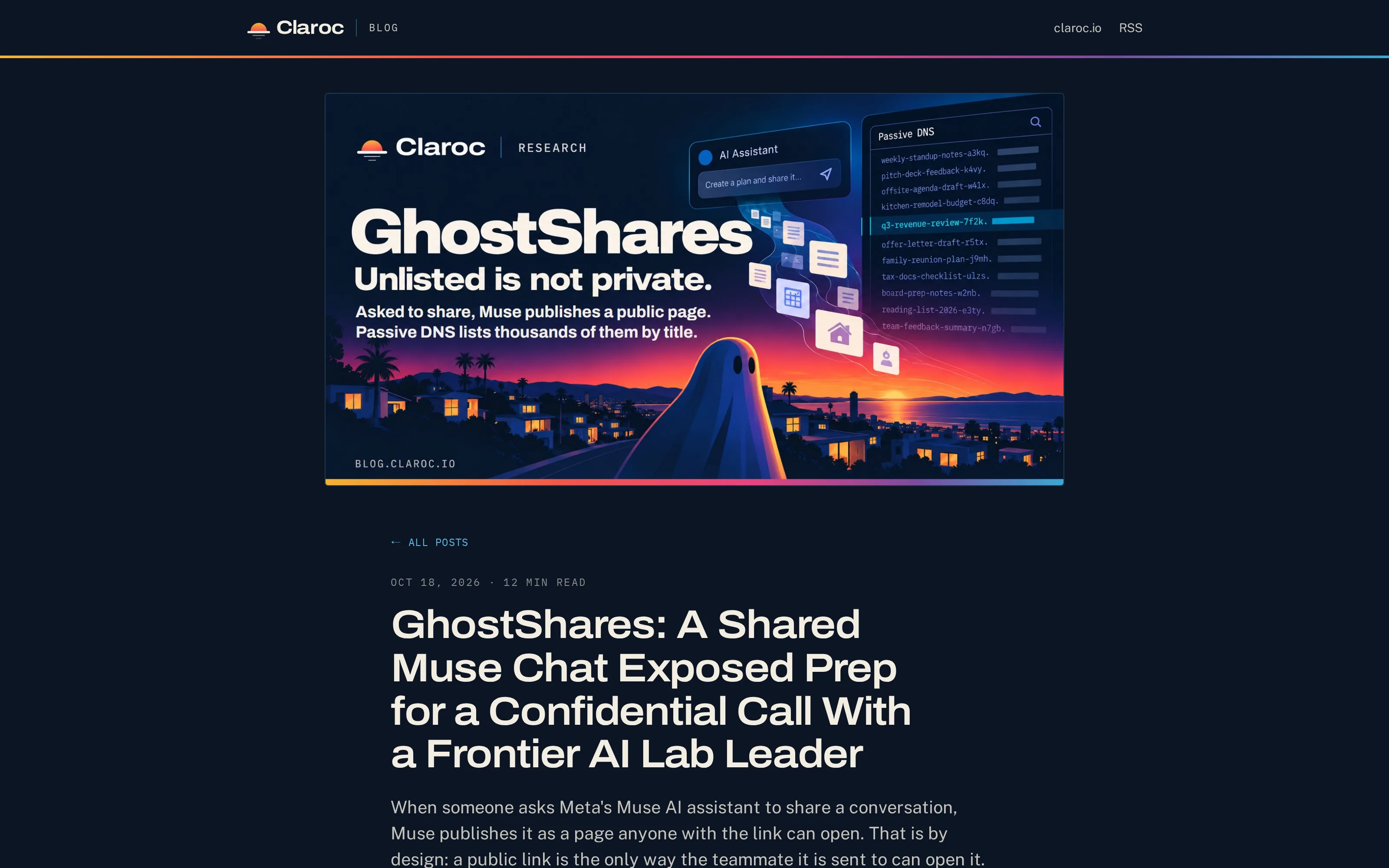
The researchers say they did not guess addresses or break into accounts. A recipient did not have to forward a link to them, either. This distinction matters if you use “only people with the link” to mean “only people I invited.”
Why the title in the hostname mattered
A Muse share used the conversation title and a random ID in a subdomain under cf.metaaiusercontent.com. When someone opened the share, a DNS lookup could expose that complete hostname to a passive-DNS service that observed the response. The title made the record legible; the random ID stopped being a secret once a record held it. This is a design explanation, not an invitation to hunt for shares.
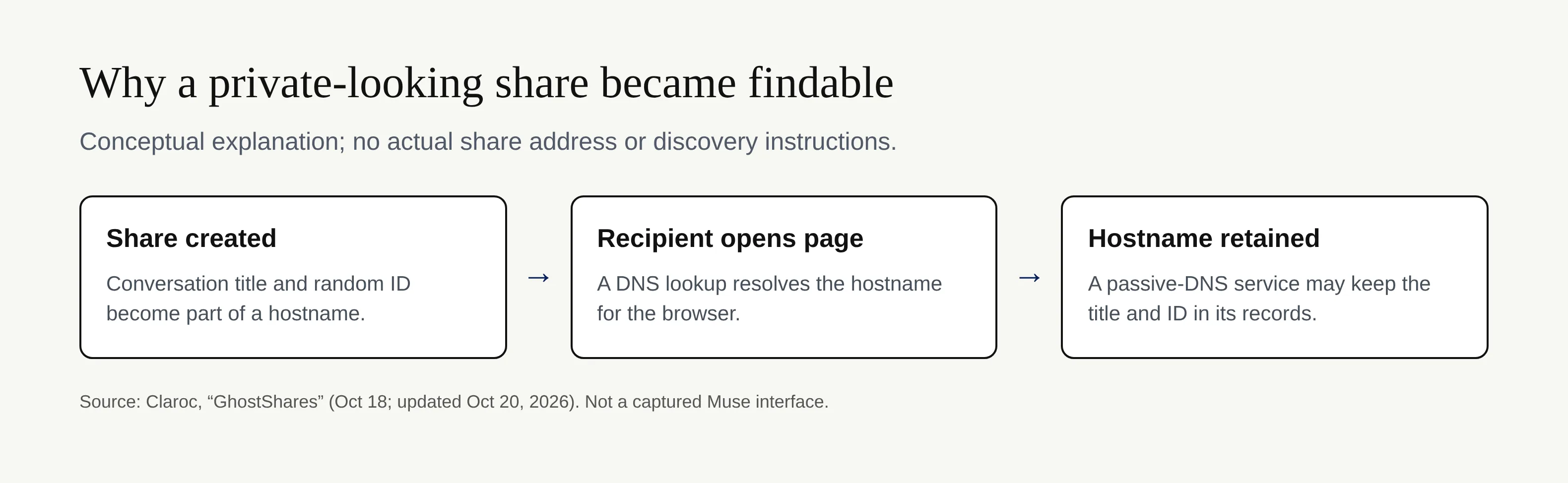
Blocking search crawlers is a different control. Claroc notes Muse discouraged crawlers with robots.txt, yet its findings came through DNS history rather than search indexing. Nor did the team examine every possible DNS observer or every Muse share. The Verge's account confirms Meta's pause and describes the title-plus-ID design.
What did the researchers actually see?
Among a few hundred opened shares, Claroc described confidential preparation for an executive-search call with an AI lab, an internal company revenue review marked for its CEO, a small-business loan application, and a to-do entry about a bank-fraud alert containing a partial account number. Its report also describes a property performance report and a staff vacation calendar. The firm withheld identifiers, links and figures. We won't republish them.
Many sampled shares were mundane. The serious finding isn't that every share was private: it is that a user could publish a sensitive chat believing its recipient needed a hard-to-guess link, while an unrelated person might find the hostname elsewhere. A student sharing a financial-aid draft or a solo business owner discussing cash flow should treat that distinction as practical, not semantic. Engadget's report also notes that previously reachable sampled links stopped opening after Meta's change.
What Meta paused, and what remains uncertain
Meta told Ars it had paused the sharing functionality while reviewing Claroc's report and considering changes to how links can be discovered. Claroc says it retested 40 previously accessible shares on October 20 and none opened then, while the hostnames, including titles, remained in passive-DNS history. Neither statement establishes that all historical records have vanished, that every old link was inaccessible, or that any third party exploited the exposure. Claroc explicitly says it has no evidence of misuse.
Quartz's coverage describes the same incident, but its account is not an independent census of affected users. The direct investigation and Meta's reported response are the firmer basis for an individual decision.
The earlier Muse security incident is different
This link-design issue should not be confused with the September zero-day reported by Ars Technica. Researcher Patrick Wardle found a path for software running on a user's Mac to take control of a Muse account; a ClickFix social-engineering scenario could supply that initial local execution. Ars subsequently reported a Meta hotfix. The earlier incident involved account control, whereas GhostShares concerned the discoverability of pages users chose to share. Neither is proof that every Muse installation was compromised.
Account access changes the stakes
A personal agent can act across calendars, files and accounts. That usefulness makes a small disclosure channel more consequential: a chat about a bank alert can carry facts useful to an impersonator even if no password appears. When an agent can also send messages or submit forms, ask where human approval occurs, not merely whether the model gives good answers. Our guide to personal AI agents covers what delegation means; the separate Amazon–Muse access dispute concerns platform permission, not this DNS issue.
Zentor's workspace-memory approach makes portability a useful question: can you take your memory to another AI through Zentor MCP rather than trapping it in one agent? Portability alone doesn't secure a public share. Zentor's always-on workflow also means access deserves periodic review even when your own computer is off. And Zentor's self-learning skills can build context over time; that makes deciding which context belongs in a share more important, not less.
There is a natural reason to want an agent to catch a missed refund or a form buried in your inbox. Mateo, built by the Zentor team, focuses on inbox and calendar life admin; the trust question still comes first. Ask what it can see and what actions you can review before connecting anything. A different brand name cannot substitute for permission design.
A minimal check before connecting an agent
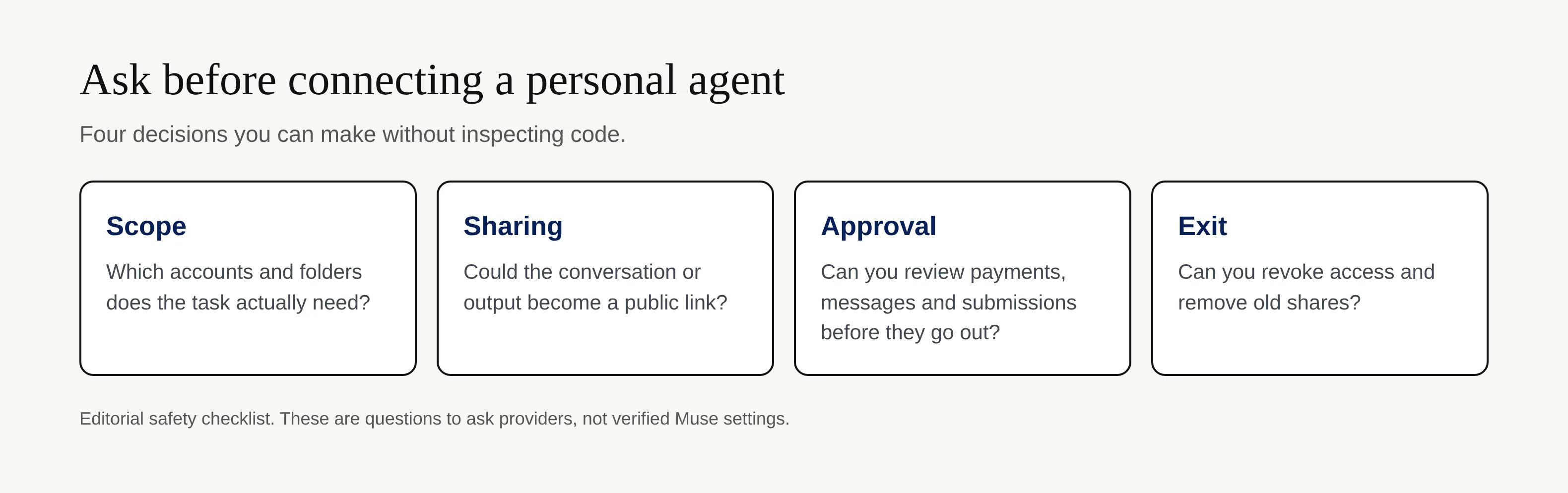
- Start narrow. Connect only the account or folder needed for today's task; skip financial and identity records until you know the sharing model.
- Treat links as publication. Read who can open a share, whether it expires and how to revoke it. If controls aren't clear, don't put confidential material in it.
- Keep a human checkpoint. Review payments, messages and applications before an agent sends them. Don't assume a permission prompt covers future shares.
- Plan the exit. Check how to remove connected accounts and old shares, then revisit those permissions after the task. If you already shared a sensitive chat, stop forwarding its link and ask the provider about revocation; consider changing any credentials that actually appeared in it.
Delegate work without forgetting who holds the context.
Zentor keeps your workspace memory portable across AI through Zentor MCP. Review permissions before sharing sensitive work.
Get early access →
FAQ: Meta Muse privacy after GhostShares
Is Muse safe now?
Meta paused Meta Muse sharing and Claroc's 40-share retest found those pages unavailable on October 20. That is narrower than a blanket safety certification; check Meta's current guidance before relying on sharing again.
Were my chats exposed?
The 6,800-plus figure counts observed share hostnames, not all chats or affected users. If you never created a share, this report does not show that your private chat was published. If you did, review the content and seek Meta's instructions for old links; Claroc didn't publish a searchable victim list.
Should I use Muse share links?
As of Meta's October 20 statement, the feature was paused. If it returns, first verify who can open a link, whether it can be discovered without being sent, and whether revocation works. For confidential records, use a channel with explicit recipients instead of an unlisted public page.

Zentor Research Public data on the AI ecosystem
Zentor Research publishes quarterly data studies on the AI tools ecosystem, drawing on public registries (npm, GitHub, Hugging Face, arXiv, Google Trends). All charts and datasets ship under CC-BY 4.0.
Turn insights into action.
Zentor automates the recurring work your analysis points to. No engineering required.