What Is the Personal Agent Protocol (Poppy)?

What is the Personal Agent Protocol (Poppy)? Learn how draft 0.1 handles agent identity and permissions, and what to check before relying on it.
The Personal Agent Protocol, or Poppy, is a draft standard for how a personal AI agent identifies itself to a company, requests account access, and works on your behalf. Meta and Sierra announced the effort on October 6, 2026; Sierra published the first draft three days later. It proposes clearer permissions for everyday jobs such as checking an order or changing a booking. It doesn't give an assistant automatic access to every business.
Mateo· built by the Zentor team
An agent for the tasks already in your inbox
Mateo checks your inbox and calendar, finds the trial, the refund and the form you forgot, and handles them. Works in any browser, anywhere.
Ask Mateo →
Free in early access
Key Takeaways:
- Poppy describes a relationship between your personal agent and a participating company.
- You choose account permissions; companies choose the routes and actions they allow.
- A design-partner announcement doesn't establish that a service is ready to use.
- Draft 0.1 can change before a stable release. Check the product you need today.
What is the Personal Agent Protocol meant to change?
Suppose you ask an assistant to find a retailer's return policy. It may browse a public page without identifying you. Changing your delivery address is different: the retailer needs to recognize your account and know whether you allowed that change.
Poppy aims to carry that distinction through the interaction. Its introduction describes personal agents working with companies through websites, APIs, or company agents. You shouldn't need to understand the plumbing to distinguish a question from an authorized action.
Zentor's workspace memory addresses another part of the job: retaining your instructions across AI tools. Saved preferences can explain what you want, but they cannot grant access to a retailer's account.
Who is building Poppy?
The original announcement named Meta, Sierra, and partners including Genesys, Instinct, Rocket, Shopify, Stripe, and Walmart. Sierra's October 9 update added 35 design partners, among them OpenAI, Visa, Mastercard, PayPal, and Bank of America.
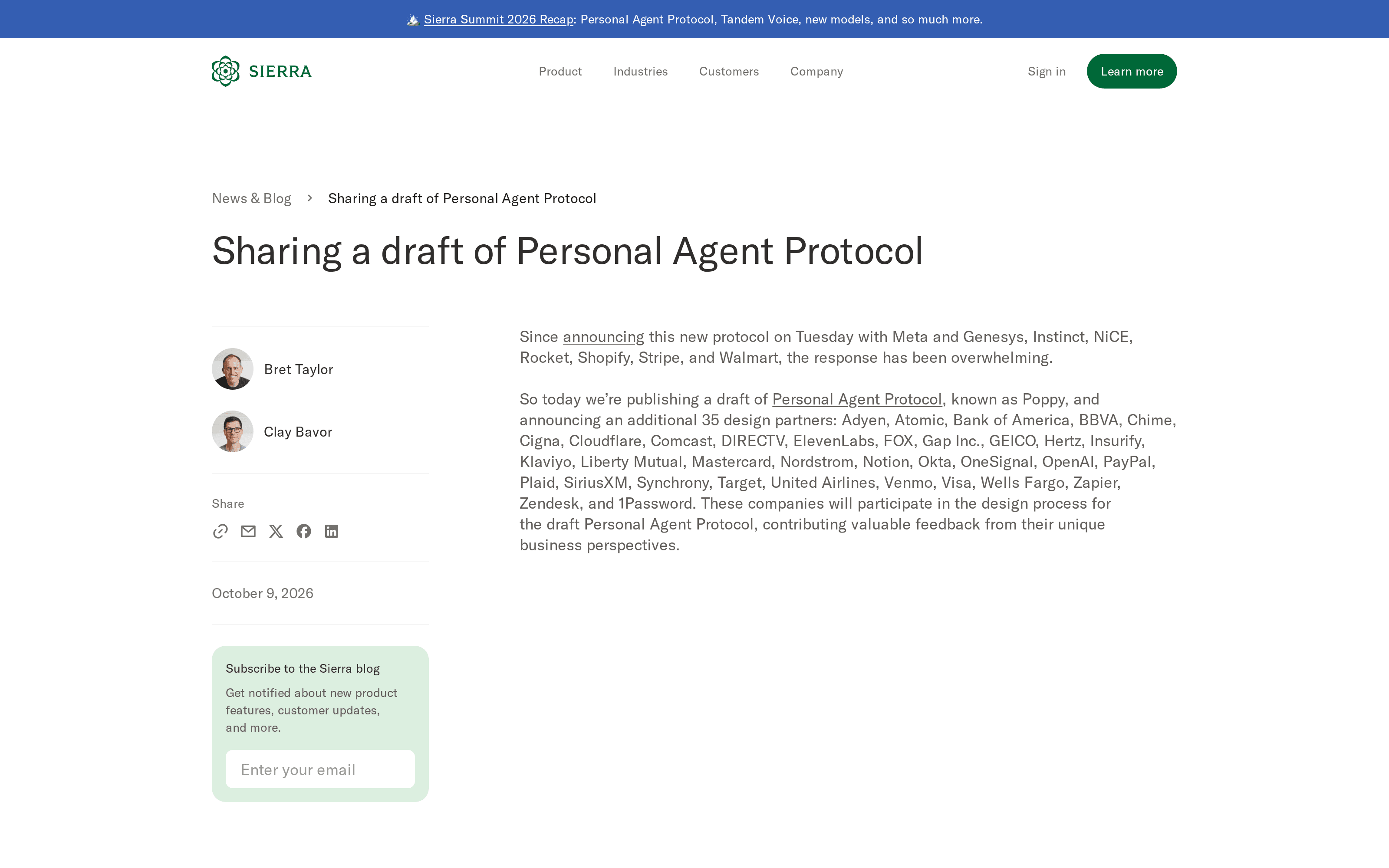
Design partners help shape a protocol; their names aren't a compatibility directory. Sierra described a demonstration involving Meta's Muse and Rocket's agent for mortgage pre-approval. That establishes what the demonstration showed, not what every customer can now do. Look for a supported product route before relying on one.
How does Poppy work?
The specification, still draft 0.1 when checked on October 14, describes company discovery and sessions that can span several channels. A participating company advertises its routes in a poppy.json file at /.well-known/poppy.json. Your agent uses that information to find the company's services.
A session can begin signed out. If the task needs your account, the company offers a sign-in method and asks for permissions. Read access and write access are separate scopes. The draft binds session tokens to an agent-held key through DPoP, so possessing a copied token alone isn't sufficient to use it.

For you, the practical question is whether the requested permission fits the job. Finding an order shouldn't quietly become permission to alter it. Ask what account the assistant is using and which action you are approving.
Personal Agent Protocol vs MCP and OAuth
Poppy builds on existing standards. OAuth supplies authorization mechanisms; MCP can provide a route to a company's tools. The proposed protocol connects those pieces to a user-specific relationship with a company, including discovery and conversation. It doesn't replace either standard.

The distinction matters when choosing an assistant. An MCP connection alone doesn't tell you whether an outside company supports Poppy. Likewise, Zentor MCP makes your workspace memory available to AI tools; that portability is separate from the company's permission to access an account. See Zentor's guide to agent memory and chat history for the context side of that distinction.
How is Poppy different from UCP?
The Universal Commerce Protocol describes commerce capabilities such as checkout and order management. Poppy addresses the broader relationship between a personal agent and a company. A shopping task can involve both kinds of problem: identifying an authorized customer and completing a particular transaction.
Don't assume the protocol name settles the payment step. Poppy's current roadmap still lists payments among the areas needing further work. A merchant may have a separate payment process, and the assistant must follow that actual process rather than treating account access as permission to buy.
For a one-person shop, this is a useful distinction when evaluating a vendor. Ask which tasks customers can complete now, what requires approval, and where a person takes over.
Should you adopt Poppy now?
Treat it as an experiment rather than a dependency for essential work. The official path to 1.0 says authors are working through implementations with design partners and that revisions can break compatibility. Payments, push notifications, and attachments remain open topics. The pages reviewed here don't establish a universal deployment date or a complete list of production-ready services.
If you run a business, ask your platform provider about a specific supported task. If you are choosing an assistant, try a reversible job and inspect the result in the company's own account. Keep client information within approved tools; Zentor's Bring Your Own Agent guide explains why owning an account doesn't authorize uploading someone else's records.
A useful first trial is an order inquiry with a clear stopping point: find the delivery status and show you the answer. Check that the assistant distinguishes information it read from changes it made. If it asks to update an address, confirm that the request belongs to the same account and order. Save the company's confirmation separately from the assistant's summary. For a seller, test the customer experience yourself before advertising support. A successful inquiry is evidence about that inquiry; it says little about a refund, a payment, or another company's integration.
For everyday inbox and calendar chores, you can evaluate an existing assistant on what it does today. Mateo, built by the Zentor team, focuses on missed trials, refunds, forms, and scheduling loose ends. That is a present-day task to assess; this article makes no claim that Mateo or Zentor supports Poppy.
Keep your working context in your hands
Zentor keeps workspace memory usable across AI tools. Start with one task you can review, and keep account permissions separate.
Get early access →
FAQ
What is poppy.json?
It is the company's machine-readable discovery document. You don't need to write one to use an assistant; the company publishes it to advertise supported routes.
Does Poppy replace MCP or OAuth?
No. It uses existing standards to organize how personal agents work with companies. Tool access, account authorization, and your saved context remain distinct responsibilities.
Can any company use the draft?
The official roadmap invites anyone to implement it and provide feedback. That invitation doesn't establish that a particular company's implementation is available or suitable for your task.
When will Poppy be stable?
The reviewed roadmap describes a path to version 1.0 without a firm launch date. Follow the published specification and check the actual service before depending on it. For now, choose a narrow task, review the requested permissions, and keep consequential decisions in your hands.

Zentor Editorial Zentor editorial team
The Zentor editorial team writes about workflow automation, AI agents, and the tools we build. Default byline for industry overviews, listicles, and collaborative pieces.
Ready to put this into practice?
Zentor runs browser tasks, research, and schedules automatically. Try it free.