What Is Manus Cue? Personal Agents Explained

Manus Cue is an early-access app for personal agents with separate identities. Learn what it can do, where it runs, and what to verify.
Manus Cue is a standalone app for personal AI agents with their own communication identities and a shared group chat. Unlike a chatbot, they can carry work across tools and hand it off, within your permissions.
Key Takeaways:
- Agents can have separate conversations, email, phone, wallet, and computer access, depending on availability and permissions.
- In one macOS test, two agents preserved sources and uncertainties across a research-to-review handoff.
- That handoff needed a human follow-up before the second agent produced its audit.
- Start with a reviewable shortlist, not an unsupervised message or purchase.
I tested a hypothetical 40-person Manhattan workshop using only public venue information. Nara returned three venues in about four minutes. One looked plausible for 40 until the seating layouts mattered: it allowed 40 in theatre rows, but only 30 in a classroom setup. Cue turned that caveat into a warning in group chat. The headline capacity was not the useful number; the seating layout was. One run is not a reliability score.
Testing note: On October 1, 2026, I used Cue for macOS with a signed-in account. I checked the linked venue listings independently. I did not use calling, payments, private files, connected accounts, or external outreach.
Quick Answer
Manus Cue lets you create personal agents with distinct roles and working contexts. It is separate from Manus Studio, although both come from Manus. For freelancers, the test is whether agents return verifiable work while you control client access and real-world actions.
What Is Manus Cue?
Manus introduced Cue alongside Manus 2.0 as a standalone app built on Manus infrastructure. Studio is a project workspace; Cue is organized around agents and conversations. It does not establish transfer of Studio files or permissions.
Cue personal agents illustrate the difference between an answer and an action: a task can continue beyond one reply. That is category context, not a Cue integration.
How Personal Agents Work in Cue
Separate Identities and Communication Channels
An AI agent identity in Cue may include an email address, phone number, wallet, and computer, depending on availability and permissions. The Cue app presents these as work channels; availability varies.
Separate identities do not guarantee client-data separation. Check connected accounts and context before sharing a brief.
Agent Groups and Task Handoffs
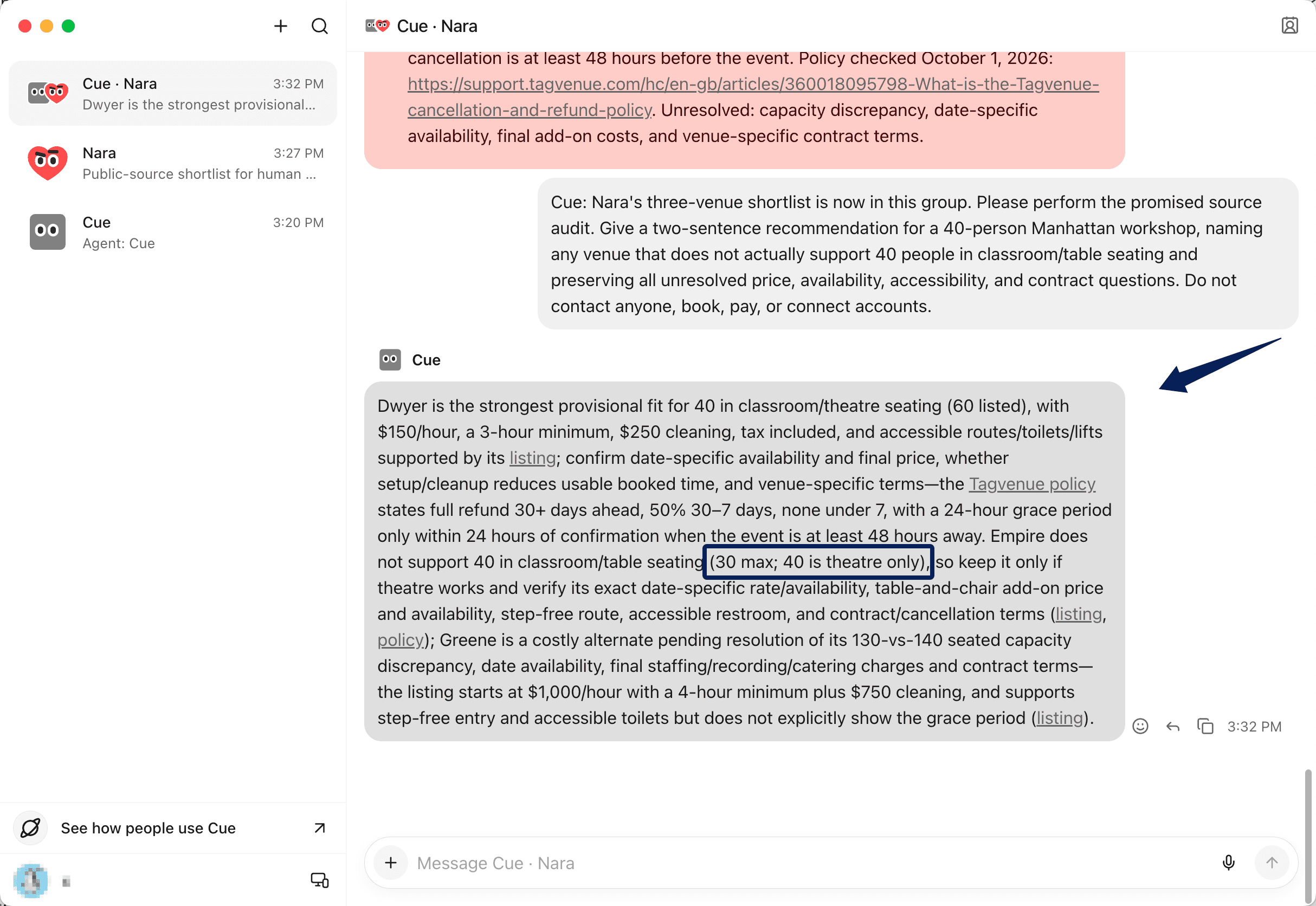
I created an agent group chat with Nara and Cue. Nara brought its one-to-one shortlist into the group with links, dates, and unresolved points. Cue acknowledged that it would audit the list, but did not produce the audit until I sent a second, explicit instruction. The information crossed over; the next action needed a nudge.
Cue then distinguished "40 theatre" from "30 classroom" for the Midtown option and kept the open questions visible. The useful question is whether such constraints survive into the recommendation.
Everyday Tasks That Fit Cue
Event Planning and Shortlists
The task asked for three venues and four fields each: capacity, public price, accessibility, and cancellation terms. Nara supplied all 12 fields with source links, while flagging missing date-specific availability and final contract terms. It flagged conflicting seated-capacity figures.
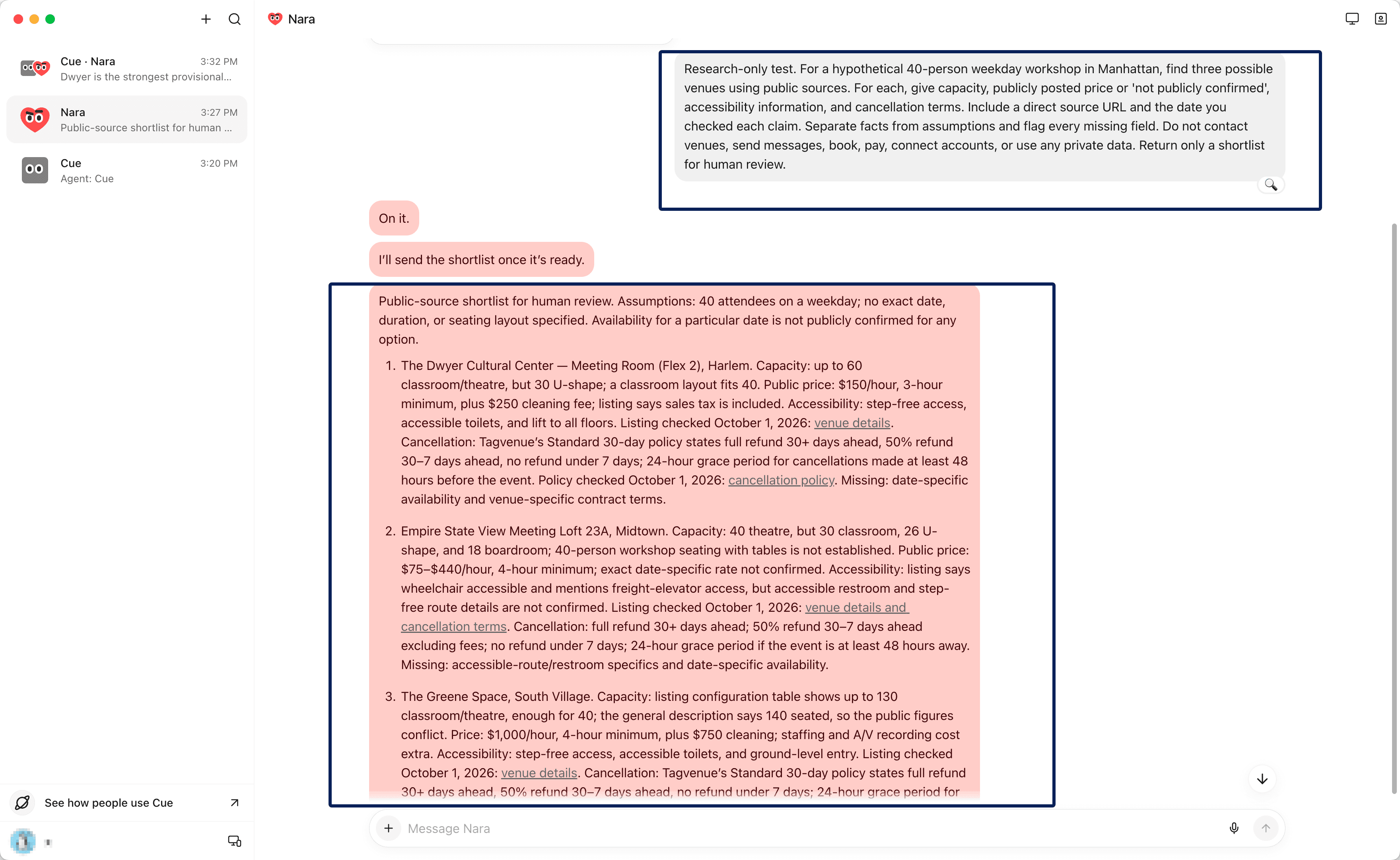
I spot-checked the Midtown loft listing: the live page showed $75-$440 per hour, a four-hour minimum, and only 30 classroom seats. I also checked the Greene Space listing, where the headline and description differed on seated capacity. The Dwyer listing shows 60 classroom seats but only 30 U-shape. Maximum headcount alone does not describe a usable workshop room. The shortlist did not settle availability or the final bill.
Calls, Messages, and Summaries
I did not test calling. For a first trial, use a consenting contact and check whether the summary preserves deadlines without inventing promises. Keep sensitive client calls out until that basic check holds up.
Where Human Control Still Matters
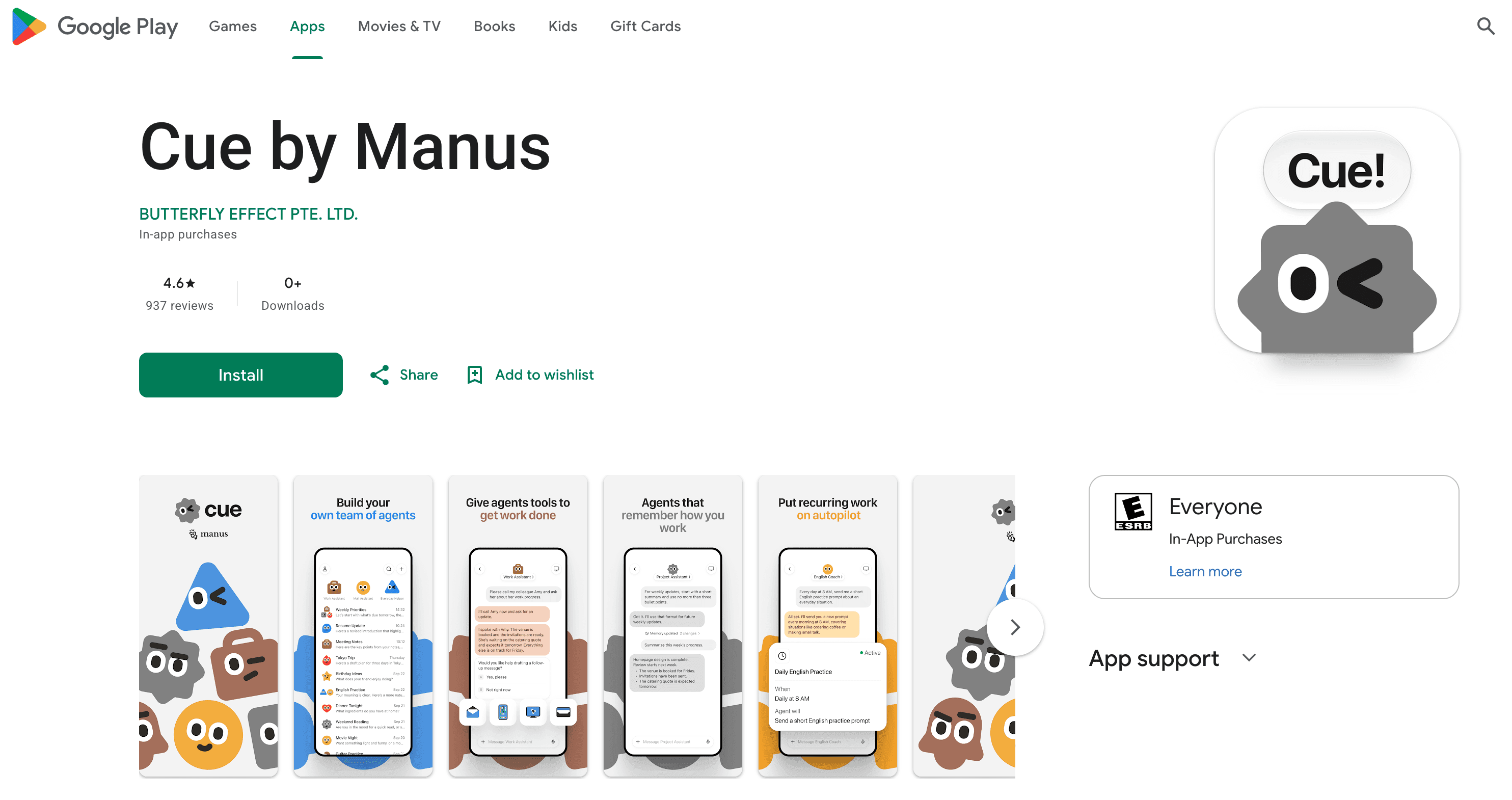
Keep approval before connecting an account, contacting an outsider, or spending money. Cue's Android listing describes user-set permissions and purchase approval. That does not guarantee a correct outcome.
My test stopped at research and review. Before an inquiry, check the recipient, rate, seating, and cancellation terms. A wrong message from an agent's address can look like your commitment.
What Early Access Has Not Yet Proven
At launch, Cue early access was free by invitation on web, desktop, and mobile, with iOS awaiting App Store review then. The live Cue site offers desktop downloads, and its Android listing still mentions an invite. Neither promises permanent free access or equal regional coverage.
One shortlist cannot establish reliability for calls, payments, or interrupted work. Repeat the brief before widening permissions. Zentor's agent evaluation framework is a separate lens for judging that step, not a Cue integration.
FAQ
Can One Cue Account Keep Client Projects Separate?
Separate agents can keep different conversations, but strict client isolation is not publicly established. Before sharing a confidential brief, check each agent's connected accounts, memory, and group-chat visibility. In a harmless test, confirm what from a one-to-one chat becomes visible after the agent joins a group.
Can a Cue Agent Contact Someone Who Does Not Use Cue?
Yes, where email or phone is available on the account. The recipient need not join Cue, but consent and approval still matter.
What Happens to an Agent's Email and Wallet After Deletion?
The public launch does not specify what happens to an agent's address, wallet, or pending transactions after deletion. Settle activity and confirm retention first.
Can Users Transfer an Invite Code to Another Account?
No transfer route for redeemed codes is documented. Manus announced extra codes to share, which is different.
Can Cue Task History Move Into Manus Studio?
The public materials reviewed here do not define how Cue task history carries into Manus Studio. Manus does advertise cross-device continuity between Cue and desktop, so verify exactly which history and context carry over.
Where Manus Cue Earns Its Place
Cue is most interesting when agents can research and review without losing evidence. Here, the shortlist and caveats survived group chat, but the audit needed another prompt. Widen access only when that handoff holds up in your own work.

Zentor Editorial Zentor editorial team
The Zentor editorial team writes about workflow automation, AI agents, and the tools we build. Default byline for industry overviews, listicles, and collaborative pieces.
Ready to put this into practice?
Zentor runs browser tasks, research, and schedules automatically. Try it free.