Yelp Check for Me: AI Calls Restaurants

Yelp Check for Me will call restaurants for a current wait and text you the answer. See rollout limits, booking distinctions and the AI-to-AI call risk.
Yelp Check for Me is an announced AI phone agent that will call an eligible restaurant for its current walk-in wait time and text the answer to you. Yelp announced it on October 20, 2026, but says the feature will roll out in the coming months on eligible U.S. restaurant pages and in Yelp Assistant on iOS; it isn't a general-purpose calling service available everywhere today. Yelp's Fall Product Release describes a request that asks for your party size and phone number, then leaves the choice of where to eat with you.
Key Takeaways:
- The reported output is a current wait-time estimate by text, not a booked table or a promise that you'll be seated when you arrive.
- Party size is an input to the request; Yelp hasn't said that the text separately guarantees accommodation for a particular group.
- If a business voice agent answers, your agent may have to speak to another agent. TechCrunch raises this as a possible point of failure, not a documented failed call.
- Availability is limited by device, location, restaurant eligibility and a future rollout.
What Check for Me actually does
The useful part is narrow. Suppose you have a short lunch break and don't want to sit on hold just to learn whether a walk-in is realistic. Yelp says its agent will place that call and return the reported wait by SMS within minutes. The company's October 20 release identifies the output as a current wait time. You still choose whether the estimate is worth the trip.
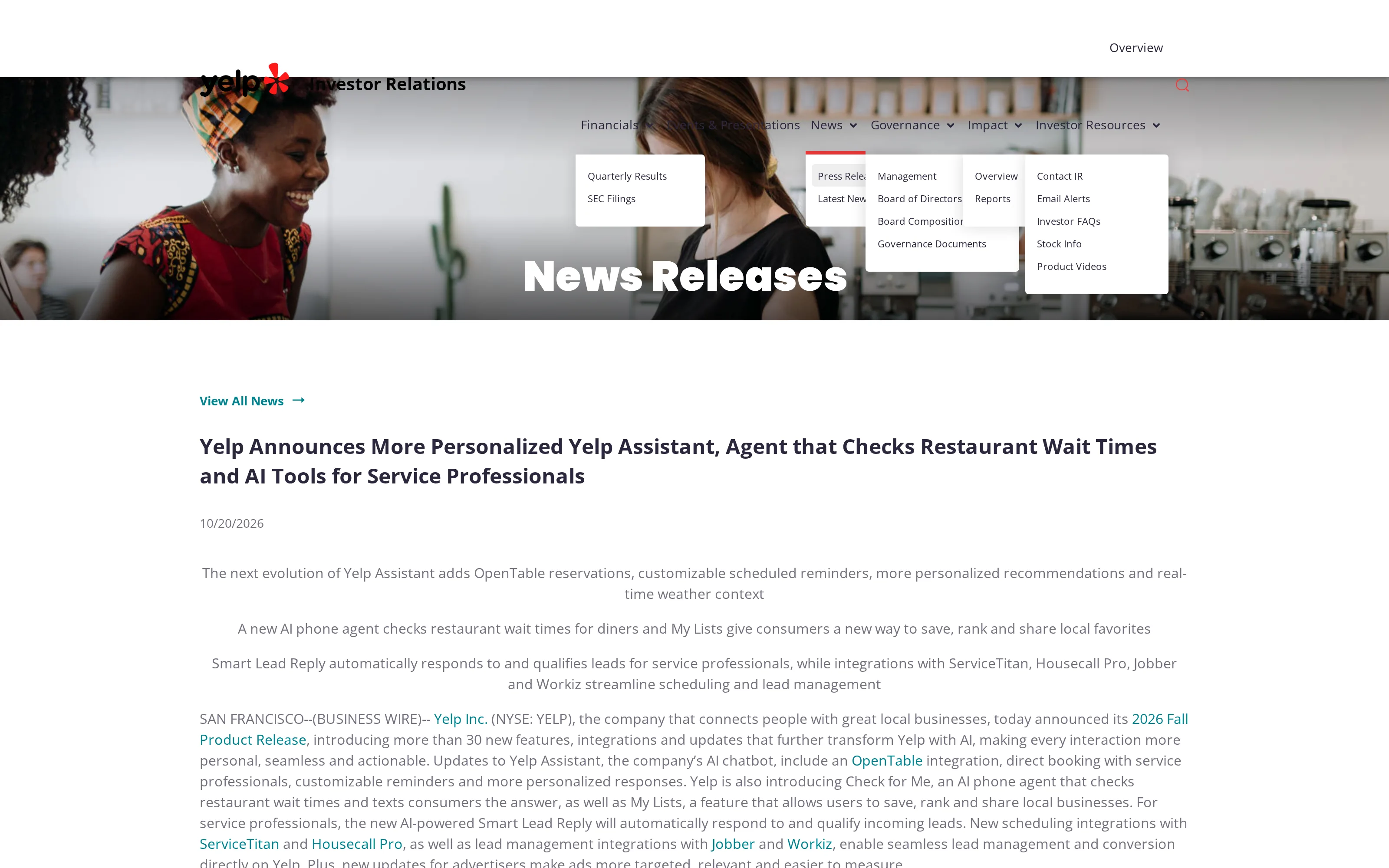
The screenshot shows Yelp's public announcement, not an in-app Check for Me session. That distinction matters while the announced feature remains in rollout.
How the AI voice agent calls on your behalf
This isn't a transcript of a live test. Yelp's published sequence is simple: a diner submits a party size and phone number on an eligible listing; an AI phone agent calls the restaurant; the diner receives a text with the wait. Yelp does not publish the agent's exact script, call recording, recognition accuracy or fallback behavior in the release. Describing the agent as negotiating seating, reserving a table or confirming a specific arrival time would add capabilities the announcement doesn't establish.
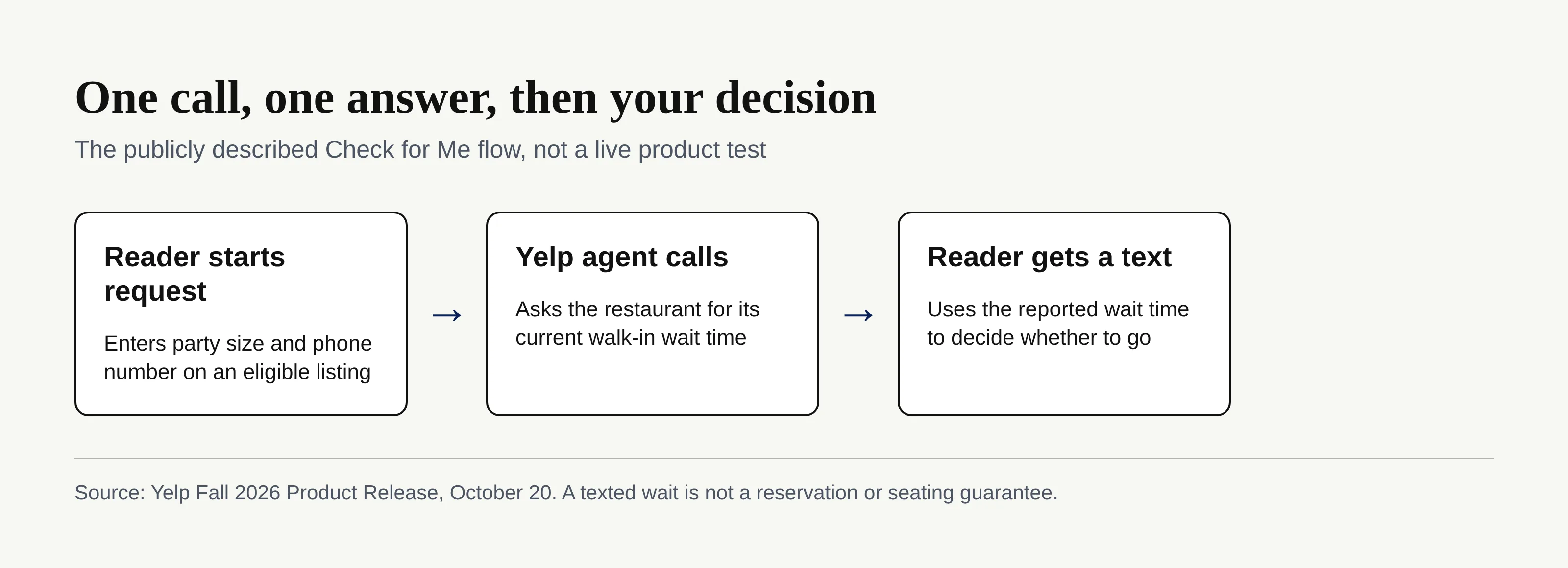
An outbound call is different from Yelp Assistant surfacing a review-derived recommendation. Reviews can help you pick a place, but a live wait requires an answer from the restaurant at that moment. This is a small example of an agent moving from finding information to doing an errand; the handoff is still a text for you to judge.
What happens when an AI calls a business's AI?
The other end of the line might not be a person. Yelp Host is a separate, business-side phone agent that can handle restaurant calls, including reservations and other inquiries. TechCrunch points out the resulting agent-to-agent communication problem: a diner's calling agent could reach a restaurant's answering agent, and the conversation could break down.
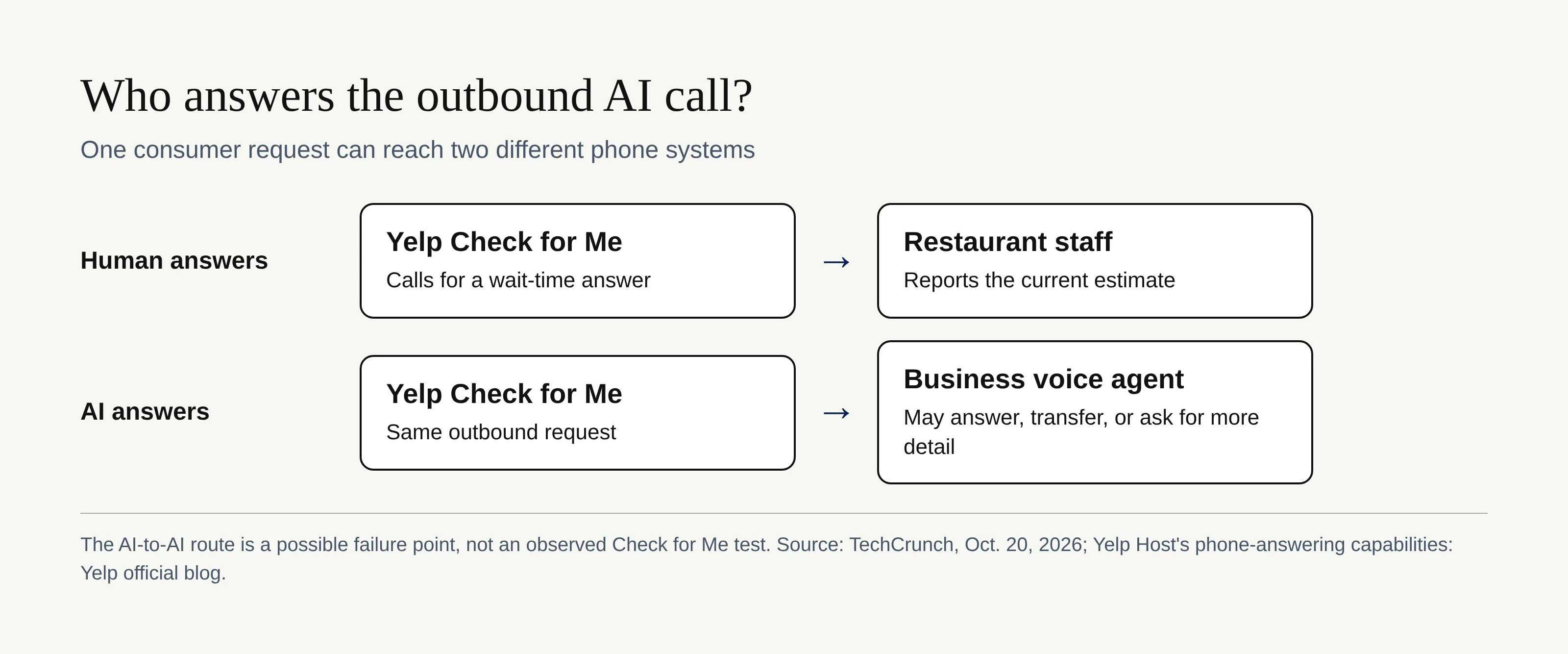
That is a possible interaction, not proof that the two Yelp products have failed together. A useful question for any calling agent is what happens when the answer is ambiguous: does it report uncertainty, ask for a person or quietly produce a confident text? Yelp hasn't detailed Check for Me's handling of that case. A consumer-facing text should not turn an unresolved call into an apparently verified wait.
What a wait-time text can and cannot confirm
A wait time is perishable. Your table might open sooner, or a larger party might face a different delay by the time you arrive. The published flow asks for party size, but Yelp's stated result is the latest wait time, not a guaranteed capacity check or reservation for that exact party. If you need wheelchair access, a large-group arrangement or a firm time slot, verify those with the restaurant rather than treating the wait text as a commitment.
There are three distinct actions here: ask for a wait, join a waitlist and book a reservation. Yelp Check for Me addresses the first. Yelp says eligible diners can join Yelp Waitlist within Assistant and receive table-ready updates; a reservation uses a separate booking flow. Putting all three under the word “booking” would hide the important difference.
Yelp's other AI updates are separate products
The fall release also adds OpenTable booking within Yelp Assistant, with booking confirmation and changes handled on OpenTable. Yelp says recent Assistant chats cover the past 30 days, with full history expected later; customizable Keep Me Posted reminders can suggest local activities. The broader Assistant introduced in spring already mixed local discovery with booking and ordering links. A phone call fills a different gap: asking a business for information that may not be current online.
Those updates do not turn Check for Me into a universal assistant. The Verge's October 20 report describes the release as an iOS rollout. Yelp's own wording is more precise: eligible walk-in restaurants in the U.S., over the coming months.
Should you let an agent make calls for you?
Yes, for a narrow, reversible question such as “what's the wait right now?”; no, if you need the call to authorize a charge, promise a booking or convey sensitive details without your review. The practical test is whether the result comes back with enough context to let you decide. A texted wait passes that test only if it reflects an answer the restaurant actually gave and you can still check anything consequential yourself.
This is the boundary between a platform feature and an agent workflow. Yelp's caller belongs to Yelp, not Zentor; there is no Yelp integration with Zentor claimed here. Personal AI agents explained looks at task state and inspectable outputs; what autonomous agents should handle draws the line around consequential action. Zentor's workspace memory can carry context between AI tools through Zentor MCP, while keeping that memory under your control. It does not make a restaurant phone call on Yelp's behalf. For any assistant, ask what it did, what it learned and where you get to approve the next step.
Delegate the errands you can review
Zentor keeps your working context available across AI tools. Start with a bounded task and inspect the result before anyone acts on it.
Get early access →
FAQ: Check for Me and restaurant calls
Does Yelp call the restaurant for you?
That is the announced function: for an eligible U.S. restaurant with walk-ins, its AI agent calls for a wait time and texts the result. Yelp says availability will expand over the coming months on iOS; don't assume the option appears for every restaurant today.
Is Check for Me free?
Yelp's fall announcement does not specify a consumer price for this feature. Do not infer one from the separately priced Yelp Host service for businesses. Check the feature's terms when it becomes available to you.
What does the AI say on the call?
Yelp says the agent calls to check the restaurant's current wait time after you supply party size and phone number. It has not published an exact Check for Me call script in the sources reviewed here, so no one should present a sample dialogue as an official transcript.

Zentor Research Public data on the AI ecosystem
Zentor Research publishes quarterly data studies on the AI tools ecosystem, drawing on public registries (npm, GitHub, Hugging Face, arXiv, Google Trends). All charts and datasets ship under CC-BY 4.0.
Turn insights into action.
Zentor automates the recurring work your analysis points to. No engineering required.