GLM-5.4: Size, Loop Transformer and What Changed From GLM-5.3

GLM-5.4 explained: 750B scale, the Loop Transformer that runs 28 layers twice, 1M context, new vision, and what Z.ai did not publish at launch.
GLM 5.4 is Z.ai's new flagship coding model, released on 23 November 2026: roughly 750 billion parameters, a 1M token context window, new vision input, and the first production model built on the company's Loop Transformer architecture. It is live now inside the GLM Coding Plan, ZCode and Z.ai Chat; the open API and weights are still pending.
Key Takeaways:
- GLM 5.4 loops 28 layers of the GLM-5 base model twice, trading compute for depth without adding parameters
- Size is approximately 750B; Z.ai claims parity with 2T-3T models, which is a claim, not a measurement
- Vision is new: image, video and file input, text output, versus GLM-5.3's text-only
- Z.ai published no standard benchmark scores for GLM-5.4 itself, only a win-rate chart and a 30B ablation
- Known limitation the vendor admits: marathon thinking loops; community timing puts hard tasks at tens of minutes
The clean one-line version came from Z.ai's engineer on launch day: "scale loop depth, (next) scale model size". That is what the first half of the roadmap looks like shipped.
Size, context and what is actually new
Three numbers define GLM 5.4 on paper. Scale sits around 750B parameters, the base it starts from is the GLM-5 pre-trained model, and the context window runs to 1M with 128K maximum output. Input modality is the headline change: video, image, text and file in, text out. GLM-5.3 accepted text only, so anything visual, a screenshot of a UI bug, a design mockup, a video of a mechanism, is new territory for the flagship line.
Speed, per Z.ai's model card, reaches up to 200 tokens per second off-peak and holds 70 to 80 at peak load, which matters because the architecture's cost is paid in thinking time rather than output rate.
One clarification on context: the 1M window is opt-in, not automatic. In Claude Code it requires the glm-5.4[1m] model string plus a million-token compact-window setting; other tools take a context-size parameter. If a session truncates early, check that knob before blaming the model.
The Loop Transformer, in plain words
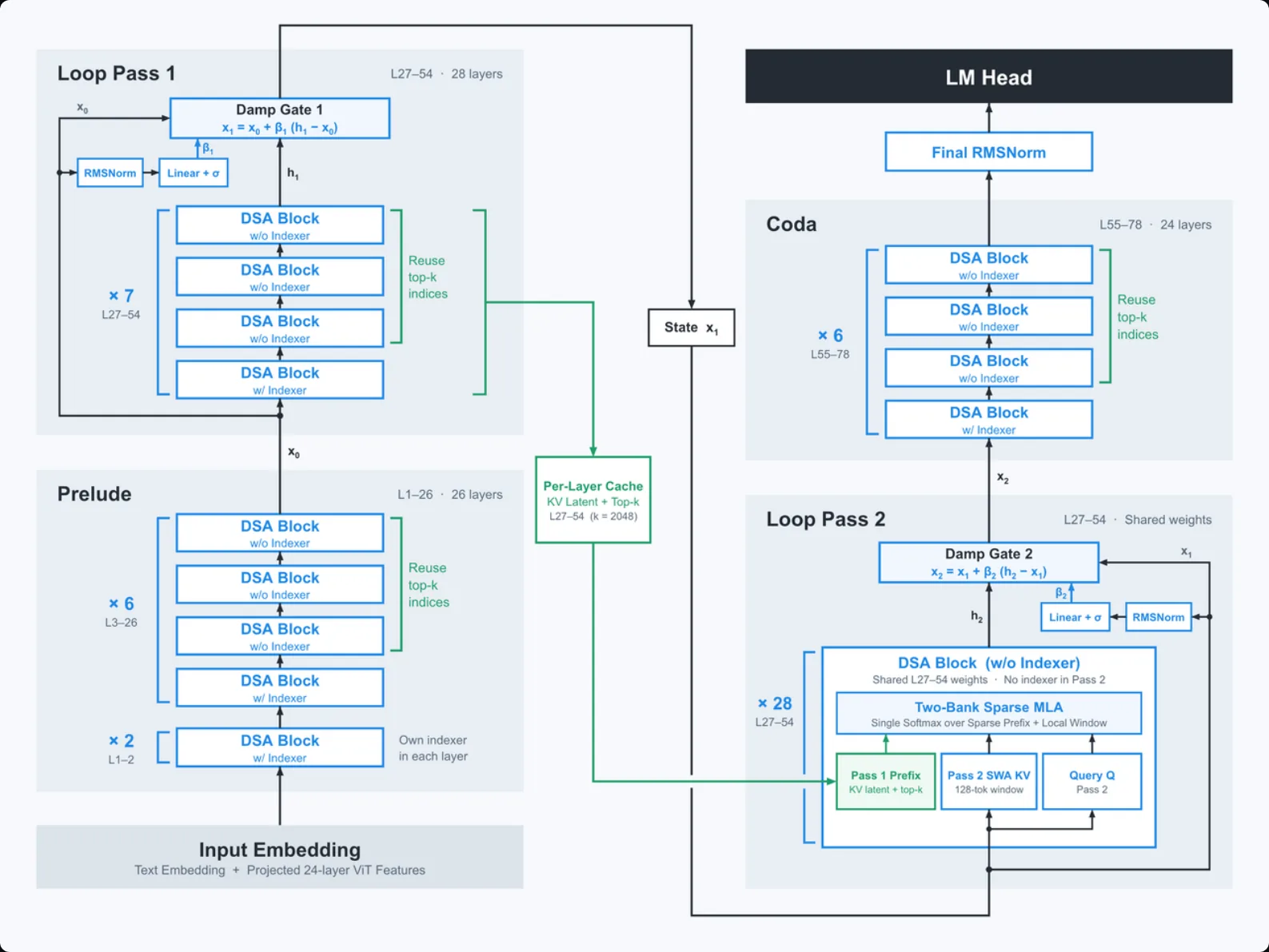
A normal transformer reads each token through its stack of layers once. GLM-5.4 takes 28 of the GLM-5 base's layers and runs them twice, a second pass over the same parameters, so the model reasons deeper without carrying more weights. The idea is older than the branding; what Z.ai did at flagship scale is the engineering part, since naively looping a trained stack makes activations blow up.
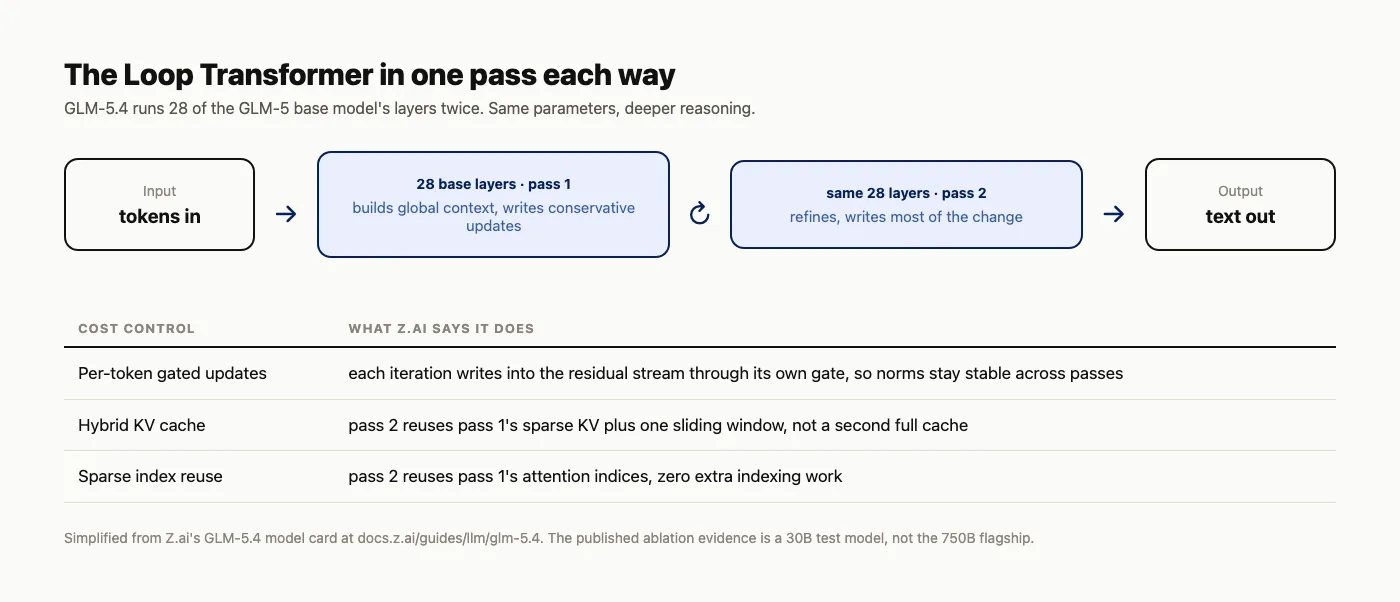
Z.ai's card lists three modifications that made the loop survivable at 750B: per-token gated updates that keep activations stable across passes, a hybrid KV cache so the second pass costs one sliding window rather than a second full cache, and reuse of the first pass's sparse attention indices. The result, in the company's framing, is intelligence "comparable to 2T-3T parameter models". Treat that as a claim: Z.ai has not published the comparison method, and no standard benchmark table for GLM-5.4 itself exists yet.
Why loop instead of just training a bigger model? Compute economics. Scaling parameters scales training cost roughly linearly, while a second pass over existing layers spends inference compute on demand instead of in pretraining. GLM-5.4 loops every token twice; adaptive per-token iterations, giving harder tokens more loops, is what Z.ai lists as future work. The other open question it names is what returns look like as loop count and model size grow together. The engineer's "scale model size" checkbox is still unticked, so expect the loop idea to be applied to a larger base next.
The ablation evidence Z.ai does give comes from a 30B iso-parameter test model, showing roughly 10% more training compute buying its largest gains on math, science reasoning and long context, with output length down 10 to 14% on GPQA-Diamond and MMLU-Pro. Those numbers describe the test model, not GLM 5.4; any article quoting them as the flagship's scores is misreading the card.
"Generalized Coding", the demo reel
Z.ai's pitch for 5.4 is that coding generalizes beyond software: the launch materials show it writing code that produces a self-narrated "Hello World" music video, driving a 6-axis robot arm design in FreeCAD and Blender, generating a 3D bird-watching scene in custom GLSL shaders, and building a complete game. These are vendor demos, chosen to flatter the model, so read them as "things it was shown to do once" rather than a capability list. The direction is real, though: vision input plus code output means "describe the artifact, get the thing that makes the artifact" is now a supported workflow, and that is what "generalized coding" is selling.
GLM-5.4 vs GLM-5.3, the short table
| GLM-5.3 | GLM 5.4 | |
|---|---|---|
| Architecture | standard transformer | Loop Transformer, 28 layers x 2 passes |
| Vision | text only | image, video, file input |
| Thinking off | disabled errored |
maps to low, forced thinking |
| Default effort | max | max |
| Coding Plan multiplier (in/cached/out) | 6.9 / 1.7 / 24 | 4.6 / 1.1 / 16 |
| Weekly quota on plan | baseline | 1.5x for weekly-quota plans |
| API access | gated at launch | pending security assessment |
| KingBench 4 (community) | 27.5 | 33.2, 7th of 19 |
The multiplier row surprises people: it burns about two-thirds of GLM-5.3's credits per token, which is the mechanics behind the "50% more quota" headline. The full plan maths is in our rate-limits explainer. the effort story in full is in the reasoning effort guide.
Read the table as a personality change rather than a spec bump. GLM-5.3 was a fast text model with a visible off switch; 5.4 is a slower multimodal one where the lightest setting still thinks. The cheaper multipliers and bigger quota sound like a price cut, and per token they are, but a model that spends a million reasoning tokens on a suite of six tasks can still outspend its predecessor in practice.
Who should actually care
Three audiences have a reason to look now. Coding Plan subscribers, because the model is already in their picker and costs less per token than 5.3. Anyone doing visual coding, because vision input is new to the GLM flagship line. And teams who got burned by GLM-5.3's missing API at launch, because 5.4 repeats the same gate, Coding Plan first, API later, and the plan's own docs warn the API waits on a security assessment with no date. Everyone else can safely wait for the review cycle to settle, starting with our launch-week assessment.
Where you can use it today
Live on launch day: the GLM Coding Plan on all tiers (Lite, Pro, Max, Team), ZCode, Z.ai Chat, plus AutoClaw, Trae, WorkBuddy and Qoder per Z.ai's announcement. Not live: the pay-as-you-go Model API, which the docs say opens "upon completion of the security assessment", and open weights, which will be "released responsibly" with no date. OpenRouter still had no GLM-5.4 listing as of 24 November. The full access map is in how to use GLM-5.4, and it is also available in Zentor with no Coding Plan required.
What Z.ai did not publish
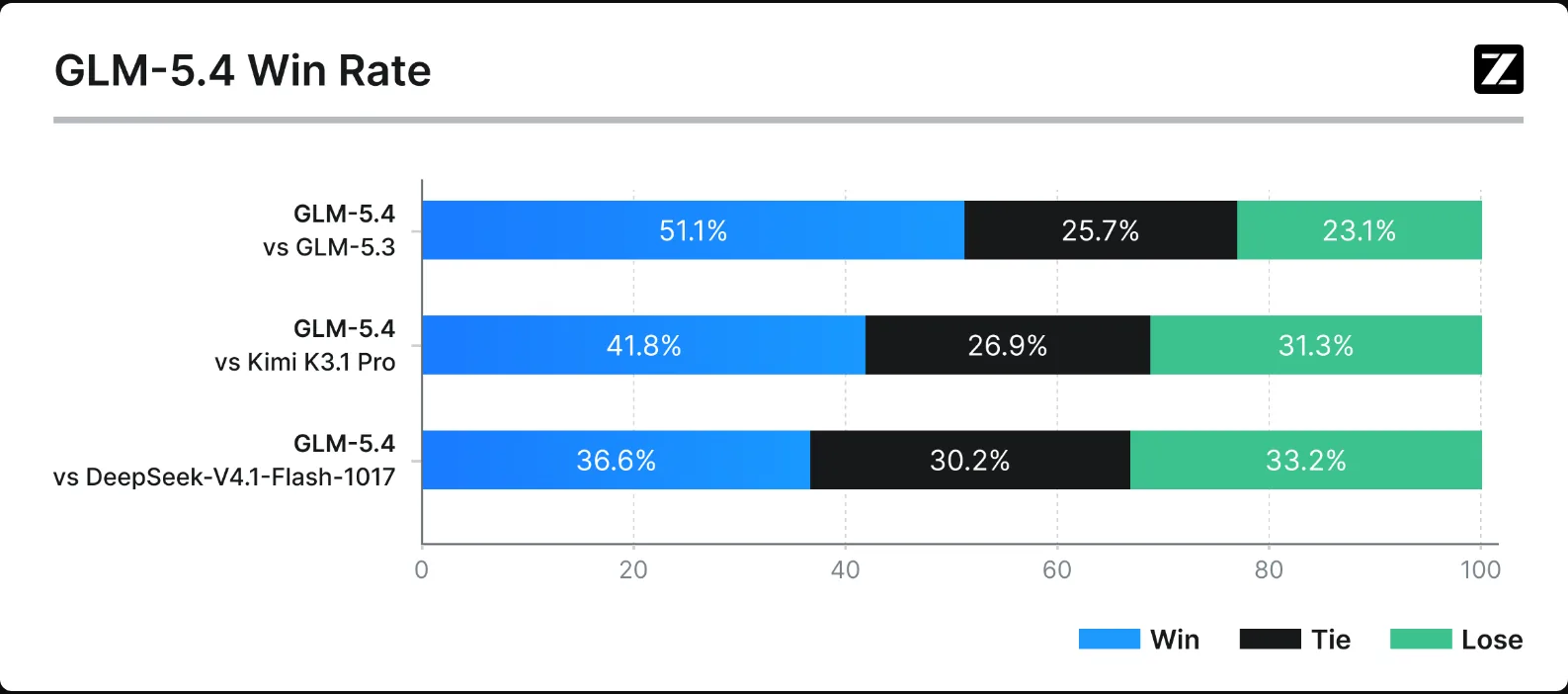
For a flagship launch, the omissions are notable. No standard benchmark table for GLM-5.4 itself, no MMLU or SWE-bench row, no latency-per-level figures, and the one capability visual on the card is a win-rate chart with no stated opponent set or methodology. The company also gave no date for the two things developers ask about most, the API and the weights. GLM-5.3's precedent cuts both ways: its flagship weights did land on Hugging Face around 28 August, about two weeks after launch as promised, but they arrived as a repo, not a date on a roadmap; for 5.4 Z.ai has given no timeframe at all. Independent boards had not caught up either: it was not yet listed on Artificial Analysis as of 24 November.
What the launch week actually showed
The community data is genuinely good on capability and genuinely bad on speed. On KingBench 4, it scored 33.2 of 60, seventh of 19 models and the top open model, up from GLM-5.3's 27.5 (@aicodeking); it also took 431 minutes versus Gemini 4 Neon's 109. Z.ai's own engineer warned about the marathon thinking in the same breath as praising its jumps on test writing, code QA and core dev tasks. Whether that tradeoff works for you is the question our GLM 5.4 review takes up in detail.
GLM-5.4, running on a machine that is not yours.
Zentor is a hosted AI computer: pick GLM-5.4, describe the task, and it works through the long thinking loops without your laptop or your Coding Plan quota involved.
Try Zentor →
How big is GLM 5.4?
Approximately 750 billion parameters, built on the GLM-5 pre-trained base. Z.ai claims intelligence comparable to 2T-3T models through its loop architecture; it has not published the method behind that comparison.
Is GLM 5.4 a new model or an upgrade?
An upgrade in architecture, not a retrain from scratch. Z.ai continued training an existing GLM-5 base with a second pass through 28 of its layers plus supporting changes to gating, KV cache and attention indexing.
Does GLM 5.4 support images?
Yes. Vision input (image, video, file) is new versus GLM-5.3, which was text-only. Output remains text.
When was GLM 5.4 released?
23 November 2026, when it rolled out to all GLM Coding Plan tiers. The API and open weights had no date as of 24 November.
Is GLM 5.4 free to use?
There is no confirmed free route with the flagship itself: access runs through the GLM Coding Plan (from $18/month list) and Z.ai's own surfaces. GLM-5.3-Flash remains the lighter option on the same plan.
Model facts were read off Z.ai's GLM-5.4 model card and Coding Plan docs on 24 November 2026. The 2T-3T comparison and the 30B ablation are Z.ai's claims, attributed; community benchmark numbers are the posters' own, linked inline.

Zentor Editorial Zentor editorial team
The Zentor editorial team writes about workflow automation, AI agents, and the tools we build. Default byline for industry overviews, listicles, and collaborative pieces.
Turn insights into action.
Zentor automates the recurring work your analysis points to. No engineering required.