GLM 5.4 Review: The Most Careful Open Model, and the Slowest

Launch-week GLM-5.4 review: top open model on KingBench 4 at 33.2 but 431 minutes to run it, the distillation dispute, and whether it earns a try.
This GLM 5.4 review is a launch-week verdict, not a lab report: the model is genuinely the top open model on KingBench 4, weights promised but not yet released, unusually careful, and slower than anything else shipping. Whether that trade makes sense depends on how much of your work is hard and unattended.
Key Takeaways:
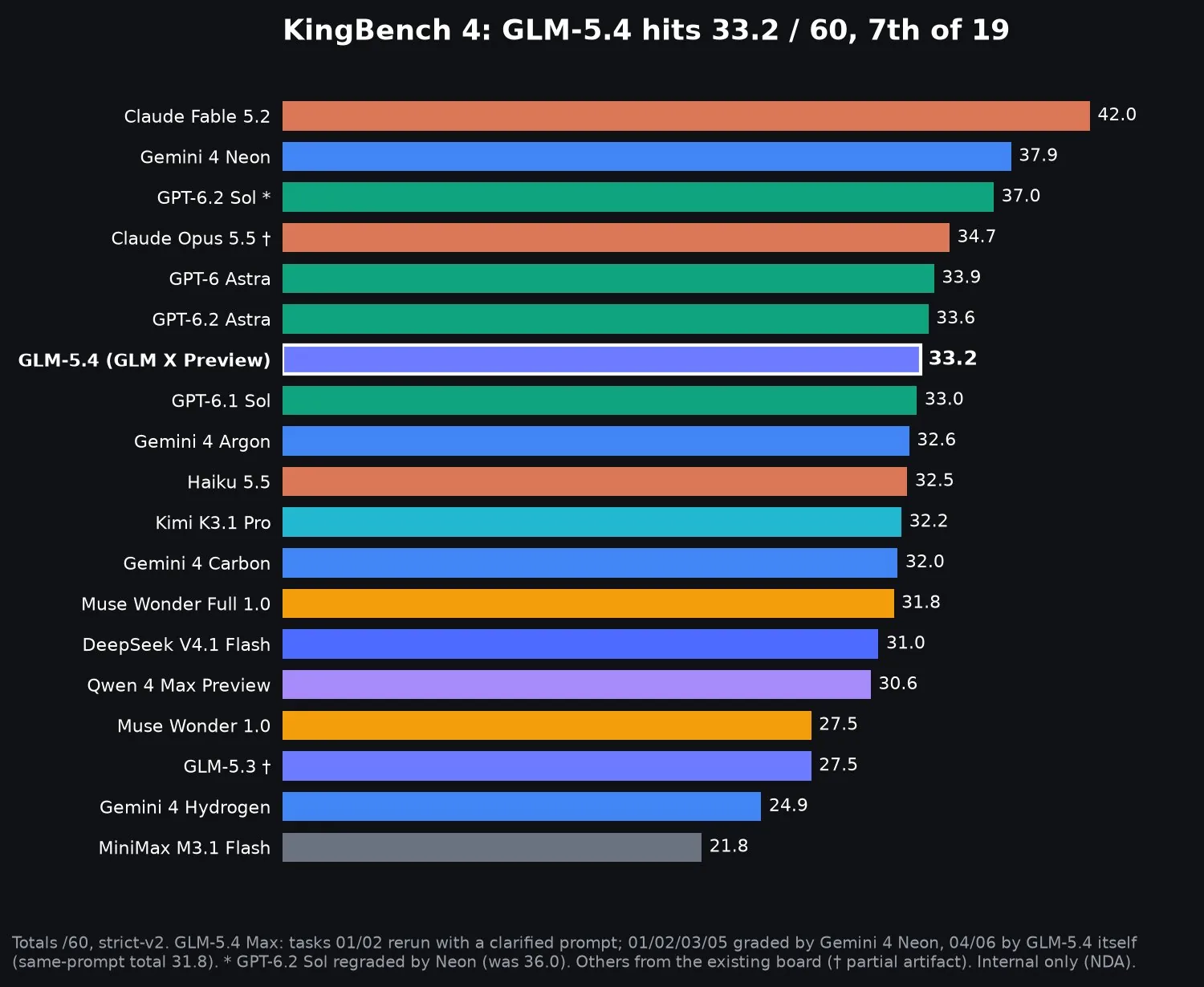
- KingBench 4: 33.2 of 60, 7th of 19 models, top open model; Claude Fable 5.2 leads at 42.0
- It took 431 minutes to get there versus Gemini 4 Neon's 109, burning ~1.04M reasoning tokens
- Reviewers who used it for days call it the most careful model they have run; it caught bugs rivals missed
- Z.ai published no standard benchmark table, and the "distilled from Opus 5.5" claim is a live dispute
- Not yet on Artificial Analysis; a circulating "58" index figure is unverified rumor
GLM-5.4 landed on 23 November 2026 with no standard benchmark table from its maker, so any GLM 5.4 review this week leans on community measurement. The most cited is @aicodeking's KingBench 4 run, and his opening line is the fairest summary available: "the best Open Model you can use right now", with the caveat that it takes a long time to reach a conclusion.
Where it actually ranks
The KingBench numbers, across six graded coding tasks: GLM-5.4 totalled 33.2 of 60, placing seventh of 19 and first among open models, ahead of GPT-6.1 Sol at 33.0 and Gemini 4 Argon at 32.6. The ceiling is clear though: Claude Fable 5.2 holds 42.0, with Gemini 4 Neon (37.9), GPT-6.2 Sol (37.0) and Opus 5.5 (34.7) between.
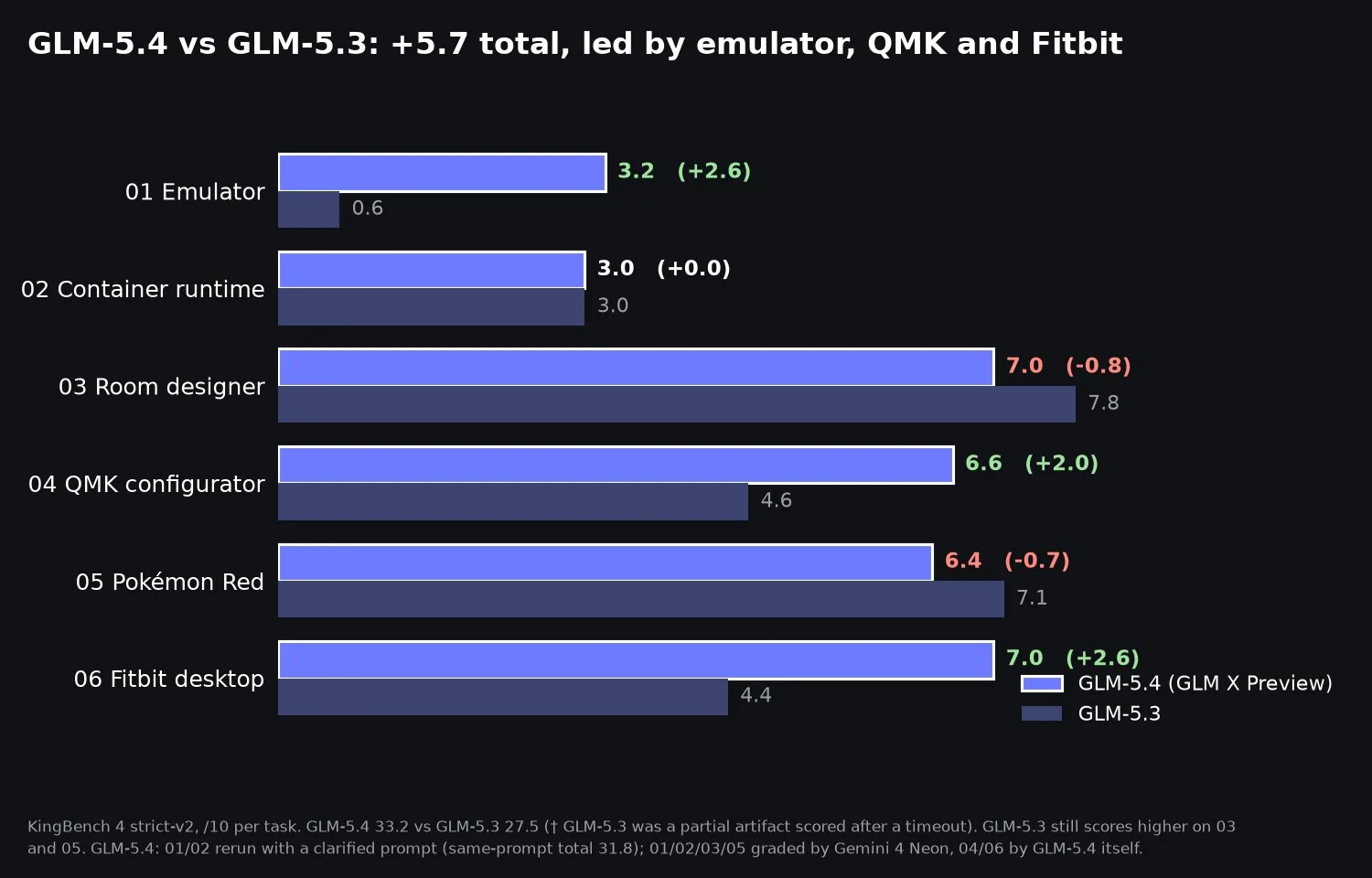
Against its own line the jump is real: GLM-5.3 scored 27.5 on the same suite, so 5.4 adds 5.7 points, led by emulator and QMK configurator tasks.
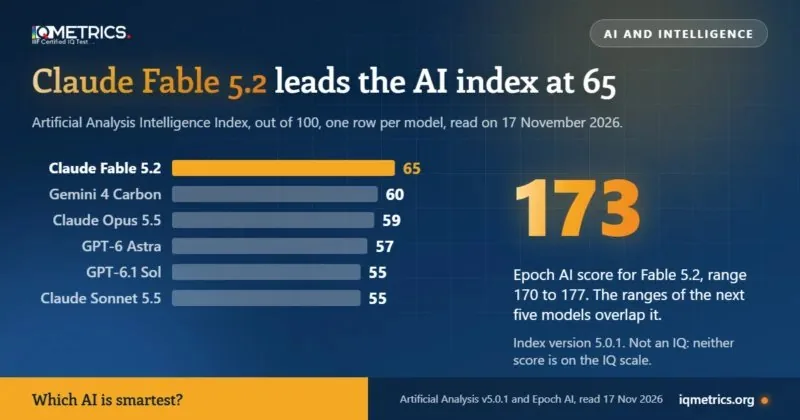
Two cautions on the broader leaderboards. Artificial Analysis had not listed GLM-5.4 as of 24 November, noted by @ymybkhn and confirmed by @idlxidlx, and a "58" index figure circulating in posts like @GodanLeeX's is unverified rumor, not a published score. Any GLM 5.4 review quoting that number as fact is getting ahead of the evidence.
What the vendor published, and what it did not
Z.ai's launch materials carry a loop-transformer architecture story, a win-rate chart with no stated opponent set or methodology, and a 30B ablation whose numbers describe a test model rather than the 750B flagship. There is no MMLU row, no SWE-bench entry, no standard table at all. That absence is itself part of the launch picture: the model arrived inside a subscription first, and the measurement burden fell to the community. The verified spec side, 750B scale, 1M context, vision input, is covered in what is GLM-5.4.
What it is like to use
The texture of the reviews is consistent across languages and tools, which matters because a single enthusiastic benchmark can be a fluke but a pattern of independent testers reaching for the same word usually is not. @aicodeking called it "the most careful model that I have ever used" and credits it with finding bugs and security issues that rivals, Fable included, missed. @ZCODER9000's Claude Code log shows the same care in miniature: the model inspected its own screenshot, decided "the camels look like horses", and fixed them. And @0xcherry's AutoQuant account describes a model that, an hour into a strategy task, wrote its own search-acceleration scaffold and then outpaced models that had already converged.
The cost of that care is time, and the numbers are not subtle: 431 versus 109 minutes on the KingBench suite, roughly four times slower than Neon at max effort, 9 to 14 times the reasoning tokens per task. @qwjcool's six-hour ASCII-art build is the extreme case, against 25 minutes for the same prompt on Neon, and @feixing_felix logged routine project turns of 30, 50, 60 minutes. @Dav338876 measured 9 to 14 times the consumption of a fast rival and was not kind about it. The mechanism and the fix are in our reasoning effort guide: the default max is the expensive one, high is where reviewers landed, and easy turns should go to GLM-5.3-Flash. The vendor's own engineer conceded the point early: marathon thinking pays off on debugging and big codebases but is "overkill for quick one-liners".
Worth separating two kinds of slow. Slow per step, it is not: KingBench timed 22.9 seconds per model turn against Neon's 26.7. Slow in steps, it emphatically is: 1,128 turns against 244. GLM-5.4 does not lag, it iterates, and the wall-clock difference is the iteration count.
The distillation dispute you will see cited
A viral thread by @Da7_Tech argues GLM-5.4 is distilled from Opus 5.5, built on style-analysis over millions of logged characters. The pushback is as loud: @ivanfioravanti points out training began before Opus 5.5 was released, and @BubbleBrain dismisses it as inconsistent with the capability gap. Treat it as an open dispute: plausible-sounding evidence on one side, timeline problems on the other, no verdict to hand you.
Where it costs you and where it does not
On the GLM Coding Plan, 5.4 is cheaper per token than 5.3 (a 4.6/1.1/16 multiplier against 6.9/1.7/24) and weekly-quota plans got a 1.5x allowance for it. The catch is behavioural: a model that reasons 14 times longer on a task can still outspend a cheaper-per-token rival. @ZCODER9000's Lite plan ran out on max, which is the lived version of that arithmetic. The plan math itself is in our rate-limits piece.
The picture a week cannot give you
A launch-week GLM 5.4 review has structural blind spots, and being honest about them is cheaper than pretending otherwise. Weight-class questions are unanswerable until the API opens and independent labs run standard suites; the 2T-3T parity claim from Z.ai sits untested. Reliability questions, does the marathon thinking degrade across long sessions, do preserved-thinking sessions drift, need weeks of logs, not days. And the two promised artifacts, API access and open weights, have no dates, so the model's real ecosystem position is still hypothetical. The GLM-5.3 launch taught the same lesson in reverse: its flagship weights did land on Hugging Face around 28 August, about two weeks after launch as promised, but they arrived as a repo, not a date on a roadmap; for 5.4 Z.ai has given no timeframe at all.
One more lens: the plan economics of a slow model
An under-discussed angle in this GLM 5.4 review is that slowness is priced. Thinking is generated output, and output carries the 16 multiplier on 5.4, so a model that thinks long spends quota long. Z.ai lowered the per-token price for 5.4 versus 5.3, but the subscription that looked like a bargain on the multiplier table is the one @ZCODER9000's Lite plan ran out on at max effort.
The honest verdict
Who should not bother yet: anyone needing an API, self-hosted weights, or a router listing, since none exist; anyone whose work is mostly quick interactive turns, where the default thinking overhead is a tax with no return; and anyone benchmark-shopping, because the only independent number that exists is one community suite.
For one-shot visual builds, long careful refactors, test writing and code review, GLM-5.4 earns a try: it is the best open model on the only independent suite that has scored it, and "careful" is the one word every reviewer reaches for. For quick interactive turns it is the wrong tool at the default setting, and the vendor says so itself. The real GLM 5.4 review will be written in a month, when Artificial Analysis and the arenas have scored it properly; until then, run it on your own hardest task rather than trusting either the hype or the dunking. It is in Zentor now if you want a route with no Z.ai subscription, and setup options are mapped in how to use GLM-5.4.
Give it your hardest task and close the lid.
GLM-5.4 runs in Zentor, the hosted AI computer. Let it think as long as it wants, on hardware that stays awake.
Try Zentor →
FAQ
Is GLM 5.4 good?
For careful, hard coding tasks, yes: it tops the open-model table on KingBench 4 and reviewers call it the most careful model they have used. For speed or quick turns, no, it is among the slowest models shipping.
How does GLM 5.4 compare to Claude Fable 5.2?
On KingBench 4, Fable 5.2 leads at 42.0 versus GLM-5.4's 33.2. Reviewers note 5.4 catching bugs Fable missed in some cases, but the overall ceiling clearly belongs to Fable.
Is GLM 5.4 distilled from Opus 5.5?
Unproven. A style-analysis thread claims it; the timeline objection, training began before Opus 5.5 shipped, remains unanswered. Z.ai has not commented on the claim directly.
What is GLM-5.4's Artificial Analysis score?
There is none yet: the model was not listed as of 24 November 2026. A circulating "58" figure is an unverified rumor, not a published result.
Should I switch from GLM-5.3 to 5.4?
For hard tasks, the KingBench gap (+5.7 points) and the cheaper credit multiplier say yes, keeping 5.3-Flash for easy turns. If your work is mostly quick interactive sessions, the thinking overhead may not pay; the effort settings decide most of that answer.
Benchmark figures are the named community measurements linked inline, read 24 November 2026. Z.ai has published no standard scores for GLM-5.4 itself; the distillation claim and AA listing status reflect that date.

Zentor Editorial Zentor editorial team
The Zentor editorial team writes about workflow automation, AI agents, and the tools we build. Default byline for industry overviews, listicles, and collaborative pieces.
Turn insights into action.
Zentor automates the recurring work your analysis points to. No engineering required.