GPT-6.2 Review: Early Verdicts, Both Sides

Early GPT-6.2 review verdicts split hard: embargoed testers call it unusable, independent benchmarks put Astra second, and OpenAI concedes the UX gap.
GPT 6.2 review coverage split into two camps within a day of the November 17, 2026 launch, and both camps have evidence. The numbers side points at results like one builder's same-prompt test where GPT-6.2 Astra produced a 3D plane scene for $9.62 in 46 minutes against Fable 5.2's $209.50 in 3 hours (@EnvolDev). The tester side counters that the model loses coherence on long real work. The honest summary: for one-shot, visual, and cost-sensitive jobs the evidence favors GPT-6.2; for multi-hour work that must stay coherent, the critics' point is not yet rebutted.
Key Takeaways:
- Embargoed testers were blunt: "the worst model OpenAI has ever released" and "essentially unusable"
- Independent data disagrees with "worst": Astra is #2 on the Artificial Analysis Intelligence Index behind only Claude Fable 5.2 and leads much of the cost-per-task frontier
- OpenAI concedes the UX gap: "very smart" but with "more work ahead of us on making the models nice to work with"
- The testers likely reviewed a pre-final build, according to OpenAI's Codex lead
- For long coherent work, Fable and Opus still have the better testimonials; for fast, cheap, visual builds, 6.2 has the receipts
The split, in one paragraph
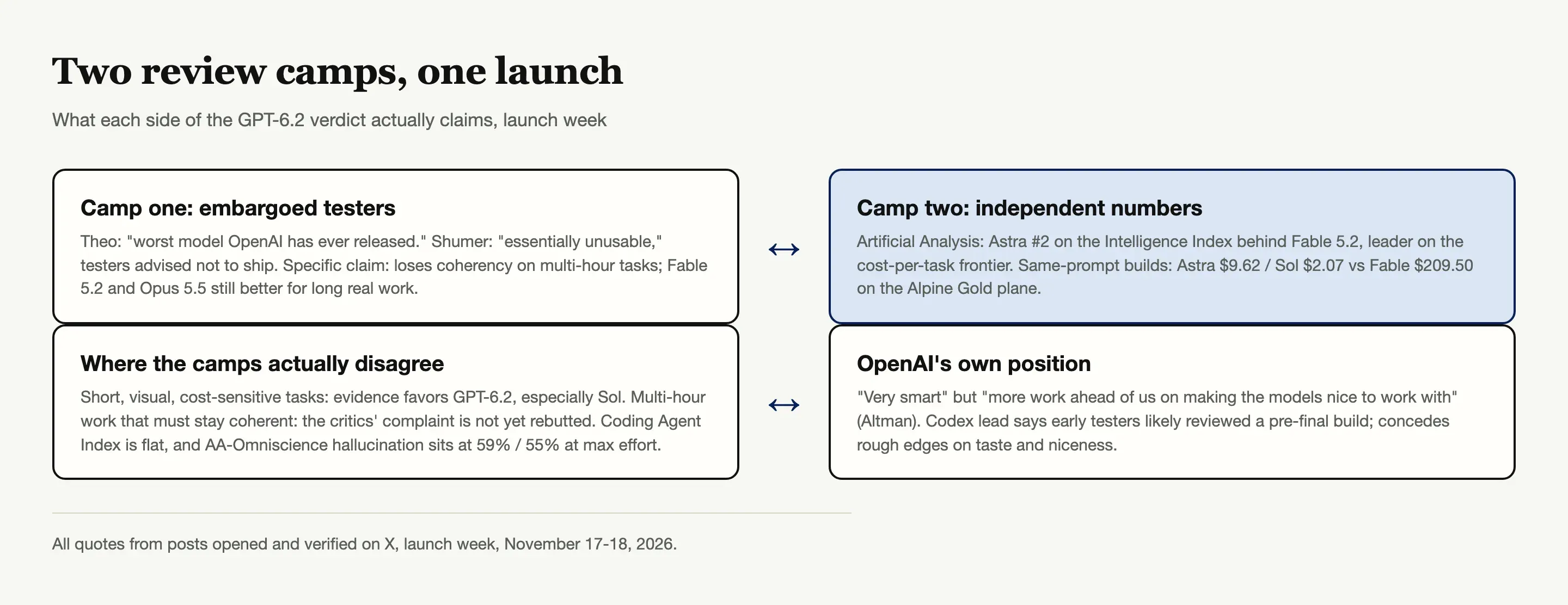
Launch day produced two loud and contradictory verdicts at the same time. A group of early testers, led publicly by Theo and Matt Shumer, called GPT-6.2 a bad release. Independent benchmarkers and the same-prompt build community posted numbers that made it look like a leap. OpenAI itself occupies the uncomfortable middle: proud of the capability jump, openly admitting the models are not yet nice to work with. Any GPT 6.2 review that picks only one of those three sources is missing most of the story.
Camp one: the early testers' verdict
The loudest launch-day post came from Theo, who had been testing Astra before release: "I think this is the worst model OpenAI has ever released" (@theo). Matt Shumer was equally direct: "I had a terrible experience testing them. They were essentially unusable. I do not recommend these models" (@mattshumer_).
The complaints are specific enough to take seriously. Shumer says he tried GPT-6.2 Astra as a sub-agent inside his Claude-driven workflow and that "Opus/Fable got so frustrated with it and ended up redoing all the work themselves" (@mattshumer_). He also says a number of testers advised OpenAI not to release the model, and pushed back on the conspiracy-reading of the synchronized negative reviews: "Why are the reviews all negative: the model is bad. It's pretty simple, guys."
Theo's detailed criticism is about long-task coherency rather than raw intelligence. His follow-up after trying OpenAI's suggested system-prompt fix: it "helped a lot but it still isn't enough. Model loses coherency after a few hours on long tasks" (@theo). His longer thesis is that OpenAI "has maintained pace with capability, at the cost of coherency and readability," and he argues Artificial Analysis needs behavioral benches because "Opus 5.5 is still the best value available for real long running code work." Asked which model he would use where, he conceded one lane: "If I'm making a 3d model, I prefer Astra." For getting real work done he still picks a different model entirely.
Camp two: the independent numbers
The counter-evidence is not OpenAI marketing; it is independent measurement. Artificial Analysis placed GPT-6.2 Astra second on its Intelligence Index at launch, five points above GPT-6 Astra and behind only Claude Fable 5.2, with OpenAI models occupying most of the cost-per-task Pareto frontier (@ArtificialAnlys). The same lab also credits Astra with leading its 3D and Robotics evaluations.
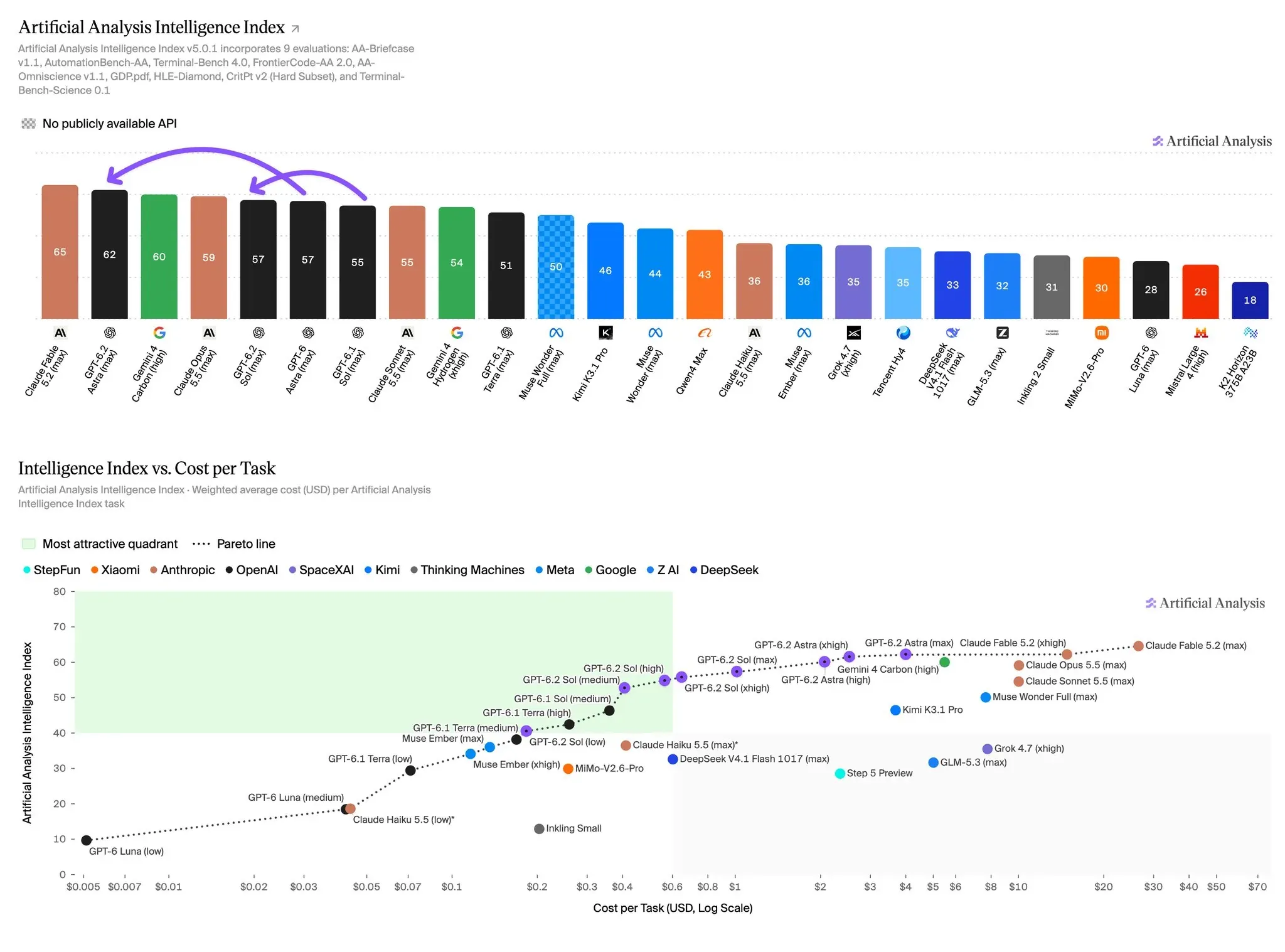
Media from @ArtificialAnlys on X.
The same-prompt community tests line up with the efficiency story. EnvolDev's four-model Alpine Gold plane build came out at $9.62 in 46 minutes for Astra, $2.07 in 31 minutes for Sol, $209.50 in just over 3 hours for Fable 5.2, and $31.85 in 2h 46m for Opus 5.5. That is one tester's harness and one prompt, but the cost gap is too large to wave away. More verified builds are collected in the GPT-6.2 examples post.
The numbers camp has its own honest caveat. Artificial Analysis's Coding Agent Index, run in a Codex harness at max effort, has Astra flat versus GPT-6 Astra and Sol down 3 points versus GPT-6.1 Sol (@ArtificialAnlys). AA's hallucination measurement is also unflattering in absolute terms: Astra 59% and Sol 55% at max effort on AA-Omniscience, which measures guessing when the model does not know the answer.
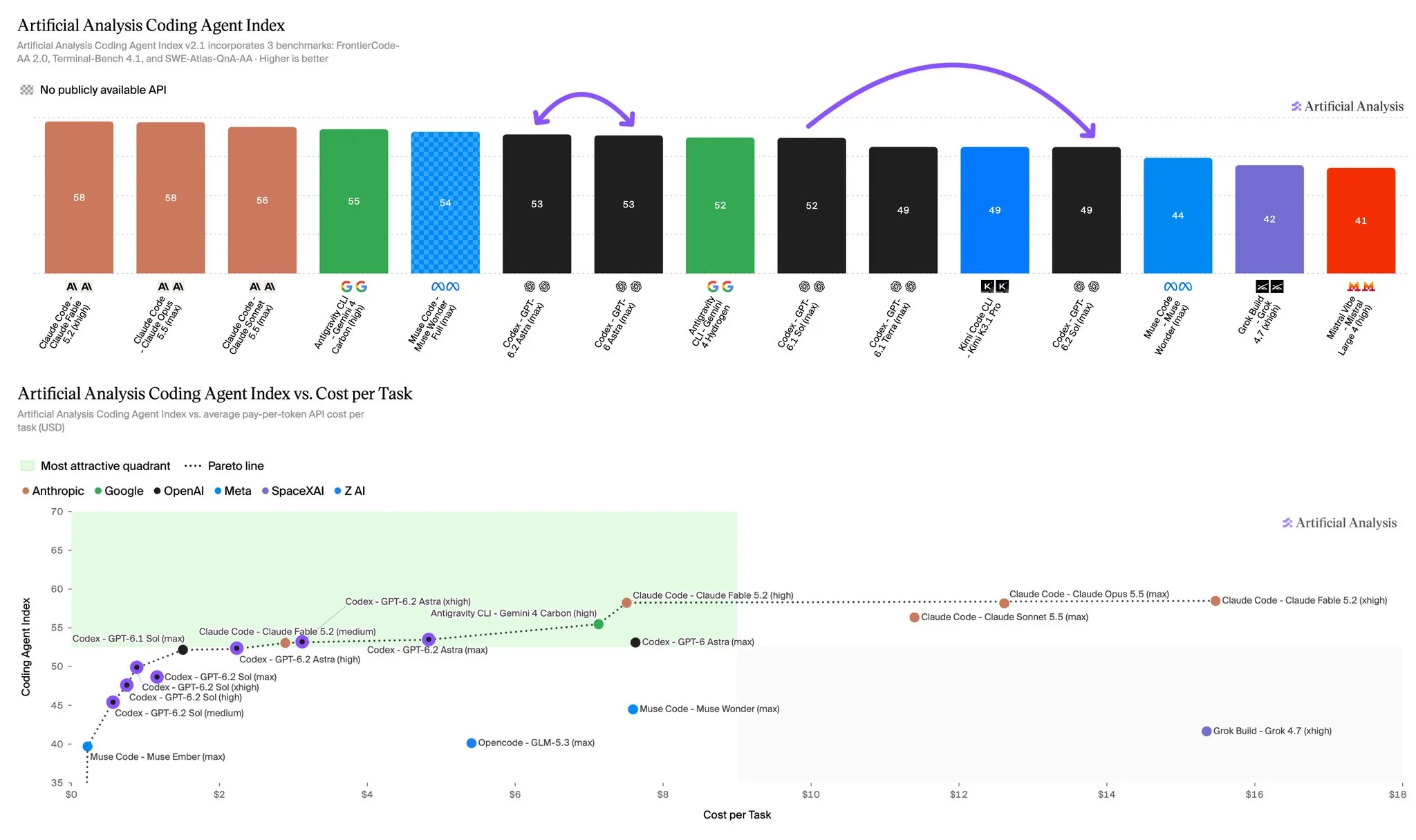
Media from @ArtificialAnlys on X.
What OpenAI itself concedes
The unusual part of this launch is that OpenAI partially agrees with the critics. Sam Altman posted that although the models are "very smart," the company has "more work ahead of us on making the models nice to work with, and will prioritize that for upcoming releases" (@sama).
Codex lead Tibo Sottiaux offered a more structural explanation for the bad reviews: early access went out "a while ago," the team "made a lot of changes in the last 3-4 days," and he is "pretty sure no re-testing was done" before the testers filmed their content (@thsottiaux). He also conceded the substance: the models are "by no means perfect" on taste and niceness. When Theo reported that prompt changes did not fix long-task coherency, Tibo suggested adding "Talk to me ELI5 by default and go deeper if I ask" to Codex custom instructions, and said "team is on it" (@thsottiaux).
It is also worth noting where OpenAI's own enthusiasm actually lands. The launch material and staff posts praise Sol, not Astra, as the everyday model: the company says many of its employees use GPT-6.2 Sol as their go-to, and Altman singled out "6.2 Sol ultrafast" as the feature people will enjoy. The Astra vs Sol comparison covers why the cheaper model is the one insiders reach for.
What the dispute is actually about
Read closely, the two camps are not measuring the same thing. The benchmarks and cost tests measure what the model can do in a bounded task: produce a scene, answer a benchmark, finish a build. The tester complaints are about what the model is like across hours of real work: whether it stays coherent, communicates well, and holds taste over a long session. Both can be true at once, and the launch-week evidence says they are.
That is also why "is GPT-6.2 good" has no single answer yet. For the head-to-head that matters most to this comparison, the GPT-6.2 vs Claude Fable 5.2 post walks through the same-prompt evidence: cost tests favor 6.2 heavily, polish tests split, and the critics' coherency complaint is exactly the kind of thing a two-hour benchmark cannot see.
How to read any GPT 6.2 review from here
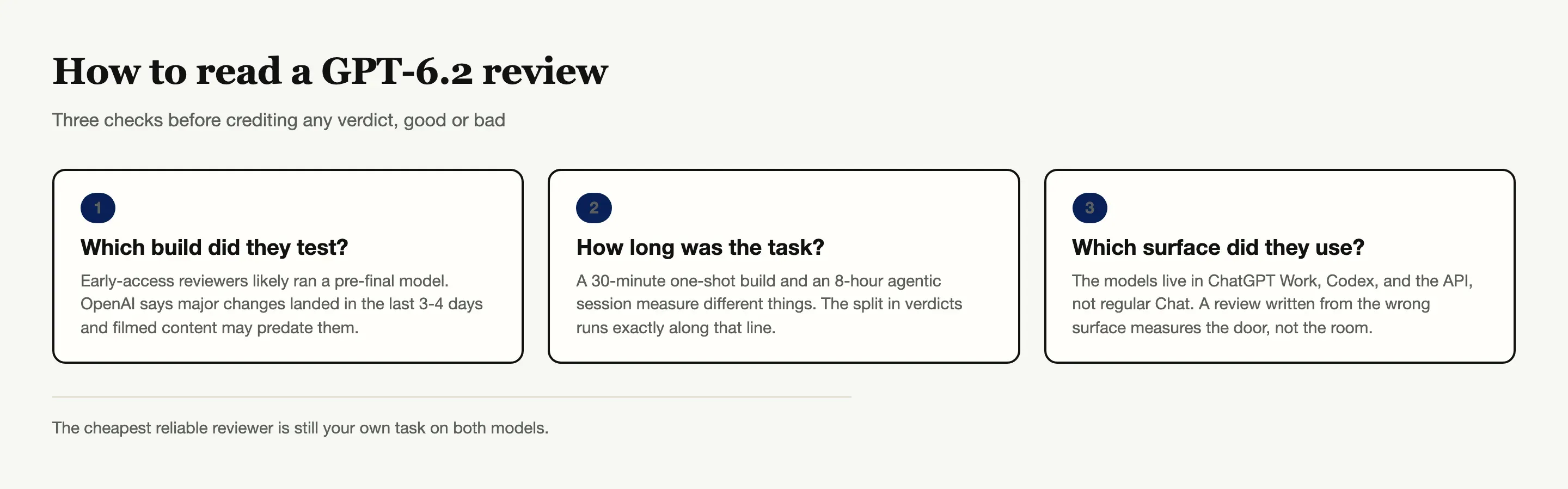
Three questions sort honest reviews from noise. First, which build did they test: early-access reviewers likely ran a pre-final version, by OpenAI's own account, so check when the footage was produced. Second, what task did they run: a 30-minute one-shot build and an eight-hour agentic session are different instruments measuring different things, and the launch-week verdicts diverge along exactly that line. Third, where did they run it: the models live in ChatGPT Work, Codex, and the API rather than regular Chat, so a review written from the wrong surface is measuring the door, not the room. The access routes by plan post maps which surface is which.
The fastest way to form your own GPT 6.2 review
The cleanest resolution of this argument is a task you actually care about. GPT-6.2 Astra and GPT-6.2 Sol are both available in Zentor on plan credits, with no OpenAI account and no API key, and they run as agents that do work rather than chat about it. Pick a task, send it to one model, send it to the other, and compare the finished results; the details are on the GPT-6.2 integration page. A thirty-minute experiment answers more than another week of reviews.
GPT 6.2 review: the verdict that holds today
A fair one-line verdict: GPT-6.2 is a real capability and efficiency release wrapped in a UX the testers are right to complain about. If your work is short, visual, cost-sensitive, or one-shot, the evidence says try it, starting with Sol. If your work is a six-hour task that must stay coherent end to end, the critics' warning stands and Fable or Opus remains the safer default this week. Neither verdict is likely to be the final one, since OpenAI is already shipping prompt-level and behavioral fixes.
FAQ
Is GPT-6.2 actually good?
Depends on the job. Independent benchmarks rank Astra #2 behind Claude Fable 5.2 with class-leading cost per task, while early testers report poor coherency on multi-hour work. Short and visual tasks get the better reviews; long agentic sessions get the worse ones.
Why did reviewers call GPT-6.2 the worst OpenAI model?
The loudest negative reviews came from embargoed early testers. Theo said "the worst model OpenAI has ever released" and Matt Shumer called the models "essentially unusable," citing bad taste, communication, and degraded coherency on long tasks. OpenAI's Codex lead says those reviewers likely tested a pre-final build.
Is GPT-6.2 better than Claude Fable 5.2?
On cost and speed for comparable tasks, the same-prompt tests say yes by wide margins. On long-running coherent work, the critics and coding-agent indices still favor Fable 5.2 and Opus 5.5. It is a job-by-job call, not a ranking.
What does OpenAI say about the bad reviews?
Sam Altman conceded the models need work on being "nice to work with" and said upcoming releases will prioritize that. Codex lead Tibo Sottiaux said early testers probably reviewed a build from before the final days of changes, while admitting the models are "by no means perfect."
Should I use Astra or Sol first?
Sol, for almost everything. It is the everyday model, dramatically cheaper per task, and the one OpenAI staff say they use themselves. Reach for Astra on long professional deliverables where a mistake costs more than the run.
Where can I try GPT-6.2 without a ChatGPT plan?
GPT-6.2 Astra and Sol are both available in Zentor on plan credits, no OpenAI account or API key needed. It is the fastest way to run your own task against both models and form your own verdict.

Zentor Editorial Zentor editorial team
The Zentor editorial team writes about workflow automation, AI agents, and the tools we build. Default byline for industry overviews, listicles, and collaborative pieces.
Turn insights into action.
Zentor automates the recurring work your analysis points to. No engineering required.
References @theo on X · @mattshumer_ on X · @ArtificialAnlys on X · @ArtificialAnlys Coding Agent Index · @ArtificialAnlys AA-Omniscience · @sama on X · @thsottiaux on X · @thsottiaux ELI5 reply · @EnvolDev on X · @theo on X · @theo longer thesis · @theo Astra vs Muse · @mattshumer_ embargo reply · @mattshumer_ sub-agent reply · @mattshumer_ testers advised