GPT-6.2 Astra vs Sol: Which to Use

GPT-6.2 Astra vs Sol compared: identical specs, a 4x API price gap, OpenAI's own benchmark claims, community receipts, and when to pick each.
GPT 6.2 Astra vs Sol is really a question about what you are paying for per token. OpenAI shipped both on November 17, 2026 with the same context window, the same image support, and the same surfaces; what differs is capability and price, and by a wide enough margin that picking wrong costs real money (the announcement). Sol is the right default for most everyday work. Astra earns its roughly 4x API price on long, professional deliverables where a mistake is expensive.
Key Takeaways:
- Same surface, same 1,050,000-token context, same image input: the difference is capability and price
- OpenAI reports Sol within 0.5 points of Astra on FrontierCode 2.0 at about a fifth of the cost
- OpenAI reports Sol beating GPT-6 Astra on LifeVal at about a seventh of the cost
- Astra is the pick for decks, workbooks, legal-style briefs, and long agent runs
- Community same-prompt tests so far show Sol dramatically cheaper on the API, sometimes slower on the clock
What is actually different between GPT-6.2 Astra and Sol
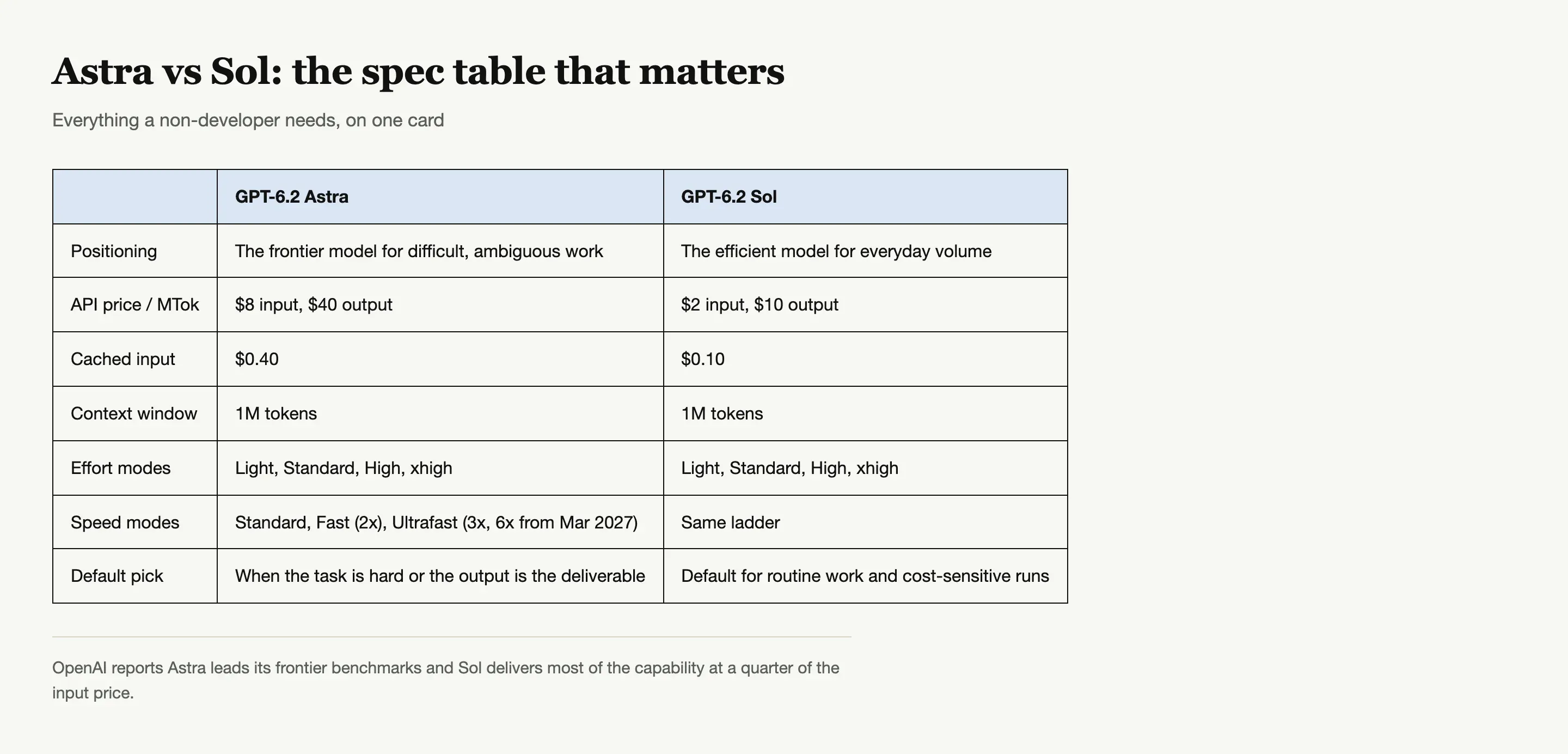
The spec sheets are deliberately boring. Both models take text and image input, write text out, hold a 1,050,000-token context window, and produce up to 128,000 output tokens. Knowledge cutoffs are close: May 18 for Astra, June 1 for Sol (the model docs, linked under the screenshots below). There is no context or modality reason to pick one over the other.
What separates them is positioning. OpenAI calls Astra the frontier model "for your hardest projects" and Sol "efficient, versatile" for everyday work. On the API, that positioning lands in the price: Astra is $8 input and $40 output per million tokens, Sol is $2 and $10. Inside a subscription, the same logic shows up as defaults: consumer Work chats open on Sol at Light effort, not on Astra.
OpenAI's own numbers on Astra vs Sol
Benchmarks here are vendor claims, so take them with the attribution attached. OpenAI reports that Astra scores 5.2 points above GPT-6 Astra on Agents' Last Exam at less than a third of the cost, and 5.5 points above Claude Fable 5.2 at about 5% of the cost (the full head-to-head is in GPT-6.2 vs Claude Fable 5.2). For Sol, OpenAI reports it lands within 0.5 points of Astra on FrontierCode 2.0 at about a fifth of the cost, and that it beats GPT-6 Astra on LifeVal at about a seventh of the cost.
Read plainly: Sol gets you to nearly Astra quality on everyday benchmarks at everyday prices, and Astra's edge concentrates in exactly the category where a weak deliverable costs more than the model did.
Try GPT-6.2 on a real task in Zentor
Available on plan credits, no OpenAI account or API key. Let the task decide the model.
Try Zentor →
Where the 4x gap actually comes from
The 4x gap is a pricing decision, not a spec difference: same context window, same modalities, different cost per task. OpenAI's own positioning is task-based rather than architectural: Sol is the go-to model for everyday work and Astra the choice for the hardest projects.
That framing matters because it flips the decision. You are not choosing the best model, you are choosing the right cost per task, and the right cost for most tasks is the cheap one.
When Sol is the right pick
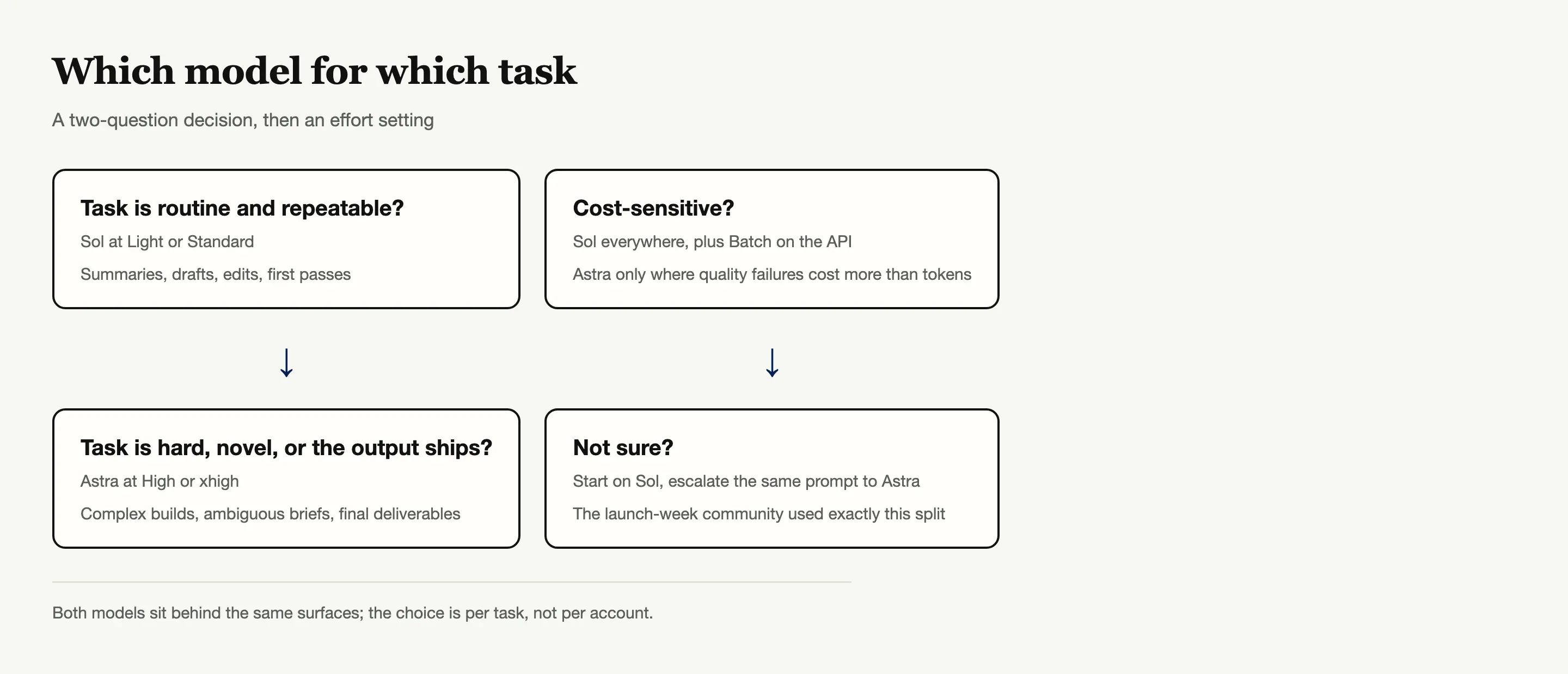
Sol is the default for a reason: most work is everyday work. Drafting, analysis, summarizing a long thread, turning meeting notes into a project brief, reviewing a pull request, revising code after feedback. If the task is one you could hand to a competent colleague without a warning label, Sol handles it, and it does so at a fraction of Astra's cost.
The launch-week community tests back this up. A developer gave Sol and Astra the exact same Three.js prompt for a 3D aquarium; both finished in about 20 minutes in Codex on High, all four controls working, and Sol's estimated API cost came in under half of Astra's (@dilemma017). That is the everyday tier doing the job for less, which is the entire argument for defaulting to it.
When Astra is worth the premium
Astra earns its price where the deliverable is long, polished, and hard to redo: slide decks that have to match a template, workbooks with real structure, legal-style briefs, research that has to cross-check several sources, or multi-hour agent runs where a mid-task wobble costs you the session. OpenAI claims Astra produces slides, spreadsheets, and documents that follow templates better and "read less like AI", and that it builds better frontends for sites, games, and 3D work.
The community receipts are starting to match. One tester ran three one-shot frontends through Astra in Codex at xhigh: a GPU fluid hero, a 180,000-particle sculpture, and a holographic card deck, each a single HTML file with no libraries and no edits (@laizhenglin). Another built a playable block version of Germany from official 3D building data covering all 16 states (@VraserX). These are exactly the long, ambitious builds where OpenAI says to reach for Astra.
The jobs where the difference shows and where it does not
Concrete examples help more than abstract scores. Ask for a weekly status update from messy notes and both models produce something sendable; Astra's version might read slightly more polished, rarely enough to justify the price. Ask for a 25-slide investor deck that has to match your existing template and follow your house style, and the gap widens fast: structure, tone consistency, and template fidelity are exactly where Astra pulls ahead.
The same holds for code-shaped work. Revising a pull request, generating a utility script, cleaning up a query: Sol territory. A multi-hour autonomous build that has to hold together end to end: Astra territory.
What the same-prompt tests say about cost
The wider set of launch-week builds these tests come from is collected in GPT-6.2 examples.
The most useful community data point is the direct comparison. One builder ran the same Alpine Gold scene through Sol and Claude Opus 5.5; Sol produced its 3D plane in 30m 47s for $2.07 against Opus's 2h 45m 42s for $31.85 (@EnvolDev). Another ran a Van Gogh-style Gaussian splat world on both; Sol took about an hour at roughly $5.45 where Opus took 53 minutes at about $12.14, slower on the clock but under half the bill (@sshayahmet).
A Blender stress test tells a complementary story. A studio recreated a detailed asteroid mining drone from one concept image: Sol finished in 24 minutes, nine minutes faster than Astra's 33-minute run, while Astra produced the more elaborate articulated kinematics (@DatumFoundryAI). Speed and cost on Sol, depth on Astra, again.
Neither test is a benchmark, and both are single prompts from fans playing with a new toy. But they sketch the same shape OpenAI's numbers do: Sol's cost advantage is large enough that "just use the frontier model" is an expensive habit, not a strategy.
Effort settings change the answer less than the model does
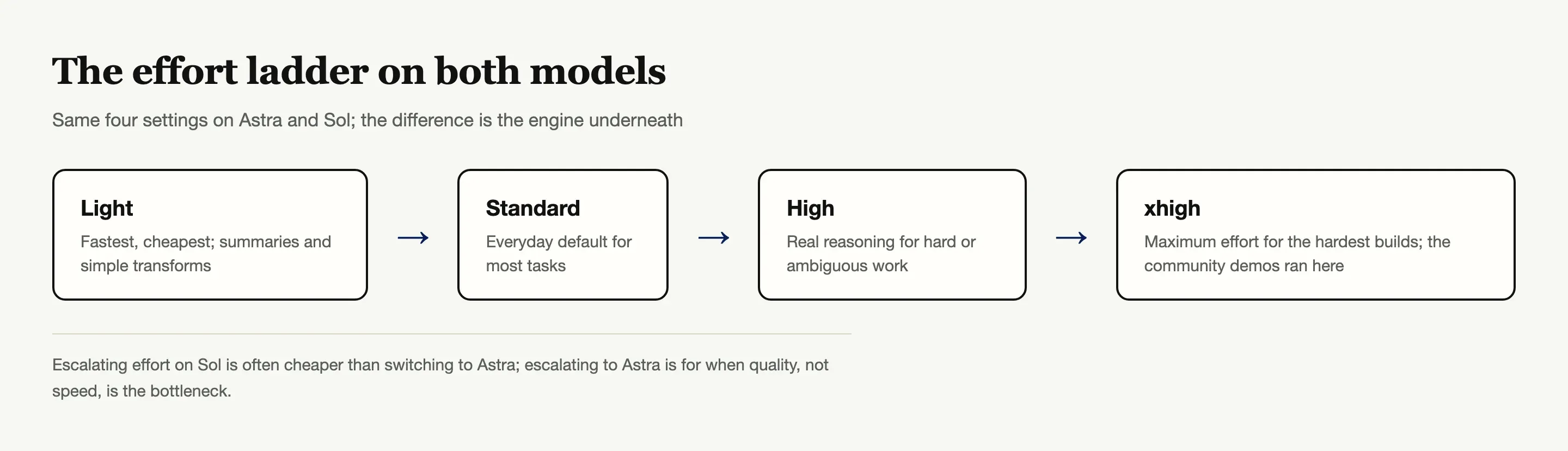
Both models accept reasoning effort settings, and Work chats start Sol at Light by default. Raising effort buys deeper reasoning on either model; it does not turn Sol into Astra, and it does not make Astra cheap. If a task feels undercooked on Sol, the honest sequence is raise the effort first, then reach for Astra only when the result is still short. Most of the time the first step is enough.
The picker's defaults, decoded
In ChatGPT Work, consumer plans open new chats on Sol at Light effort and enabled Enterprise workspaces open on Sol at Medium (ChatGPT docs). OpenAI is making the same call this article is: Sol first, Astra when the job earns it. In Codex, the company suggests Astra for work like tracing a bug across services and testing the fix, and Sol for reviewing a pull request or revising code after feedback.
OpenAI's own staff vote the same way. The launch post for Sol says "many OpenAI employees use GPT-6.2 Sol as their go-to model across technical and non-technical work" (@OpenAI), Sam Altman singled out "6.2 Sol ultrafast" as the thing he thinks people will really enjoy (@sama), and Codex lead Tibo Sottiaux recommends Pro 200 and 500 users try it, calling it "quite the blast to use and a completely different feel" (@thsottiaux). Note the plan gating: Ultrafast on Pro $200 starts with Sol only, while Pro $500 gets it on both models.
On Zentor the same logic applies directly: both GPT-6.2 models are available there on plan credits, so you pick Astra or Sol for the task and let the job decide. The integration notes are on the GPT-6.2 page.
Pricing side by side, for reference
The API numbers, since several readers will hit them eventually: Astra is $8 per million input tokens and $40 per million output, with cached input at $0.40. Sol is $2 and $10, with cached input at $0.10. Both double input and cache rates once a request passes 272K input tokens, and both take 50% off in Batch mode. Ultrafast multipliers apply on top, covered in the GPT-6.2 pricing post. Inside subscriptions the same 4x-ish gap shows up as how much usage a task burns, which is why the default lands where it does.
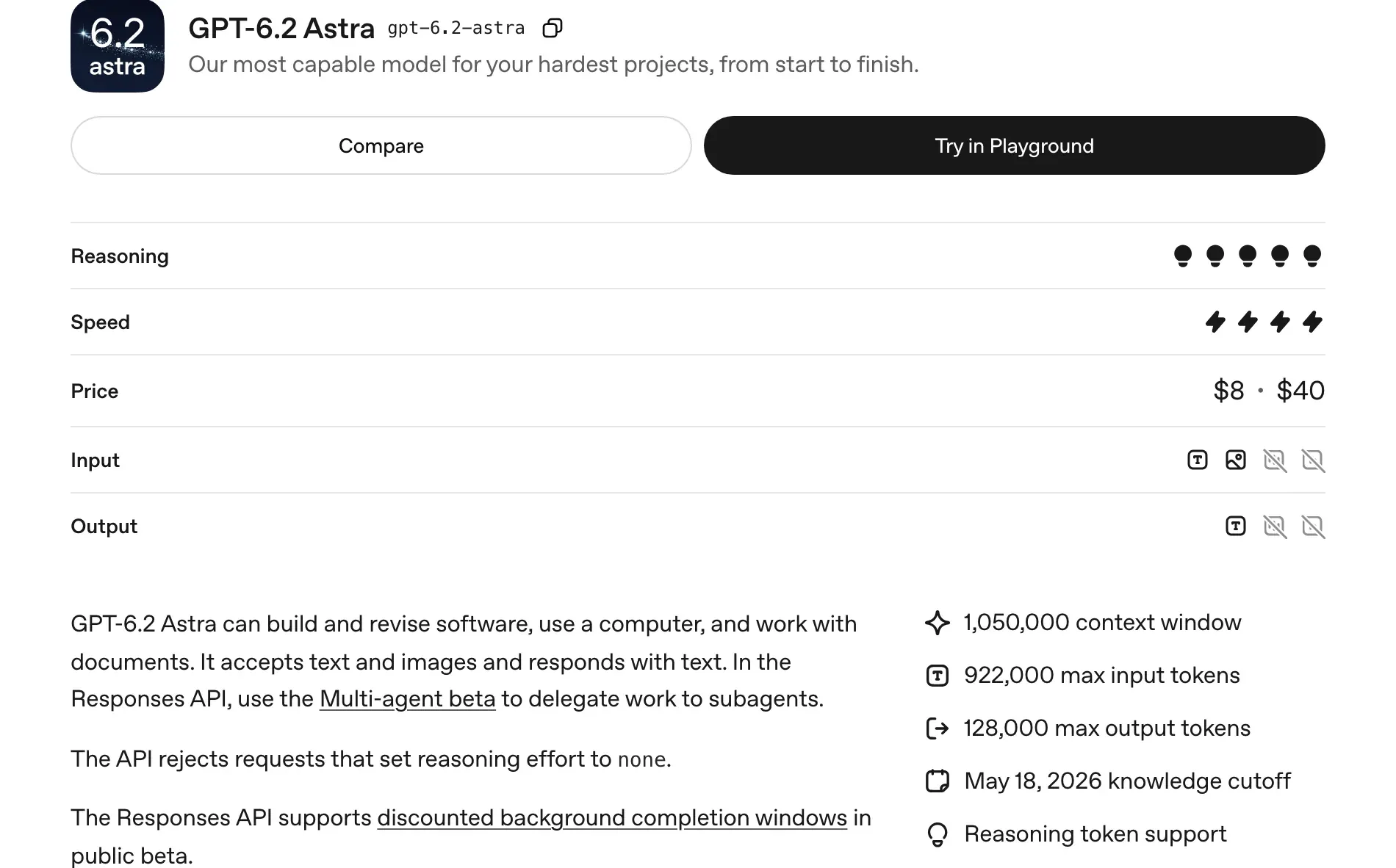
Source: OpenAI's GPT-6.2 Astra model page.
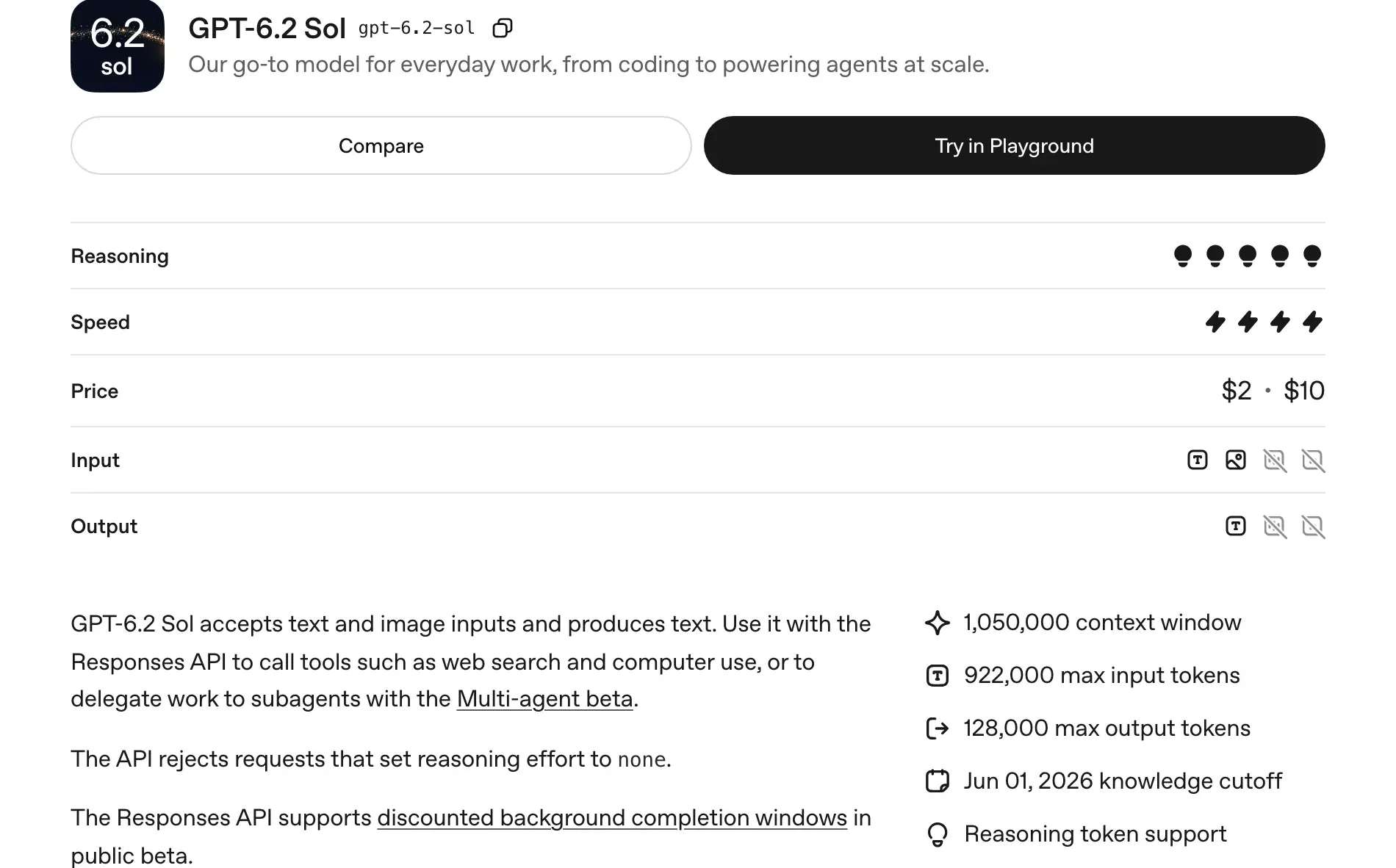
Source: OpenAI's GPT-6.2 Sol model page.
GPT 6.2 Astra vs Sol: a decision rule that holds
The early-review landscape splits on exactly this pick, both camps with sources in the GPT-6.2 review. If you only remember one thing, make it this: default to Sol for anything you would describe as routine, and spend Astra on the jobs where a mediocre result is worse than no result. Sol for volume, Astra for stakes. The 4x price gap means the wrong default costs you every single day, while the occasional Astra run on a genuinely hard deliverable costs less than one redo.
FAQ
Is GPT-6.2 Sol as good as Astra?
OpenAI reports Sol within 0.5 points of Astra on FrontierCode 2.0 at about a fifth of the cost, which is close enough for most everyday work. Astra's edge shows up on long, polished, high-stakes deliverables.
Which is cheaper, GPT-6.2 Astra or Sol?
Sol, by a lot: $2 input and $10 output per million tokens on the API, versus Astra's $8 and $40. Community tests so far show the same ratio in real single-task costs.
GPT 6.2 Astra vs Sol: which should I pick in Work?
Sol for everyday drafting, analysis, and coding chores; it is the default for a reason. Switch to Astra for decks, workbooks, research briefs, and long agent runs where quality failures are expensive.
Does Astra have a bigger context window than Sol?
No. Both hold 1,050,000 tokens, take text and image input, and write up to 128,000 output tokens. The difference is capability and price, not capacity.
Is Astra worth 4x the price?
For routine work, no; OpenAI's own numbers put Sol within half a point of Astra on everyday benchmarks. For hard, professional deliverables where a redo costs more than the run, yes, and OpenAI's benchmark claims target exactly that gap.

Zentor Editorial Zentor editorial team
The Zentor editorial team writes about workflow automation, AI agents, and the tools we build. Default byline for industry overviews, listicles, and collaborative pieces.
Choosing between tools? Let Zentor run the work.
An always-on AI assistant that does the work. No switching required, no setup.
References OpenAI: Introducing GPT-6.2 Astra and Sol · OpenAI GPT-6.2 Astra model page · OpenAI GPT-6.2 Sol model page · @dilemma017 on X · @EnvolDev on X · @DatumFoundryAI on X