GPT-6.2 Examples: Real Launch-Week Builds

Real GPT-6.2 examples verified from launch week: shader museums, playable worlds, one-shot frontends, and same-prompt cost tests with receipts.
GPT 6.2 examples started appearing within hours of the November 17, 2026 launch, and the interesting thing is not any single demo but what the pattern of builds says about who each model is for. Every post below was opened and verified on X; nothing here is a screenshot of a screenshot. The receipts are concrete: one builder's same-prompt 3D plane build finished at $2.07 on Sol against $31.85 on Opus 5.5 (@EnvolDev). Sol is showing up as the cheap everyday engine people compare things on, while Astra is the model people reach for when the demo itself is the flex.
Key Takeaways:
- Launch week produced real, verifiable builds on both models: shader museums, playable worlds, Blender drones, one-shot frontends
- Sol examples cluster on cost: same-prompt comparisons where it does the job for a fraction of rival prices
- Astra examples cluster on ambition: single-prompt builds that would have been projects, not prompts, a month ago
- Community builds are anecdotes, not benchmarks; they show range, not rankings
- GPT-6.2 Astra and Sol are both available in Zentor on plan credits, for readers who want to run a task rather than watch demos
What people actually built in launch week
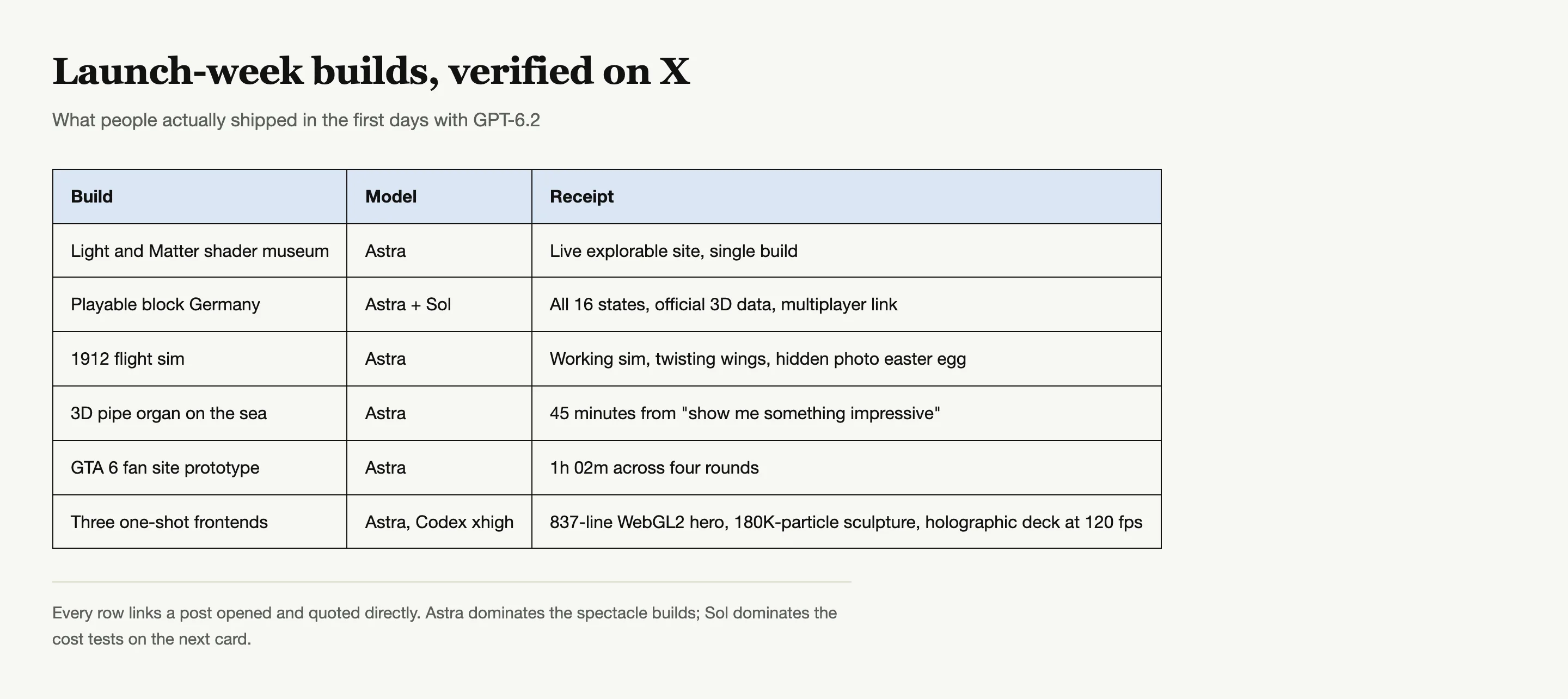
The builds sort themselves into three loose categories. First, visual and creative pieces: a shader museum called Light and Matter built with Astra and shared as a live explorable site (@pvncher), plus a playable 3D pipe organ floating on the sea, made in 45 minutes from a "show me something impressive" prompt (@hajimetwi3).
Second, functional tools and worlds: a playable block version of Germany built from official 3D building data across all 16 states (@VraserX), a 1912 Blackburn Type D flight sim with wings that visibly twist in a bank (@dun4ev), and a GTA 6 fan site prototype built in 1h 02m across four development rounds (@wngl176432).
The Germany build deserves a second look because it is the least flashy and the most instructive. The builder typed an address, landed there, and could walk or fly through streets built from real 3D data, then sent a link to a friend and met up in Berlin inside the thing. That is not a graphics demo; it is a working application with data plumbing, a map, and a shareable URL, assembled in a single build session. The flight sim is similar: banking the plane visibly twists the wooden wing geometry, and flying through a hidden ring uncovers a photo of the real 1912 aircraft. Small details, but they are the kind of details that used to mark the difference between a prototype and a project.
Third, the comparison builds, which are the most instructive of the GPT 6.2 examples because they put numbers on the models rather than just showing output. The dedicated Fable 5.2 matchup is in GPT-6.2 vs Claude Fable 5.2.
Your turn: run GPT-6.2 on your task in Zentor
Available on plan credits, no OpenAI account or API key. Watching demos is optional.
Try Zentor →
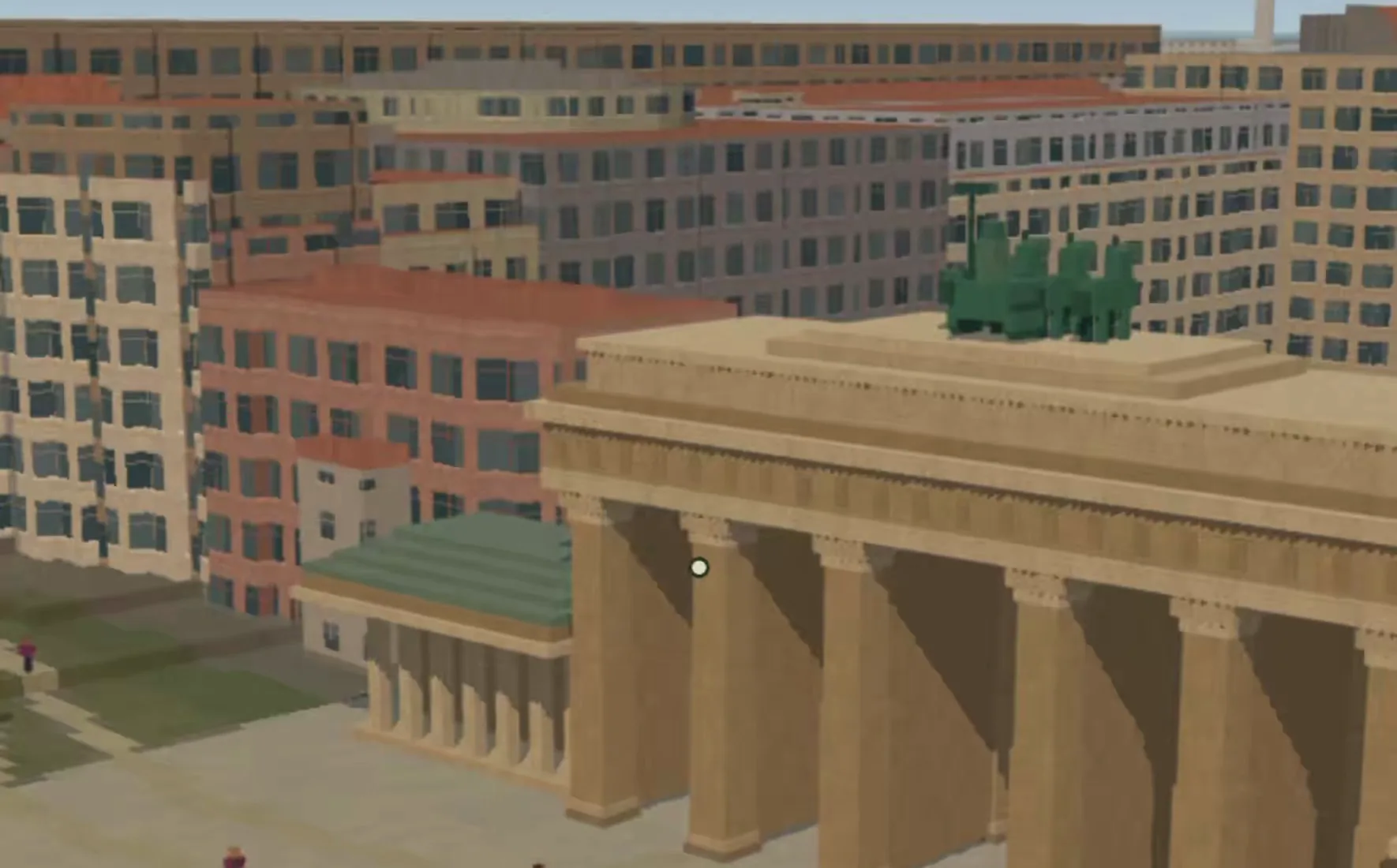
Media from @VraserX on X.
The one-shot frontend builds, in detail
The most technically dense example came from a developer who ran three prompts through Astra in Codex at xhigh, one HTML file each, no libraries, zero edits allowed (@laizhenglin). The three results: a GPU fluid hero in 837 lines of raw WebGL2, a particle sculpture where he asked for 150,000 particles and got 180,000 morphing between a galaxy, a DNA helix, and a torus knot, and a holographic card deck with foil that follows the tilt. All three held 120 fps on his M4 Pro. The detail worth quoting: the model tested its own work, driving a headless browser against each page before handing it over, and when headless WebKit would not launch, it wrote a jsdom harness instead.
A bonus from the same thread: Simon Willison's classic pelican-on-a-bicycle SVG prompt came back as a static illustration, chain and spokes included, in 7 minutes 16 seconds.
A paint app that paints itself
One more creative example worth its own paragraph: a builder made a paint app and had Astra draw inside it, asking the model to render Young Sheldon stroke by stroke; the video of the result runs at 3x speed and took 413,108 brush strokes to finish (@avliwii). It is a gimmick, but a telling one: the model did not just generate an image, it operated a tool hundreds of thousands of times in sequence to produce one. That is the agentic behavior OpenAI advertises, caught on camera by a community member rather than a keynote.
The same-prompt cost tests
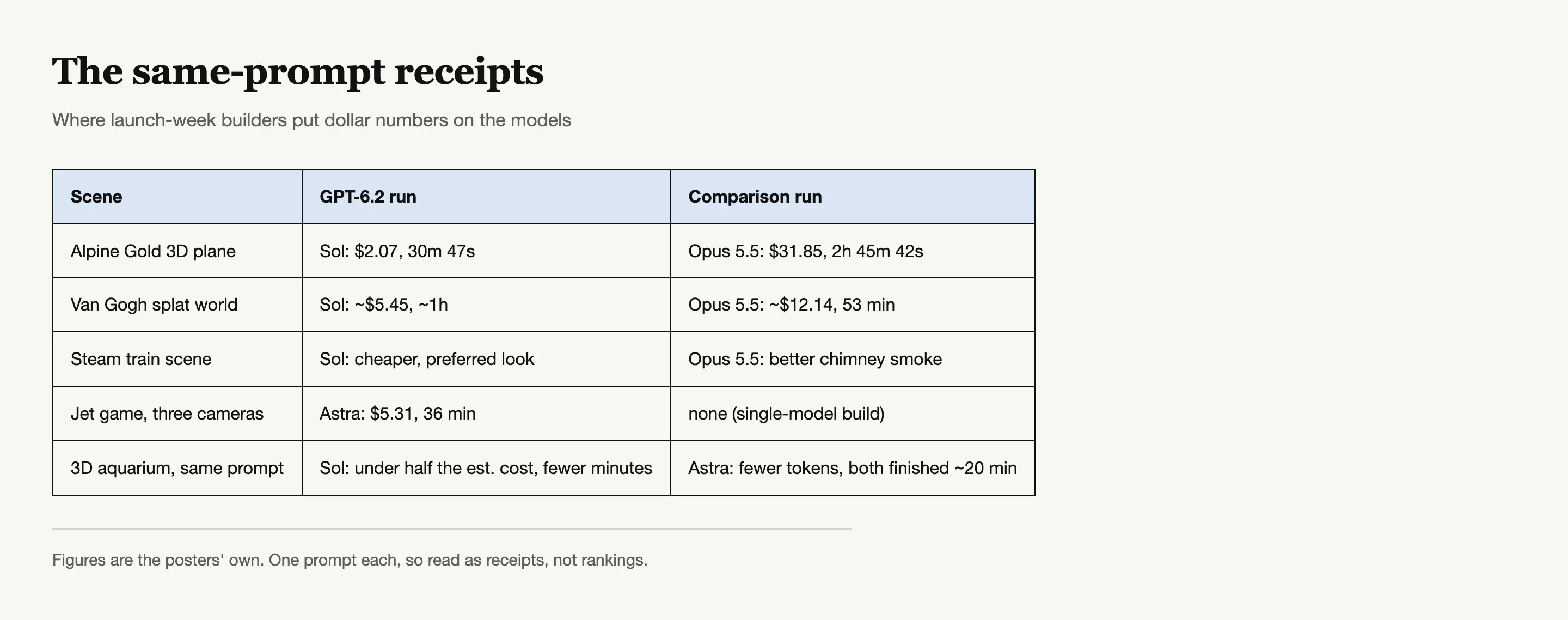
Three of the launch-week GPT 6.2 examples put Sol head-to-head with Claude models on identical prompts, and the receipts are unusually concrete. On an Alpine Gold 3D plane scene, Sol finished in 30m 47s for $2.07 while Opus 5.5 took 2h 45m 42s for $31.85 (@EnvolDev). On a Van Gogh-style Gaussian splat world, Sol took about an hour at roughly $5.45 where Opus 5.5 took 53 minutes at about $12.14 (@sshayahmet). On a Three.js steam train scene, Sol again ran cheaper and the poster preferred its look, conceding only that Opus's chimney smoke was better (@mewset).

Media from @EnvolDev on X.
A fourth test compared Sol and Astra on the same 3D aquarium prompt: both finished in about 20 minutes with all controls working, Astra used fewer tokens, and Sol's estimated API cost was under half of Astra's (@dilemma017). That is the cleanest in-family cost data point of the week. A fifth receipt came from a jet game with three camera views, built on Astra in 36 minutes for $5.31 (@AnikaCodes).
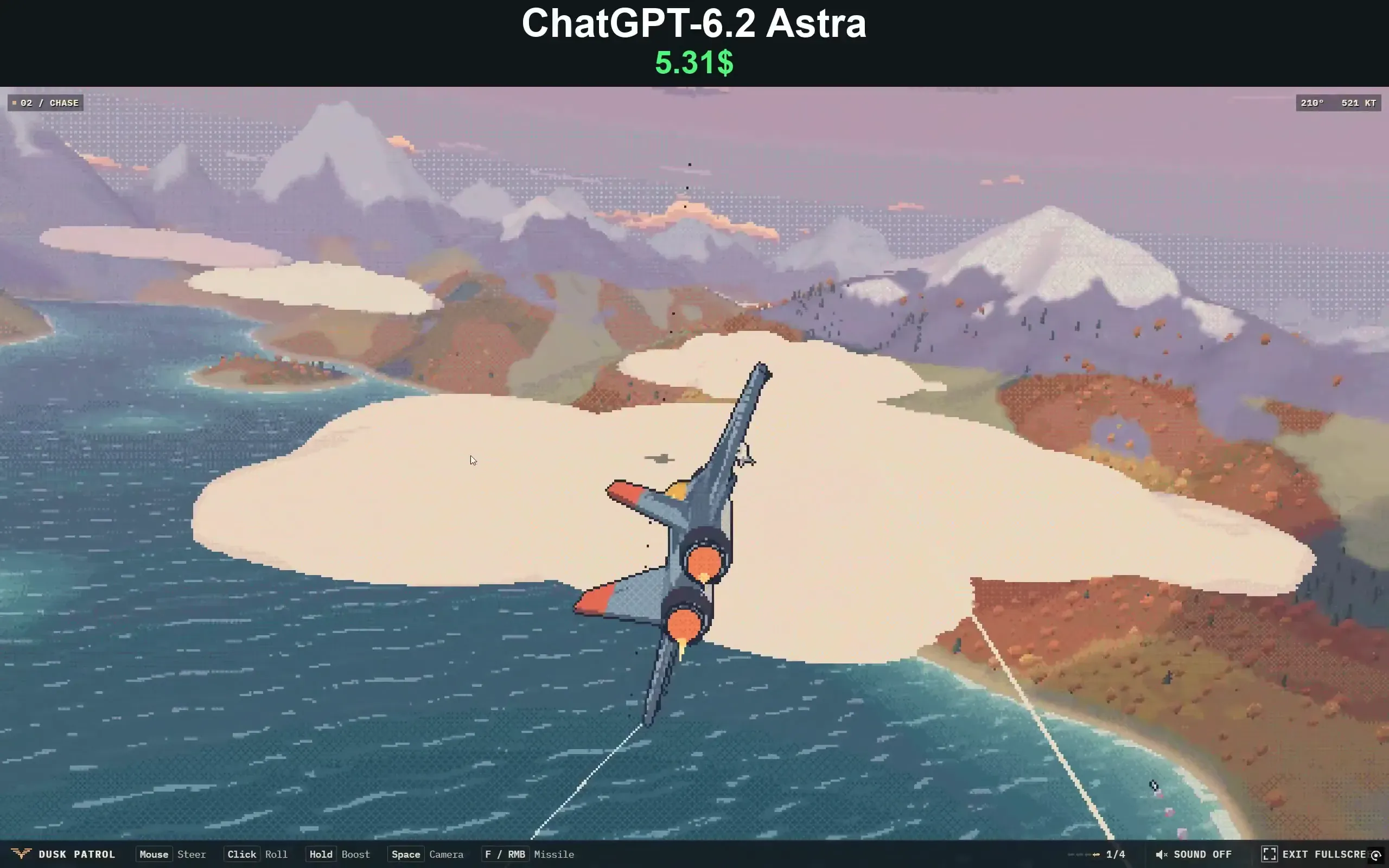
Media from @AnikaCodes on X.
The patterns behind the builds
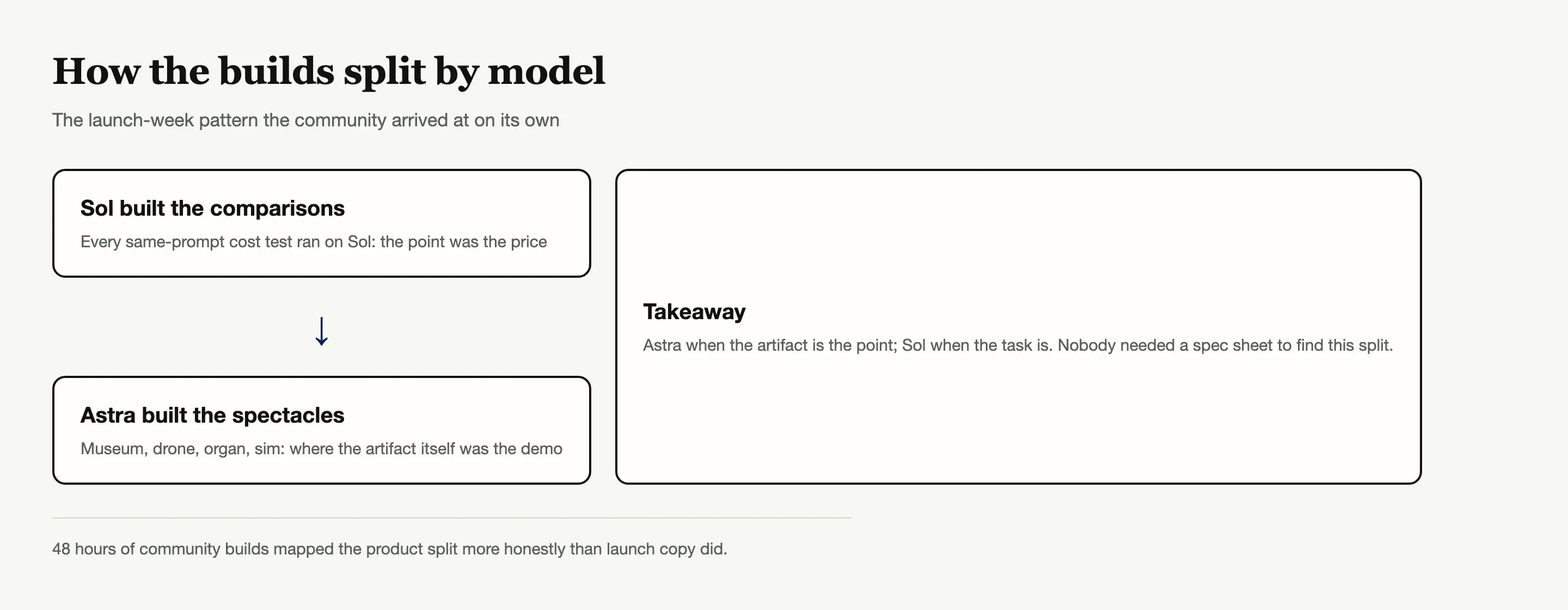
Zoom out one level and the week mostly sorts by model role. The long, polished, single-artifact builds (museum, drone, organ, sim) ran on Astra or named it specifically, and most same-prompt cost comparisons ran on Sol and emphasized the bill. The exceptions are real though: @dilemma017's aquarium test ran Astra on cost and @AnikaCodes ran a jet game on Astra with a $5.31 receipt, so the split is a tendency, not a rule: Astra when the artifact is the point, Sol when the task is.
That is useful calibration for your own projects more than any spec sheet is.
The Blender stress test
One studio ran the hardest single test of the week: recreate a detailed EX-04 asteroid mining drone in Blender from a single concept image, on Fable 5.2, Astra, and Sol (@DatumFoundryAI). Fable won on procedural weathering and mechanical detail; Astra ran a 33-minute autonomous sprint with 62 tool calls and 4.0M tokens, producing a rotating turret with clean kinematics; Sol finished fastest at 24 minutes, healed through six tool errors, and did not dent 1% of the usage quota. Three different wins on one prompt, which is a fair summary of where the models sit.
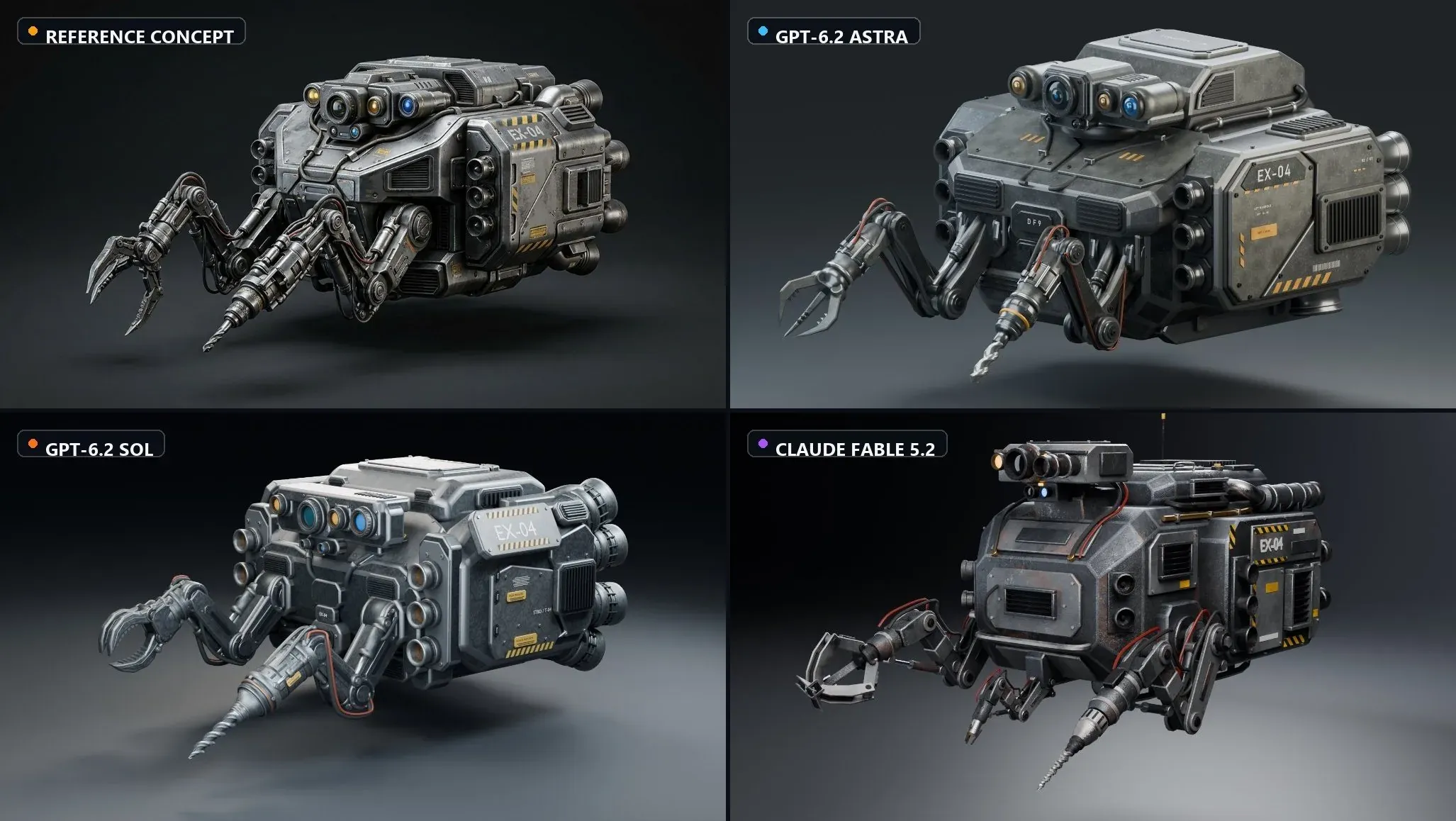
Media from @DatumFoundryAI on X.
What did not get built, and why that matters
Honest coverage of the week's GPT 6.2 examples has to include the quiet half: nobody posted a mundane office deliverable. There were no "here is my quarterly report cleaned up" or "my inbox triaged" builds, because those are not screenshot-worthy, yet that is precisely the work most readers would actually run. The demos skew spectacular by selection; the boring everyday jobs are exactly where Sol's cost advantage matters most, and they are underrepresented in the feed, not absent from the models' abilities.
What these GPT 6.2 examples actually tell a non-developer
Strip the excitement out and the pattern is practical. Sol is doing the everyday work at prices that make "just try it" a reasonable default: single-digit dollars for builds that used to be weekend projects. Astra is doing the ambitious work where the prompt is the project: the museum, the drone, the organ, the flight sim. If your job looks like the first group, Sol-class efficiency is the takeaway; if it looks like the second, Astra's premium is the point.
Caveats worth keeping: these are enthusiasts showing off a new toy on day one, not controlled tests. The builds are real and the numbers are quoted from the posters themselves, but sample size is one prompt each, and nobody posts their mediocre runs.
Running your own GPT 6.2 examples on Zentor
The other way to evaluate the launch is to skip the demos entirely. GPT-6.2 Astra and Sol are both available in Zentor now on plan credits, with no OpenAI account and no API key; you pick either model, describe the task, and it runs as an agent on files, browser, and tools, which is the same shape these builders used. Model notes are on the GPT-6.2 integration page, and the Astra vs Sol breakdown helps decide which model your own project belongs to.
A note on the numbers in these posts
All costs and times quoted above are the posters' own figures, not lab measurements. The $2.07 plane, the $5.45 splat world, the 33-minute drone run: each is one person's run on one prompt, often in Codex where the environment does part of the work. They are honest receipts from named accounts, but treat them as "what one build cost" rather than "what this model always costs" and they are genuinely useful.
FAQ
What are some real GPT 6.2 examples from launch week?
Verified builds include a shader museum (Light and Matter), a playable block Germany, a 1912 flight sim, a Blender mining drone, three one-shot frontends, a 3D pipe organ, and several same-prompt cost tests against Claude models.
Is GPT-6.2 Sol good enough for real projects?
Launch-week examples say yes for most work: it matched or beat rivals on cost in every same-prompt test, and held its own on quality. The Blender test shows Astra still wins on the most intricate builds.
Which model built the shader museum?
GPT-6.2 Astra, built by @pvncher as a site called Light and Matter, shared as a live explorable link.
Are these GPT 6.2 examples verified?
Every post cited here was opened on X and quoted from the poster's own text. Numbers like $2.07 and 30m 47s are their claims, reproduced as such, not independent measurements.
How can I try builds like these myself?
In ChatGPT Work or Codex on a Plus or better plan, or in Zentor on plan credits with no OpenAI account. Pick Astra or Sol and describe the task the way these builders did and let the model run it.

Zentor Editorial Zentor editorial team
The Zentor editorial team writes about workflow automation, AI agents, and the tools we build. Default byline for industry overviews, listicles, and collaborative pieces.
Turn insights into action.
Zentor automates the recurring work your analysis points to. No engineering required.
References @pvncher on X · @hajimetwi3 on X · @wngl176432 on X · @laizhenglin on X · @avliwii on X · @dilemma017 on X · @VraserX on X · @EnvolDev on X · @AnikaCodes on X · @DatumFoundryAI on X