GPT-6.2 vs Claude Fable 5.2: Which to Use

GPT-6.2 vs Claude Fable 5.2 on launch-week specs, vendor-reported benchmarks, community tests, and price. What each model is genuinely better at.
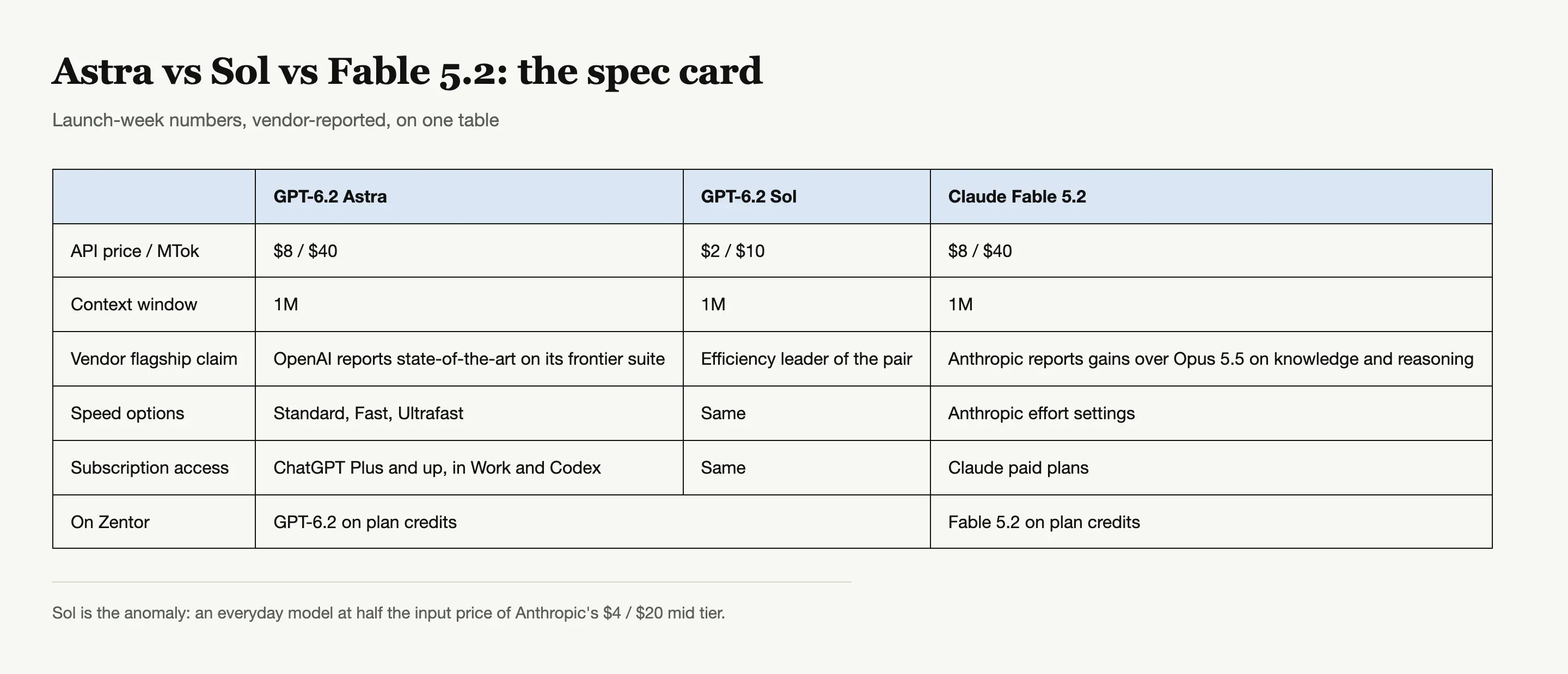
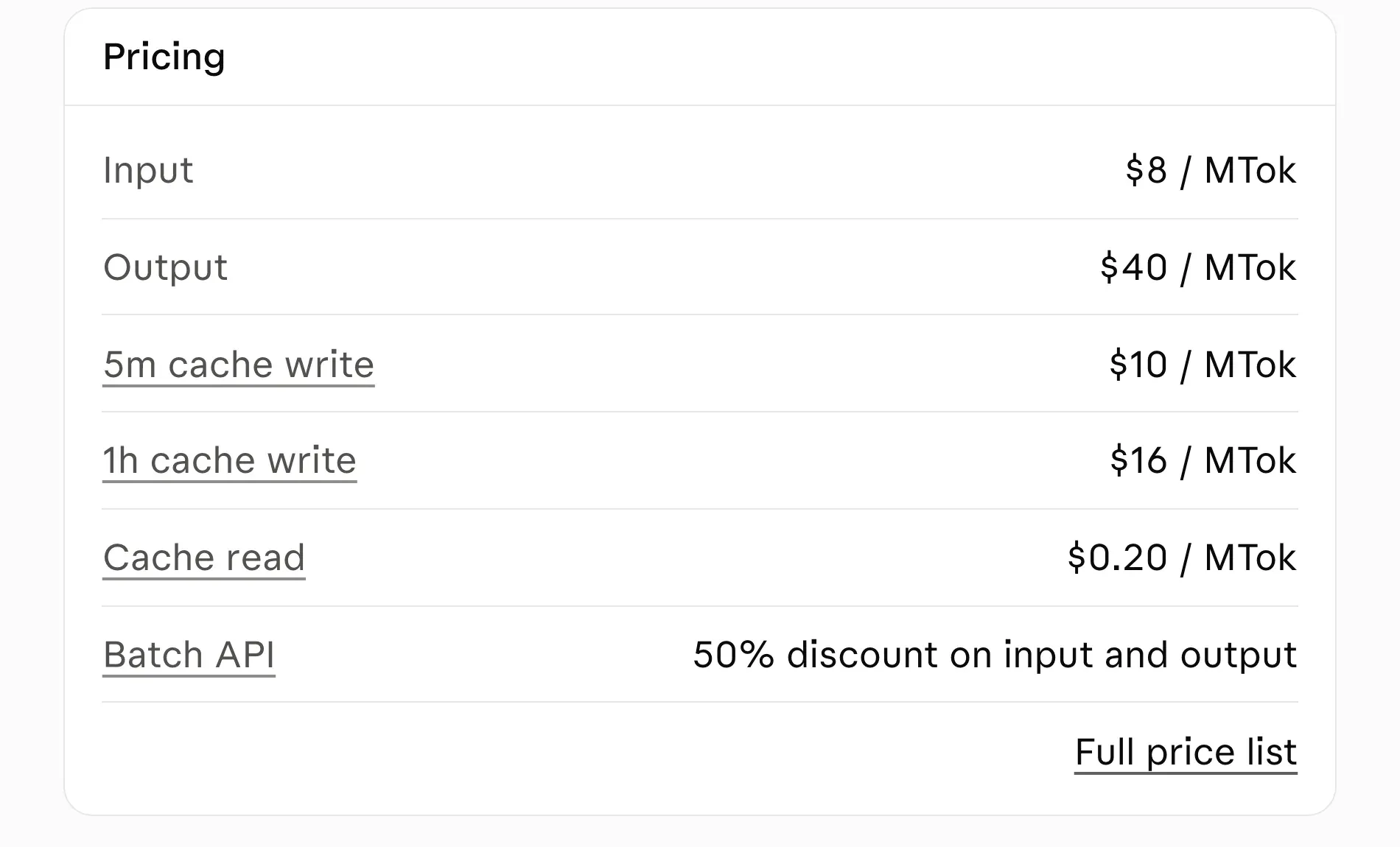
GPT 6.2 vs Claude Fable 5.2 is the rare frontier comparison where the headline prices are identical: OpenAI's GPT-6.2 Astra and Anthropic's Claude Fable 5.2 both list at $8 input and $40 output per million tokens on their APIs. They launched eight days apart, on November 17 and November 9, 2026 (OpenAI, Anthropic). The right pick, though, depends on the job, and on which subscription you already pay for.
Key Takeaways:
- Same API headline: Astra and Fable 5.2 both cost $8 / $40 per million tokens
- OpenAI reports Astra 5.5 points above Fable 5.2 on Agents' Last Exam at about 5% of the cost; Anthropic's own tables put Fable 5.2 at 69.9 on FrontierSWE v2
- GPT-6.2 Sol undercuts everything at $2 / $10 for everyday work
- Community same-prompt tests favor Sol on cost, Fable on polish in at least one 3D build
- Both are available by subscription: Fable on paid Claude plans, GPT-6.2 in ChatGPT Work, and both through Zentor on plan credits
The spec table at a glance
Both are frontier models with million-token context, text and image input, and large output budgets. Both also arrived with unusually loud claims attached: OpenAI positioned Astra against Fable by name on launch day, and Anthropic's own table positions Fable against its previous generation and Opus 5.5. The spec overlap is what makes the comparison genuinely hard rather than rhetorical. Astra and Sol hold a 1,050,000-token window with up to 128,000 output tokens; Fable 5.2 holds a 1M window with 128K max output on the sync API. Fable defaults to high effort with adaptive thinking always on, while GPT-6.2 chats default to Sol at Light effort. None of that separates them. The separating variables are benchmarks, per-task cost, and what your subscription actually includes.
Source: Anthropic's Claude Fable 5.2 docs.
Source: Anthropic's Claude Fable 5.2 docs.
Where the two releases overlap and where they diverge
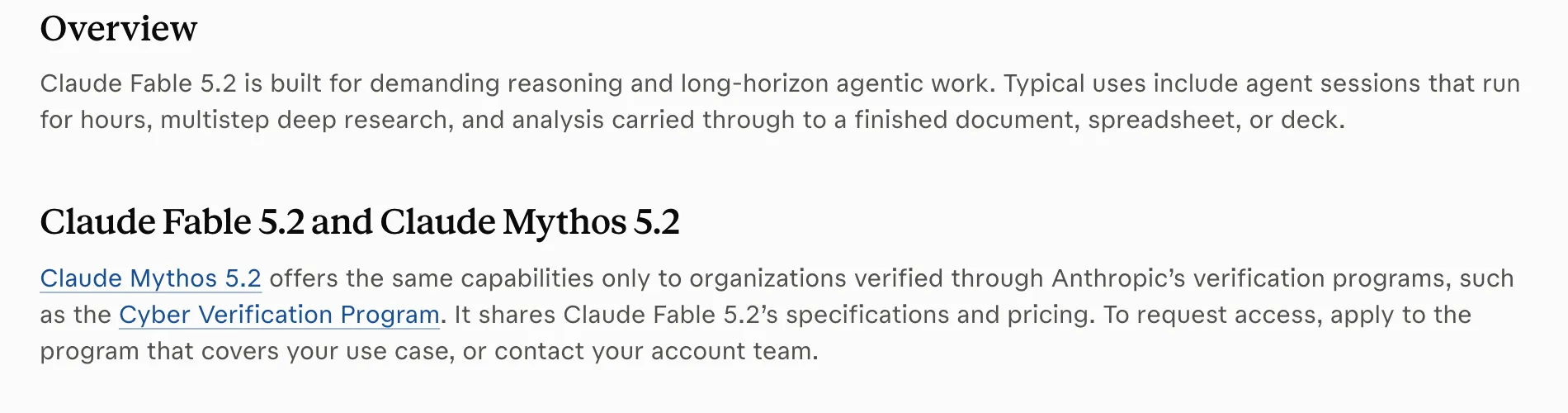
The lineups rhyme rather than match. Anthropic's Fable 5.2 sits above Opus 5.5, its September predecessor, the way Astra sits above Sol: a frontier tier for hard work, an efficient tier for volume. (Anthropic's own November sibling release is Mythos 5.2, the life-sciences and cyber variant, not an everyday model.) Both pairs share context windows, image input, and the same surfaces their siblings already used. The divergence is in the lineup beneath: OpenAI gives you Sol at $2 / $10 for everyday work; Anthropic's closest counterpart is Opus 5.5 at $4 / $20, double the price for the everyday tier.
That asymmetry matters more than any benchmark for most buyers, because most work is everyday work.
What each company claims, attributed
OpenAI reports that Astra scores 5.5 points above Claude Fable 5.2 on Agents' Last Exam at about 5% of the cost, and more than double Fable 5.2's pass rate on Harvey LAB-AA at about a sixth of the cost. Worth knowing: OpenAI's own footnote says the Fable results exclude nine tasks that used a fallback model, which flatters the comparison.
Anthropic's announcement table, their own claims, shows Fable 5.2 at 69.9 on FrontierSWE v2, 51.4 on AutomationBench, and 49.1% on FrontierCode 2.0 at xhigh effort. Anthropic positions Fable as the top of its lineup, with Opus 5.5 as the recommended daily driver.
Neither company's table answers your question; each is tuned to make its own model look like the default. Treat both as vendor marketing and lean on the same-prompt tests below instead.
Independent data sits between the two vendor tables. Artificial Analysis placed GPT-6.2 Astra at number 2 on its Intelligence Index, five points above GPT-6 Astra, behind only Claude Fable 5.2, and put OpenAI's models on most of the cost-per-task Pareto frontier (@ArtificialAnlys). The same lab's Coding Agent Index is less flattering: Astra flat versus GPT-6 Astra and Sol down 3 points versus GPT-6.1 Sol on their Codex harness.
The launch-week reviewers who had early access were harsher than any index. Theo called Astra "the worst model OpenAI has ever released" and later reported that it "loses coherency after a few hours" on long tasks (@theo), while arguing that Opus 5.5 remains the best value for real long-running code work. Matt Shumer called the models "essentially unusable" and said that when he tried Astra as a sub-agent, "Opus/Fable got so frustrated with it and ended up redoing all the work themselves" (@mattshumer_). OpenAI's reply, from Sam Altman and Codex lead Tibo Sottiaux, is that the models are very smart but need work on being "nice to work with," and that early testers likely reviewed a pre-final build.
Run GPT-6.2 and Fable 5.2 side by side in Zentor
Both live on plan credits in one workspace. No OpenAI or Anthropic account needed.
Try Zentor →
What the same-prompt community tests actually show
The full set of verified launch-week builds, with every post opened on X, is in GPT-6.2 examples.
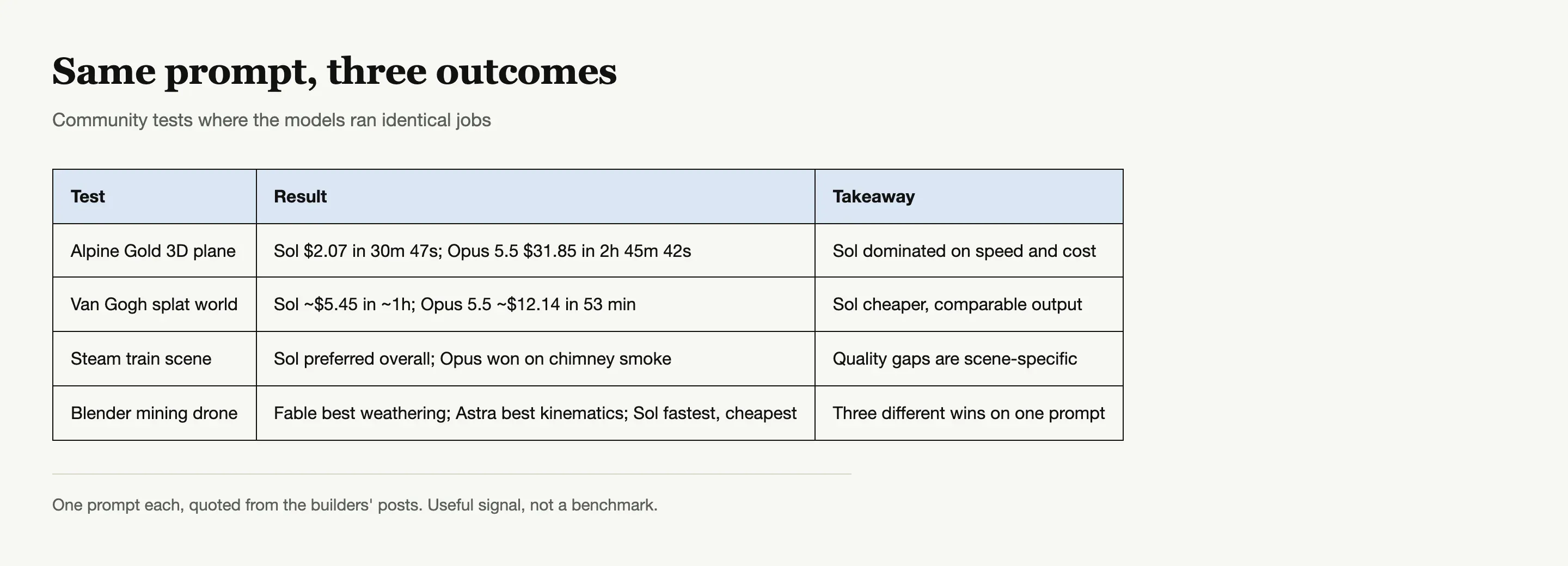
Launch week produced several direct comparisons, and they cut both ways. On cost, one builder ran the same Alpine Gold 3D plane prompt through all four models and reported Astra at $9.62 in 46 minutes, Sol at $2.07 in 31 minutes, Fable 5.2 at $209.50 in just over 3 hours, and Opus 5.5 at $31.85 in 2h 46m (@EnvolDev). On a Van Gogh-style Gaussian splat world, Sol took about an hour at roughly $5.45 against Opus's 53 minutes at about $12.14 (@sshayahmet).
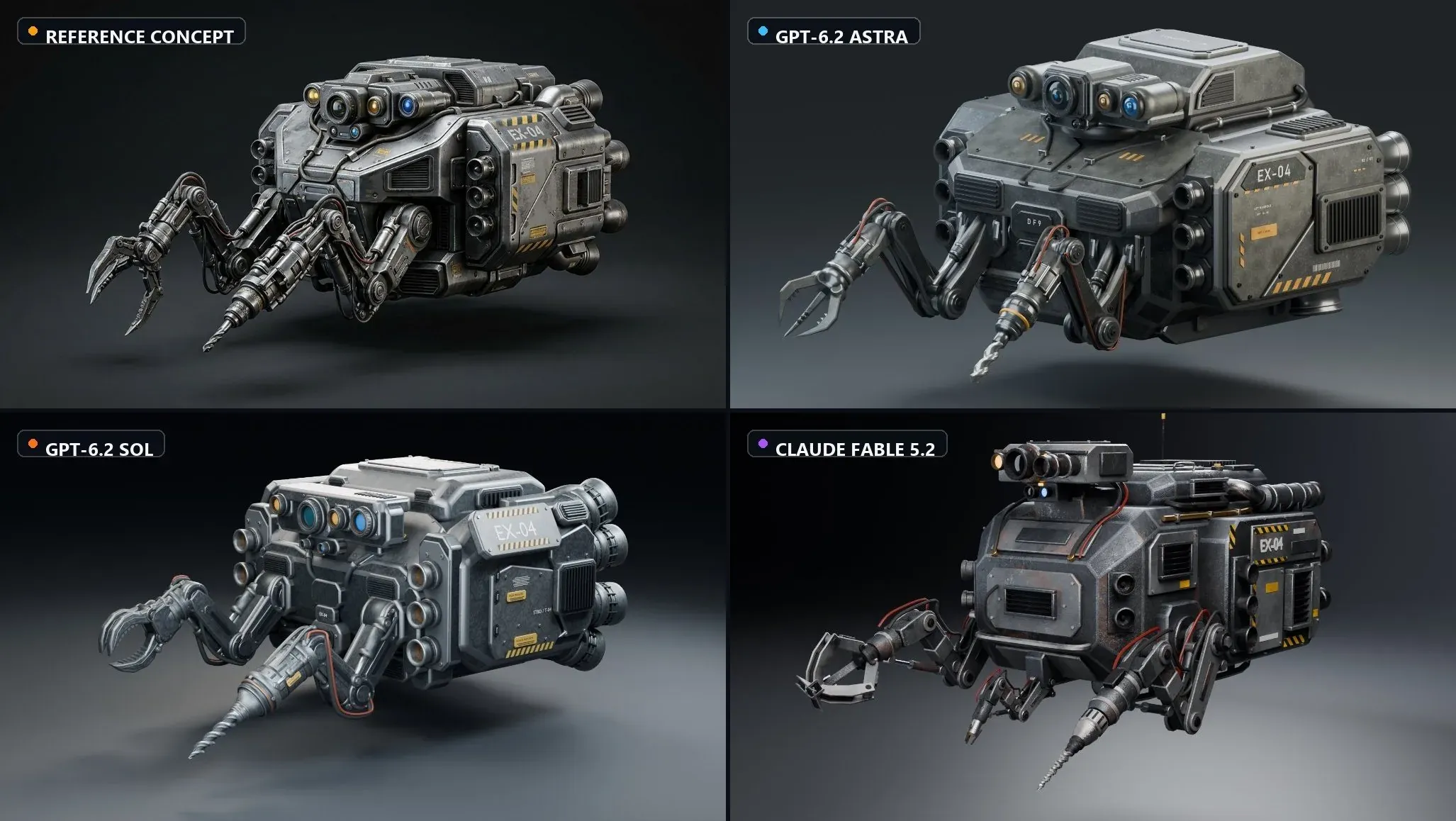
On polish, the picture reverses in spots. A Blender studio recreated an intricate mining drone from one concept image on Fable 5.2, Astra, and Sol, and gave Fable the edge on procedural weathering and mechanical detail, while Astra ran a 33-minute autonomous sprint and Sol finished fastest at 24 minutes (@DatumFoundryAI).
Media from @DatumFoundryAI on X.
A separate cowboy animation test had Astra finishing in about 2 hours with 60k tokens where Fable 5.2 took nearly 20 hours and 150k to 300k tokens, and still coming out looking better to the poster (@_jayyy18_13k).
The honest read: Sol and Opus-class models are cheap enough that Astra and Fable only need to win on jobs where quality differences show. And there, so far, the community evidence says "it depends on the artifact" rather than crowning either one.
The safety and effort differences worth knowing
Two quieter differences sit under the benchmarks. OpenAI tightened the cyber and bio safeguards on 6.2, which means some legitimate security-research requests get refused; Anthropic's Fable ships the same guarded model to everyone, with the life-sciences and cyber variants split off as Mythos 5.2. On effort, Fable defaults to high thinking always on, while GPT-6.2 Work chats default to Light, so out of the box the two answer at very different depths. Raise Sol to xhigh and the comparison changes; judge at matched effort or the test lies.
What each costs a subscriber, not a developer
API prices matter less to most readers than plan prices. Fable 5.2 sits on every paid Claude plan (Pro, Max, Ultra, Team, Enterprise), and Anthropic ran launch-week Fable allowances with resets for eligible subscribers. GPT-6.2 sits in ChatGPT Work on Plus and up, shares a usage pool with Codex, and offers Ultrafast on Pro $200 (Sol only) and Pro $500 (both models).
So the subscription math is: one Claude subscription buys you Fable 5.2 as your top model; one ChatGPT subscription buys you both 6.2 models, but on a surface you may never have opened. A Plus subscriber gets Astra in Work; a Pro subscriber gets Fable in the Claude picker. If you are choosing a subscription partly for the frontier model, the honest comparison is not the API sticker but what tasks each plan actually lets you finish in a week. The detailed plan math is in the GPT-6.2 pricing post.
Reading the benchmark footnotes honestly
One caveat worth repeating because launch coverage skipped it: benchmark wins are publisher wins. OpenAI's Agents' Last Exam number excludes nine Fable tasks that used a fallback model. Anthropic's FrontierCode 2.0 number is measured at xhigh effort, the top of its range. Both are real numbers; neither is the neutral arbiter a reader wants them to be. The same-prompt community tests are smaller but more honest evidence, which is why this article leans on them for the verdict.
Where each model actually wins
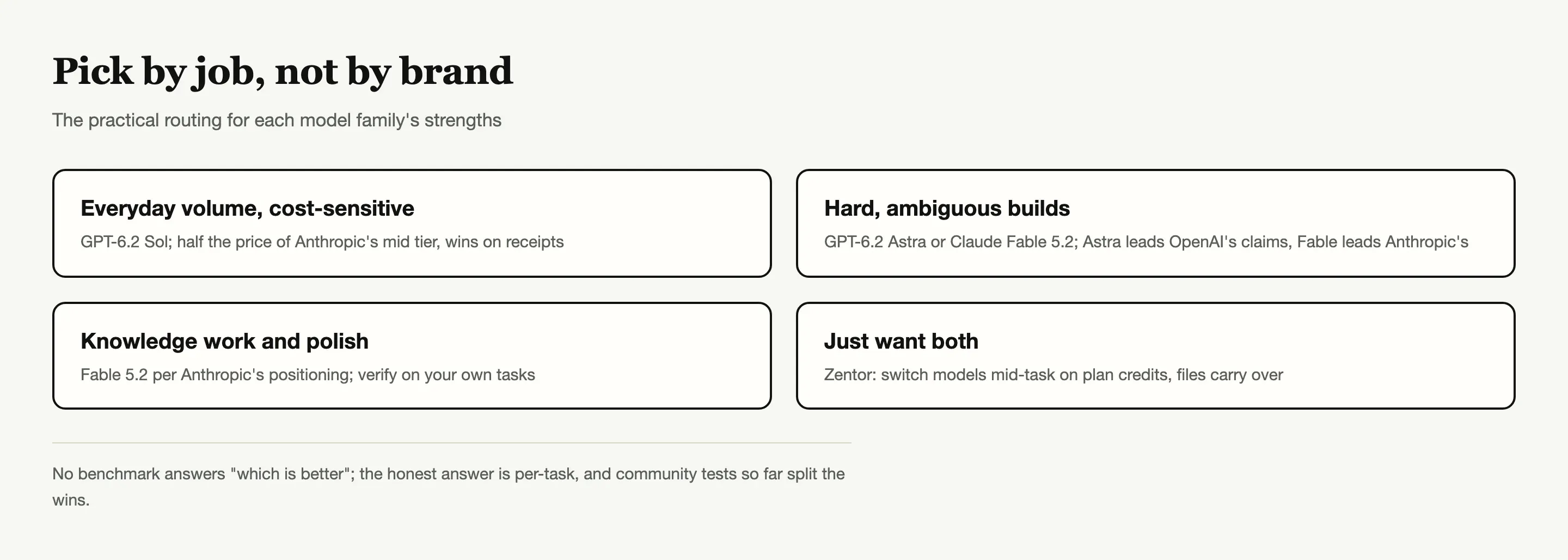
Reach for GPT-6.2 Astra when the job is a long professional deliverable: a deck that has to match a template, a workbook with real structure, a research brief that cross-checks sources. OpenAI's claims target exactly that category, and the early community builds support the ambition. Reach for Fable 5.2 when the job is open-ended technical work where Anthropic's own guidance sends you: ambitious builds, orchestration, and the kind of polished output the Blender test showed off. And for work that is genuinely everyday, Sol at $2 / $10 is the cheapest serious option on either side of this comparison.
There is also a third path for the deciding factor most comparisons ignore: which tool finishes the work. On Zentor, GPT-6.2 Astra, GPT-6.2 Sol, and Fable 5.2 are all available on plan credits in the same workspace, so you can run the same task through each and keep whichever output is better. The GPT-6.2 integration page has the details.
GPT 6.2 vs Claude Fable 5.2: who should pick which
The full early-review landscape, both camps with sources, is in GPT-6.2 review. If your week is decks, workbooks, and research deliverables, GPT-6.2 Astra is the better bet at identical sticker price, with Sol covering everything cheaper. If your week is ambitious technical builds and you already live in Claude, Fable 5.2 is the better fit, with Opus 5.5 underneath it for daily work. And if you have not committed to either subscription, that is the easiest decision of all: run all three on Zentor plan credits and let your actual tasks settle it.
FAQ
Is GPT-6.2 better than Claude Fable 5.2?
OpenAI reports Astra ahead of Fable 5.2 on Agents' Last Exam and Harvey LAB-AA; Anthropic's tables show Fable strong on its own benchmarks. Community same-prompt tests so far say it depends on the job: Sol wins on cost, Fable on polish in at least one detailed 3D build.
Do GPT-6.2 and Claude Fable 5.2 cost the same?
At the API headline, yes: both Astra and Fable 5.2 are $8 input / $40 output per million tokens. The everyday difference is GPT-6.2 Sol at $2 / $10, which has no Anthropic equivalent at that quality tier.
Which is better for coding, Astra or Fable 5.2?
OpenAI reports Astra's edge on agentic and document benchmarks; Anthropic reports Fable 5.2 at 69.9 on FrontierSWE v2. Early community builds are mixed, so run your own task through both where possible.
Can I use GPT-6.2 and Claude Fable 5.2 without two subscriptions?
Yes. Both are available in Zentor on plan credits, no OpenAI or Anthropic account required, and you can switch models mid-conversation while keeping files and history.
GPT 6.2 vs Claude Fable 5.2 for everyday work: which wins?
Neither is the everyday pick on its own side. Sol at $2 / $10 and Opus 5.5 at $4 / $20 cover routine work far cheaper; Astra and Fable are for the jobs where a mediocre result is expensive.

Zentor Editorial Zentor editorial team
The Zentor editorial team writes about workflow automation, AI agents, and the tools we build. Default byline for industry overviews, listicles, and collaborative pieces.
Choosing between tools? Let Zentor run the work.
An always-on AI assistant that does the work. No switching required, no setup.
References OpenAI: Introducing GPT-6.2 Astra and Sol · Anthropic: Claude Fable and Mythos 5.2 · Claude Fable 5.2 platform docs · @EnvolDev on X · @DatumFoundryAI on X · @_jayyy18_13k on X